Understanding the Madrid Protocol: An Introduction
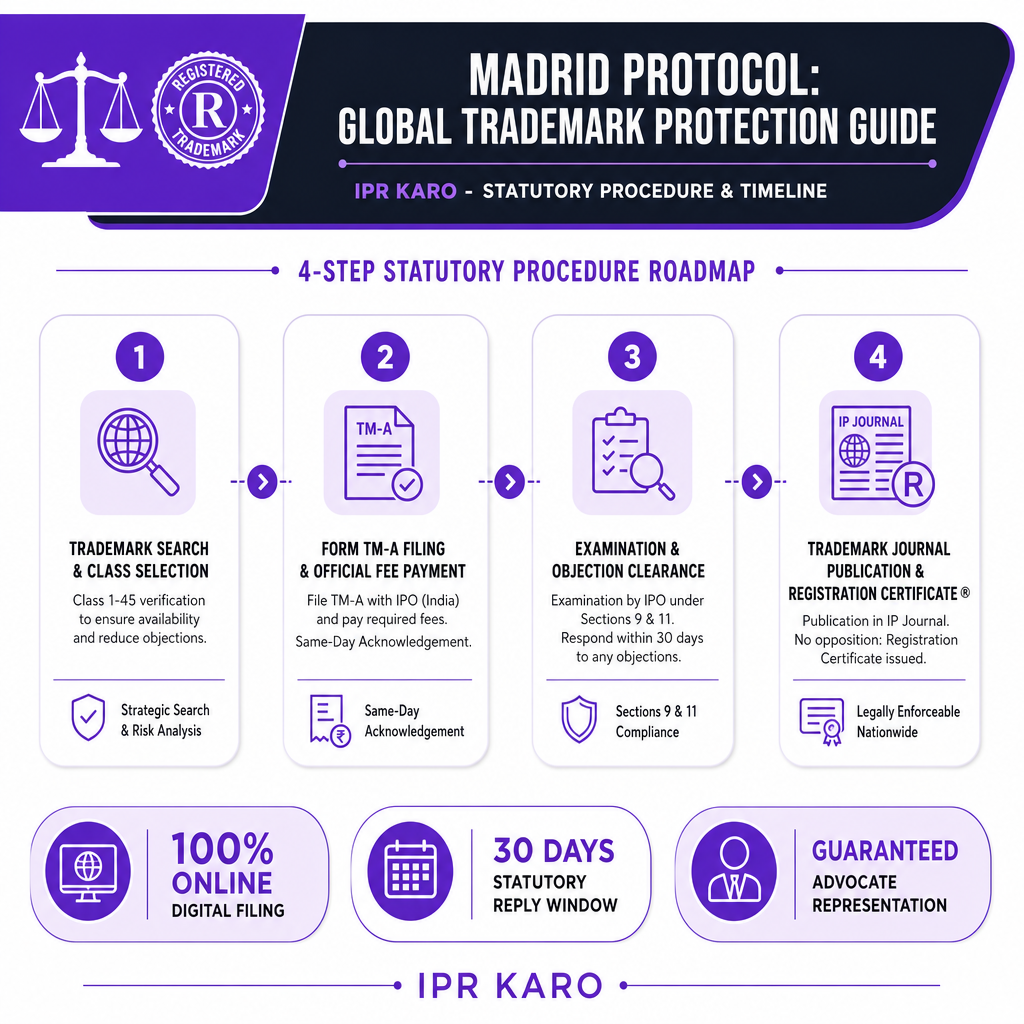
The Madrid Protocol, established in 1989, is a pivotal international treaty that simplifies the process of filing trademarks across multiple jurisdictions. For Indian enterprises seeking global brand protection, this protocol offers a streamlined pathway to secure their trademarks in over 125 member countries through a single application. Governed by the Trade Marks Act, 1999, and leveraging provisions such as Sections 9 and 11, the Madrid Protocol aligns with India’s strategic interests in enhancing global brand recognition.
To utilize the Madrid Protocol, Indian trademark holders must first have a national application or registration to base their international application on. This is filed with the Controller General of Patents, Designs and Trade Marks (CGPDTM), utilizing forms like TM-A and adhering to guidelines outlined by the registry. Our Trademark Class Finder (Classes 1-45) can assist in identifying the correct classes for applications, ensuring comprehensive coverage.
Once a national application is filed, the subsequent international application is submitted to the World Intellectual Property Organization (WIPO). The official fees for filing through the Madrid Protocol are distinct from domestic filings, and while the initial cost is higher for companies (₹9,000) compared to individuals or startups (₹4,500), the long-term benefits of global protection are significant. Our Trademark Registration Services offer expert guidance in navigating these intricacies.
The Madrid Protocol is not without its challenges, particularly in terms of managing international registrations and addressing objections. However, by leveraging tools like our AI Trademark Public Search Tool to conduct preliminary searches, Indian brands can mitigate potential issues. For personalized assistance, our team of IPR Karo Legal Advocates & Strategists is available to provide expert advice and strategic solutions. For further inquiries or to discuss your specific needs, Consult IP Attorney today.
Eligibility Criteria for Indian Brands under the Madrid Protocol
Indian brands seeking to leverage the Madrid Protocol for international trademark protection must meet specific eligibility criteria based on the Trade Marks Act, 1999 and accompanying rules. The initial requirement involves having a registered trademark or a pending application in India, known as the "basic application" or "basic registration". This is a prerequisite for filing an international application.
Additionally, the applicant must be a national, domiciliary, or have a real and effective industrial or commercial establishment in India. This aligns with Sections 18 and 36D of the Trade Marks Act, 1999, which emphasize the necessity for a genuine connection to India. The applicant must also specify the countries where protection is sought, choosing from among the 110 member countries of the Madrid Protocol.
The financial aspect is equally critical. The official fees for individuals or startups, as defined under TM Rules 2017, are ₹4,500, while companies must pay ₹9,000. Understanding the cost implications is essential, and our Consult IP Attorney service can provide detailed guidance. It's vital to ensure that the goods and services classification in the international application aligns with the Trademark Class Finder (Classes 1-45).
Parameter | Section / Rule | Statutory Requirement | Legal Effect / Remedy |
|---|---|---|---|
Basic Application/Registration | Section 18, 36D | Mandatory initial filing in India | Foundation for international application |
Connection to India | Section 36D | Nationality, domicile, or establishment | Eligibility for Madrid Protocol |
Fees | TM Rules 2017 | ₹4,500 for individuals/startups, ₹9,000 for companies | Cost of filing and processing |
Goods/Services Classification | Section 7 | Accurate classification as per TM Rules | Prevents classification disputes |
Designated Countries | Section 36E | Selection from member countries | Scope of international protection |
Before initiating the AI Trademark Public Search Tool can assist in ensuring that no similar marks exist, which could potentially hinder the application process. For comprehensive support, our team at IPR Karo Legal Advocates & Strategists offers expert assistance in navigating these prerequisites.
Step-by-Step Guide to Filing a Madrid Application from India
Filing a Madrid Application from India involves a structured process that starts with a basic application or registration in India. The Trade Marks Act, 1999 and the Trade Marks Rules 2017 provide a robust framework for this. Below is a concise guide to navigate the complexities of international trademark registration under the Madrid Protocol.
Basic Application/Registration: Ensure you have a valid Indian trademark application or registration, serving as the 'basic mark'. This is a prerequisite under Section 18 of the Trade Marks Act, 1999. For efficient classification, utilize our Trademark Class Finder (Classes 1-45).
Filing the International Application: Submit Form MM2 through the Trademark Registration Services at the Indian IP Office (CGPDTM). The official fee is ₹4,500 for individuals/startups and ₹9,000 for companies, as per the latest CGPDTM Registry guidelines.
Examination by WIPO: Upon submission, WIPO conducts a formal examination. Any procedural irregularities are notified, requiring prompt rectification. For detailed advice, Consult IP Attorney.
Notification and Protection: Once the application passes examination, it is forwarded to designated countries for substantive examination. It is essential to stay informed of each jurisdiction’s response under Sections 29 and 30 of the Trade Marks Act, 1999.
Parameter | Section / Rule | Statutory Requirement | Legal Effect / Remedy |
|---|---|---|---|
Basic Mark Requirement | Section 18 | Indian registration or application | Foundation for international registration |
Filing Form MM2 | TM Rules 2017 | Submit through CGPDTM | Initiates WIPO examination |
WIPO Irregularity Notice | Section 29 | Rectify within prescribed time | Prevents application abandonment |
International Examination | Section 30 | Jurisdictional compliance | Protects trademark in designated countries |
For Indian brands aiming for global reach, understanding each step is crucial. Leverage tools like our AI Trademark Public Search Tool and expert guidance from IPR Karo Legal Advocates & Strategists to streamline the process and safeguard your trademarks internationally.
Managing and Maintaining Your International Registrations
Once your international trademark registration is secured through the Madrid Protocol, the journey doesn't end there. Effective management and maintenance are crucial to ensure continued protection across various jurisdictions. To maintain your registration, you must comply with specific procedural and statutory requirements that align with provisions of the Trade Marks Act, 1999.
Renewal and Monitoring:
International registrations under the Madrid Protocol need renewal every ten years. Ensure timely renewal by monitoring expiration dates in each jurisdiction, as failing to renew can lead to the loss of rights. Refer to Section 23 of the Trade Marks Act, 1999 for renewal requirements.
Use IPR Karo’s AI Trademark Public Search Tool for monitoring potential infringements and staying updated with any similar marks that may affect your brand.
Handling Changes and Assignments:
Any change in the name or address of the registrant, or any assignment of the trademark, must be recorded in the International Register. Use Form TM-M for making such amendments in India, which will be reflected internationally.
Maintaining accurate records is imperative to avoid complications during disputes or enforcement actions. Sections 57 and 134 of the Trade Marks Act, 1999 provide a framework for contesting or defending registered trademarks.
Addressing Objections and Cancellations:
Be proactive in managing objections or cancellations raised by other parties in any member country. Utilize local counsel or Consult IP Attorney at IPR Karo to navigate complex litigation processes.
Understand the implications of Sections 29 and 30 of the Trade Marks Act, 1999, which deal with infringement and permissible use, to mitigate risks associated with cancellation proceedings.
For Indian enterprises and legal practitioners, leveraging IPR Karo's comprehensive Trademark Registration Services and Trademark Class Finder (Classes 1-45) can streamline the management process, ensuring that your international registrations are well-protected and compliant with all statutory requirements.
Common Challenges and Solutions in Madrid Protocol Filings
Filing for international trademark protection under the Madrid Protocol offers Indian brands a streamlined process, but it comes with its share of challenges. Understanding these hurdles is crucial for successful filings and maintaining international registrations effectively.
1. Language and Documentation Barriers
The language of filing and documentation requirements can be daunting. The Madrid Protocol mandates filings in English, French, or Spanish, which can pose a challenge for Indian applicants more familiar with local languages. The solution lies in engaging proficient legal translation services and consulting experienced attorneys from IPR Karo Legal Advocates & Strategists to ensure compliance with linguistic and documentation standards. Utilizing the Trademark Registration Services can also mitigate errors and align filings with international protocols.
2. Compliance with Local Laws and Objections
Each designated country under the Madrid Protocol may have unique local laws, leading to potential objections or refusals based on absolute grounds (Section 9, Trade Marks Act 1999) or relative grounds (Section 11). To navigate these obstacles, applicants should conduct a comprehensive AI Trademark Public Search Tool and use the Trademark Class Finder (Classes 1-45) to ensure proper classification, reducing the likelihood of objections. It's advisable to respond promptly to any examination reports using Form TM-O through the local IP office or the Trade Marks Registry E-Filing Gateway (CGPDTM).
3. Monitoring and Enforcement of Rights
Once registered, maintaining and enforcing trademark rights internationally can be challenging. This involves regular monitoring for potential infringements and renewing registrations. Under Sections 29 and 135 of the Trade Marks Act 1999, trademark owners have the right to seek redress against infringement. Employing professional monitoring services and consulting with an IP Attorney can aid in effectively managing these tasks. Additionally, using the World Intellectual Property Organization (WIPO) resources helps keep track of international registrations.
Official Sources, Statutory Portals & Legal References
For verified statutory records, official e-filings, and case status tracking, consult India's official intellectual property portals:
Trade Marks Registry E-Filing Gateway (CGPDTM) - Official portal for Form TM-A filings, Examination Reports, and Trademark Journal publications.
Intellectual Property India Official Portal - Comprehensive public records and Nice Classification schedules.
World Intellectual Property Organization (WIPO) - Madrid Protocol international trademark search and treaty framework.
Copyright Office of India - Statutory registration and literary/artistic copyright documentation.
India Code Legislative Repository - Full text of the Trade Marks Act, 1999 and Trade Marks Rules, 2017.
Delhi High Court (Intellectual Property Division) - Commercial IP disputes, rectification appeals, and infringement precedents.