
Written byRahul Roy
Trademark Research Specialist
Overview of Trademark Status
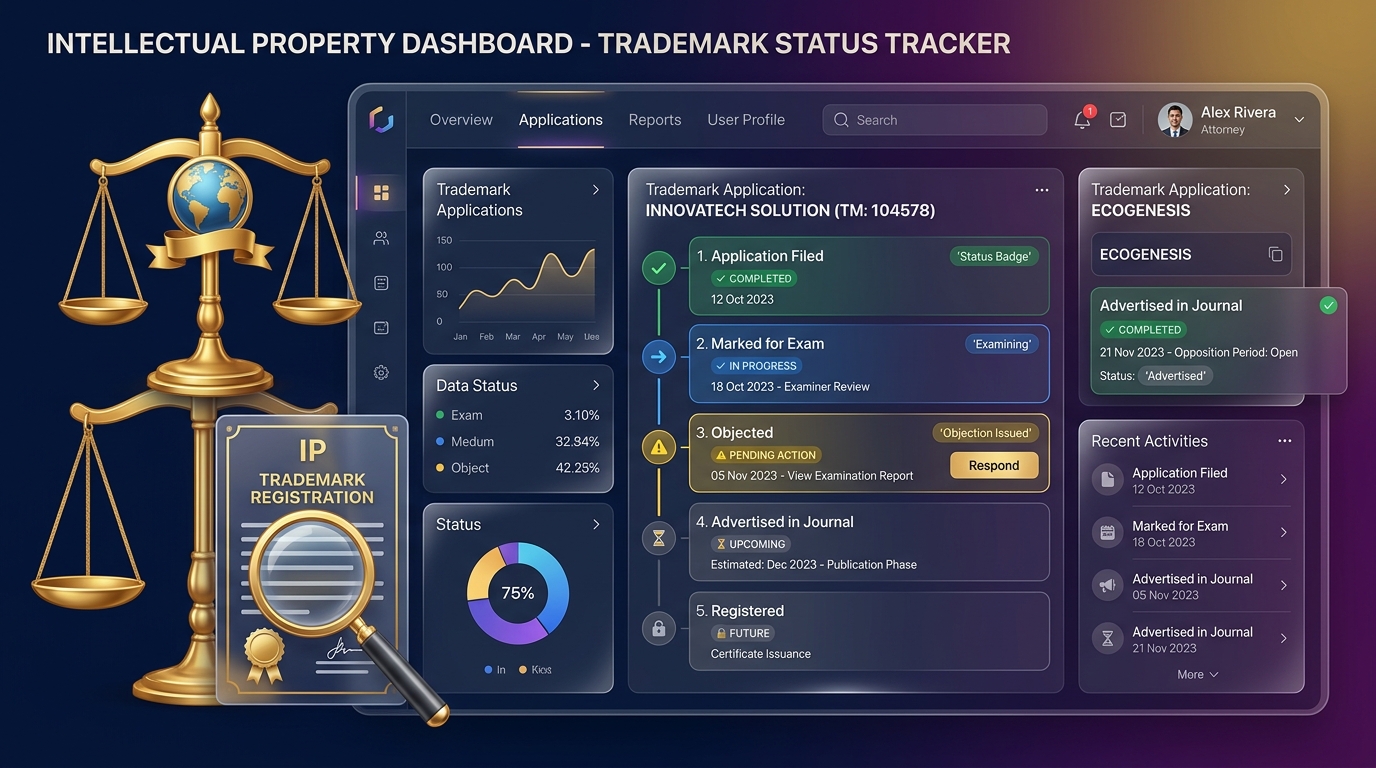
Trademark application status reflects the exact procedural standing of your mark on the IP India Trade Marks Registry e-portal. Key statutory stages include Formalities Check Pass, Marked for Exam, Objected (under Section 9 or 11), Under Show Cause Hearing, Accepted & Advertised in Journal, and Registered. Tracking your status is mandatory because legal notices, such as examination reports, carry an unforgiving 30-day statutory response deadline to prevent deemed abandonment.
When an entrepreneur or enterprise files an application for trademark registration on Form TM-A, the Trade Marks Registry issues an official electronic acknowledgment receipt bearing a unique 5 to 7-digit trademark application number. While filing grants an immediate legal priority date, it does not confer instant registration or exclusive statutory monopoly rights.
Between application submission and final certificate issuance, every file undergoes systematic scrutiny by the Registrar of Trade Marks under the statutory roadmap outlined in ourtrademark registration process guide. Applications pass through administrative verification, substantive legal examination, public opposition scrutiny, and digital certificate generation.
Understanding each status entry on the electronic register enables brand owners to react swiftly. Whether addressing an examination query, uploading a Power of Attorney on Form TM-48, or defending against a third-party competitor notice, timely tracking prevents permanent forfeiture of valuable commercial goodwill.
How to Check Status Online
The Trade Marks Registry provides a public e-register portal where any applicant, attorney, or business owner can check real-time dossier records free of cost. Follow this verified step-by-step navigation protocol:
1. Access the IP India E-Register
Visit the official electronic register portal atIP India E-Register Gateway. Choose the “Trade Mark Application/Registered Mark” option.
2. Select National / IRDI Number
Choose the “National IRDI Number” radio button. Enter your designated application number exactly as printed on your filing CBR receipt without adding spaces or slashes.
3. Solve Security Captcha & Submit
Enter the visual security verification code shown on the screen and click “View”. The system will fetch the matching record from the centralized Trade Marks Registry database.
4. Review Dossier & Download Documents
Click on the hyperlinked application number to open the full dossier. Click “View Examination Report”, “Notices”, or “Uploaded Documents” to download official registry correspondence.
All Trademark Status Stages
Each status entry on the IP India portal communicates a distinct legal milestone under the Trade Marks Rules, 2017. Here is what every procedural status indicates:
New Application & Send to Vienna Codification
Upon filing, the initial status displays asNew Application. The application details are digitized and indexed into the Trade Marks Registry intranet.
If your filing includes a figurative device, logo, or label mark, the status updates toSend to Vienna Codification. Under the Vienna Agreement, registry officers assign standardized international numerical codes to visual elements (such as shapes, animals, geometric patterns, or human figures) to facilitate relative similarity searches. For word marks without graphic logos, this stage is bypassed automatically.
Formalities Check Pass vs. Formalities Check Fail
The registry conducts an initial clerical audit of filing documents under Rule 37. If all mandatory forms, applicant identification proof, stamped Power of Attorney (Form TM-48), and user affidavits are compliant, your mark receivesFormalities Check Pass.
Conversely, if there are discrepancies—such as submitting an unstamped Form TM-48, unclear goods descriptions, or choosing an ineligible startup fee concession without an MSME certificate—the status reflectsFormalities Check Fail.
Statutory Rectification Window:When a formalities check fails, the applicant must file a formal clarification or Form TM-M within 30 days. Failure to cure clerical defects leads to immediate file abandonment.
Marked for Exam & Examination Report Issued
Once clerical formalities pass, the application updates toMarked for Exam. It is allocated to an Examiner who evaluates whether the brand qualifies for statutory registration under the Trade Marks Act, 1999.
The Examiner scrutinizes the mark for:
- Absolute Grounds for Refusal (Section 9):Lack of distinctiveness, purely descriptive terms, laudatory adjectives, or generic trade expressions.
- Relative Grounds for Refusal (Section 11):Confusing similarity or phonetic identity with earlier registered trademarks or pending applications in the same or complementary Nice classes. Discover how to inspect competing names using ourtrademark search tool.
If objections are raised, the status updates toObjectedorExam Report Issued. The applicant must file a formal legal reply via our guide onhow to respond to trademark examination reportwithin 30 days.
Under Show Cause Hearing & Ready for Hearing
If your written examination response does not completely satisfy the Examiner, the Registrar will not immediately refuse the mark. Under the principles of natural justice, the file moves toShow Cause Hearing.
A digital hearing notice is dispatched outlining the date and virtual conference link. During the hearing, your trademark attorney presents oral legal arguments, commercial turnover invoices, and judicial precedents to justify registration.
Following the hearing, the Hearing Officer either accepts the mark, orders an amendment on Form TM-M (such as adding a disclaimer or pruning goods descriptions), or marks the application asRefused.
Accepted & Advertised vs. Advertised Before Acceptance
When the mark clears examination or hearing, it is published in the bilingual weekly Trade Marks Journal. The status reflectsAccepted & AdvertisedorAdvertised Before Acceptanceunder Section 20.
This publication invites the general public and competing brand owners to inspect the mark. Section 21 of the Trade Marks Act provides a strict4-month opposition windowfrom the date of journal publication.
If a competitor files a notice of opposition on Form TM-O, the status transitions toOpposed, initiating inter-partes quasi-judicial litigation. The applicant must file a counter-statement within two months or forfeit the application.
Registered & Certificate Issuance
If no opposition is filed during the 4-month advertisement period (or if third-party opposition proceedings are decided in the applicant's favor), the status transitions toRegisteredunder Section 23.
The Registrar issues a digitally signed, authenticCertificate of Registrationbearing the official seal of the Trade Marks Registry. The registration is valid for exactly 10 years from the original application date and can be renewed indefinitely viatrademark renewal on Form TM-R.
If a mark lapses due to unheeded notices, explore our guide onhow to restore abandoned trademarkto evaluate emergency procedural relief.
Status & Action Matrix
Use this comprehensive statutory matrix to understand the exact procedural implications, mandatory deadlines, and necessary actions for each IP India portal status update:
| Portal Status | Lifecycle Stage | Mandatory Action Required | Statutory Deadline | Risk Level | Governing Rule |
|---|---|---|---|---|---|
| New Application | Filing Intake | Verify CBR details and preserve e-receipt | None (Routine) | Low | Rule 23 |
| Formalities Check Pass | Administrative Clearance | No action required; mark moves to examination queue | None | Low | Rule 37 |
| Formalities Check Fail | Clerical Defect | File rectification reply or missing Form TM-48 | 30 Days from Notice | Moderate | Rule 37 Proviso |
| Marked for Exam | Substantive Review | Monitor docket weekly for Examination Report issuance | None | In-Progress | Rule 33 & Sec 18 |
| Objected | Registry Examination | Draft and file comprehensive legal rebuttal with use proof | 30 Calendar Days | High | Sec 9 & 11 / Rule 33 |
| Show Cause Hearing | Quasi-Judicial Hearing | Appear virtually before Hearing Officer with attorney | Date of Hearing | Critical | Rule 33(4) |
| Accepted & Advertised | Journal Publication | Monitor weekly Trade Marks Journal for oppositions | 4 Months Window | Low (Watch Stage) | Sec 20 & 21 |
| Opposed | Third-Party Dispute | File Counter-Statement on Form TM-O to contest opposition | 2 Months from Notice | Critical | Sec 21(2) & Rule 44 |
| Registered | Registration Completed | Download digital certificate; affix (R) symbol; calendar 10-year renewal | 10 Years Validity | None (Protected) | Sec 23 & 25 |
Critical Deadlines & Monitoring Pitfalls
The Trade Marks Registry enforces rigid statutory timelines. Unlike civil litigation where procedural condonation of delay is routinely granted, registry clocks under the Trade Marks Act, 1999 are unforgiving:
1. Missing the 30-Day Examination Response Window
Under Rule 33(1), when an Examination Report is generated, the applicant has strictly 30 days to submit a formal written rebuttal. Missing this 30-day window triggers an automated order of abandonment under Section 132. Never wait for a physical letter—registry notices are issued electronically.
2. Relying on Unmonitored Email Inboxes
Registry hearing notices and examination reports are dispatched to the correspondence email recorded on Form TM-A. If the filing was handled by a third-party agency or the applicant's email filters route government emails to spam, notices can go unread for months until the file is abandoned.
3. Non-Appearance at Scheduled Virtual Show Cause Hearings
If a hearing is scheduled before the Hearing Officer and neither the applicant nor their authorized trademark counsel logs in via video conference, the application is marked “Refused for Non-Appearance”. Restoring a refused application requires an expensive review petition on Form TM-M or a High Court appeal.
4. Failing to File Counter-Statement Within 2 Months of Opposition
Under Section 21(2), when a notice of opposition is served, the applicant must file a formal counter-statement on Form TM-O within exactly two months. The Trade Marks Act specifies that if no counter-statement is filed within this 2-month period, the applicant “shall be deemed to have abandoned his application”. The Registrar has zero statutory discretion to extend this deadline.
Legal Rights & Commercial Risks
Your trademark status directly impacts your legal standing and your ability to enforce commercial exclusivity in commerce:
Transition from ™ to ® Symbol:While your application status is “New Application”, “Marked for Exam”, “Objected”, or “Advertised”, you are legally permitted to affix the™ (trademark)symbol to your brand. This puts competitors on notice of your common-law claim. However, using the® (registered)symbol before actual certificate issuance is a punishable criminal offence under Section 107 of the Trade Marks Act, 1999.
Evidentiary Injunctions in Court:A status of “Registered&rdquo. Grants statutory rights under Section 28 and Section 29. This enables you to file infringement suits, obtain ex-parte interim injunctions, and secure damages in civil court without having to prove continuous commercial goodwill under common-law passing off.
Madrid Protocol Protection Abroad:For companies expanding internationally under ourinternational trademark registration guide, the home country Indian application serves as the foundation. If your Indian base status collapses due to unaddressed objections, all linked foreign registrations across the United States, Europe, and Asia will automatically fall under the Madrid Protocol dependency principle.
Status Tracking Checklist
- Record Application & CBR Numbers:Secure your official filing receipt and note the exact 5 to 7-digit trademark number and priority date.
- Establish Monthly Docket Audits:Log in to the IP India e-register at least once every 15 to 30 days to check for real-time status transitions.
- Download Examination Reports Promptly:When “Objected” appears, download the full examination report PDF immediately and note the 30-day deadline.
- Verify Attorney Representation:Ensure your Power of Attorney (Form TM-48) is properly docketed on the portal so notices reach authorized counsel.
- Track Journal Publication:When “Accepted & Advertised” appears, record the Journal Number and calculate the 4-month opposition window.
- Secure Registration Certificate:Upon reaching “Registered”, immediately download the digitally signed certificate and backup the PDF.
- Set 10-Year Decennial Renewal Alerts:Calendar automated reminders for 9 years from the filing date to prepare for timely decennial renewal.
Frequently Asked Questions
Q.Where and how can I check my trademark application status online in India?
You can track your trademark application status in real time through the official IP India Trade Marks Registry portal (ipindiaonline.gov.in/eregister/eregister.aspx). Select 'Trade Mark Application/Registered Mark' under National/IRDI Number, choose 'National IRDI Number', enter your 5 to 7-digit trademark application number, complete the security CAPTCHA, and click 'View'. The portal displays your live status, examination reports, hearing notices, and certificates.
Q.What is the difference between 'Formalities Check Pass' and 'Formalities Check Fail'?
'Formalities Check Pass' signifies that your initial application satisfied procedural verification under Rule 37, including correct applicant details, class classification, power of attorney (Form TM-48), and user affidavit. Conversely, 'Formalities Check Fail' indicates clerical defects such as incorrect stamp duty, missing documents, or classification ambiguities. This requires a formal rectification response within 30 days.
Q.What does 'Marked for Exam' mean and how long does examination take?
'Marked for Exam' confirms that your trademark application has passed initial administrative screening and has been assigned to a designated Trademark Examiner for substantive statutory review under Sections 9 and 11 of the Trade Marks Act, 1999. In India, substantive examination typically takes between 1 to 3 months from filing under current streamlined digital processing.
Q.What should I do if my trademark status shows 'Objected'?
An 'Objected' status means the Examiner has issued an Examination Report citing legal objections under Section 9 (lack of distinctiveness, descriptive terms) or Section 11 (similarity with existing prior marks). You must file a comprehensive, point-by-point legal reply along with documentary proof of commercial prior use within exactly 30 calendar days from the report receipt date to prevent statutory abandonment.
Q.What does 'Accepted & Advertised' mean and what is the opposition window?
'Accepted & Advertised' means the Registrar has approved your mark for registration. It has been published in the weekly Trade Marks Journal under Section 20. This triggers a mandatory 4-month statutory opposition period. If no third party files an opposition on Form TM-O within this 4-month window, the application automatically progresses to Certificate Issuance.
Q.What causes a trademark status to become 'Abandoned' and can it be revived?
A mark becomes 'Abandoned' when an applicant fails to meet a statutory deadline, such as responding to an examination report within 30 days, filing evidence, or attending a scheduled show-cause hearing. In genuine cases involving procedural irregularities, system errors, or non-receipt of registry notices, you can file a petition for revival supported by an affidavit explaining reasonable cause.
Q.When can I legally start using the registered (R) symbol instead of TM?
You can only use the ® (registered) symbol after your status officially reflects 'Registered' and the digital Trademark Registration Certificate has been formally issued by the Registrar. Using the ® symbol while your status is 'Pending', 'Objected', or 'Advertised' is a criminal offence under Section 107 of the Trade Marks Act, 1999, punishable by fine or imprisonment.
Q.What is a 'Show Cause Hearing' and how should an applicant prepare?
A 'Show Cause Hearing' is scheduled under Rule 33 when the Examiner is not fully convinced by the written examination reply. Hearings are conducted virtually via video conference before the Hearing Officer. The applicant or their authorized trademark attorney must present oral legal arguments, judicial case law precedents, and commercial turnover evidence to secure an order of acceptance.
Strategic Application Tracking Advice
A trademark application is not a passive filing—it is an active legal asset undergoing rigorous state examination. In high-growth startups and established commercial enterprises, managing multiple filings across distinct Nice classes requires institutional docketing hygiene.
Never leave status tracking to chance or rely solely on physical postal communications. By engaging registered trademark attorneys and setting up systematic tracking protocols, you safeguard your brand from unmerited objections, competitor poaching, and administrative abandonment. Take proactive control of your trademark portfolio today.
Is Your Trademark Status Stuck or Objected?
Overcome examination objections, draft authoritative legal replies, and represent your brand before the Trade Marks Registry. Partner with expert IP advocates to secure your registration certificate.
Certified IP Advocates • Same-Day Objection Replies • Virtual Show Cause Hearing Representation