Understanding Trademark Basics for Startups
Trademarks serve as indispensable business assets for startups, helping distinguish products and services in a competitive marketplace. As defined under the Trade Marks Act, 1999, a trademark can include a word, logo, symbol, or combination intended to represent the goods or services of an enterprise. For startups, establishing a trademark is crucial for brand recognition and protection against infringement. Key statutory provisions are fundamental to understanding the nuances of trademark registration in India. Section 9 of the Trade Marks Act, 1999, lists absolute grounds for refusal, such as marks devoid of distinctive character. Section 11 deals with relative grounds, including potential conflicts with existing marks. Startups must conduct comprehensive trademark searches using our AI Trademark Public Search Tool to ensure their chosen mark does not infringe on another's rights.
The Trademark Class Finder (Classes 1-45) is essential for determining the appropriate classification of goods and services.
Filing for registration involves completing Form TM-A per the Trade Marks Rules, 2017, with applicable fees: ₹4,500 for individuals/startups and ₹9,000 for companies.
Strategic trademark selection is more than just a compliance task; it's a business strategy. Selecting a strong, distinctive trademark enhances business value and ensures robust legal protection. Leveraging guidance from IPR Karo Legal Advocates & Strategists can optimize this process. Engaging professional Trademark Registration Services can mitigate risks and streamline the registration process. Understanding these basics empowers startups to create a strong foundation for brand integrity and legal protection. For personalized assistance, do not hesitate to Consult IP Attorney at IPR Karo. This first step secures your brand's distinct identity and fortifies its market position.
Step-by-Step Trademark Registration Process
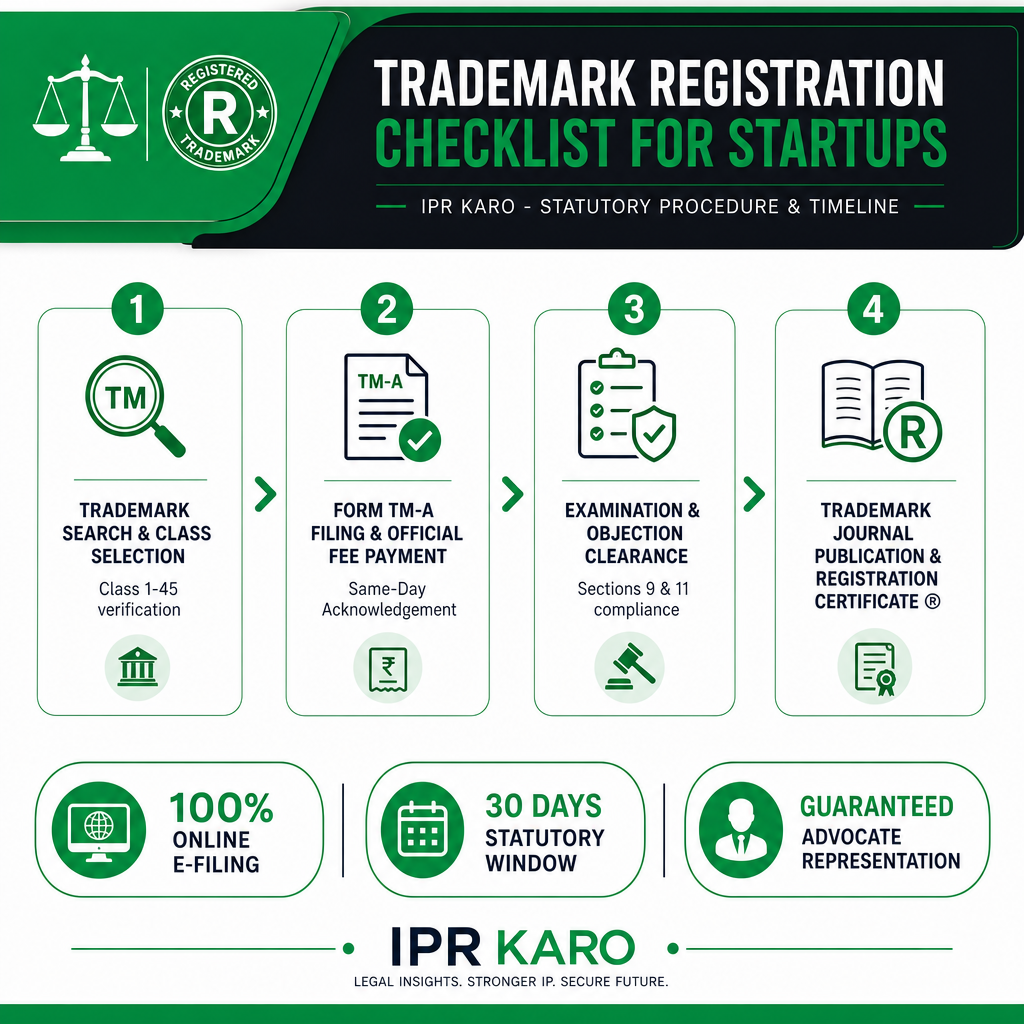
To successfully register a trademark in India, startups must meticulously follow the outlined steps to ensure compliance with the Trade Marks Act, 1999 and the Trade Marks Rules, 2017. Here is a comprehensive guide to the trademark registration process: 1. Conduct a Trademark Search: Begin by performing a thorough trademark search to ensure that your desired mark is available and not already registered or pending registration. Utilize our AI Trademark Public Search Tool to streamline this process. This step is crucial to avoid conflicts and potential opposition as per Section 11 of the Trade Marks Act, 1999. 2. Determine the Appropriate Class: Identify the correct class for your goods or services using the Trademark Class Finder (Classes 1-45). There are 45 classes under the Nice Classification, and selecting the right class is essential to secure proper protection. Misclassification can lead to rejection or limited protection under Section 9 of the Act. 3. File the Trademark Application: Complete Form TM-A and submit it to the Controller General of Patents, Designs & Trade Marks. The application can be filed online or physically with the requisite fee of ₹4,500 for individuals/startups or ₹9,000 for companies. Ensure that the application is comprehensive, including details of the mark, applicant, and goods/services as outlined in Rule 25 of the Trade Marks Rules, 2017. 4. Examination and Publication: Upon filing, the Registrar examines the application for compliance with statutory requirements under Section 21. If compliant, the mark is published in the Trade Marks Journal. Objections, if any, can be raised by third parties within four months, under Section 21.
Parameter | Section / Rule | Statutory Requirement | Legal Effect / Remedy |
|---|---|---|---|
Trademark Search | Section 11 | Ensure availability and uniqueness | Avoids future conflicts and oppositions |
Classification | Rule 25 | Correct class selection | Ensures comprehensive protection |
Application Filing | Form TM-A | Submit detailed application | Initiates the registration process |
Examination | Section 21 | Compliance check by Registrar | Determines eligibility for publication |
Publication & Opposition | Section 21 | Open for public objection | Acceptance or challenge of the mark |
For a seamless filing experience, consider engaging our Trademark Registration Services. Our team of IPR Karo Legal Advocates & Strategists can assist in navigating the complexities of trademark registration. Should you have any questions, Consult IP Attorney for personalized guidance.
Common Pitfalls and How to Avoid Them
Trademark Selection and Availability: One of the most common pitfalls in trademark registration is selecting a mark that is either too generic or already in use. According to Sections 9 and 11 of the Trade Marks Act, 1999, a trademark must be distinctive and should not create confusion with existing trademarks. Utilize our AI Trademark Public Search Tool to ensure your chosen mark is unique and available. A thorough search can prevent future legal disputes and objections from the Trademark Registry. Incorrect Classification: Filing under the wrong class can lead to rejection or limited protection scope. It's crucial to accurately classify your goods or services. The Trade Marks Rules, 2017 stipulate the use of the Nice Classification system, which categorizes goods and services into 45 classes. Use our Trademark Class Finder (Classes 1-45) to identify the correct class for your trademark.
Parameter | Section / Rule | Statutory Requirement | Legal Effect / Remedy |
|---|---|---|---|
Distinctiveness | Section 9 | Trademark must be distinctive and not descriptive | Objection raised; possible refusal of registration |
Conflict with Existing Marks | Section 11 | Trademark must not be identical or similar to existing marks | Opposition from existing trademark holders |
Classification Mistake | TM Rules 2017 | Correct classification of goods/services is essential | Amendments needed, possible rejection |
Non-Compliance with Procedural Requirements: Failure to comply with procedural formalities, such as using the correct forms or paying the appropriate fees, can delay the process. Ensure you use the correct application forms such as TM-A for new applications, and adhere to the fee structure (₹4,500 for individuals/startups; ₹9,000 for companies). Responding to Opposition and Objections: If an opposition is filed under Section 21, or an objection is raised by the examiner, timely and adequate responses are critical. Engaging with experienced legal professionals like IPR Karo Legal Advocates & Strategists can help in crafting effective responses and remedies, avoiding litigation, and ensuring smooth registration. Avoid these common pitfalls by leveraging resources like our Trademark Registration Services and consult with an Consult IP Attorney to navigate the complexities of trademark registration effectively.
Post-registration: Maintaining Your Trademark
Ensuring Continued Protection: Once your trademark is registered, it is crucial to maintain its validity and enforceability. As per the Trade Marks Act, 1999, a registered trademark is valid for 10 years, after which it must be renewed. To avoid lapsing, file for renewal using Form TM-R and pay the applicable renewal fees: ₹9,000 for companies, and ₹4,500 for individuals or startups. Timely renewal preserves your rights under Sections 29 and 30, allowing you to enforce your trademark against unauthorized use. Monitoring Usage and Vigilance: It is vital to actively monitor the market for any unauthorized usage of your trademark. Section 134 of the Trade Marks Act, 1999 empowers you to take legal action against infringement. Utilize online tools such as the AI Trademark Public Search Tool to regularly track potential violations. This vigilance helps in maintaining the distinctiveness of your mark and prevents dilution or misuse that could harm your brand. Addressing Changes and Modifications: Businesses evolve, and so might your brand identity. If there are changes in the ownership or address of your trademark, notify the Trademark Registry using Form TM-P. For modifications to the trademark itself, file Form TM-M as per Rule 97 of the Trade Marks Rules, 2017. These updates ensure the registry reflects accurate details, safeguarding your legal standing and operational clarity. Leveraging Strategic Trademark Management: Proactively leverage your trademark as a strategic business asset. Consider licensing or franchising opportunities to expand your reach, a process that requires careful legal considerations and can be supported by Trademark Registration Services offered by firms like IPR Karo Legal Advocates & Strategists. For comprehensive management strategies, Consult IP Attorney to ensure your trademark portfolio aligns with business growth objectives. By adhering to these practices, you maintain not only the legal validity of your trademark but also its strategic value as a cornerstone of your brand identity.
Leveraging Your Trademark for Business Growth
Once registered, your trademark becomes a vital asset that can propel your business forward. It distinguishes your products or services, adds value to your brand, and builds customer loyalty. Here’s how you can strategically leverage your trademark:
Strengthening Brand Identity
A trademark enhances brand recognition and ensures consistent marketing efforts. By registering your trademark under the appropriate class using our Trademark Class Finder (Classes 1-45), you safeguard your brand's unique identity across diverse commercial channels. This consistency fosters trust and reliability among consumers, which is crucial for sustaining long-term business relationships.
Expanding Market Presence
Your trademark can serve as a springboard for market expansion, both domestically and internationally. Leveraging tools like the AI Trademark Public Search Tool helps you evaluate potential markets and identify competitors. Utilizing the Madrid Protocol under the World Intellectual Property Organization (WIPO) allows you to protect your trademark internationally, thereby opening new avenues for growth and enhancing your global footprint.
Monetizing Trademark Assets
Trademarks can be monetized through licensing, franchising, or even selling, contributing significantly to revenue streams. By granting usage rights, you can expand your reach while maintaining control over your brand's quality and image. Ensure these agreements are well-drafted in compliance with Sections 29 and 30 of the Trade Marks Act, 1999, to prevent potential disputes.
Legal Protection and Competitive Edge
Enforcing your trademark rights is essential to maintaining exclusivity. Vigilantly monitor for unauthorized use and take timely action using Sections 134 and 135 of the Trade Marks Act, 1999, to address infringements. Our Trademark Registration Services offer strategic planning and enforcement support to safeguard your interests, thus delivering a competitive edge in the marketplace.
Official Sources, Statutory Portals & Legal References
For verified statutory records, official e-filings, and case status tracking, consult India's official intellectual property portals:
Trade Marks Registry E-Filing Gateway (CGPDTM) - Official portal for Form TM-A filings, Examination Reports, and Trademark Journal publications.
Intellectual Property India Official Portal - Comprehensive public records and Nice Classification schedules.
World Intellectual Property Organization (WIPO) - Madrid Protocol international trademark search and treaty framework.
Copyright Office of India - Statutory registration and literary/artistic copyright documentation.
India Code Legislative Repository - Full text of the Trade Marks Act, 1999 and Trade Marks Rules, 2017.
Delhi High Court (Intellectual Property Division) - Commercial IP disputes, rectification appeals, and infringement precedents.