
Written byRahul Roy
Trademark Research Specialist
Trademark vs Copyright: Key Differences at a Glance
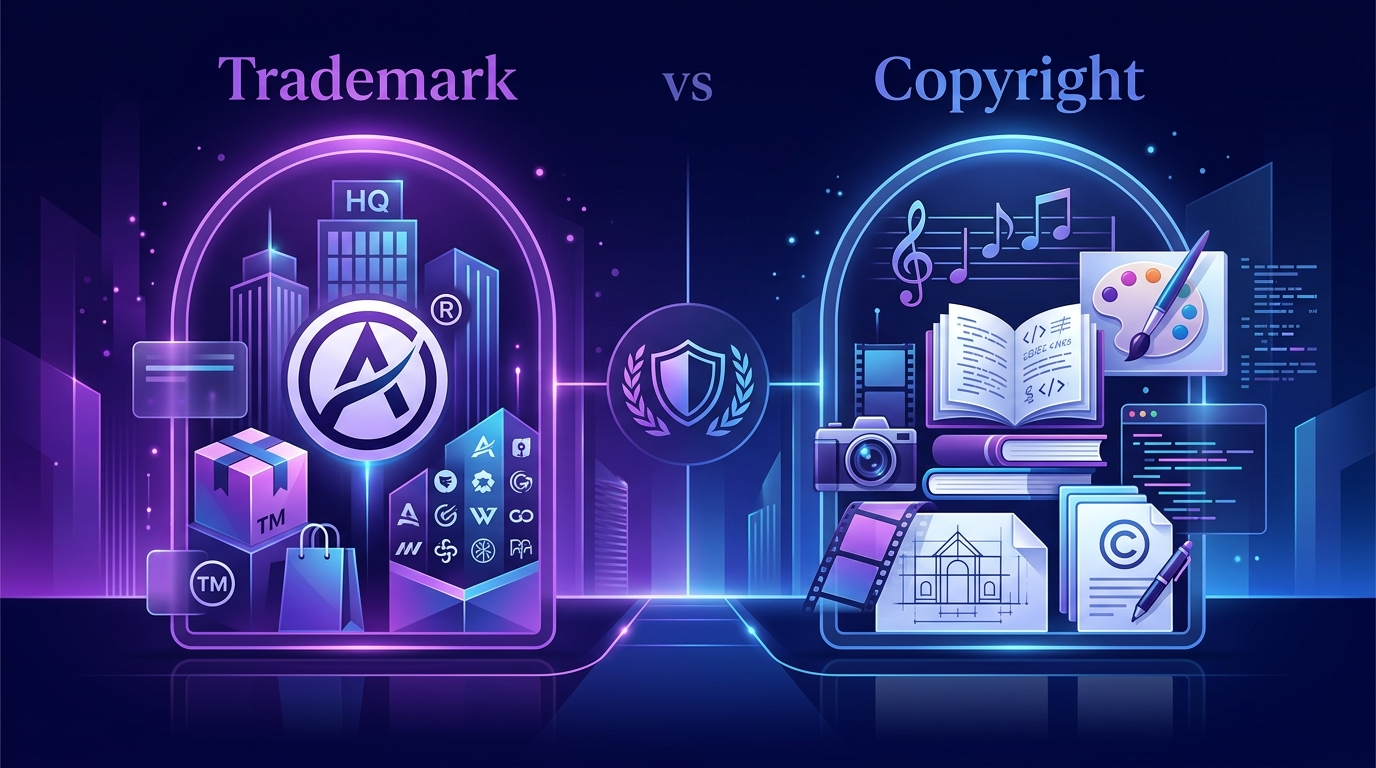
What is the difference between trademark registration and copyright registration? Trademark registration protects commercial identifiers—such as brand names, logos, slogans, and trade dress—that distinguish goods or services in the marketplace under the Trade Marks Act, 1999. In contrast, copyright registration protects original creative expressions—such as literary works, software source code, music, films, and artistic drawings—under the Copyright Act, 1957. While trademarks can be renewed indefinitely every 10 years to protect brand goodwill, copyright lasts for the author's lifetime plus 60 years and protects creative originality.
Both trademarks and copyrights are pillars of modern Intellectual Property Rights (IPR) in India. However, they serve fundamentally different commercial and legal purposes. Confusing the two often causes entrepreneurs to file under the wrong registry, leaving their core brand identity or technological assets vulnerable to infringement and competitors.
A trademark guards your brand reputation in the market so customers know exactly who made the product. A copyright rewards authors, coders, and artists by granting them exclusive legal rights over how their original creative content is reproduced, published, adapted, or distributed.
What Is Trademark Registration?
Under Section 2(1)(zb) of theTrade Marks Act, 1999, a trademark is defined as a visual mark capable of being represented graphically and capable of distinguishing the goods or services of one enterprise from those of others.
Trademarks represent commercial goodwill and market source. They protect words, letters, numerals, device marks (logos), combinations of colors, the shape of goods, packaging (trade dress), slogans, and sound marks. When you obtain a trademark registration certificate from the Trade Marks Registry (CGPDTM), you earn the exclusive statutory right to use the registered trademark symbol (®) across the classes in which your mark is filed.
Core Examples of Trademarks
- Brand Names & Wordmarks:“IPR Karo”, “Tata”, “Infosys”.
- Brand Slogans & Taglines:“Just Do It”, “Connecting People”.
- Logos & Device Marks:Nike's swoosh, Apple's bitten apple logo.
- Product Packaging & Shape Marks:Distinctive contours of the Coca-Cola contour bottle.
- Sound Marks:The signature Netflix sonic chime or Intel chime.
What Is Copyright Registration?
Governed by theCopyright Act, 1957, copyright is a bundle of exclusive legal rights granted to creators of original literary, dramatic, musical, and artistic works, cinematographic films, and sound recordings. Copyright protects the specific tangible expression of an idea, rather than the abstract idea itself.
While copyright protection automatically vests in an author the moment an original work is created and fixed in a tangible medium, official copyright registration with the Copyright Office (Department for Promotion of Industry and Internal Trade) provides an indispensable certificate of registration (Extract from the Register of Copyrights, Form ROC). This certificate acts as prima facie evidence in courts of law under Section 48 of the Copyright Act.
Core Examples of Copyrightable Works
- Literary Works:Books, research papers, marketing whitepapers, articles, and compilations.
- Software Code:Source code, object code, system scripts, and database architectures.
- Artistic Works:Original paintings, graphic illustrations, photographs, architectural plans, and logo artwork.
- Cinematographic & Audiovisual:Explainer videos, short films, documentaries, and YouTube video productions.
- Musical Works & Sound Recordings:Audio tracks, podcast episodes, voice recordings, and musical scores.
Comprehensive Legal Comparison
The table below highlights the crucial differences between trademark registration and copyright registration under Indian statutes, regulatory practices, and commercial enforcement frameworks:
| Legal Parameter | Trademark Registration | Copyright Registration |
|---|---|---|
| Primary Objective | Protects brand identity and prevents consumer confusion in trade. | Protects original creative expression and rewards authors/creators. |
| Governing Statute | Trade Marks Act, 1999 | Copyright Act, 1957 |
| Regulatory Authority | Trade Marks Registry / CGPDTM (Ministry of Commerce) | Copyright Office (DPIIT, Ministry of Commerce) |
| Protected Elements | Words, brand names, logos, slogans, trade dress, sound marks. | Books, articles, software code, illustrations, songs, films. |
| Classification System | 45 Nice Classes (Classes 1–34 Goods, Classes 35–45 Services). | 6 Categories (Literary, Artistic, Dramatic, Musical, Sound, Film). |
| Validity & Term | 10 years; renewable indefinitely every 10 years. | Author's lifetime + 60 years; cannot be renewed. |
| Registration Requirement | Must be distinctive; prior search and examination required. | Must be original; exists upon creation; registered for proof. |
| Legal Symbols | ™ (application pending), ® (officially registered). | © (copyright claimed or registered). |
| Statutory Govt Fees | ₹4,500 (Individual/MSME) / ₹9,000 (Companies) per class. | ₹500 to ₹2,000 depending on the artistic/literary category. |
| Commercial Logo Nuance | Protects commercial badge of origin for target goods/services. | Requires Section 45 TM-C Search Certificate if used in commerce. |
Subject Matter & Protection Scope
The scope of legal protection defines what competitors can and cannot do under each framework:
Trademark Scope
Trademark protection operates on aclass-specific principleusing the international Nice Classification system (45 classes). A trademark registered for footwear (Class 25) does not automatically block a third party from using the same word for computer software (Class 9), unless the mark has achieved “well-known trademark&rdquo. Status under Section 11(2) of the Act.
Trademarks prevent competitor confusion, deceptive similarity, and deceptive imitation. You can check classification overlap using ourtrademark class finder.
Copyright Scope
Copyright protection operates on auniversal, cross-industry basis. Once your original book, software codebase, or vector illustration is protected under copyright, no one can copy, reproduce, translate, or commercially distribute your creative work in any industry or sector without authorization.
However, copyright does not protect single words, titles, brand names, or functional business systems. Anyone is free to create another software solving the same problem, provided they write original code.
Duration, Renewal & Ownership Rules
A major practical difference between trademark and copyright lies in how long rights endure and how ownership is sustained over time:
Trademark Duration: Indefinitely Renewable
A registered trademark in India is valid for10 yearsfrom the application filing date. It can be renewed every 10 years indefinitely by submitting Form TM-R with the statutory renewal fee. Famous marks like Coca-Cola or Tata have maintained trademark exclusivity for over a century through timely renewals. If not renewed, the mark enters an “expired” status and can be abandoned.
Copyright Duration: Lifetime + 60 Years
For published literary, dramatic, musical, and artistic works, copyright protection lasts for theentire lifetime of the author plus 60 yearsfrom the beginning of the calendar year following the author's death. For cinematographic films, sound recordings, photographs, and works published posthumously, the term is 60 years from the date of publication. Once this statutory period lapses, the work enters the public domain and cannot be renewed.
Work Made for Hire & Ownership Transfer
In copyright law, under Section 17 of the Copyright Act, the author is the first owner unless created in the course of employment under a contract of service. For independent freelancers or agencies designing your company logo or coding software, ownership remains with the contractor unless explicitly assigned in writing under Section 19. Trademarks, on the other hand, are applied for directly in the name of the commercial enterprise or proprietor.
Dual Protection for Logos & TM-C NOC
One of the most frequent legal intersections between trademark and copyright occurs when protecting a company logo, brand mascot, or packaging artwork. A stylized logo is simultaneously anartistic workand acommercial brand mark.
Section 45 of the Copyright Act: Mandatory Search Certificate
Under Section 45(1) of the Copyright Act, 1957, if an applicant applies for copyright registration of an artistic work which is used or capable of being used in relation to any goods or services, the application must be accompanied by aSearch Certificate (Form TM-C)issued by the Registrar of Trade Marks certifying that no identical or deceptively similar trademark has been registered or applied for by another person.
Why do growing enterprises choose dual protection?
- Trademark Registration (Form TM-A):Protects your logo as an exclusive badge of commercial origin for your specific products and services, empowering you to block marketplace competitors.
- Copyright Registration (Form XIV):Protects the underlying graphic art, color scheme, and typography globally. This prevents competitors in unrelated industries from copying your visual design.
- Defense Against Infringement:Holding both certificates gives you statutory standing under both the Trade Marks Act, 1999 and the Copyright Act, 1957.
Registration Process & Timelines
Both registration procedures are handled electronically through government web portals, but their statutory scrutiny steps differ significantly:
Trademark Registration Flow
- Pre-Filing Clearance Search:Check the IP India portal to avoidSection 11 similarity conflicts.
- Application Filing (Form TM-A):File online to immediately receive the trademark application number and use ™.
- Formalities Check & Examination:Examiner issues an Examination Report under Sections 9 and 11.
- Objection Reply & Hearing:File a legal response within 30 days if objections are raised.
- Journal Publication:Advertised in the Trade Marks Journal for a 4-month public opposition window.
- Registration Certificate:Issued if no opposition is filed (typically 6–18 months).
Copyright Registration Flow
- Work Preparation:Prepare manuscript, source code, or artwork copies along with author NOCs.
- TM-C Certificate (If Commercial Art):Obtain Search Certificate from Trade Marks Registry under Section 45.
- Application Filing (Form XIV):Submit on the official Copyright e-filing portal with fees.
- Mandatory 30-Day Waiting Period:Statutory window for third parties to submit objections to the Registrar.
- Scrutiny & Discrepancy Notice:Examiner reviews originality and procedural compliance.
- ROC Certificate Issued:Extract from the Register of Copyrights granted (typically 2–6 months).
Infringement Penalties & Remedies
When a competitor unlawfully uses your intellectual property, both statutes empower you to seek stringent civil and criminal remedies through District Courts and Commercial Courts in India:
Civil Injunctions & Damages
Under both the Trade Marks Act (Section 135) and Copyright Act (Section 55), the owner can file a civil suit for an interim injunction (stay order), permanent injunction, delivery up of infringing goods, and rendition of profits or punitive damages. Learn more aboutcivil vs criminal infringement remedies in India.
Criminal Sanctions & Police Raids
Both statutes contain powerful criminal provisions. Under Section 103/104 of the Trade Marks Act and Section 63/64 of the Copyright Act, intentional infringement is a cognizable offense punishable with imprisonment for a term not less than6 months up to 3 years, along with fines ranging from ₹50,000 to ₹2,00,000. Police officers are empowered to conduct search and seizure operations without a prior court warrant upon obtaining the Registrar's opinion.
Which Registration Does Your Business Need?
Use this decision framework to determine which registration protects each asset in your enterprise:
Register a Trademark
Commercial Identifiers
- Company name & trading style
- Brand names & product titles
- Catchy marketing slogans
- Domain names used as brands
- Distinctive packaging shapes
Register a Copyright
Creative Content
- Software source code & APIs
- Website text & marketing articles
- Training videos & audio tracks
- Books, eBooks & whitepapers
- Architectural drawings & blueprints
Register Both
Hybrid Visual Assets
- Stylized corporate logos
- Brand mascots & cartoon avatars
- Distinctive artistic packaging design
- Game character designs & UI badges
- Signature graphical iconography
IP Registration Decision Checklist
- Asset Classification:Categorized each asset as a commercial identifier (brand name, slogan) or creative work (content, code, art).
- Pre-Filing Trademark Clearance:Executed an exact, phonetic, and similarity search on the IP India registry across target Nice classes.
- Section 45 Assessment:Verified whether artistic logos require a Search Certificate (Form TM-C) before copyright filing.
- Authorship & Assignment Chain:Secured written copyright assignments and NOCs from freelance designers and software developers.
- Applicant Entity Status:Claimed 50% statutory fee concessions by providing MSME / Udyam or Startup India recognition certificates.
- Dual Filing Strategy:Initiated trademark protection for commercial market exclusivity and copyright for universal artistic defense.
- Professional Legal Review:Engaged experienced IP attorneys to handle classification, objections, and registry hearings.
Frequently Asked Questions
Q.What is the fundamental difference between trademark and copyright?
A trademark protects commercial brand identifiers like names, logos, and taglines used to distinguish goods or services in commerce under the Trade Marks Act, 1999. A copyright protects original creative expressions like books, software code, music, films, and artwork under the Copyright Act, 1957.
Q.Can a company logo have both trademark and copyright protection in India?
Yes. A company logo can be protected as an artistic work under the Copyright Act, 1957 and as a device mark under the Trade Marks Act, 1999. This dual protection safeguards both the artistic design globally and the exclusive commercial right to use it on specified goods or services.
Q.Does copyright protection last longer than trademark protection?
Copyright lasts for the author's lifetime plus 60 years and cannot be renewed once it expires. A trademark is valid for 10 years at a time but can be renewed indefinitely every 10 years upon payment of renewal fees, offering perpetual commercial protection.
Q.Is registration mandatory to protect trademark and copyright in India?
Registration is not strictly mandatory for copyright, as rights arise automatically upon work creation, nor for trademarks, which enjoy common law passing-off protection. However, statutory registration provides a government certificate serving as prima facie evidence in court and grants statutory infringement remedies.
Q.What is a Section 45 Search Certificate from the Trademark Registry?
Under Section 45 of the Copyright Act, 1957, if an applicant seeks copyright registration for an artistic work used or capable of being used on goods or services, they must first obtain a Search Certificate (Form TM-C) from the Trade Marks Registry confirming no conflicting marks exist.
Q.Can I copyright my business name or tagline instead of trademarking it?
No. The Copyright Office does not protect single words, short business names, slogans, or titles because they do not constitute substantial literary works. Commercial names and taglines must be registered as trademarks with the Trade Marks Registry.
Q.How is computer software protected under Indian intellectual property law?
Computer software source code and object code are protected as literary works under Section 2(o) of the Copyright Act, 1957. Meanwhile, the software's commercial brand name, product title, and mobile app icon are registered as trademarks under Class 9 and Class 42.
Q.Which is more affordable to register in India: a trademark or a copyright?
Copyright registration is generally more affordable, with government statutory fees starting at ₹500 for literary, software, or musical works. Trademark registration government fees are ₹4,500 per class for individuals, startups, and MSMEs, or ₹9,000 for standard enterprises.
Final Takeaway & Legal Advice
Choosing between trademark registration and copyright registration is never an either/or dilemma for growing companies. A robust intellectual property portfolio deploys both instruments strategically: trademark registration to monopolize brand names, slogans, and customer loyalty in commerce, alongside copyright registration to prevent unauthorized reproduction of software code, marketing literature, and artistic designs.
For artistic logos and mascots, securing dual protection under both the Trade Marks Act, 1999 and the Copyright Act, 1957 provides airtight legal defense against copycats across India and international jurisdictions. To consult official government records or file applications, visit the officialIP India Portaland the Copyright Office portal. For professional clearance, TM-C certificates, and end-to-end filing, consult the certified IP attorneys at IPR Karo.
Protect Your Brand and Creative Assets Today
Consult our certified IP attorneys to determine the right combination of trademark and copyright protection for your business names, software, and logos in India.
Trade Marks Act 1999 • Copyright Act 1957 • Section 45 Search Certificate • End-to-End Filing