
Written byRahul Roy
Trademark Research Specialist
Overview of Section 115 Police Raids
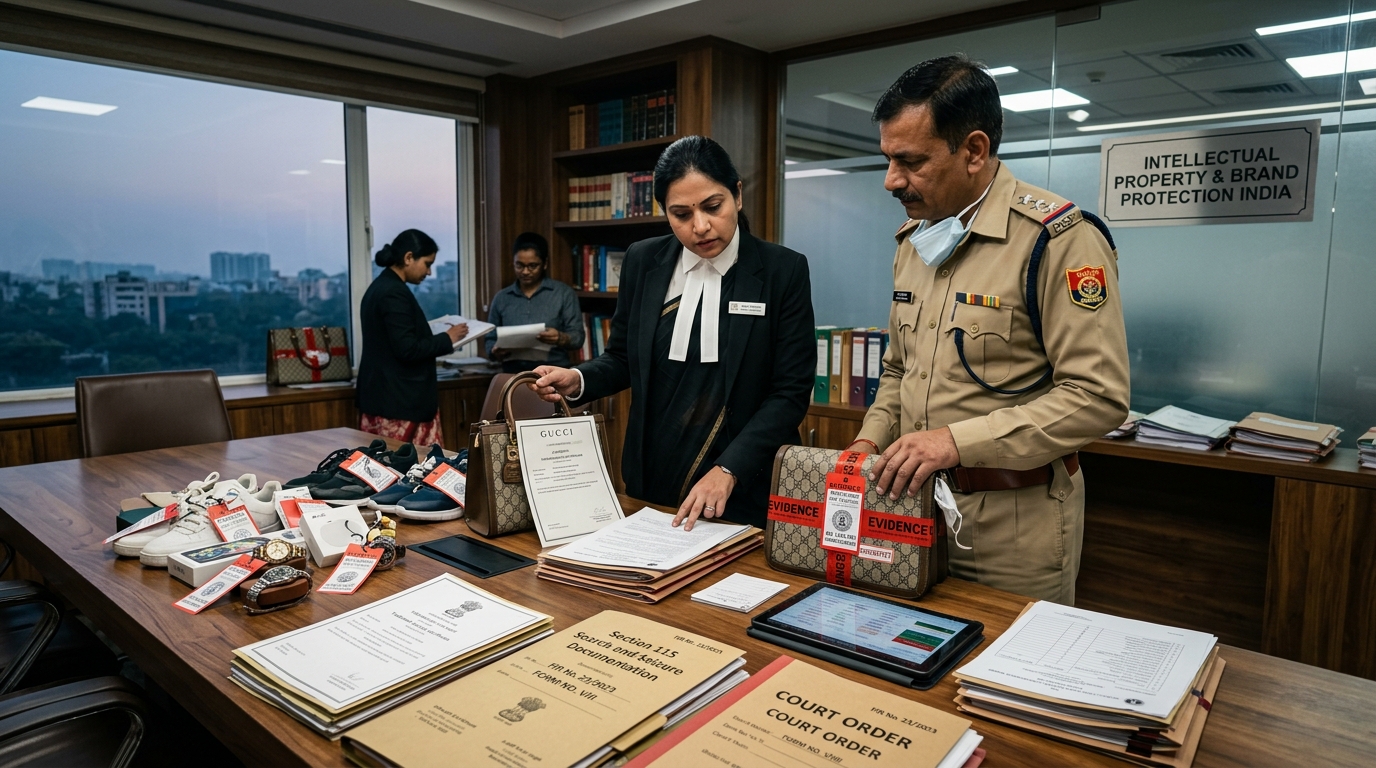
An anti-counterfeiting police raid in India is executed under Section 115 of the Trade Marks Act, 1999. It empowers a police officer not below the rank of Deputy Superintendent of Police (DSP) or Assistant Commissioner of Police (ACP) to search premises and seize counterfeit goods, packaging materials, dies, and manufacturing machinery without a warrant. Before conducting the raid, the police officer must obtain a formal opinion from the Registrar of Trade Marks verifying the trademark registration and infringement facts. Offences under Sections 103 and 104 are cognizable and non-bailable, punishable by up to 3 years imprisonment and ₹2,00,000 in fines.
Counterfeit manufacturing and illicit trade represent an existential crisis for legitimate brand proprietors in India. From spurious life-saving pharmaceuticals and automotive components to cosmetic duplicates and fast-moving consumer goods (FMCG), counterfeiters siphon billions in enterprise valuation while exposing end consumers to severe health and safety hazards.
While civil remedies—such as commercial injunction suits and Local Commissioner appointments under Order 39 of the Code of Civil Procedure (CPC)—provide financial compensation and restraining orders, they often lack the immediate deterrent shock of criminal law. A criminal raid under Section 115 physically seizes counterfeit inventory, halts manufacturing assembly lines, arrests perpetrators on the spot, and initiates criminal prosecution under theTrade Marks Act, 1999, theIndian Penal Code (IPC), and theBharatiya Nyaya Sanhita, 2023 (BNS).
To execute an effective criminal police raid that withstands judicial scrutiny and avoids quashing petitions, brand protection directors and legal counsels must follow strict statutory procedures. Learn how criminal remedies integrate into overall brand defense in our detailed analysis oncivil vs criminal trademark infringementandhow to stop trademark infringement.
Section 115 Statutory Framework & Mandate
Section 115 of the Trade Marks Act, 1999 governs the cognizance of offences and vests specific search and seizure powers in Indian law enforcement authorities. Understanding its sub-clauses is essential for lawful raid execution:
1. Cognizance of General Registry Offences — Section 115(1)
Section 115(1) establishes that no court shall take cognizance of offences relating to false representation of a mark as registered (Section 107), improper description of a place of business (Section 108), or falsification of entries in the register (Section 109), except upon a written complaint made by the Registrar of Trade Marks or an authorized officer.
2. Cognizable Status of Counterfeiting Offences — Section 115(3)
Section 115(3) explicitly declares that offences underSection 103(applying false trade marks and trade descriptions),Section 104(selling goods or providing services with false trade marks), andSection 105(enhanced penalty for second or subsequent conviction) arecognizable. This statutory recognition allows police officers to register a First Information Report (FIR) and start immediate criminal investigation.
3. Search & Seizure Without Warrant — Section 115(4)
Section 115(4) grants extraordinary authority: any police officer not below the rank ofDeputy Superintendent of Police (DSP), Assistant Commissioner of Police (ACP), or equivalent, who is satisfied that an offence under Sections 103, 104, or 105 is being or is likely to be committed, maysearch and seize without warrantany goods, dies, blocks, machines, plates, or other instruments used in committing the crime.
4. The Mandatory Proviso: Registrar's Opinion — Section 115(4) Proviso
The Proviso to Section 115(4) contains a vital procedural check:“Provided that the police officer, before making any search and seizure, shall obtain the opinion of the Registrar on facts involved in the offence and shall abide by the opinion so obtained.”Failure to comply with this proviso can render the entire search illegal and lead to discharge of the accused in High Court.
Offences & Criminal Penalties in India
The Trade Marks Act, 1999 imposes strict criminal sanctions on individuals and corporate syndicates engaged in commercial counterfeiting:
Section 103 (Falsification)
Applies to anyone who applies a false trademark to goods, forges any trademark, or makes/possesses dies, blocks, or machines for falsification.
Section 104 (Trading Spurious)
Applies to wholesalers, retailers, distributors, and e-commerce vendors who sell, let for hire, or possess counterfeit goods for sale.
Section 105 (Repeat Offence)
Applies to habitual counterfeiters convicted of a second or subsequent offence under Section 103 or Section 104.
Interplay with IPC / Bharatiya Nyaya Sanhita (BNS) 2023
Police complaints are routinely drafted invoking both the Trade Marks Act and general criminal provisions:Section 420 IPC / Section 318(4) BNS(Cheating and dishonestly inducing delivery of property),Section 486 IPC(Selling goods marked with a counterfeit property mark), andSections 468 & 471 IPC / Sections 336 & 340 BNS(Forgery of packaging labels and security holograms for cheating). For more on statutory liabilities, review our comprehensive breakdown onpenalty for trademark infringement in India.
Pre-Raid Market Intelligence & Evidence Collation
A successful Section 115 police raid depends almost entirely on the quality and confidentiality of pre-raid intelligence. Police departments will not mobilize senior DSP/ACP officers based on mere hearsay or speculation. Brand owners must present an airtight investigation dossier.
1. Market Surveillance & Supply Chain Mapping
Deploy certified private corporate investigators to trace the counterfeit distribution network. Identify manufacturing units, packaging printing presses, transit hubs, and clandestine storage godowns. Key counterfeit epicenters in India include Chandni Chowk, Sadar Bazar, and Gaffar Market in Delhi NCR, Bhiwandi and Crawford Market in Mumbai, Surat in Gujarat, and wholesale clusters in Kolkata, Chennai, and Ludhiana.
2. Sample Test Purchases (Mystery Shopping)
Execute controlled test purchases of the spurious products. Ensure undercover investigators obtain physical tax invoices, cash receipts, visiting cards, WhatsApp communication records, or UPI payment transaction IDs that directly link the counterfeit goods to the target premises and suspects.
3. Technical Authenticity Verification Report
Brand technical experts or Quality Assurance (QA) directors must prepare a side-by-side comparative examination report. Document subtle discrepancies between authentic and counterfeit items, including micro-printing errors, inferior packaging cardstock, missing UV security ink, distorted logo proportions, altered batch serial numbers, and fake QR codes.
4. Title Verification & Legal Proceedings Certificate
Ensure your trademark registration is active, renewed, and free from adverse registry orders. Obtain a certified copy of theTrademark Registration Certificate (Form TM-RG)or apply for aLegal Proceedings Certificatefrom the Indian Trade Marks Registry to prove clear statutory title under Section 28 and Section 31.
Obtaining Registrar's Opinion under Section 115(4)
The Proviso to Section 115(4) is one of the most litigated provisions in Indian criminal IP jurisprudence. It was introduced to prevent frivolous or vexatious criminal raids initiated by business rivals against genuine traders.
Judicial Precedents on Section 115(4) Compliance
- Supreme Court of India (Aneeta Hada & Subhashchandra Patni):The Apex Court and various High Courts have reiterated that obtaining the Registrar's opinion is a statutory condition precedent before a police officer conducts search and seizure under Section 115(4).
- Delhi High Court (Sanyo Electric Co. Ltd. V. State):The High Court affirmed that while police can initiate preliminary inquiry upon receiving a complaint, executing search and seizing goods without first seeking the Registrar's opinion vitiates the recovery.
- Procedure for Securing Opinion:The investigating officer or the brand owner's legal counsel submits a formal requisition along with certified trademark certificates, test purchase samples, and the comparison matrix to the Registrar of Trade Marks. The Registrar evaluates whether the impugned mark is deceptively similar or identical under Section 102 and issues an official opinion certificate.
Drafting & Lodging Criminal Complaints
A standard police complaint filed at a local police station desk is frequently delayed or mishandled due to lack of specialized IP training. Brand owners must draft a comprehensive complaint and present it to senior supervisory officers.
Where to Lodge the Anti-Counterfeiting Complaint in India
1. Economic Offences Wing (EOW)
Specialized state police wing equipped with dedicated IPR cells to investigate commercial counterfeiting syndicates exceeding designated financial thresholds.
2. Crime Branch / Special Cell
Handles multi-jurisdictional, inter-district, and organized illicit supply chains involving clandestine factories and major transport godowns.
3. Commissioner / SSP / DCP Office
Filing directly before the Commissioner of Police, Senior Superintendent of Police (SSP), or Deputy Commissioner of Police (DCP) ensures direct DSP/ACP rank assignment.
4. Magistrate Section 156(3) Route
If police hesitate to register an FIR, filing an application under Section 156(3) CrPC / Section 175(3) BNSS 2023 before the Judicial Magistrate mandates an FIR.
7-Step Anti-Counterfeiting Raid Execution Process
Executing an anti-counterfeiting police raid in India requires synchronization between corporate brand protection teams, private investigators, IP advocates, and law enforcement officers:
Ground Surveillance & Target Dossier Finalization
Investigators conduct pre-raid reconnaissance 24 to 48 hours before the operation. Confirm suspect presence, active inventory movement, factory operating hours, and exact GPS coordinates with photographs of building entryways and godown shutters.
Briefing the Senior Police Officer (DSP / ACP Rank)
Brand representatives and advocates brief the designated DSP/ACP. Present the investigation dossier, sample test purchases, authenticity discrepancies, and trademark registration proofs to satisfy statutory suspicion requirements under Section 115(4).
Mobilizing the Police Raiding Party
Form the raiding team comprising the DSP/ACP, Station House Officer (SHO), sub-inspectors, armed constables, female police personnel (if residential/commercial premises involve female occupants), and two independent local respectable witnesses (Panchas).
Simultaneous Multi-Location Search & Entry
To prevent suspects from alerting suppliers or moving inventory, execute simultaneous entries across manufacturing units, printing presses, and retail outlets. Secure all exits, confiscate mobile devices, and isolate electronic billing terminals.
Identification, Physical Seizure & Sealing
Brand technical experts inspect and identify counterfeit goods on the spot. Police confiscate finished goods, packaging labels, cartons, dies, screen printing blocks, injection moulds, and raw chemical ingredients. Pack items into evidence sacks and apply official police wax seals.
Drafting the Panchnama (Seizure Memo) on the Spot
The investigating officer prepares a detailed recovery memo (Panchnama) under Section 100 CrPC / Section 103 BNSS 2023. Record exact quantities, descriptions, seal impressions, and obtain signatures from independent witnesses, the accused, and the raiding officer.
Arrest of Suspects, FIR Registration & Court Remand
Arrest the kingpins and operators under Sections 103 and 104 of the Trade Marks Act and Section 420 IPC / Section 318(4) BNS. Transport the accused and sealed evidence to the police station, register the formal FIR, and produce the accused before the Judicial Magistrate within 24 hours.
Seizure Memo (Panchnama) & Chain of Custody
The Seizure Memo (Panchnama) is the evidentiary backbone of the prosecution case. In criminal trials, defense advocates routinely challenge the integrity of the raid by attacking procedural lapses in the Panchnama.
Essential Elements of a Valid Section 115 Seizure Memo
- Exact Date & Time:start and conclusion of search.
- Accurate Location Description:Full postal address and physical boundaries.
- Two Independent Witnesses:Names, parentage, addresses, and ID proofs of Panchas.
- Granular Inventory List:Exact count of finished goods, packaging, and machinery.
- Sample Seal Impressions:Detailed record of sample units extracted for forensics.
- Signatures & Copy Service:Signed by accused, receiving a mandatory carbon copy.
Preserving Chain of Custody & Superdari Custody:After seizure, goods are deposited in the police evidence store (Malkhana). Due to storage constraints for large bulk seizures (e.g., thousands of counterfeit auto parts or electronic appliances), brand owners can file an application underSection 451 CrPC / Section 497 BNSS 2023for release of goods on “Superdari” (interim custody on bond), preserving the sealed evidence safely until trial completion.
Criminal Police Raid vs Civil Injunction Action
Brand owners facing widespread infringement often debate whether to initiate a criminal police raid under Section 115 or file a civil commercial suit in High Court / District Commercial Court:
| Key Parameter | Criminal Raid (Section 115) | Civil Action (Order 39 / CPC) |
|---|---|---|
| Primary Objective | Immediate deterrence, seizure & criminal arrest | Injunction, damages & rendition of accounts |
| Enforcing Authority | State Police (DSP/ACP & EOW / Crime Branch) | Court-appointed Local Commissioner / Advocate |
| Speed of Action | Rapid (within 24 to 72 hours of intelligence) | Requires drafting suit, listing, & ex-parte hearing |
| Arrest Powers | Yes (Non-bailable offences under Sec 103/104) | No (Contempt of court only upon order breach) |
| Unknown Infringers | Investigated on ground via police powers | Handled via John Doe (Ashok Kumar) orders |
| Financial Damages | Government fines only (no corporate damages) | Monetary compensation & punitive damages awarded |
The Hybrid Strategy:Leading multinational and Indian enterprises frequently employ a hybrid model: launching Section 115 criminal raids against clandestine manufacturing units and godowns for immediate seizure and deterrence, while concurrently filing civil commercial suits against corporate entities to secure permanent injunctions and substantial financial damages undertrademark infringement and passing off.
Industry Counterfeiting Vulnerability Matrix
Counterfeiting impacts specific commercial sectors with distinct modus operandi. The following matrix illustrates key sectors, target classes, and specialized raid considerations:
| Industry Vertical | Trademark Class | Typical Modus Operandi | Raid Seizure Focus |
|---|---|---|---|
| Pharmaceuticals & Healthcare | Class 5 | Chalk/starch formulations, spurious blister foils, cloned batch codes | Active pharmaceutical ingredients, tableting machines, foil printing dies |
| Automotive Spares & Lubricants | Classes 4, 7, 12 | Recycled engine oil, spurious brake pads, fake branded cardboard boxes | Oil blending drums, fake hologram labels, laser etching machines |
| Electronics & Mobile Accessories | Class 9 | Substandard lithium batteries, fire-hazard adapters, fake brand logos | Pad printing machinery, unbranded accessories, counterfeit packaging |
| FMCG, Cosmetics & Perfumery | Classes 3, 29, 30 | Toxic chemical creams, fake shampoo bottles, spurious ghee/spices | Bottle blow moulding units, screen printing screens, packaging rolls |
| Apparel, Footwear & Luxury Goods | Classes 18, 25 | First-copy luxury bags, fake sports jerseys, counterfeit shoe soles | Embroidery machines, metal brand badges, heat transfer stickers |
Explore sector-specific protection strategies in our guides ontrademark for pharmaceuticals,trademark for clothing brands, andtrademark for D2C brands.
Anti-Counterfeiting Raid Action Checklist
- Verify Registered Title:Ensure valid Trademark Registration Certificate on Form TM-RG or Legal Proceedings Certificate from IP India.
- Execute Mystery Shopping:Secure verified sample test purchases with authentic commercial receipts, UPI records, or video evidence.
- Draft QA Technical Report:Prepare an expert comparative analysis highlighting forensic packaging and manufacturing discrepancies.
- Obtain Section 115(4) Opinion:Procure the mandatory verification opinion from the Registrar of Trade Marks before executing search and seizure.
- Approach Senior Police Command:Lodge a detailed criminal complaint before the Commissioner of Police, SSP, or EOW to assign a DSP/ACP rank officer.
- Execute Multi-Location Raids:Conduct simultaneous search, seize finished goods, packaging, dies, and printing machines, and seal in evidence sacks.
- Complete Panchnama Protocol:Ensure on-the-spot execution of Seizure Memos signed by two independent respectable local witnesses (Panchas).
- FIR & Judicial Prosecution:Register FIR under Sections 103/104 Trade Marks Act + Section 420 IPC / Section 318(4) BNS, oppose bail, and apply for Superdari custody.
Frequently Asked Questions
Q.Is trademark counterfeiting a cognizable and non-bailable offence in India?
Yes. Under Section 115(3) of the Trade Marks Act, 1999, offences under Section 103 (applying false trade marks) and Section 104 (selling goods with false trade marks) are cognizable. The Supreme Court of India and High Courts have consistently held that because these offences carry penalties of up to 3 years imprisonment, they are non-bailable under the Code of Criminal Procedure (and Bharatiya Nagarik Suraksha Sanhita, 2023). This allows police to arrest counterfeiters without a prior warrant.
Q.What rank of police officer is authorized to conduct a search and seizure under Section 115?
Under Section 115(4) of the Trade Marks Act, 1999, search and seizure without a warrant can only be executed by a police officer not below the rank of Deputy Superintendent of Police (DSP), Assistant Commissioner of Police (ACP), or an equivalent rank. If subordinate officers execute the raid, they must be officially authorized and accompanied by a DSP/ACP rank officer to preserve statutory validity.
Q.Is the Registrar's opinion mandatory before conducting a Section 115 police raid?
Yes. The Proviso to Section 115(4) explicitly mandates that before conducting any search and seizure, the police officer must obtain the formal opinion of the Registrar of Trade Marks on the facts involved in the offence and abide by that opinion. Raids executed without securing the Registrar's certificate or opinion risk being quashed in High Court under Section 482 CrPC (or Section 528 BNSS 2023) for procedural non-compliance.
Q.What evidence must a brand owner gather before filing a criminal raid complaint?
A brand owner must compile: (1) Certified copy of the Registered Trademark Certificate or Legal Proceedings Certificate from IP India, (2) Board Resolution or Power of Attorney authorizing the raid representative, (3) Mystery shopping test purchase invoices, (4) Physical counterfeit sample units, (5) Technical product authenticity comparison report demonstrating spurious markers, and (6) Accurate intelligence dossier detailing godown/factory locations, suspect names, and logistics hubs.
Q.What items can police seize during an anti-counterfeiting raid under Section 115?
Under Section 115(4), police are empowered to seize all counterfeit finished goods, packaging materials, labels, cartons, holograms, security stickers, dies, blocks, printing plates, machinery, moulding equipment, computers, billing software, and accounting registers used directly or indirectly in the commission of the counterfeiting offence.
Q.What is a Panchnama (Seizure Memo) and why is it critical during a police raid?
A Panchnama (or Seizure Memo under Section 100 CrPC / Section 103 BNSS 2023) is the official contemporaneous record of the search and recovery. It itemizes every seized item, batch number, quantity, and packaging state. It must be prepared on the spot, sealed in evidence bags, and signed by at least two independent respectable local witnesses (Panchas) and the raiding officer to establish an unbroken chain of custody in court.
Q.Can an anti-counterfeiting police raid be conducted without a registered trademark?
No. Criminal search and seizure under Section 115 specifically enforces registered proprietary rights under the Trade Marks Act, 1999. If your trademark is unregistered or pending, you cannot invoke Section 115 powers or obtain a favorable Registrar's opinion. Unregistered brand owners must instead pursue civil passing-off remedies or file general cheating complaints under Section 420 IPC / Section 318(4) BNS.
Q.What happens to the seized counterfeit goods after the criminal raid?
Seized goods are deposited in the police evidence room (Malkhana) or released to the brand owner under Superdari custody (interim bond under Section 451 CrPC / Section 497 BNSS) subject to court production. Upon conclusion of the criminal trial and conviction of the accused under Section 103/104, the Trial Court issues a final order under Section 111 for the complete confiscation and destruction of the spurious goods.
Strategic Anti-Counterfeiting Enforcement Advice
Protecting your intellectual property against counterfeit syndicates requires relentless vigilance, thorough investigation, and decisive legal execution. Conducting police raids under Section 115 dismantles illegal supply chains at their root, penalizes rogue operators, and sends a powerful deterrence message across the marketplace.
Never permit counterfeit products to erode your brand reputation or endanger consumer safety. Partner with veteran intellectual property litigators and brand protection specialists to coordinate pre-raid investigations, secure Registrar opinions, liaison with Crime Branch and EOW officials, and obtain permanent commercial injunctions. For related enforcement workflows, review our guides onhow to send trademark legal notices,Flipkart brand approval & lock, andAmazon Brand Registry requirements.
Shut Down Counterfeiters with Section 115 Police Raids
Deploy expert IP litigators to secure Registrar opinions, coordinate with State Police & EOW, execute search and seizure raids, and prosecute infringers under Indian criminal law.
Registered IP Advocates • Pre-Raid Intelligence • Section 115 Police Raids • Pan-India Enforcement