
Written byRahul Roy
Trademark Research Specialist
Overview of Infringement vs Passing Off
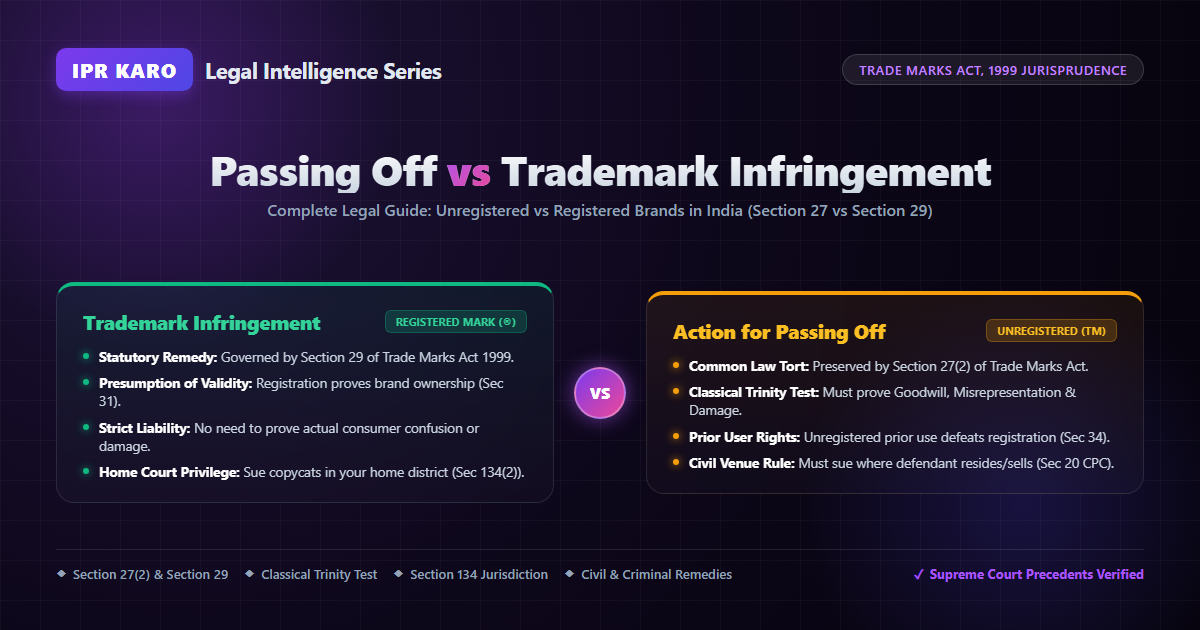
Trademark infringement in India is a statutory civil remedy governed by Section 29 of the Trade Marks Act, 1999, available strictly to proprietors of registered trademarks. It confers strict liability where the plaintiff need only establish deceptive similarity without proving consumer confusion or actual commercial damage. In contrast, passing off is a common law tort preserved under Section 27(2) that protects unregistered brands. It requires the plaintiff to satisfy the Classical Trinity test by affirmatively proving prior market goodwill, deceptive misrepresentation by the defendant, and actual or probable financial loss.
Every growing business eventually confronts the threat of unauthorized brand duplication. Whether it involves an opportunist launching a counterfeit consumer product under an identical name, a competing technology startup adopting a deceptively similar domain, or a retailer copying distinctive trade dress packaging, the unauthorized appropriation of commercial identity inflicts severe reputational and financial damage.
Under Indian commercial jurisprudence, the legal path available to an aggrieved brand owner splits into two distinct doctrines: anaction for trademark infringementand anaction for passing off. While both seek to prevent commercial deception and protect consumer choice, they originate from fundamentally different legal systems, impose radically divergent evidentiary burdens, and confer vastly unequal procedural privileges in Indian commercial courts.
Understanding this demarcation is essential not only for litigating brand disputes, but also for corporate founders determining whether to invest in formaltrademark registration processesearly or rely temporarily on common law use rights.
Key Differences: Statutory vs Common Law
The foundational cleavage between trademark infringement and passing off lies in their legal roots. One is a creature of legislative statute codified by the Parliament of India, while the other is an equitable doctrine inherited from English common law:
Trademark Infringement
Vested exclusively in the registered owner upon issuance of the registration certificate. It protects the proprietary title in the mark itself. The plaintiff need only produce the certified register extract under Section 31 to establish a prime facie presumption of validity.
Action for Passing Off
Rooted in the timeless tort principle that no person has the right to sell their goods under the pretense that they are the goods of another. It protects commercial goodwill and customer trust built through prior market adoption, regardless of registration status.
Section 27 of the Trade Marks Act, 1999 codifies this dual structure with remarkable clarity. Subsection (1) provides that no person shall be entitled to institute any proceeding to prevent, or recover damages for, the infringement of an unregistered trade mark. But subsection (2) immediately introduces an absolute statutory safeguard:
“Nothing in this Act shall be deemed to affect rights of action against any person for passing off goods or services as the goods or services of another person or the remedies in respect thereof.”
This dual statutory architecture ensures that while unregistered brands are denied the expedited evidentiary privileges of statutory infringement, they are never left defenseless against predatory market copycats.
Side-by-Side Legal Comparison Matrix
The table below provides a detailed structural comparison across 12 crucial procedural, evidentiary, and tactical dimensions under Indian intellectual property law:
| Legal Feature | Trademark Infringement | Action for Passing Off |
|---|---|---|
| Statutory Basis | Section 29, Trade Marks Act, 1999 | Common law tort preserved by Section 27(2) |
| Registration Mandatory? | Yes; strictly requires a valid registered mark | No; available for unregistered & pending marks |
| Protected Legal Asset | Proprietary monopoly in the registered mark | Commercial goodwill, reputation & customer trust |
| Burden of Proof | Identity or deceptive similarity of marks & goods | Classical Trinity: Goodwill, Misrepresentation & Damage |
| Proof of Actual Confusion | Not required; presumed under Section 29(3) | Must establish probability of deception & confusion |
| Defense of Added Matter | No defense; packaging differences are irrelevant | Valid defense if added packaging dispels confusion |
| Court Venue Privilege | Section 134(2): Can sue in plaintiff's home court | Section 20 CPC: Must sue where defendant resides/sells |
| Presumption of Validity | Statutory presumption under Section 31 | No presumption; reputation must be proved ab initio |
| Pre-Filing Evidence Needed | Registration Certificate & infringing sample | Extensive invoices, CA turnover, ads, media coverage |
| Interim Injunction Speed | Faster; prima facie case established by certificate | Slower; heavy contested hearings on market goodwill |
| Scope Beyond Goods | Covers dissimilar goods only if well-known (Sec 29(4)) | Broad; can cover trade dress, get-up & business names |
| Criminal Prosecution | Direct police search under Sections 103, 104, 115(4) | Complex; must establish cheating under IPC/BNS Section 420 |
What Constitutes Trademark Infringement
Under Section 28 of the Trade Marks Act, 1999, registration grants the proprietor the exclusive legal right to use the trademark in relation to the goods or services for which it is registered, and to obtain relief against infringement. Section 29 elaborates the exact circumstances that constitute statutory infringement:
Section 29(1): Identical Mark on Identical Goods
When a person who is not a registered proprietor or registered user adopts an identical mark in the course of trade for identical goods or services. This is counterfeit reproduction and triggers an automatic statutory presumption of infringement without requiring proof of market deception.
Section 29(2): Deceptively Similar Mark & Similar Goods
When the competing mark is either identical to the registered mark on similar goods, or deceptively similar on identical/similar goods, such that there exists a likelihood of confusion on the part of the public or a likelihood of association with the registered mark. Under Section 29(3), where marks and goods are both identical, likelihood of confusion is presumed by law.
Section 29(4): Infringement by Dilution (Well-Known Marks)
Even if the defendant uses an identical or similar mark on entirely dissimilar goods or services, infringement occurs if the plaintiff's mark has a reputation in India, and the unauthorized use takes unfair advantage of, or is detrimental to, the distinctive character or repute of the registered mark (anti-dilution doctrine).
Section 29(8): Advertising & Commercial Detriment
Infringement also encompasses unauthorized advertising that takes unfair advantage of honest commercial practices, disparages the mark, or impairs the commercial repute of the registered brand.
The crucial advantage of an infringement action is that the plaintiff does not need to establish that anyone was actually deceived. The court compares the plaintiff's registered mark with the defendant's mark side-by-side using the doctrine of imperfect recollection. If the essential phonetic, structural, or visual features have been appropriated, infringement is established as a matter of law.
What Constitutes an Action for Passing Off
Passing off is an actionable tort under common law designed to restrain commercial piracy and fraud. While trademark infringement protects the formal statutory monopoly granted by the state, passing off protects the commercial reputation and goodwill of a business entity.
In the classic words of Lord Halsbury inReddaway v. Banham (1896 AC 199):
“Nobody has any right to represent his goods as the goods of somebody else.”
Passing off extends far beyond registered trademarks. Because it is founded on goodwill rather than registration, an action for passing off can be deployed to protect:
- Unregistered Wordmarks & Brand Names:Marks that are in active commercial use but have not yet completed registration or are pending before the Trade Marks Registry.
- Trade Names & Corporate Identities:Business names, partnership titles, and company nomenclature protected under common law (Laxmikant V. Patel v. Chetanbhai Shah).
- Trade Dress, Packaging & Get-Up:Unique bottle shapes, color combinations, product labels, and distinct packaging styles that consumers associate with a specific commercial source.
- Internet Domain Names:Cybersquatting, typo-squatting, and deceptive website URLs (Satyam Infoway Ltd. V. Sifynet Solutions).
- Service Marks & Professional Reputations:Consulting services, healthcare clinics, hospitality chains, and educational institutions where customer loyalty rests on quality perception.
The Classical Trinity Test in Passing Off
To succeed in an action for passing off, the plaintiff must satisfy what is known across common law jurisdictions as theClassical Trinitytest. Reaffirmed by the House of Lords inReckitt & Colman Products Ltd. V. Borden Inc. (1990 1 All ER 873)(the famous Jif Lemon case) and formally adopted by the Supreme Court of India inLaxmikant V. PatelandCadila Health Care, the plaintiff must prove three cumulative pillars:
Goodwill & Market Reputation
The plaintiff must affirmatively prove that their brand name, logo, or get-up has acquired substantial goodwill and customer recognition in the relevant geographical market before the defendant's date of adoption.
Evidence required:Sales turnover figures, years of continuous use, chartered accountant certificates, advertising expenditure bills, and distributor affidavits.
Misrepresentation to the Public
The defendant must have made a misrepresentation (whether deliberate, reckless, or unintentional) to prospective customers or ultimate consumers in the course of trade, leading or likely to lead them into believing that the goods or services offered are those of the plaintiff or connected with the plaintiff.
Core test:Would an ordinary consumer of average intelligence and imperfect recollection be confused as to the commercial origin of the product?
Damage or Likelihood of Damage
The plaintiff must demonstrate that they have suffered actual financial damage (such as lost sales, diversion of business, or price erosion), or face a real, tangible probability of suffering damage to their commercial goodwill and trade reputation as a consequence of the defendant's misrepresentation.
Standard:While actual loss of sales proves damage, in quia timet actions, proving probable dilution or consumer deception is sufficient for an interim injunction.
If any one of these three pillars fails, the entire passing off suit collapses. This creates an enormous evidentiary burden for unregistered brand owners compared to registered trademark proprietors who need only point to their Certificate of Registration.
Section 134 Home Court vs Section 20 CPC
One of the most consequential yet frequently overlooked advantages of trademark registration in India is the procedural venue concession provided underSection 134(2) of the Trade Marks Act, 1999. This provision completely alters the tactical economics of IP litigation:
Registered Trademark (Sec 134)
Plaintiff's TurfUnder Section 134(2), a registered trademark proprietor can file an infringement suit in the District Court within whose territorial limits theplaintiffactually and voluntarily resides, carries on business, or personally works for gain.
Tactical Benefit:A Delhi-based registered brand owner can sue a copycat operating out of Surat or Kolkata right inside the Delhi High Court or Commercial District Court. The infringer is forced to travel, engage local counsel, and defend in the plaintiff's home jurisdiction.
Unregistered Trademark (Sec 20 CPC)
Defendant's TurfIn a pure passing off suit for an unregistered mark, Section 134(2) cannot be invoked. The suit is governed strictly by the general civil jurisdiction rules ofSection 20 of the Code of Civil Procedure, 1908 (CPC).
Tactical Hardship:The plaintiff must institute the suit where thedefendantresides, carries on business, or where the cause of action (actual commercial sale of infringing goods) arose. An unregistered Delhi brand owner may be forced to litigate thousands of kilometers away in the infringer's hometown.
As confirmed by the Supreme Court of India inIndian Performing Rights Society Ltd. V. Sanjay Dalia (2015 10 SCC 161)and reaffirmed by various High Courts, Section 134(2) was enacted specifically to relieve intellectual property owners from the hardship of chasing infringers all over the country. However, this statutory privilege is strictly conditioned upon possessing a registered trademark. Unregistered brand owners are denied this home pitch advantage.
Prior User Rights vs Prior Registration
While registration provides decisive procedural and statutory advantages, Indian trademark law remains firmly anchored in the principle thatprior commercial adoption trumps subsequent registration. This is codified underSection 34 of the Trade Marks Act, 1999:
Section 34: Statutory Shield of the Prior Continuous User
Section 34 prevents a registered proprietor from interfering with or restraining the use of an identical or similar mark by any person who has continuously used that mark from a date before the registered proprietor's use or application date. Furthermore, the Registrar cannot refuse to register the prior user's mark simply because an identical mark was subsequently registered.
InNeon Laboratories Ltd. V. Medical Technologies Ltd. (2016 2 SCC 672), the Supreme Court of India held that Section 34 carves out an insurmountable exception to Section 28 exclusivity. Even where a multinational or large corporation holds a registered trademark certificate, if a smaller domestic enterprise proves prior continuous commercial use of the brand under atrademark user affidavit, the registered mark cannot be used to throttle the prior user's trade.
Consequently, an unregistered prior user can not only defend against an infringement suit, but can actively sue the registered proprietor for passing off and initiate cancellation proceedings to expunge the mark from the Trade Marks Register.
Legal Remedies and Reliefs in Court
Under Section 135 of the Trade Marks Act, 1999, the relief which a court may grant in any suit for infringement or for passing off includes both injunctions and monetary compensation. Brand owners can mobilize both civil and criminal machineries:
1. Interlocutory Injunctions (Order 39 Rules 1 & 2 CPC)
Ex-parte ad-interim injunctions restraining the defendant from manufacturing, selling, advertising, or dealing in infringing goods during the pendency of the suit. In infringement suits, interim injunctions are granted swiftly because the certificate establishes a prima facie title. In passing off, the plaintiff must withstand intense scrutiny regarding market goodwill.
2. Anton Piller Orders & Local Commissions
The court appoints an advocate as a Local Commissioner with authority to enter the defendant's premises without prior notice, search godowns and manufacturing units, seize counterfeit goods, stamp stock books, impound infringing dies and packaging, and deposit them in safe custody.
3. John Doe (“Ashok Kumar”) Ex-Parte Injunctions
Where counterfeit goods are flooding markets but the identity of the underground manufacturers, distributors, or digital hosting providers is unknown, Indian courts issue John Doe orders empowering court commissioners and law enforcement to raid and seize contraband from any unnamed party found infringing the mark.
4. Damages or Rendition of Accounts (Section 135(1))
The plaintiff can elect between compensatory damages (calculated based on actual business loss and brand erosion) or an account of profits (requiring the defendant to surrender all illegal net profits generated from the infringing sales). Furthermore, Commercial Courts regularly award exemplary and punitive damages to deter deliberate commercial piracy.
5. Delivery Up and Destruction of Contraband
Mandatory court direction under Section 135(2)(b) ordering the physical destruction, erasure, or delivery up of all counterfeit goods, labels, packaging boxes, printing blocks, dies, and advertising materials in the presence of court officers.
6. Criminal Sanctions (Sections 103, 104 & 115)
Applying a false trade mark or selling goods with false trade descriptions is a cognizable criminal offense punishable with mandatory imprisonment of not less than 6 months (extendable to 3 years) and fines between ₹50,000 and ₹2,00,000. Under Section 115(4), a police officer not below the rank of Deputy Superintendent of Police (DSP) can execute warrantless raids, provided they obtain a certificate of opinion from the Registrar of Trade Marks for registered marks.
Landmark Indian Court Precedents
The jurisprudence governing infringement and passing off has been refined by several landmark rulings of the Supreme Court of India:
Kaviraj Pandit Durga Dutt Sharma v. Navaratna Pharmaceutical Laboratories
The Supreme Court laid down the definitive difference between the two actions. In infringement, if the essential features of the plaintiff's registered mark have been copied, it is no defense that the get-up, packaging, or added writing indicates a different trade origin. In passing off, however, the defendant can escape liability if they prove that the added matter is sufficient to distinguish their goods from the plaintiff's.
Key takeaway: The “added matter” defense is valid in passing off, but completely barred in statutory infringement.
Cadila Health Care Ltd. v. Cadila Pharmaceuticals Ltd.
In a dispute involving medicinal brands “Falcigo&rdquo. And “Falcitab”, the Supreme Court established a comprehensive 7-factor test for assessing deceptive similarity in passing off actions for unregistered marks. The Court ruled that stricter scrutiny applies to pharmaceuticals because public confusion in medicine can cause life-threatening health consequences.
Key takeaway: The 7 factors include nature of marks, degree of resemblance, nature of goods, similarity in performance, class of purchasers, mode of purchase, and other relevant circumstances.
Laxmikant V. Patel v. Chetanbhai Shah
The Supreme Court extended passing off protection to commercial business names and service enterprises (a color photography studio named “Muktajivan Studio”). The Court held that an action for passing off is maintainable to protect a business name even if the mark is unregistered, and courts must grant an immediate interlocutory injunction to prevent theft of commercial goodwill.
Key takeaway: Honest business reputation is property protected by common law; delay in granting injunctions permits irreparable commercial injury.
Satyam Infoway Ltd. v. Sifynet Solutions Pvt. Ltd.
The Supreme Court applied passing off jurisprudence to the digital realm. The Court held that internet domain names are not merely technical URLs or web addresses; they serve the primary commercial function of trademarks as identifiers of business origin. Consequently, copying a brand name in a domain name constitutes actionable passing off.
Key takeaway: Passing off operates seamlessly across physical and digital commerce. This protects domain names, mobile apps, and online service identities.
Step-by-Step Enforcement Process
When you discover an infringing copycat in the Indian market, executing an organized, legally sound enforcement roadmap is critical to securing immediate interim injunctions:
Market Investigation & Trap Purchases
Before alerting the copycat, retain an independent investigator to document the infringement. Secure commercial samples of the infringing product along with tax invoices, packaging boxes, delivery challans, and retail receipts.
For digital copycats, preserve certified timestamped screenshots, WHOIS domain ownership records, social media advertisements, and e-commerce listings under Section 65B of the Indian Evidence Act (now Section 63 of Bharatiya Sakshya Adhiniyam, 2023).
Legal Audit & Section 137 Certified Register Copy
Verify your legal title. If your mark is registered, apply immediately on Form TM-M for a Certified Copy of the Trademark Entry under Section 137 of the Trade Marks Act, which serves as prima facie evidence of registration in court.
If your mark is unregistered or pending, conduct a comprehensive audit of prior continuous use evidence. Collate the earliest commercial invoices, trademark filing receipts, and CA turnover certificates to establish unassailable prior adoption. You can verify whether the copycat has attempted to file their own application by conducting atrademark search.
Strategic Cease & Desist Legal Notice
Instruct your IP counsel to draft and serve a formal Cease & Desist notice. The notice must detail your proprietary rights (or established goodwill), cite statutory provisions (Section 29 or Section 27(2)), identify the infringing acts, and demand an immediate written undertaking to cease use, withdraw infringing products, and surrender stock within 7 to 15 days.
Tactical caveat:In blatant counterfeiting cases where there is a grave risk that the infringer will destroy evidence or hide stock upon receipt of a notice, brand owners often skip the Cease &. Desist notice and move directly to court for an ex-parte Anton Piller search order.
Filing Commercial Suit (Combined Infringement & Passing Off)
Institute a civil commercial suit in the appropriate Commercial District Court or High Court having Ordinary Original Civil Jurisdiction (such as Delhi, Bombay, Madras, or Calcutta). Registered proprietors should invoke Section 134(2) to file in their home court and plead both infringement and passing off in a combined plaint.
Execute a Power of Attorney onForm TM-48or standard advocate vakalatnama authorizing legal counsel to represent your commercial entity in all hearings.
Ex-Parte Ad-Interim Injunction & Local Commission
Move an urgent application under Order 39 Rules 1 & 2 CPC for an ex-parte ad-interim injunction restraining the defendant from using the mark. Simultaneously, file an application under Order 26 Rule 9 CPC for the appointment of a Local Commissioner to enter the infringer's premises, inventory counterfeit goods, and seal unauthorized packaging.
Once an ex-parte injunction and local commission are executed, most commercial copycats surrender and seek an out-of-court settlement rather than face expensive full-dress trial proceedings.
Trial, Rendition of Accounts & Permanent Injunction
If the defendant contests the suit, the matter proceeds to framing of issues, cross-examination of witnesses, and final arguments. The court evaluates the trap purchase evidence, the commissioner's report, and comparative marks.
Upon finding infringement or passing off, the court issues a permanent decree of injunction, orders destruction of seized stock, and directs payment of compensatory/punitive damages or rendition of profits under Section 135.
Evidence Checklist to Win a Passing Off Suit
Because an unregistered trademark does not enjoy the statutory presumption of validity under Section 31, proving market goodwill in a passing off lawsuit requires robust documentation. Brand proprietors must assemble this evidentiary dossier:
- Commercial Invoices:Continuous, chronological sales invoices dating back to the first date of commercial adoption, clearly displaying the brand name or logo.
- CA Turnover Certificates:Independent certificates issued by a Chartered Accountant certifying annual turnover and revenue generated exclusively under the specific trademark.
- Marketing & Advertising Bills:Invoices for digital advertising (Google Ads, Meta Ads), print media advertisements, hoardings, influencer campaigns, and television commercials showing brand promotion.
- Media Clippings & Industry Awards:News articles, press releases, trade journal write-ups, industry recognitions, and awards highlighting brand prominence.
- Customer Inquiries & Confusion Evidence:Misdirected emails, customer complaints, or messages received from consumers who mistakenly purchased the defendant's goods thinking they were yours.
- Geographical Distribution Records:Dealer networks, retail stockist lists, and shipping consignment notes demonstrating widespread consumer reach across multiple states.
Frequently Asked Questions
Q.Can I sue for trademark infringement if my trademark is not registered in India?
No. Under Section 27(1) of the Trade Marks Act, 1999, no person is entitled to institute any proceeding to prevent, or recover damages for, the infringement of an unregistered trade mark. However, Section 27(2) specifically preserves your common law right to sue for passing off. If your unregistered brand has established market goodwill and prior commercial use, you can institute a civil suit for passing off to restrain copycats and claim damages.
Q.What is the Classical Trinity test in a passing off lawsuit?
Formulated in the landmark English Reckitt & Colman (Jif Lemon) case and adopted by the Supreme Court of India in Laxmikant V. Patel and Cadila Health Care, the Classical Trinity requires the plaintiff to establish three indispensable elements: (1) Goodwill or reputation acquired by the goods or services in the relevant consumer market. (2) Misrepresentation by the defendant (intentional or otherwise) leading the public to believe their goods originate from the plaintiff. And (3) Damage or likelihood of actual damage to the plaintiff's business, goodwill, or commercial reputation.
Q.Why is Section 134 jurisdiction a major tactical advantage for registered trademark owners?
Under Section 134(2) of the Trade Marks Act, 1999, a registered proprietor or registered user can institute an infringement suit in the District Court within whose local limits the plaintiff resides, carries on business, or personally works for gain ('Home Court' advantage). Conversely, in a pure passing off suit for an unregistered mark, the plaintiff cannot invoke Section 134(2) and must sue under Section 20 of the Code of Civil Procedure (CPC)—which forces the plaintiff to litigate where the defendant resides or where the cause of action arose.
Q.What is the defense of 'added matter', and why does it work in passing off but not in infringement?
In an infringement suit, if the defendant has adopted the essential features of a registered mark, adding extra words, distinct packaging, or their own house logo is legally irrelevant and cannot be pleaded as a defense (Kaviraj Pandit Durga Dutt Sharma v. Navaratna). In contrast, in a passing off suit, the core question is whether the customer is deceived into believing the goods are the plaintiff's. If the defendant proves that the packaging, clear disclaimers, distinct color schemes, or added matter dispel consumer confusion, they can escape liability.
Q.Does prior use of an unregistered trademark defeat a subsequent registered trademark in India?
Yes. Under Section 34 of the Trade Marks Act, 1999, the rights of a prior continuous user of an unregistered trademark supersede the statutory rights of a subsequent registered proprietor. The Supreme Court of India reaffirmed in Neon Laboratories Ltd. V. Medical Technologies Ltd. That India follows the 'first in the market' principle. A prior user can not only defend against an infringement claim by a registered owner, but can also institute a passing off action against them and seek rectification or cancellation of the registered mark under Section 57.
Q.Can a brand owner file a lawsuit for both trademark infringement and passing off together?
Yes. In Indian intellectual property litigation, it is standard legal practice for registered proprietors to plead both causes of action in a single composite plaint. Pleading infringement provides strict statutory protection under Section 29, while pleading passing off acts as a robust fallback under Section 27(2) in case the defendant challenges the validity of the registered mark, files for rectification, or adopts deceptive packaging that extends beyond the registered wordmark or logo.
Q.What civil and criminal remedies are available for passing off and trademark infringement in Indian courts?
In civil proceedings, courts grant interlocutory and permanent injunctions (Order 39 Rules 1 & 2 CPC), Anton Piller search-and-seizure orders to impound counterfeit stock, Mareva asset freezes, John Doe ('Ashok Kumar') orders, damages or rendition of profits, and destruction of infringing goods under Section 135. Criminally, Sections 103 and 104 provide for imprisonment of 6 months up to 3 years and fines ranging from ₹50,000 to ₹2,00,000 for falsely applying trademarks.
Q.How does passing off apply to website domain names and digital brand copying?
In the landmark judgment Satyam Infoway Ltd. V. Sifynet Solutions Pvt. Ltd. (2004), the Supreme Court of India held that domain names do not merely represent Internet addresses but serve the primary commercial function of trademarks. Therefore, the common law action for passing off applies squarely to domain name disputes, cybersquatting, and digital impersonation. This allows businesses with unregistered online brands to secure injunctions against confusingly similar website URLs.
Strategic Passing Off vs Infringement Advice
While the common law action for passing off provides a vital legal lifeline for unregistered brands, relying on passing off as your primary intellectual property strategy is a high-risk, expensive gamble. Litigating passing off demands hundreds of pages of historical invoices, contested interim hearings on goodwill, higher legal fees, and the substantial procedural disadvantage of having to sue infringers in their home states under Section 20 CPC.
In contrast, securing a registered trademark transforms your brand into a statutory fortress. With a registration certificate in hand, you gain strict liability protection under Section 29, the invaluable “home court&rdquo. Advantage under Section 134(2), the ability to block copycats on Amazon Brand Registry and social media portals with a single click, and seamless commercial monetization throughtrademark assignment and licensing.
If your brand is currently unregistered or in pending examination status, take immediate action to formalize your legal rights. File your application on Form TM-A with an experienced trademark attorney, submit a comprehensiveuser affidavitdocumenting prior use, and safeguard your commercial identity before market competitors poach your hard-earned reputation.
Protect Your Brand from Copycats
Don't wait for a competitor to pirate your goodwill. Partner with certified IP attorneys to register your trademark, secure Section 134 home court advantage, and obtain nationwide legal exclusivity under the Trade Marks Act, 1999.
Certified IP Advocates • Same-Day Form TM-A Filing • Transparent Fixed Fee Structure