
Written byRahul Roy
Trademark Research Specialist
Overview of Trademark Renewal
Trademark renewal in India is a statutory procedure governed by Section 25 of the Trade Marks Act, 1999 and Rule 57 of the Trade Marks Rules, 2017. A registered mark is valid for 10 years from the application filing date and can be renewed indefinitely in successive 10-year blocks by filing Form TM-R with the government fee of ₹9,000 per class. Renewal can be submitted up to one year before expiry, within a 6-month post-expiry grace period with a ₹4,500 surcharge, or restored up to one year post-expiry before permanent removal.
Unlike patents and copyright, which eventually enter the public domain upon the expiry of a non-renewable statutory term, trademarks represent a perpetual commercial asset. Under Indian intellectual property jurisprudence, brand ownership can endure indefinitely—provided the proprietor maintains active commercial use and timely compliance with the decennial renewal schedule established under the Trade Marks Act, 1999.
The 10-year validity term is calculated strictly from the original application filing date, not from the date the certificate is finally sealed. Because standardtrademark registration processescan take several months or years to resolve examination objections and oppositions, many business owners are surprised to learn that their 10-year clock has already elapsed significantly by the time they establish operations.
Allowing a trademark to lapse leaves your commercial enterprise vulnerable to catastrophic legal and financial damage. Third-party competitors can initiate non-use cancellations, poach your established brand goodwill, or register conflicting names. Furthermore, for companies operating overseas, failing to renew your domestic Indian registration compromises any foreign filings secured throughinternational trademark registrationunder the Madrid Protocol.
Prerequisites for Filing Form TM-R
Before submitting a renewal application on the official IP India portal, brand proprietors and trademark attorneys must verify crucial registry records and assemble statutory prerequisites. Overlooking these preliminary checks can cause administrative rejections or procedural defects.
Registry Status Verification
Confirm that the mark on the Trade Marks Registry e-portal currently reflects a status of “Registered”. Marks under rectification, stay orders, or pending division proceedings require specialized compliance steps before submitting renewal fees.
Chain of Title & Address Alignment
Check whether the applicant entity has changed its name, registered address, or corporate structure (such as conversion from a partnership into a Private Limited company). Any changes must be officially recorded on Form TM-P to avoid ownership disputes during renewal.
Original Certificate & Classes
Collate the original Trademark Registration Certificate (Form TM-RG) or the most recent decennial renewal receipt. Identify all registered Nice classes so renewal fees are accurately calculated for each specific commercial class.
Power of Attorney (Form TM-48)
If retaining a registered trademark agent or legal counsel to execute the renewal, an executed and stampedForm TM-48 Power of Attorneyauthorization is statutory. It must be signed by the current authorized signatory of the proprietor entity.
7-Step Trademark Renewal Process
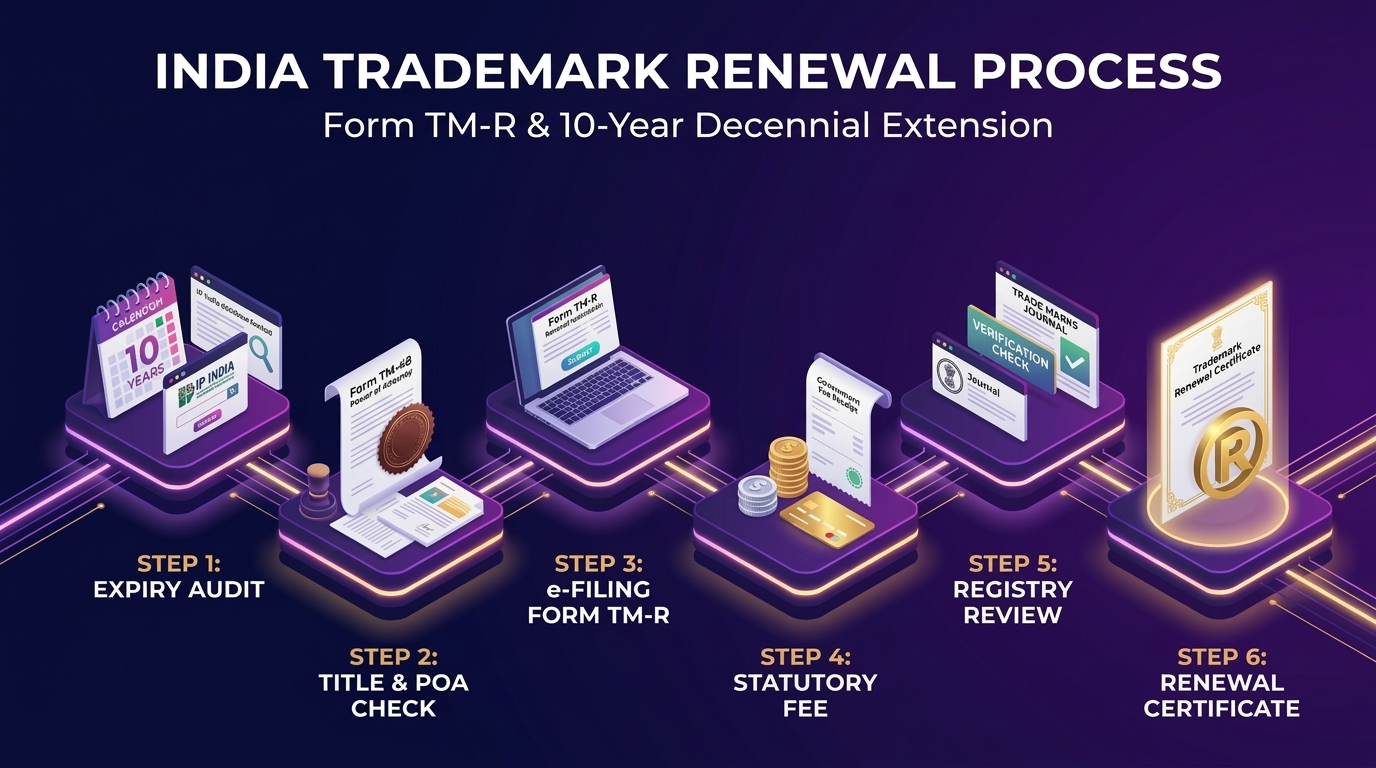
Renewing a trademark under the Trade Marks Rules, 2017 is an online procedure conducted through the comprehensive e-filing gateway of the Controller General of Patents, Designs and Trade Marks (CGPDTM). Follow these 7 statutory stages:
Registry Audit & Expiration Date Confirmation
Begin by accessing the public Trade Marks Registry database or conducting a thorough review using the officialIP India Portal. Enter your registered application number to inspect the electronic register entries.
Confirm the exact date of application and current validity deadline. Check if the Registrar has dispatched an O-3 notice (Notice of Expiration). Verify that your brand has not been cited in third-party rectification filings or subjected to conflicting trademark registrations across complementary classes. You can verify whether similar marks have appeared by performing atrademark search.
Chain of Title & Multi-Class Reassessment
Over a 10-year span, corporate dynamics change dramatically. Founders incorporate, companies rebrand subsidiary entities, or rights are assigned through commercial licensing. Under Indian trademark law, the renewal applicant must strictly match the current registered proprietor.
If an assignment, transmission, or change in company name has taken place without being registered on Form TM-P, file the record of title concurrently. Furthermore, review your goods and services descriptions across all classes using ourtrademark class finderto decide whether all classes must be renewed or if non-operative classes can be pruned.
Drafting Form TM-R & Legal Authorization
The Trade Marks Rules, 2017 consolidated multiple legacy renewal forms (such as TM-12, TM-13, and TM-10) into a single comprehensive statutory format:Form TM-R. The form covers four specific legal renewal scenarios:
- Standard Renewal:Filed within 12 months before the expiration date.
- Renewal with Surcharge:Filed within 6 months after the expiration date under Section 25(3).
- Restoration & Renewal:Filed between 6 months and 1 year after the expiration date under Section 25(4) and Rule 60.
- Renewal of International Registration:Designating India under the Madrid Protocol.
Ensure that an updated Form TM-48 (Power of Attorney) is executed with applicable state stamp duty if an attorney or agent represents your renewal filing.
Online Submission on the IP India Gateway
Using a valid Class 3 Digital Signature Certificate (DSC), log in to the IP India comprehensive e-filing system. Select Form TM-R and enter the trademark registration number. The system will automatically populate historical registration data, including the trade mark representation, proprietor name, and class numbers.
Select the appropriate category of renewal (Standard, With Surcharge, or Restoration). Upload supporting documents, including the copy of the registration certificate and stamped Form TM-48, and digitally sign the application.
Paperless Efficiency:E-filing Form TM-R offers immediate timestamping and eliminates the processing lag associated with physical filings across regional branches in Mumbai, Delhi, Kolkata, Chennai, and Ahmedabad.
Statutory Fee Remittance & E-Receipt Generation
Remit the official government fee through the integrated Bharatkosh payment gateway. The standard online renewal fee is₹9,000 per class. If filing within the post-expiry 6-month grace period, an additional statutory surcharge of₹4,500 per classis added automatically by the gateway.
Upon successful electronic transaction, the portal generates an official e-acknowledgment receipt containing a distinct CBR (Cash Book Receipt) number and timestamp. This receipt serves as statutory proof that renewal was initiated within the permissible legal window.
Registry Scrutiny & Journal Advertisement
Once Form TM-R is lodged, the renewal division of the Trade Marks Registry scrutinizes the submission for formal accuracy. The examiner confirms whether the fee matches the registered classes, verifies attorney authorization, and reviews if the mark was subject to any unrecorded judicial assignments or cancellations.
Under Rule 59 and Rule 61, the renewal is officially recorded and published in the weekly Trade Marks Journal under the section “Registered Marks Renewed”. This public notification puts competitors and industry stakeholders on notice that your statutory monopoly has been renewed for another ten years.
Issuance of Renewal Certificate & Portfolio Docketing
Following scrutiny and journal notification, the Registrar issues an electronically authenticatedCertificate of Renewalunder Rule 61. The electronic status on the IP India database updates to “Registered - Valid until [New Expiry Date]”.
This certificate serves as conclusive evidence of unbroken brand ownership dating back to your original filing year. Download the authenticated PDF certificate and docket your next renewal deadline exactly 10 years into the future.
If your mark was lapsed beyond the 6-month grace period, you will need to complete specialized restoration steps. Learn more about emergency procedures in our in-depth guide onhow to restore expired trademarkand read our analysis onwhat happens if trademark expires.
Renewal Timelines, Fees, and Surcharges
The Trade Marks Rules, 2017 structure the renewal process into three progressive statutory windows based on the date of application. Government fees escalate significantly if deadlines are missed:
| Filing Stage | Statutory Window | Statutory Form | Govt E-Filing Fee | Physical Fee | Legal Governing Provision |
|---|---|---|---|---|---|
| Standard Renewal | Within 1 year before expiry | Form TM-R | ₹9,000 / class | ₹10,000 / class | Section 25(1) & Rule 57 |
| Late Renewal (Grace Period) | Within 6 months after expiry | Form TM-R + Surcharge | ₹13,500 / class | ₹15,000 / class | Section 25(3) & Rule 58 |
| Restoration and Renewal | Between 6 and 12 months after expiry | Form TM-R (Restoration) | ₹18,000 / class | ₹20,000 / class | Section 25(4) & Rule 60 |
| Permanent Removal | After 12 months from expiry | Fresh Application (TM-A) | ₹4,500 or ₹9,000 | ₹5,000 or ₹10,000 | Section 25(4) proviso & loss of priority |
Common Renewal Pitfalls to Avoid
Managing decennial brand renewals requires strict compliance. Over a decade, organizational oversight can lead to avoidable mistakes that jeopardize your trademark exclusivity:
1. Relying Solely on Physical Registry Notices (Form O-3)
While the Registrar is required under Section 25(3) to dispatch a notice of impending expiration (Form O-3), postal delays or outdated correspondence addresses on the register mean proprietors frequently never receive it. The statutory burden to renew rests entirely on the trademark proprietor.
2. Unrecorded Mergers, Name Changes, or Assignments
Submitting Form TM-R under a new corporate entity name without having filed Form TM-P to record the assignment or transmission will trigger an immediate discrepancy notice. Always record corporate changes before or concurrently with renewal.
3. Conflating Trademark Renewal with Trademark Alteration
Form TM-R extends the legal life of a mark exactly as registered. It cannot be used to update your logo graphics, alter font styles, or expand goods specifications. Brand modernizations require filing Form TM-M (for minor variations) or submitting a fresh application on Form TM-A.
4. Missing the 12-Month Restoration Cutoff
Once 12 months have passed from the expiry date, the Registrar lacks statutory authority under Section 25(4) to entertain restoration. The trademark is permanently expunged from the register, sacrificing your decade-old priority date and leaving your mark open to competitor filings.
Rights Maintained After Renewal
Timely execution of Form TM-R preserves the substantial legal remedies granted to registered proprietors under the Trade Marks Act, 1999:
Unbroken Priority Date:Your original filing date remains the benchmark for all priority conflicts under Section 11. Even if competitors enter the market during your second decade of operations, your seniority remains unassailable in court.
Statutory Infringement Remedies:Under Section 28 and Section 29, active registration provides prima facie legal proof of ownership in civil courts. You retain the right to obtain ex-parte interim injunctions, order delivery-up of counterfeit goods, and claim punitive damages or accounts of profit against infringers without the heavy evidentiary burden of proving common-law passing off.
Commercial Asset Valuation:Active trademarks are balance-sheet assets. Continued renewal preserves brand valuation during venture funding rounds, initial public offerings (IPOs), franchising agreements, and intellectual property collateralization.
Trademark Renewal Checklist
- Audit Registry Status:Confirm that the mark status reads “Registered” and note the exact 10-year expiration date.
- Verify All Registered Classes:Identify whether the mark is registered in single or multiple classes and calculate fees at ₹9,000 per class.
- Reconcile Corporate Ownership:Ensure any corporate name changes, mergers, or assignments have been recorded on Form TM-P.
- Execute Form TM-48:Have the authorized signatory execute a stamped Power of Attorney authorizing your trademark counsel.
- File Online Form TM-R:Submit the application via the official IP India gateway using a Class 3 Digital Signature.
- Track Journal Notification:Monitor the Trade Marks Journal until the registration is listed under “Registered Marks Renewed”.
- Download Renewal Certificate:Secure the digitally authenticated Certificate of Renewal and set calendar docket alerts for 10 years later.
Frequently Asked Questions
Q.When should I file for trademark renewal in India?
Under Rule 57 of the Trade Marks Rules 2017, you can file Form TM-R for trademark renewal anytime within one full year (12 months) before the expiration of the current 10-year registration cycle. Filing early prevents last-minute administrative rushes, ensures uninterrupted legal exclusivity, and avoids statutory late fee surcharges.
Q.What is the official government fee for trademark renewal in India?
The official government e-filing fee for trademark renewal under Form TM-R is ₹9,000 per class. If filed physically in paper format at the registry counter, the statutory fee is ₹10,000 per class. Unlike initial registration under Form TM-A, there is no government fee discount for individuals, startups, or MSMEs on renewal filings.
Q.Is there a concession for startups or MSMEs in trademark renewal fees?
No. The First Schedule of the Trade Marks Rules, 2017 provides a 50% statutory fee concession for individuals, startups, and MSMEs solely for initial trademark filings (Form TM-A). For trademark renewal (Form TM-R), a uniform statutory fee of ₹9,000 per class applies across all applicant categories, regardless of business size or legal entity type.
Q.What is the grace period if I miss the trademark renewal deadline?
If you fail to renew before the 10-year expiration date, the Trade Marks Act provides a statutory 6-month grace period under Section 25(3). During these 6 months post-expiry, you can still file Form TM-R along with the standard renewal fee of ₹9,000 plus a statutory late-filing surcharge fee of ₹4,500 per class (totaling ₹13,500 per class for online e-filing).
Q.How can I restore an expired or removed trademark in India?
If a trademark is not renewed within the 6-month post-expiry grace period, it is advertised in the Trade Marks Journal for removal. Under Section 25(4) and Rule 60, the proprietor has a restoration window between 6 months and 1 year after the expiration date to apply for Restoration and Renewal on Form TM-R by paying the restoration fee of ₹9,000 plus the renewal fee of ₹9,000 (totaling ₹18,000 per class).
Q.What documents are required to renew a trademark online?
To renew online, you need your trademark registration number and class details, a copy of the original Trademark Registration Certificate (or previous renewal certificate), applicant identification proof, Power of Attorney on Form TM-48 if filing through a trademark attorney or registered agent, and a Class 3 Digital Signature Certificate (DSC) for portal authentication.
Q.Can I make changes to my logo or add new classes during renewal?
No. Form TM-R is strictly dedicated to extending the validity of an existing registration as recorded on the Trade Marks Register. You cannot alter the logo design, change the wordmark spelling, or add new classes of goods or services on Form TM-R. Any substantial alteration requires a separate Form TM-M (if minor) or an entirely new trademark application on Form TM-A.
Q.What happens to my international trademark under Madrid Protocol if my Indian trademark expires?
Under Article 6 of the Madrid Protocol, an international registration remains dependent on the home country base mark for a period of 5 years from its international registration date (the 'dependency principle'). If your Indian base trademark is cancelled or removed due to non-renewal during this 5-year window, your international trademark protection in all designated foreign countries will automatically collapse.
Strategic Trademark Renewal Advice
A registered trademark is one of the very few commercial assets that appreciates in value the longer it is used in commerce. By maintaining strict renewal hygiene, brand owners safeguard decades of marketing capital, customer trust, and corporate enterprise value.
Do not wait for statutory grace periods or journal removal warnings to initiate action. Establishing automated docketing cycles and engaging certified IP attorneys ensures that your Form TM-R is lodged cleanly, fees are reconciled without error, and your exclusive rights remain perpetual. Start your renewal assessment today to secure your brand legacy for the decade ahead.
Renew Your Brand Exclusivity Today
Partner with expert IP attorneys to manage your decennial trademark renewal. From portfolio docket audits and Form TM-R filing to journal notifications and final renewal certificate issuance.
Certified IP Advocates • Same-Day Form TM-R Filing • Transparent Government Fee Invoicing