
Written byRahul Roy
Trademark Research Specialist
Overview of International Trademark Registration
International trademark registration allows brand owners to protect their trade names, logos, and slogans across multiple foreign jurisdictions simultaneously. Through the Madrid Protocol administered by the World Intellectual Property Organization (WIPO), Indian applicants can file a single centralized application (Form MM2(E)) via the Indian Patent Office, designating over 130 member countries in one language (English) and paying fees in Swiss Francs (CHF). Alternatively, brands can file direct national applications in non-member states.
Under the fundamental international legal doctrine known as theprinciple of territoriality, intellectual property protection granted by any sovereign patent and trademark office remains enforceable solely within that specific country's geographical borders. Registering a trademark with the Trade Marks Registry in Mumbai, Delhi, Chennai, Kolkata, or Ahmedabad gives you enforceable rights under the Indian Trade Marks Act, 1999, but confers zero protection once your goods cross maritime customs or digital software packages are downloaded abroad.
Without international brand registration, Indian companies venturing into overseas trade face severe risks of trademark squatting, unauthorized distributor registrations, and counterfeit production. In major first-to-file jurisdictions such as China, the European Union, and Japan, bad-faith competitors routinely register emerging brand names before the genuine owner enters the market. Once an overseas competitor secures local registration, they can legally block your authentic goods at foreign ports through customs seizures.
To protect Indian enterprises expanding globally, India officially acceded to the Madrid Protocol on April 8, 2013, with the treaty coming into full legal force on July 8, 2013. The Indian Trade Marks Act, 1999 was specifically amended to introduceChapter IVA (Sections 36A to 36G). This creates a formal statutory bridge between the Indian Trade Marks Registry and the International Bureau of WIPO in Geneva. You can explore the foundational domestic filing steps in our comprehensive guide on theprocess and steps of trademark registration.
Key Prerequisites Before International Filing
Filing an international trademark through the Madrid System is not an independent or isolated action. The system is structurally anchored to your domestic IP assets. Before initiating an application, Indian applicants must verify four mandatory legal prerequisites.
Active Indian Base Mark
The applicant must hold either an active pending trademark application (filed via Form TM-A) or a registered trademark certificate issued by the Indian Trade Marks Registry. This is known as the “basic application” or “basic registration”. Without an existing Indian filing number, an international Madrid application cannot be created.
Statutory Entitlement Criterion
The applicant must establish a legal connection with India. Under Article 2 of the Madrid Protocol, the applicant must be an Indian citizen, be domiciled in India, or maintain a real and effective industrial or commercial establishment within Indian territory. For startups, check our guide onhow to register a trademark for my startup.
Absolute Identity of the Mark
The mark depicted in the international application must be identical in all respects to the Indian base mark. If your Indian mark is a wordmark, the international mark must remain a wordmark with matching spelling and capitalization. If it is a figurative device or logo, the identical graphic file must be submitted.
Specification & Nice Class Alignment
The list of goods and services in the international application cannot be broader than the goods and services covered by the basic Indian filing. While you may narrow the specification for specific target countries, adding new items or classes will result in immediate rejection by the Indian Office of Origin. Verify classifications using ourtrademark class finder.
Two Primary Filing Pathways: Madrid vs Direct National
When designing a global intellectual property strategy, enterprises must evaluate whether to file centrally via the Madrid Protocol or file directly through national patent offices in each target jurisdiction.
Pathway A: Madrid Protocol System
A centralized, multilateral treaty administered by WIPO. You file one electronic application (Form MM2(E)) through the Indian Trade Marks Registry, select your designated contracting parties, and pay a single fee in Swiss Francs.
- Covers 130+ countries including USA, EU, UK, Japan, Australia, China, Singapore.
- Centralized renewals and ownership updates directly via WIPO.
- Substantially lower initial attorney fees and administrative overhead.
- Vulnerable to the 5-year “central attack” rule.
Pathway B: Direct National Filing
Direct filing with individual foreign trademark offices (such as the USPTO in the US, EUIPO in Europe, or SAIP in Saudi Arabia). Requires engaging a qualified local trademark attorney in each foreign territory.
- Mandatory for non-Madrid countries (e.g., Saudi Arabia, South Africa, Nepal, Bangladesh).
- Immune to domestic Indian objections or central attack vulnerability.
- Allows broad, independent goods specifications tailored to local practice.
- Higher costs due to separate local attorney representation and foreign translation.
Paris Convention 6-Month Priority Window
Under Article 4 of the Paris Convention for the Protection of Industrial Property, if you file an international trademark application within6 monthsof filing your initial Form TM-A in India, you can claim convention priority. This legally backdates your international filing date in all foreign member countries to the exact date of your original Indian application, preempting overseas copycats who filed after your Indian date.
7-Step International Trademark Registration Process
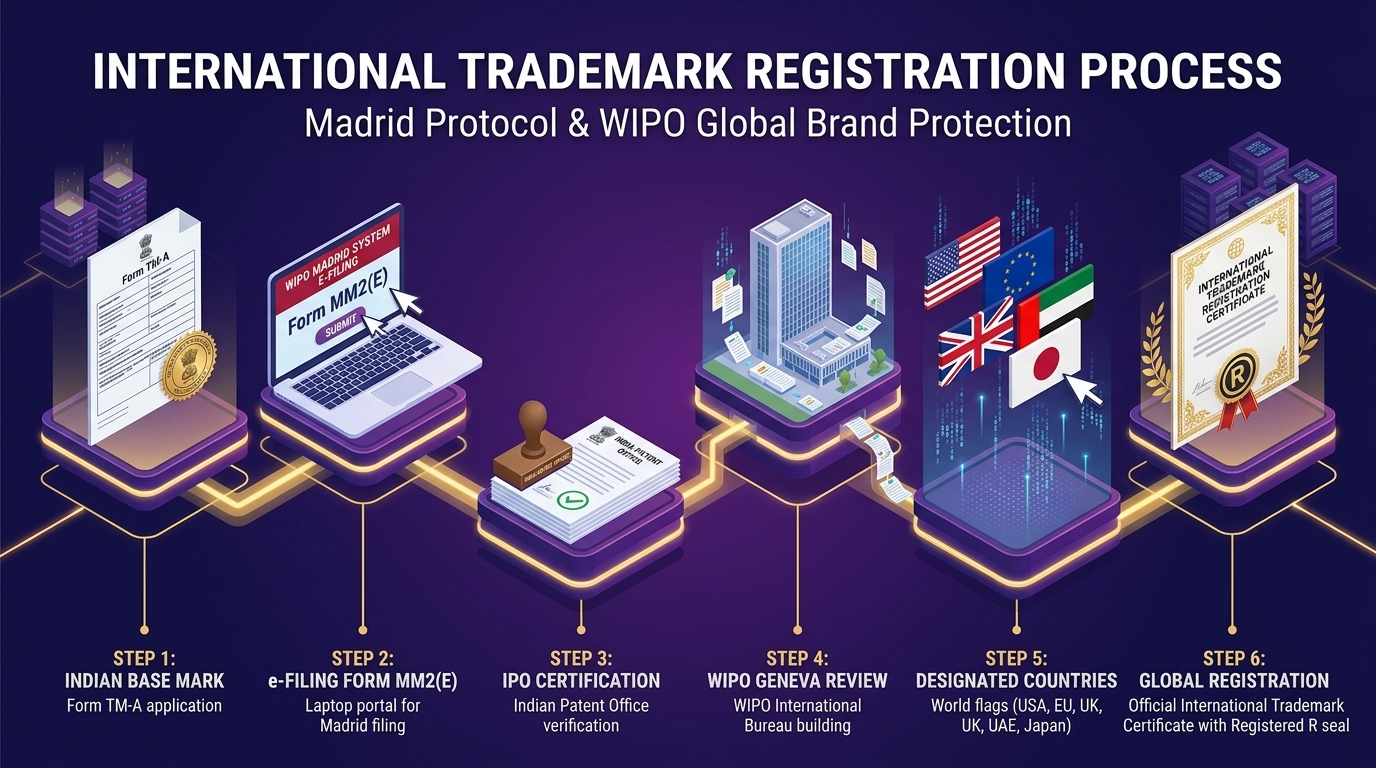
Filing an international trademark under the Madrid Protocol follows an organized, multi-tier regulatory pathway involving the Indian Trade Marks Registry, WIPO in Geneva, and individual foreign national intellectual property offices.
Conduct Comprehensive International Prior Art Clearance
Before committing capital to international filing fees, brand owners must verify whether their desired mark is legally available in every target country. Conducting domestic clearance on the IP India database is insufficient. You must search global databases including theWIPO Global Brand Database, TMview for European marks, and the USPTO TESS database for American registrations.
Clearance must account for local linguistic connotations, phonetically equivalent terms in foreign scripts (such as Cyrillic, Arabic, or Chinese Hanzi), and prior unregistered common-law rights in target jurisdictions. Begin your search with ourfree AI powered trademark searchor consult our guide onhow to search for existing trademark.
Secure the Baseline Application or Registration in India
The Madrid System requires an active “Office of Origin” base mark. Indian applicants must file Form TM-A with the Indian Trade Marks Registry across the relevant classes. It is not mandatory to wait for the final registration certificate; a valid pending application with an issued application number is legally sufficient to anchor an international application.
However, because the international registration will be tied to this basic Indian filing for 5 years. This ensures that the Indian base mark is robust, distinctive, and defended against Section 9 or 11 objections is crucial. You can initiate domestic filing immediately through oure-filing trademark portal.
Prepare and Submit Form MM2(E) via IP India Portal
Under Indian Madrid Regulations, international applications are submitted electronically through the official IP India gateway usingForm MM2(E). Applicants cannot file directly with WIPO; the application must be routed through the Indian Patent Office as the Office of Origin.
The application requires specifying:
- Applicant details identical to the basic Indian application.
- High-resolution representation of the mark (with color claims if applicable).
- The designated Madrid contracting parties where protection is sought (e.g., US, UK, EU, UAE, Singapore).
- Itemized specifications of goods and services classified under the Nice system.
- Payment of the Indian handling/certification fee of₹2,000.
Certification and Transmission by the Indian Registry
Upon receiving Form MM2(E), a designated international examiner at the Indian Trade Marks Registry conducts a strict comparison between the international application and the Indian base filing. The examiner verifies applicant identity, mark representation, and ensures that the goods/services do not exceed the Indian specification.
Once verified, the Indian Registry certifies the application and transmits it electronically to the WIPO International Bureau in Geneva. If the Indian Registry transmits the application within2 monthsof receipt, the official international registration date corresponds to the date Form MM2(E) was submitted in India.
Formal Review and Publication in the WIPO Gazette
Upon transmission, WIPO examiners conduct a formal examination. WIPO doesnotassess whether your mark conflicts with existing trademarks or lacks distinctiveness; they evaluate classification accuracy, linguistic translations, clarity of specifications, and fee computations.
If formal requirements are met, WIPO registers the mark in the International Register, assigns anInternational Registration Number (IRN), issues the official Certificate of International Registration to the applicant, and publishes the mark in theWIPO Gazette of International Marks. WIPO then formally notifies the trademark offices of all designated countries.
Substantive Examination by Designated Foreign Offices
Each designated country evaluates the international registration under its domestic intellectual property statutes, exactly as if it were a direct national application. Examiners examine the mark for relative grounds (prior confusing marks on their domestic registers) and absolute grounds (descriptive, generic, or deceptive terms).
Under Madrid Protocol Article 5, designated offices must complete their examination and notify WIPO of any refusal within a statutory timeframe—either12 months(standard) or18 months(for contracting parties that elected the extended window, such as the United States, United Kingdom, and China). If an office fails to notify WIPO within this deadline, protection is automatically granted by default.
Issuance of Grant Statements and Global Portfolio Management
If a designated national office raises no objections, or after any objections or third-party oppositions are resolved, that office issues an officialStatement of Grant of Protectionto WIPO. WIPO records the grant in the International Register and forwards the notice to the applicant.
At this stage, your trademark possesses the exact same legal force and remedies against infringement as a domestic trademark registered directly in that foreign nation. The international registration remains valid for 10 years, renewable centrally via WIPO. If an examiner raises issues, learn how our attorneys help youovercome trademark objections.
International Trademark Stages, Timelines, and Legal Standards
Understanding the statutory fee architecture and procedural duration is essential for budgeting international IP expansion. Below is a structured comparative analysis of international registration stages.
| Process Stage | Statutory Form | Official Fee Structure | Typical Duration | Governing Legal Standard |
|---|---|---|---|---|
| 1. Base Indian Filing | Form TM-A | ₹4,500 (MSME) / ₹9,000 (Co.) | Immediate E-filing | Section 18, Indian Trade Marks Act 1999 |
| 2. Indian IPO Handling | Form MM2(E) | ₹2,000 Handling Fee | 1–2 Months | Rule 67, Trade Marks Rules 2017 |
| 3. WIPO Basic Fee | WIPO Schedule | 653 CHF (B&W) / 903 CHF (Color) | 2–3 Months | Rule 14, Common Regulations under Madrid |
| 4. Designation Fees | MM2(E) Annex | Variable by country (100–850 CHF) | Paid at filing | Article 8(7), Madrid Protocol Individual Tariffs |
| 5. Foreign Examination | National Dockets | Covered by designation fee | 12–18 Months | Article 5(2), Madrid Protocol Statutory Window |
| 6. Provisional Refusal Defense | Local Office Reply | Foreign attorney professional fees | Within 30–90 Days | Domestic patent/trademark laws of target nation |
| 7. Decennial Renewal | Form MM11 | 653 CHF basic + country renewal fees | Every 10 Years | Article 7, Madrid Protocol Unified Maintenance |
Central Attack Doctrine and Legal Defense Strategies
The single most critical legal nuance of the Madrid Protocol is theFive-Year Dependency Rule, colloquially known in international intellectual property law as theCentral Attack.
The Central Attack Mechanism (Article 6)
For exactly 5 years from its international registration date, the international registration remains legally tethered to the fate of the basic Indian mark. If the Indian application is abandoned, refused by the examiner under Section 9/11, revoked after opposition, or withdrawn by the applicant within this 5-year window, the international registration is automatically cancelled inall designated countriesto the exact same extent.
A predatory competitor in the United States or Europe can defeat your international protection across the globe simply by hiring an Indian counsel to oppose or invalidate your domestic Indian base application. Once the domestic trunk is severed, all foreign international branches immediately fall.
Strategic Safeguards Against Central Attack
- Anchor on a Registered Mark:Whenever feasible, base your Madrid application on a fully registered Indian trademark that has already survived opposition and examination, rather than a vulnerable pending application.
- File a Separate International Base Application:If your commercial Indian mark faces opposition, file a fresh, narrowly tailored Indian application specifically formulated for international transmission.
- Invoke Transformation (Article 9quinquies):If your Indian base mark suffers cancellation, the Madrid Protocol provides a vital emergency remedy calledTransformation. Within3 monthsof cancellation, you can transform your international registration into independent national applications in each designated country. You preserve your original international registration date and convention priority. This prevents total loss of rights.
Common International Trademark Pitfalls
Cross-border intellectual property filings involve diverse domestic legal traditions, varying examination standards, and strict statutory timelines. Avoiding these common procedural errors saves months of delays and thousands of dollars in foreign counsel costs.
1. Overly Broad Specifications of Goods
While the Indian Trade Marks Registry accepts broad class headings, foreign offices—most notably the United States Patent and Trademark Office (USPTO)—reject indefinite descriptions such as “computer software&rdquo. Or “consulting services”. The USPTO requires explicit identification of software functionality and commercial purpose, triggering automatic provisional refusals.
2. Ignoring Local Language Translations and Transliterations
A mark that sounds distinctive and catchy in English may translate into an offensive, generic, or descriptive term in target markets like Germany, Spain, or China. Failing to conduct cross-linguistic phonetic and semantic clearance often results in immediate public policy or descriptiveness refusals abroad.
3. Missing Provisional Refusal Statutory Response Windows
When a foreign office issues an objection, WIPO forwards the notification to the Indian applicant. In many countries (such as the UK, Japan, and the US), the deadline to respond is non-extendable (often between 30 and 90 days). Failing to instruct local counsel before the deadline results in total abandonment of your mark in that territory.
4. Forgetting United States Intention-to-Use Declarations (MM18)
Whenever designating the United States in Form MM2(E), applicants must mandatorily complete and executeForm MM18(Declaration of Intention to Use the Mark in Commerce). Omitting Form MM18 or signing it without proper officer authority causes WIPO and the USPTO to invalidate the US designation immediately.
International Trademark Filing Checklist
- Conduct Multi-Jurisdictional Clearance:Search the WIPO Global Brand Database, TMview, and USPTO databases to verify availability in all export territories.
- Establish Indian Base Application:File Form TM-A with the Indian Registry to secure a home application number and establish your priority anchor.
- Claim 6-Month Paris Priority:Submit your international application within 6 months of the Indian filing date to backdate priority worldwide.
- Verify Strict Correspondence:Ensure applicant legal name, entity type, address, and mark artwork match your Indian base filing with 100% precision.
- Complete Form MM2(E) on IP India Gateway:Select target contracting parties, attach MM18 if designating the US, and remit the ₹2,000 certification fee.
- Settle WIPO Fees in Swiss Francs (CHF):Pay the basic administrative fee and designated country fees directly through WIPO's e-Payment gateway.
- Monitor 12-18 Month Examination Windows:Track national dockets via WIPO Madrid Monitor and instruct overseas counsel immediately if provisional refusals arise.
Frequently Asked Questions
Q.What is an international trademark registration and how does it work?
An international trademark registration is a centralized mechanism governed by the Madrid Protocol and administered by WIPO in Geneva. It enables an applicant to file a single standardized application (Form MM2(E)) through their domestic intellectual property office to seek brand protection in over 130 member countries simultaneously. This eliminates the need to file separate national applications in different languages.
Q.Can I register an international trademark directly without an Indian trademark?
No, under the Madrid Protocol, Indian applicants must possess a basic home mark—either a pending application (Form TM-A) or an active registration certificate—with the Indian Trade Marks Registry before applying internationally. Your international mark and specification of goods or services must precisely correspond with your Indian base filing.
Q.What is the difference between the Madrid Protocol and direct national filing?
The Madrid Protocol provides a single centralized application, one currency (Swiss Francs), and unified portfolio management across 130+ contracting parties. In contrast, direct national filing requires engaging local trademark attorneys in each individual country, translating applications into local languages, and paying independent fees to each national office under their distinct domestic laws.
Q.How much does an international trademark registration cost from India?
The total fee comprises three components: a ₹2,000 certification and handling fee paid to the Indian Trade Marks Registry, a WIPO basic administrative fee (653 CHF for black-and-white marks or 903 CHF for color marks), and variable individual or complementary designation fees for each selected member country (ranging from 100 CHF to over 800 CHF per country depending on domestic tariffs).
Q.What is the Central Attack doctrine under the Madrid Protocol?
Under the Madrid Protocol, an international registration remains legally dependent on the basic home application or registration for exactly 5 years from its international registration date. If the basic Indian application is refused, withdrawn, or cancelled during this period, the international registration is automatically cancelled in all designated foreign countries to the same extent.
Q.How long does the international trademark registration process take?
The Indian Trade Marks Registry certifies and transmits the application to WIPO within 1 to 2 months. WIPO examines formal compliance and publishes the mark within 2 to 3 months. Subsequently, each designated national office has a statutory deadline of 12 to 18 months under Madrid Protocol Article 5 to conduct substantive examination and grant protection or notify provisional refusals.
Q.What happens if a designated country issues a Provisional Refusal?
A Provisional Refusal indicates that a designated country's trademark examiner has identified legal objections under their domestic law, such as prior conflicting marks or descriptive wording. The applicant must retain a qualified local trademark attorney in that country to draft and submit a formal response within the prescribed statutory deadline (usually between 30 and 90 days).
Q.How long is an international trademark valid and how is it renewed?
An international trademark registration is valid for 10 years from the official international registration date. It can be renewed indefinitely for consecutive 10-year intervals directly through WIPO's Madrid Portfolio Manager system by filing Form MM11 and paying the standard renewal fee in Swiss Francs across all designated jurisdictions.
Final Strategic Advice for Global Brand Protection
In today's hyper-connected digital economy, software solutions, direct-to-consumer goods, and industrial brands cross international borders almost instantaneously. Delaying your international trademark registration until you achieve substantial sales in a foreign territory exposes your brand to predatory squatters and expensive trademark litigation.
By coordinating your domestic Indian trademark filing with the Madrid Protocol's 6-month convention priority window, you establish an impenetrable global perimeter around your brand name, logos, and commercial reputation. For complex jurisdictions or non-Madrid nations, a blended strategy combining Madrid filings with direct national applications ensures robust, cost-effective coverage.
Protect Your Brand Across 130+ Countries
Partner with experienced international trademark attorneys to manage your end-to-end global IP portfolio. From multi-country clearance searches and Form MM2(E) filing to provisional refusal defense.
WIPO Madrid Specialists • Direct Network in 130+ Nations • Complete Portfolio Management