
Written byRahul Roy
Trademark Research Specialist
Overview of Trademark Registration
Trademark registration in India is a 7-step statutory procedure governed by the Trade Marks Act, 1999. It involves conducting a comprehensive clearance search, classifying goods or services across Classes 1–45, filing Form TM-A online, addressing examination objections, advertising in the Trade Marks Journal for a 4-month opposition window, and receiving the 10-year registration certificate. Successful filing grants nationwide exclusivity and the legal right to use the coveted registered symbol.
A trademark serves as the commercial fingerprint of an enterprise. It differentiates your products, services, and digital platforms from competitors in the marketplace. While unregistered marks receive limited common-law protection through passing-off actions, formal statutory registration under the Trade Marks Act, 1999 empowers brand owners with prima facie evidence of ownership, nationwide enforceability, and deterrence against counterfeiters.
The Indian Trade Marks Registry, functioning under the Controller General of Patents, Designs and Trade Marks (CGPDTM), operates through five administrative jurisdictions: Mumbai, Delhi, Kolkata, Chennai, and Ahmedabad. Modern filings are processed almost entirely through the comprehensive e-filing gateway, drastically accelerating turnaround times and enhancing transparent tracking for applicants across India and international markets. For enterprises expanding globally, an Indian registration also serves as the mandatory anchor forinternational trademark registrationunder the Madrid Protocol.
However, navigating the registration process requires thorough legal precision. Minor clerical discrepancies in applicant details, misclassification of goods, or failure to anticipate conflicting prior marks can trigger prolonged objections, formal hearings, or outright refusal. Understanding each progressive phase enables businesses to plan their branding milestones strategically and protect capital investments.
Key Prerequisites Before Filing
Before generating an application on the government portal, applicants must assemble critical business documentation and determine legal parameters. Completing these foundational tasks prevents procedural show-cause notices and filing defects.
Applicant Classification
Determine whether the applicant is an Individual, Startup (recognized by DPIIT), Small Enterprise (with a valid Udyam Registration Certificate), or a Large Corporate entity. Founders can follow our dedicated guide onhow to register a trademark for my startupto claim a 50% concession on government filing fees.
User Date Claim
Decide whether the mark is applied on a “Proposed to be Used” basis or with prior continuous commercial use. Claiming prior use requires submitting a notarized User Affidavit accompanied by dated invoices, packaging specimens, or marketing collateral.
Representation of the Mark
Provide a high-resolution digital image of the logo, device, label, or 3D shape in standard JPEG format. If registering a standard wordmark, exact capitalization and phonetic spellings must be finalized.
Power of Attorney (TM-48)
When retaining an advocate or registered trademark agent to handle filings and official correspondence, a duly executed Form TM-48 (stamped as per local state stamp acts) is mandatory.
7-Step Trademark Registration Process
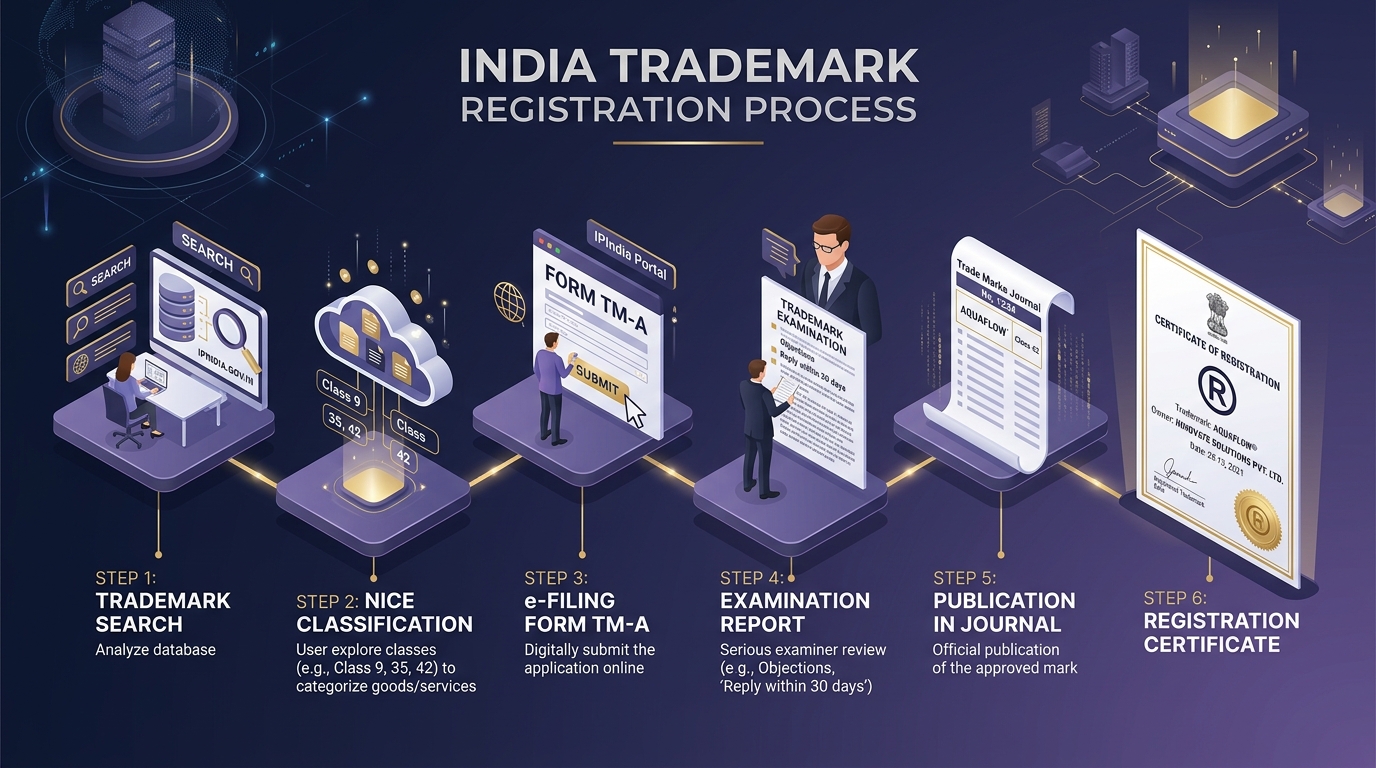
The Indian registration workflow moves through clear statutory milestones designed to confirm brand distinctiveness and protect the legitimate rights of earlier mark holders.
Comprehensive Trademark Search & Availability Assessment
Before spending resources on filing, applicants must conduct a comprehensive availability search on the official Trade Marks Registry database and leverage tools like afree AI powered trademark search. Searching must go beyond exact character matches to identify phonetic equivalents, visual resemblances, and conceptual similarities under Section 11 of the Trade Marks Act, 1999.
An effective search covers registered marks, pending applications, marks under opposition, and abandoned records across target classes and related industries. To conduct initial queries, use the dedicatedtrademark search toolor follow our practical guide onhow to search for existing trademark.
Classification of Goods and Services (Nice Classification)
Trademarks in India are categorized under 45 distinct classes as established by the international Nice Agreement. Classes 1 through 34 encompass physical manufactured goods (such as electronics, apparel, pharmaceuticals, and packaged foods), while Classes 35 through 45 cover services (including software consulting, retail operations, healthcare, and educational institutes).
Selecting incorrect classes can leave core commercial offerings unprotected or result in immediate objection. Use our interactivetrademark class finderto identify exact classifications and formulate comprehensive item specifications.
Document Compilation and User Affidavit Drafting
Accurate documentation is critical for smooth processing. Key requirements include:
- Constitutional Documents:Incorporation certificate, partnership deed, or PAN/Aadhaar of individual applicants.
- Class 3 Digital Signature Certificate (DSC):Required for online e-filing attorneys and authorized signatories.
- User Affidavit (Rule 25):If claiming historical use before filing, an affidavit affirming the continuous use date with exhibits (sales figures, GST invoices, marketing proofs) must be notarized.
- Form TM-48:Legal authorization authorizing trademark counsel to act before the registry.
Online E-Filing of Form TM-A on IP India Portal
Form TM-A is the single unified application form for trademark registration across goods and services. The application is uploaded through the official portal using a secure digital signature.
Once Form TM-A is submitted and the statutory fee is paid online, the system immediately generates an official Application Number and a stamped e-acknowledgment receipt.
Important Right:The moment your application number is issued, you are legally entitled to display theTMsymbol beside your brand mark, putting third parties on notice of your pending legal claim.
Examination by the Registry and Reply to Objections
A designated examiner at the Trade Marks Registry conducts an exhaustive substantive examination to verify whether the mark fulfills statutory criteria. The examiner scrutinizes the mark for:
- Absolute Grounds for Refusal (Section 9):Whether the mark is devoid of distinctive character, purely descriptive of goods/services, or customary in current trade language.
- Relative Grounds for Refusal (Section 11):Whether the mark is identical or deceptively similar to an earlier registered or pending trademark for identical or related goods/services.
If objections are raised, the examiner issues a formal Examination Report. The applicant must file a detailed legal written response within30 daysof receiving the report. If the written reply does not satisfy the officer, a show-cause hearing is scheduled. Learn more onhow to overcome trademark objections.
Publication in the Official Trade Marks Journal
When the examiner is satisfied by the written response or following a hearing, the trademark is formally “Accepted &. Advertised&rdquo. In the weekly Trade Marks Journal published on the officialIP India Portal.
Publication opens a statutory4-month opposition periodunder Section 21 of the Act. Any third party who believes the mark infringes their prior rights or harms fair competition can file a Notice of Opposition on Form TM-O. If no opposition is filed within 4 months, or if an opposition is resolved in favor of the applicant, the mark proceeds directly to final registration.
Issuance of Registration Certificate & Maintenance
Upon clearing the opposition period, the Registrar issues an electronically authenticated Trademark Registration Certificate bearing the seal of the Trade Marks Registry.
At this stage, you may officially replace the TM symbol with the registered®symbol. The certificate guarantees exclusive commercial rights nationwide, retroactive to the original date of application, valid for 10 years.
Protection can be preserved indefinitely through timelytrademark renewalsfiled every 10 years via Form TM-R.
Domestic Trademark Registration Stages, Timelines, and Fees
Below is a structured comparative breakdown of each operational stage in the Indian trademark lifecycle, detailing associated statutory forms, timelines, government fees, and primary legal standards.
| Process Stage | Statutory Form | Govt Fee (Individual/MSME) | Govt Fee (Company) | Typical Duration | Key Legal Standard |
|---|---|---|---|---|---|
| Pre-Filing Search | Internal / AI | Free / Nominal | Free / Nominal | 1–2 Days | Sections 9 & 11 relative conflict assessment |
| Online E-Filing | Form TM-A | ₹4,500 / class | ₹9,000 / class | Same Day | Trade Marks Rules 2017 formal compliance |
| Examination Review | Registry Exam | No additional fee | No additional fee | 1–3 Months | Inherent distinctiveness & prior citations |
| Objection Response | Reply / Form TM-M | Attorney costs only | Attorney costs only | Within 30 Days | Factual/legal counter-arguments & case law |
| Journal Publication | TM Journal | Included in filing | Included in filing | 4 Months (Fixed) | Section 21 public notice for 3rd party opposition |
| Certificate Issuance | Form TM-RG | Nil | Nil | 2–4 Weeks | Section 23 conclusive statutory grant |
| Decennial Renewal | Form TM-R | ₹9,000 / class | ₹9,000 / class | Every 10 Years | Section 25 maintenance & active commercial use |
Common Pitfalls and How to Avoid Them
A substantial percentage of trademark applications in India face administrative delays or refusal due to avoidable mistakes during initial drafting. Avoiding these pitfalls preserves legal rights and eliminates redundant expenses.
1. Selecting Descriptive or Generic Names
Attempting to register words that directly describe the function, quality, or characteristics of your product (such as “Best Cotton&rdquo. For garments or “Fast Delivery&rdquo. For courier services) attracts immediate Section 9(1)(a) objections. Favour coined, arbitrary, or suggestive marks.
2. Incorrect Class Selection
Filing in an inappropriate class or leaving out essential commercial activities means you hold no valid rights over your primary business vertical. Once filed, an application cannot be amended to add new classes; a fresh application must be submitted.
3. Inaccurate User Date Claims
Claiming continuous use from a historical date without solid documentary evidence (invoices, domain registration records, or tax receipts) will result in a show-cause notice. If evidence is unavailable, file on a “Proposed to be Used” basis.
4. Missing Statutory Deadlines
Failing to file an objection reply within the strict 30-day window causes the application status to change to “Abandoned”. While restoration is possible via Form TM-M, it involves substantial penalty fees and administrative complexities.
Post-Registration Rights and Renewal
Securing your official registration certificate transforms your brand from a vulnerable business asset into an enforceable, valuable piece of intellectual property.
As a registered proprietor, you hold exclusive legal rights under Section 28 of the Act to use the mark across India in connection with the goods and services for which it is registered. You can file civil infringement suits against unauthorized parties, obtain interim injunctions, claim damages or accounts of profit, and seek criminal action against counterfeiters under Sections 103 and 104 of the Act.
Furthermore, a registered trademark can be commercialized like any other capital asset: you can license it to franchisees for recurring royalties, assign it permanently via Form TM-P, or use it as collateral for corporate financing. Ensure you protect this asset by scheduling decennial renewals through Form TM-R before expiry.
Trademark Registration Checklist
- Run Clearance Search:Validate name and logo availability across classes 1–45 using government and AI tools.
- Map All Business Classes:Determine current product lines and anticipated expansions over the next 5 years.
- Secure Discount Certifications:Procure Udyam MSME Certificate or DPIIT Startup recognition to save 50% on fees.
- Draft User Affidavit:Prepare notarized evidence if claiming continuous prior commercial use in India.
- Submit Form TM-A:E-file through an authorized digital gateway and obtain the stamped application number.
- Monitor Registry Status:Track the status weekly to submit replies to examination reports within 30 days.
- Track 4-Month Opposition:Watch journal notifications until the certificate is signed and sealed.
Frequently Asked Questions
Q.What is the step-by-step process of trademark registration in India?
The process includes 7 core steps: preliminary trademark search, trademark classification (Classes 1–45), document compilation, online filing of Form TM-A on the IP India portal, examination by the Trade Marks Registry, publication in the Trade Marks Journal for 4 months, and issuance of the registration certificate if no opposition arises.
Q.How long does the entire trademark registration process take in India?
Under smooth conditions without objections or third-party oppositions, trademark registration typically takes between 6 to 12 months. If the examiner raises objections under Section 9 or 11, or if a third party files an opposition, the timeline may extend to 18 to 24 months.
Q.When can I legally start using the TM and (R) symbols?
You can start using the TM symbol immediately after successfully filing Form TM-A and receiving your official application number and acknowledgment receipt. The registered symbol (R) can only be used after the Registrar officially issues the final Trademark Registration Certificate.
Q.What documents are required to file a trademark application?
Required documents include the applicant's identity and address proof (PAN, Aadhaar, Certificate of Incorporation), the brand logo or wordmark specimen, user date affidavit if claiming prior usage, and a signed Power of Attorney (Form TM-48) authorizing an attorney or agent to represent you.
Q.What happens if the trademark examiner raises an objection?
The examiner issues an Examination Report detailing grounds of refusal under Section 9 (descriptiveness/distinctiveness) or Section 11 (similarity with existing marks). The applicant has exactly 30 days from the receipt date to file a comprehensive legal reply along with supporting evidence.
Q.What is the opposition period in trademark registration?
After an application is accepted, it is published in the weekly Trade Marks Journal. Third parties have a statutory window of 4 months from the publication date to oppose the mark under Section 21 if they believe it infringes on their prior rights or lacks legal merit.
Q.How much does trademark registration cost in India?
The official government e-filing fee for Form TM-A is ₹4,500 per class for individuals, startups, and MSMEs (with Udyam registration), and ₹9,000 per class for standard companies and other legal entities. Physical paper filing incurs higher fees (₹5,000 and ₹10,000 respectively).
Q.How long is a registered trademark valid in India?
A registered trademark in India is valid for 10 years from the original application filing date. It can be renewed indefinitely every 10 years by filing Form TM-R along with the prescribed renewal fee before or within the statutory grace period.
Final Strategic Advice
The trademark registration process in India is a disciplined legal journey that transforms your brand into a defensible corporate asset. By taking proactive steps—such as conducting thorough prior-art searches, categorizing goods accurately, and replying promptly to examiner reports—you position your enterprise for smooth approval and lasting market supremacy.
Whether you are an ambitious startup launching your inaugural product or an established business consolidating your IP portfolio, professional counsel ensures that every statutory requirement is met flawlessly. Check availability today and initiate your official application with complete confidence.
Protect Your Brand Identity Today
Partner with expert IP attorneys to handle your end-to-end trademark registration. From clearance search and Form TM-A filing to examination replies and final certificate issuance.
Dedicated IP Advocates • 100% Online Paperless Process • Transparent Fixed Pricing