
Written byRahul Roy
Trademark Research Specialist
Startup Trademark Registration Overview
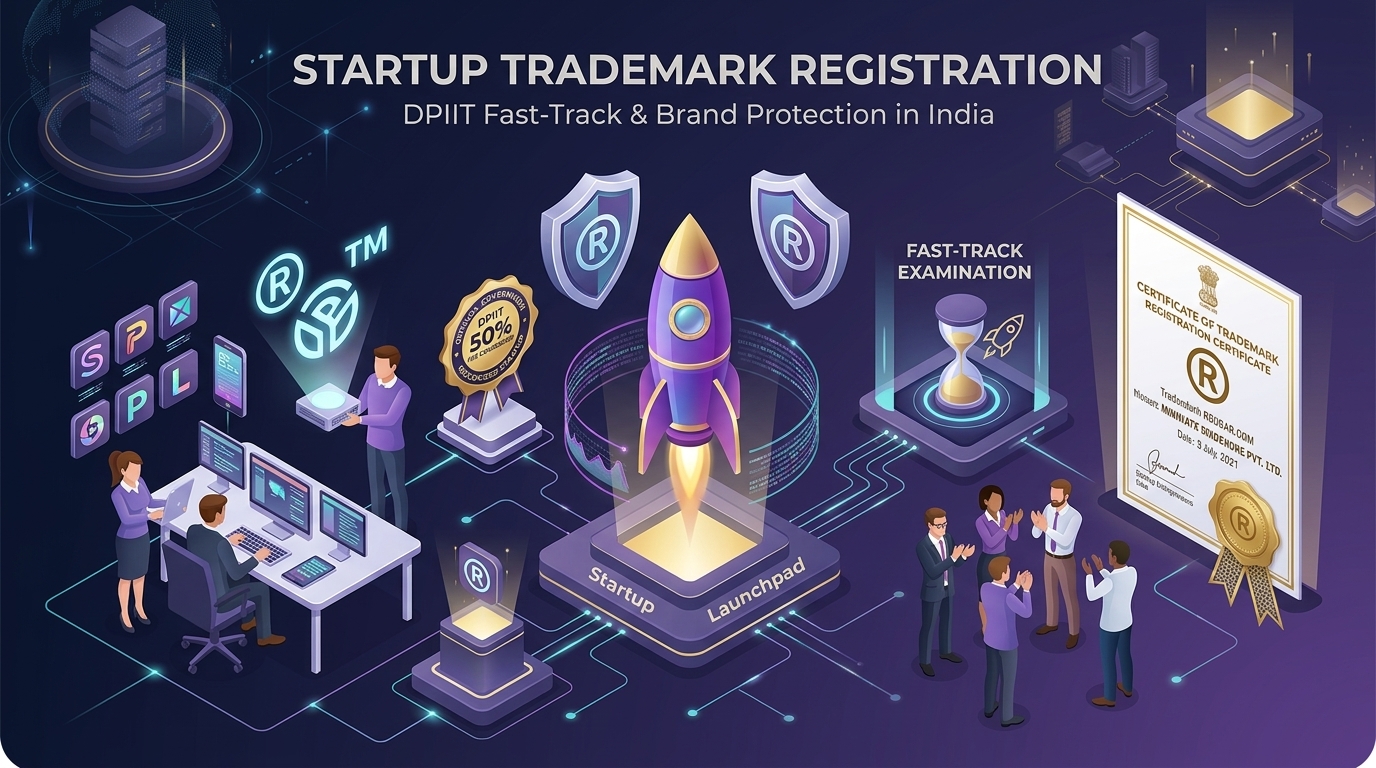
To register a trademark for your startup in India: (1) Conduct a trademark clearance search across Nice classes, (2) Claim startup status with DPIIT or MSME Udyam certificate for a 50% government fee concession (₹4,500 instead of ₹9,000 per class), (3) Draft and file Form TM-A online on the IP India gateway, (4) Request expedited examination under Rule 34 if eligible, (5) Respond to examination reports within 30 days, (6) Complete the 4-month Trade Marks Journal advertisement, and (7) Receive your 10-year registration certificate.
In the fast-moving startup ecosystem, founders often dedicate capital to product engineering, user acquisition, and hiring while leaving brand protection as an afterthought. However, intellectual property is one of the few intangible assets that appreciates in tandem with enterprise valuation. Without statutory trademark protection under the Trade Marks Act, 1999, a startup remains vulnerable to copycats, trademark squatters, and devastating re-branding demands right when scaling.
The Indian government actively fosters entrepreneurial innovation through the Startup India initiative. Under the Trade Marks Rules, 2017, recognized entities benefit from statutory concessions, including a 50% waiver on official government fees and priority access to expedited examination. Furthermore, through the SIPP (Scheme for Facilitating Start-Ups and Intellectual Property Protection), the Office of the Controller General of Patents, Designs and Trade Marks (CGPDTM) assists emerging ventures in securing exclusive rights efficiently.
Understanding the registration sequence ensures that founders avoid common traps such as descriptive naming, improper class mapping, or personal vs corporate ownership conflicts that can derail subsequent institutional fundraising rounds.
Startup Trademark Prerequisites & DPIIT Benefits
Before filing Form TM-A on the government portal, startup founders must organize foundational legal structures to secure statutory rebates and prevent administrative defects.
DPIIT Recognition or MSME Udyam
To claim the 50% government fee rebate (₹4,500 per class instead of ₹9,000), upload a valid DPIIT Startup Recognition Certificate or an MSME Udyam Registration Certificate along with Form TM-A.
Applicant Ownership Structure
Decide whether to file under the corporate entity (Private Limited / LLP) or under founder names. For VC-backed entities, filing directly under the incorporated company prevents complicated IP assignment transfers during due diligence.
Commercial User Date Assessment
Determine whether the mark is applied on a “Proposed to be Used” basis or with prior MVP/beta usage. Prior use requires a notarized Rule 25 User Affidavit with dated invoices, app store links, or domain receipts.
Brand Representation & Scope
Decide between a Word Mark (protects the text in any font or styling) or a Device/Logo Mark. Startups typically prioritize the Word Mark first for broad protection, followed by the mobile app icon and company logo.
7-Step Trademark Registration Process for Startups
The trademark registration roadmap for startups follows a disciplined sequence from pre-filing clearance to final certification. This ensures that the brand holds defensible value in front of customers, partners, and investors.
Comprehensive Trademark Clearance & Conflict Search
Before committing capital to marketing, domain acquisition, or app development, conduct an exhaustive availability search on the official Trade Marks Registry database. You can also use ourfree AI powered trademark searchto identify phonetic similarities, spelling variations, and visual resemblances that human keyword searches often miss.
The search must evaluate conflicts under Section 9 (distinctiveness) and Section 11 (relative similarity) across primary and related classes. For step-by-step guidance on public registry records, consult our tutorial onhow to search for existing trademarkor run queries directly via thetrademark search tool.
Multi-Class Mapping for Tech, D2C, and Platforms
Under the Nice Classification system, trademarks are registered across 45 classes (1–34 for goods, 35–45 for services). Startups often make the mistake of filing under only one class, leaving their core commercial activities completely exposed.
For instance, a tech or SaaS startup typically requires protection underClass 9(downloadable software, mobile applications) andClass 42(cloud hosting, software-as-a-service, platform architecture). A direct-to-consumer (D2C) brand often requiresClass 35(online marketplace and retail services) in addition to specific product classes.
To determine your startup's precise classification breakdown, explore our interactivetrademark class finder.
DPIIT Recognition Verification & Document Drafting
To capture the 50% statutory fee discount and qualify for fast-track review, compile the necessary verification documents:
- DPIIT Certificate / Udyam Certificate:Official proof of startup recognition for fee concessions.
- Company Constitutional Records:Certificate of Incorporation, Memorandum of Association (MOA), or LLP Agreement.
- Rule 25 User Affidavit:Notarized affidavit supported by exhibits (invoices, social media launch posts, beta analytics) if claiming prior use.
- Form TM-48 (Power of Attorney):Stamped legal authorization empowering your trademark attorney or agent to represent the startup before the registry.
Online E-Filing of Form TM-A & TM Symbol Rights
Form TM-A is submitted electronically through the IP India gateway using a Class 3 Digital Signature Certificate (DSC). The government fee is processed instantly at the concessional rate of ₹4,500 per class.
Upon successful transmission, the portal generates an official Application Number along with a time-stamped filing receipt.
Startup Milestone:From the moment your application number is generated, your startup is legally authorized to display theTMsymbol on your website, app store listing, pitch decks, and packaging, deterring prospective competitors.
Rule 34 Expedited Examination & Objection Response
Under Rule 34 of the Trade Marks Rules, 2017, recognized startups can request expedited examination by submitting Form TM-M. Instead of waiting 6 to 12 months for the initial examination report, expedited applications are reviewed in a matter of weeks. Learn more about thefast-track trademark registrationroute.
If the examiner raises objections under Section 9 (distinctiveness) or Section 11 (conflict with earlier marks), an Examination Report is issued. The startup has exactly30 daysto file a comprehensive written response.
A robust reply highlights phonetic differences, commercial distinctions, and acquired reputation to secure acceptance. Review our detailed guide onhow to overcome trademark objections.
Trade Marks Journal Publication & 4-Month Opposition Watch
Once the examiner accepts the application, the mark is advertised in the weekly Trade Marks Journal on the officialIP India Portal.
Publication triggers a statutory4-month opposition windowunder Section 21. Third parties who believe the mark encroaches on their prior rights can file a Notice of Opposition (Form TM-O). If no opposition is filed, or if an opposition is decided in the applicant's favor, the application proceeds to final registration.
Certificate Issuance, Corporate Assignment & Maintenance
After clearing the opposition period, the Registrar issues an electronically authenticated Trademark Registration Certificate bearing the seal of the Trade Marks Registry.
You can now replace the TM symbol with the prestigious registered®symbol. If the mark was originally filed in the personal name of a founder, execute a formal IP Assignment Agreement transferring all rights to the corporate entity via Form TM-P to satisfy investor due diligence.
Trademark protection is valid for 10 years from the date of application and can be preserved indefinitely through decennialtrademark renewalsvia Form TM-R.
Startup Trademark Timelines, Costs & Fast-Track
Review the structured breakdown of the startup trademark lifecycle, highlighting statutory forms, government filing fees with startup concessions, standard durations, and fast-track expedited options.
| Process Stage | Statutory Form | Startup Govt Fee | Standard Corporate Fee | Standard Duration | Rule 34 Fast-Track |
|---|---|---|---|---|---|
| Clearance Search | AI / Registry Search | Free / Advisory | Free / Advisory | 1–2 Days | Immediate |
| Online E-Filing | Form TM-A | ₹4,500 / class | ₹9,000 / class | Same Day | Same Day |
| Registry Examination | Registry Review | No extra fee | No extra fee | 6–12 Months | 1–3 Months |
| Objection Response | Written Reply / TM-M | Attorney costs only | Attorney costs only | Within 30 Days | Within 30 Days |
| Journal Publication | TM Journal | Included in filing | Included in filing | 4 Months (Fixed) | 4 Months (Fixed) |
| Certificate Issuance | Form TM-RG | Nil | Nil | 2–4 Weeks | 1–2 Weeks |
| Decennial Renewal | Form TM-R | ₹9,000 / class | ₹9,000 / class | Every 10 Years | Every 10 Years |
Common Startup Trademark Pitfalls & Solutions
Startup founders face unique operational pressures that can lead to strategic mistakes during trademark filing. Avoid these common traps to safeguard your intellectual property and capital.
1. Filing in the Founder's Personal Name Without Assignment
Founders often file trademarks personally before company incorporation. However, institutional investors require all IP to reside strictly within the corporate balance sheet. Failing to execute a formal IP Assignment Agreement (Form TM-P) can stall funding rounds and create co-founder equity disputes.
2. Choosing Descriptive or Generic Brand Names
Startups frequently choose literal names to explain what their product does (e.g., “FastDeliver” or “EasyTax”). The Trade Marks Registry refuses descriptive marks under Section 9(1)(a). Instead, opt for coined words (e.g., Swiggy, Zerodha) or suggestive marks that build distinctive brand equity.
3. Inadequate Multi-Class Coverage
Modern digital products rarely fit into a single category. Filing an e-commerce platform only under Class 35 leaves mobile app code (Class 9) and SaaS infrastructure (Class 42) unprotected against copycats. Map your product roadmap across all operational categories.
4. Missing the 30-Day Objection Response Window
If the registry issues an Examination Report, founders have strictly 30 days to file a legal reply. Missing this statutory deadline results in the application being marked “Abandoned”, forfeiting priority filing dates and government fees.
Trademark Rights, Fundraising & Valuation for Startups
Securing a registered trademark transforms your brand from an unprotected marketing label into an enforceable corporate asset that enhances balance sheet strength and investor confidence.
Under Section 28 of the Trade Marks Act, 1999, registration grants exclusive commercial monopoly rights across all Indian states and Union Territories. Registered owners can enforce civil infringement actions, seek interim court injunctions, claim statutory damages, and initiate criminal anti-counterfeiting proceedings under Sections 103 and 104 of the Act.
During seed, Series A, and growth funding rounds, venture capital firms conduct rigorous IP due diligence. Having a registered trademark or pending application with clean corporate ownership demonstrates regulatory maturity and defensible market moat. Furthermore, registered trademarks can be monetized through licensing, franchise agreements, and commercial assignment.
Startup Trademark Registration Checklist
- Conduct Deep Clearance Search:Verify brand name and logo across primary and adjacent Nice classes using AI and registry databases.
- Secure DPIIT / Udyam Certification:Obtain your official recognition certificate to claim the 50% government fee concession.
- Map Multi-Class Strategy:Cover immediate core products and anticipated tech or digital expansions over a 3 to 5 year horizon.
- Establish Clean Corporate Ownership:File under the incorporated entity or execute an IP assignment agreement for investor due diligence.
- Submit Form TM-A with User Proofs:E-file through the official gateway and immediately begin using the TM symbol.
- Leverage Rule 34 Fast-Track:Apply for expedited examination to shorten the registry review cycle from months to weeks.
- Monitor 4-Month Opposition Window:Track journal publications until the final registration certificate is officially issued.
Frequently Asked Questions
Q.Can an early-stage startup register a trademark before incorporation?
Yes. Founders can file Form TM-A in their individual names as proprietors on a 'Proposed to be Used' basis before incorporating a Private Limited Company or LLP. Once incorporated, the pending application or registered mark can be formally assigned to the corporate entity via Form TM-P with a nominal stamp duty.
Q.What government fee concession do DPIIT-recognized startups receive?
Under Rule 11 of the Trade Marks Rules, 2017, recognized startups with a valid DPIIT Certificate of Recognition and MSMEs with Udyam registration receive a 50% discount on official government filing fees, paying ₹4,500 per class for online e-filing instead of the standard ₹9,000 corporate fee.
Q.How does fast-track examination work for startups in India?
Under Rule 34 of the Trade Marks Rules, 2017, DPIIT-recognized startups are eligible for expedited examination. By submitting an expedited request along with the prescribed fee, the registry issues the examination report within a few working weeks rather than the typical 6 to 12 months.
Q.Which trademark classes should a tech or SaaS startup file under?
Tech and SaaS startups typically file in multiple classes: Class 9 for downloadable software, mobile apps, and digital algorithms. Class 42 for cloud computing, software as a service (SaaS), and technical consulting. And Class 35 if running an e-commerce platform, marketplace, or advertising portal.
Q.When can a startup begin using the TM and registered symbols?
A startup can display the TM symbol immediately after e-filing Form TM-A and receiving the official government application number. The registered circle-R symbol can only be legally displayed after the Trade Marks Registry officially issues the final Trademark Registration Certificate.
Q.Why do venture capital investors insist on trademark registration during due diligence?
Investors perform IP due diligence to confirm that brand equity, domain names, and core technologies are legally owned by the company rather than individual founders or vulnerable to third-party infringement claims. An unregistered brand poses severe legal and valuation risks for fundraising rounds.
Q.What is the SIPP scheme for startup trademark registration?
The Scheme for Facilitating Start-Ups and Intellectual Property Protection (SIPP) provides startups with access to government-empaneled IP facilitators who draft and prosecute trademark applications with advisory fees disbursed directly by the government, meaning startups only pay the statutory official fee.
Q.What should a startup do if its trademark application faces an objection?
If the registry issues an Examination Report citing Section 9 (distinctiveness) or Section 11 (similar existing marks), the startup must submit a formal legal response within 30 days. The reply must present legal precedents, distinct commercial evidence, and user affidavits to clear the objection.
Strategic Brand Protection for Startup Growth
Registering a trademark for your startup is more than a defensive compliance checklist. It is a foundational business milestone that solidifies your enterprise value, builds competitive moats, and protects investor capital.
By capitalizing on Startup India incentives—including the 50% government fee concession, SIPP facilitation, and Rule 34 fast-track examination—founders can secure institutional-grade brand protection without burning limited runway. Check your brand availability today and file with seasoned IP attorneys.
Protect Your Startup Brand Identity Today
Partner with expert IP attorneys to file Form TM-A with DPIIT 50% fee concessions, comprehensive multi-class mapping, expedited examination, and investor-ready IP structuring.
DPIIT Recognition Assistance • 100% Online Paperless Process • SIPP Facilitation