
Written byRahul Roy
Trademark Research Specialist
Overview of Word Marks and Device Marks
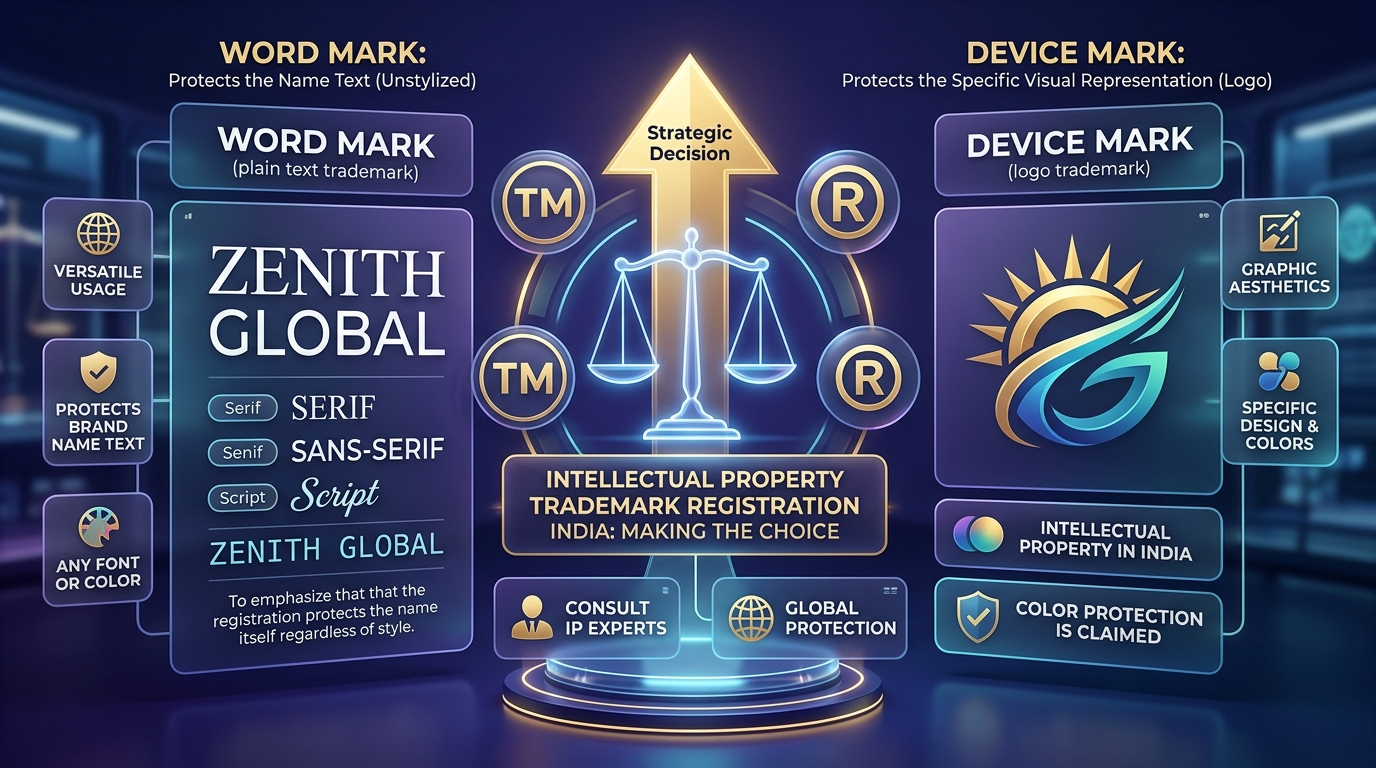
A Word Mark protects the textual name itself in plain typography across all fonts, sizes, and colors. This provides the broadest legal monopoly under the Trade Marks Act, 1999. A Device Mark protects a specific visual logo, stylized graphic, emblem, or label layout. In most business scenarios, founders should register a Word Mark first to secure complete naming exclusivity, followed by a Device Mark once the visual branding is finalized.
Under Section 2(1)(m) of the Trade Marks Act, 1999, a “mark” is defined comprehensively to include adevice, brand, heading, label, ticket, name, signature, word, letter, numeral, shape of goods, packaging or combination of colours or any combination thereof. When an enterprise files Form TM-A with the Indian Trade Marks Registry, it must designate the specific category of mark being claimed.
This initial classification dictates the scope of legal protection. It determines enforcement powers during infringement litigation under Section 29. It also governs the Anti-Dissection Rule under Section 17, and whether future visual redesigns require fresh registration. Understanding the legal anatomy of each mark type is vital before initiating the officialtrademark registration process.
What is a Word Mark in Trademark Law?
AWord Markconsists exclusively of standard characters—letters, words, numbers, or standard typographical symbols—without any claim to stylized lettering, specific fonts, graphical shapes, embellishments, or colors.
When you file a Word Mark on Form TM-A, the Registry records the plain string of characters. This provides the applicant with an expansive legal shield:
Font and Layout Neutrality
Your exclusive ownership applies regardless of whether your brand name is written in Arial, Times New Roman, cursive script, bold uppercase, or lowercase typography.
Complete Color Independence
Under Section 10 of the Trade Marks Act, an unconditioned Word Mark is deemed registered for all colors. This prevents rivals from simply adopting your name in alternate color palettes.
Broadest Infringement Protection
In an infringement suit under Section 29, you only need to demonstrate phonetic, textual, or conceptual similarity without getting bogged down by graphic differences.
Future-Proof Rebranding
You can update your visual logo, application icon, website theme, and packaging design dozens of times over 10 years without requiring a new filing.
Iconic Real-World Examples:Global and domestic market leaders such asGOOGLE,TATA,INFOSYS,FLIPKART, andNIKEhold registered Word Marks. When Google refreshed its corporate typeface from serif Catull to custom sans-serif Product Sans in 2015, its underlying Word Mark registration remained completely intact.
What is a Device Mark in Trademark Law?
ADevice Markincludes any visual, graphic, or artistic representation. In trademark registry parlance, device marks encompass standalone artistic logos, symbols, stylized lettering, composite labels, monograms, and geometric emblems.
When a Device Mark is filed, the Registry examines it under theVienna Classification (Vienna Agreement), assigning specific Vienna Codes to categorize visual elements such as crowns, animals, geometric figures, human silhouettes, or celestial bodies.
Sub-Types of Device Marks in Indian Practice:
- Pure Figurative Logos:Standalone visual symbols with zero text (e.g., Apple's bitten apple silhouette, Nike's Swoosh symbol, Mercedes-Benz three-pointed star).
- Stylized Typography / Word Logos:Words represented in a stylized, hand-crafted font or distinctive lettering arrangement (e.g., Coca-Cola Spencerian script, Disney cursive signature).
- Composite / Combined Marks:Graphic emblems integrated together with brand text, taglines, and background geometric frames into a unified label layout.
Device Marks are indispensable when the graphic identity itself creates instantaneous visual recognition in the marketplace, or when a brand name has low inherent distinctiveness and requires artistic styling to pass examination under Section 9.
Word Mark vs Device Mark Comparison
The table below highlights the statutory, procedural, and commercial distinctions between Word Marks, Device Marks, and Composite Marks in India:
| Feature / Parameter | Word Mark (Plain Text) | Device Mark (Logo / Graphic) | Composite Mark (Word + Logo) |
|---|---|---|---|
| Scope of Legal Rights | Broadest; monopolizes textual string across all styles | Specific; protects visual graphics and styling | Combined whole; limited standalone word protection |
| Font & Color Flexibility | 100% Flexible (Any font/color) | Restricted to visual design filed | Restricted to exact combined layout |
| Rebranding Resilience | Permanent; no re-filing needed | Requires fresh Form TM-A on redesign | Requires fresh Form TM-A on redesign |
| Overcoming Sec 9 Objections | Harder if word is weakly suggestive | Easier due to graphical distinctiveness | Easier due to visual styling |
| Search Methodology | Textual & Phonetic Search | Vienna Classification Search | Textual + Vienna Code Search |
| Amazon Brand Registry | Optimal across all product listings | Supported for stylized logos | Accepted if text matches exactly |
| Government Filing Cost | ₹4,500 (Startup/MSME) / ₹9,000 | ₹4,500 (Startup/MSME) / ₹9,000 | ₹4,500 (Startup/MSME) / ₹9,000 |
The Anti-Dissection Rule and Section 17
Many business owners mistakenly believe that registering a combined logo containing their brand name gives them independent legal ownership over both the logo and the name. Under Indian trademark jurisprudence, this assumption is legally flawed due to theAnti-Dissection Rulecodified under Section 17 of the Trade Marks Act, 1999.
Statutory Mandate: Section 17(1) & (2)
Section 17(1):When a trade mark consists of several matter, its registration shall confer on the proprietor the exclusive right to the use of the trade mark taken as a whole.
Section 17(2):Subject to sub-section (1), the registration thereof shall not confer any exclusive right in the matter forming only a part of the whole of the trade mark so registered, unless separate applications are made under Section 15 for each distinct part.
The Judicial Principle:In seminal judgments includingSouth India Beverages Pvt. Ltd. V. General Mills Marketing Inc.andCadila Healthcare Ltd. V. Cadila Pharmaceuticals Ltd., the Supreme Court and Delhi High Court affirmed that while commercial courts must evaluate marks as a composite whole without artificial dissection, an exception exists under theDominant Feature Doctrine.
However, proving that a specific word in a composite mark is the “dominant feature&rdquo. During an injunction hearing requires substantial documentary proof of acquired goodwill, commercial turnover, and advertising spend. If you hold only a composite registration, a competitor who uses your word in a totally different font or color might avoid an ex-parte interim injunction.
Which Trademark Should You File First?
To determine whether your enterprise should prioritize a Word Mark, a Device Mark, or a Composite Mark, evaluate your brand against this 3-factor strategic matrix:
Unique, Coined, or Arbitrary Brand Names
If your brand name is inherently distinctive (e.g., invented words likeKODAKor arbitrary words likeAPPLEfor computers),always file a Word Mark first.
Why:It secures the widest possible legal moat over the name in the relevant Nice class. You can design, tweak, and rebrand logos freely without losing priority.
Descriptive, Common, or Weak Brand Names
If your brand name contains dictionary terms, geographic identifiers, or words describing the goods/services (e.g., “Speedy Couriers&rdquo. Or “Fresh Farm Organics”), a plain Word Mark application will likely face Section 9 absolute grounds objections.
Why:A stylized Device Mark adds visual artistic distinctiveness, helping the application sail through Registry examination. Once market goodwill is established over 2–3 years, you can file the Word Mark claiming acquired distinctiveness.
Early Bootstrapped Startups with Constrained Capital
If funding permits only a single application filing fee (₹4,500 govt fee for MSME/Startup), filing a composite mark (logo containing the brand name) provides a practical immediate balance.
Caveat:Commit to keeping that exact logo design locked for at least 3–5 years until cash flow allows filing independent Word and Logo registrations.
Rebranding and Font Flexibility Impact
Modern high-growth companies frequently modernize their brand identity as they scale. Understanding how trademark registrations respond to brand evolutions prevents catastrophic loss of trademark rights:
When You Own a Word Mark:
- Change fonts from serif to sans-serif freely.
- Switch brand colors across marketing seasons.
- Redesign app icons and web UI elements without filing.
- Unbroken priority date preserved from Day 1.
When You Only Own a Device Mark:
- Substantial logo alteration leaves the new mark unregistered.
- Old registration becomes vulnerable to non-use cancellation under Section 47.
- Must file fresh Form TM-A for each redesigned logo version.
- Requires new government and professional legal fees.
Case Example:When Starbucks evolved its green Siren emblem over 40 years—removing the outer black circle and text in 2011—it filed new Device Marks for each evolution. However, its coreSTARBUCKSWord Mark registration remained unbroken since its founding. This ensures perpetual protection across all beverage classes.
Amazon Brand Registry & Online Selling
For D2C founders, marketplace sellers, and e-commerce brands, securing trademark protection is the mandatory prerequisite for enrolling inAmazon Brand Registry India, Flipkart Brand Protection, and Meta Commerce Manager.
Why Word Marks Perform Better on Amazon:
1. Automated Buy Box & ASIN Protection:Amazon's brand algorithms match textual brand names on product listing titles, backend search terms, and manufacturer metadata. A registered Word Mark aligns 100% with these automated matching engines.
2. Preventing Counterfeiter Font Variations:Counterfeit sellers often replicate brand names using slightly altered fonts or custom color schemes. A Word Mark empowers you to instantly execute Report a Violation (RAV) takedowns regardless of styling.
3. Flexible Product Packaging:Physical packaging must display the brand name permanently affixed. With a Word Mark, you can print the name in any modern packaging style without risking brand registry mismatch rejections.
Strategic 4-Stage Founder Filing Roadmap
Follow this proven 4-stage intellectual property roadmap designed by experienced trademark attorneys to maximize legal protection while optimizing compliance budgets:
Comprehensive Textual & Vienna Trademark Search
Before committing to a brand name or spending thousands on agency logo designs, conduct a rigoroustrademark searchacross the IP India portal.
Search both textual wordmarks and Vienna Classification codes in your relevanttrademark classesto ensure no conflicting prior marks exist under Section 11.
File Primary Word Mark Application (Form TM-A)
Submit your initial trademark application for the plain text Word Mark under your primary goods or services classes. This locks in your nationwide priority date immediately.
Upon receiving your official application number receipt, you can immediately begin displaying theTM symbolalongside your brand name.
File Secondary Device Mark (Logo & Icon)
Once your visual brand guidelines, mobile app icon, packaging artwork, or primary logo design are finalized, file a separate Device Mark application.
This prevents competitors from launching visually deceptive lookalike packaging or confusingly similar graphical icons under different names.
Series Marks & Madrid Protocol Filing
As your company expands into international markets, use your registered Indian Word Mark as the base application to file forinternational trademark registrationunder the Madrid Protocol across the US, UK, EU, UAE, and Singapore.
Maintain active docketing for decennial renewals under Section 25 to ensure your brand exclusivity remains perpetual throughtrademark renewalfilings.
Trademark Filing Decision Checklist
- Assess Inherent Distinctiveness:Evaluate whether your brand name is coined, arbitrary, suggestive, or descriptive on the Abercrombie spectrum.
- Perform Comprehensive Search:Verify both phonetic spelling matches and Vienna classification codes on IP India portal.
- Prioritize Word Mark Filing:File the plain text Word Mark first to establish broadest nationwide monopoly across all fonts.
- File Device Mark for Distinct Visuals:Secure independent protection for standalone logos, app icons, and unique emblems.
- Claim MSME / Startup 50% Subsidy:Ensure you leverage Udyam or DPIIT recognition to pay ₹4,500 instead of ₹9,000 statutory fee.
- Avoid Sole Reliance on Composite Marks:Do not rely exclusively on a composite logo mark if standalone word protection is critical.
- Execute Form TM-48 with Certified Attorney:Retain experienced IP advocates to handle examination reports and hearings.
Frequently Asked Questions
Q.What is the main difference between a Word Mark and a Device Mark in India?
A Word Mark protects the text, name, letters, or numerals of a brand in plain standard typography. This grants exclusive ownership over the wording regardless of font, size, color, or design. A Device Mark protects a specific visual representation, including stylized graphics, logos, emblems, label layouts, or unique typography. Word Marks provide broader legal protection against confusingly similar names, while Device Marks protect unique visual branding.
Q.Should a startup register a Word Mark or a Device Mark first?
In approximately 90% of cases, startups should register a Word Mark first. A Word Mark secures the broadest legal monopoly over the core brand name. This allows the company to redesign fonts, logos, packaging, and marketing materials over time without losing statutory protection. However, if the brand name is relatively descriptive or weak, registering a distinctive Device Mark (logo) first can help overcome Section 9 objections.
Q.What is the Anti-Dissection Rule under Section 17 of the Trade Marks Act?
Under Section 17 of the Trade Marks Act, 1999, registration of a composite trademark (containing both word and logo elements) confers exclusive rights to the trademark taken as a whole, and not separately to individual components. Unless a proprietor files a separate registration for the word mark under Section 15 or proves the word is an independently dominant feature, infringing third parties might copy the brand name without copying the exact graphic layout.
Q.If I register a Word Mark, does it protect my brand in all fonts, cases, and colors?
Yes. When you register a standard character Word Mark with the Indian Trade Marks Registry, the legal monopoly extends to the literal word itself across all visual representations—whether written in uppercase, lowercase, serif, sans-serif, neon colors, or black-and-white. Competitors cannot use identical or phonetically similar text even if they display it in completely different fonts or graphics.
Q.If I register a Device Mark (logo with text), is my brand name automatically protected?
Not necessarily. Registering a Device Mark protects the artistic composition and graphic layout as a single composite unit. If a competitor uses your brand name in plain text or in a different logo style, pursuing a statutory trademark infringement claim becomes legally complex under Section 17. You may be forced to rely on the higher evidentiary burden of common-law passing off.
Q.How does rebranding or updating a logo affect Word Marks and Device Marks?
If you own a registered Word Mark, rebranding your visual identity (such as modernizing your logo or changing corporate colors) requires no new trademark filing, as the underlying name remains fully protected. Conversely, if you only registered a Device Mark and modify your logo significantly, your existing registration will not cover the new design. This requires a fresh trademark application on Form TM-A.
Q.Which trademark type is best for Amazon Brand Registry enrollment in India?
Amazon Brand Registry accepts both Word Marks and Device Marks (with text). However, a Word Mark is strongly recommended because it seamlessly matches textual brand attributes across Amazon search algorithms, listing titles, ASIN catalogs, and backend seller identifiers. This prevents hijackers from exploiting textual variations.
Q.Can I file both Word Mark and Device Mark together in a single application?
You can file a combined 'Composite Mark' application (submitting a graphic logo containing your brand text) under a single statutory government fee. However, doing so protects the mark strictly as a combined whole. To secure independent legal exclusivity over both the standalone brand name and the standalone logo graphic, legal practitioners advise filing two separate Form TM-A applications.
Strategic Legal Guidance
Building a durable brand requires safeguarding both what customers hear (your brand name) and what customers see (your visual logo). While budget constraints often require a staged approach, securing yourWord Mark firstprovides the strongest foundational shield for any commercial enterprise in India.
As your startup grows, complement your word mark with dedicated device mark registrations to construct an impenetrable dual-layer intellectual property fortress. Consult certified trademark attorneys at IPR Karo to review your brand portfolio and formulate a customized filing roadmap today.
Protect Your Brand Name & Logo Today
Partner with expert IP attorneys to choose the right trademark filing strategy. From clearance search and Form TM-A filing to Section 9/11 objection handling and final registration certificate issuance.
Certified IP Advocates • 50% Startup Government Fee Subsidy • Same-Day Filing Receipt