
Written byRahul Roy
Trademark Research Specialist
Understanding Trademark Classes in India
In India, brand registration operates under the internationalNice Classificationsystem, comprising45 discrete trademark classes: Classes 1 through 34 categorize physical manufactured goods (such as cosmetics in Class 3, pharmaceuticals in Class 5, electronics and software in Class 9, and apparel in Class 25), while Classes 35 through 45 cover services (such as retail/e-commerce in Class 35, fintech/financial services in Class 36, education in Class 41, and software development in Class 42).
Under theTrade Marks Rules, 2017, the Trade Marks Registry consolidated all previous filing forms (such as TM-1, TM-2, TM-3, and the old multi-class Form TM-51) into a single unifiedForm TM-A. When submitting Form TM-A on the IP India e-filing portal, applicants can choose between two fundamental filing architectures:
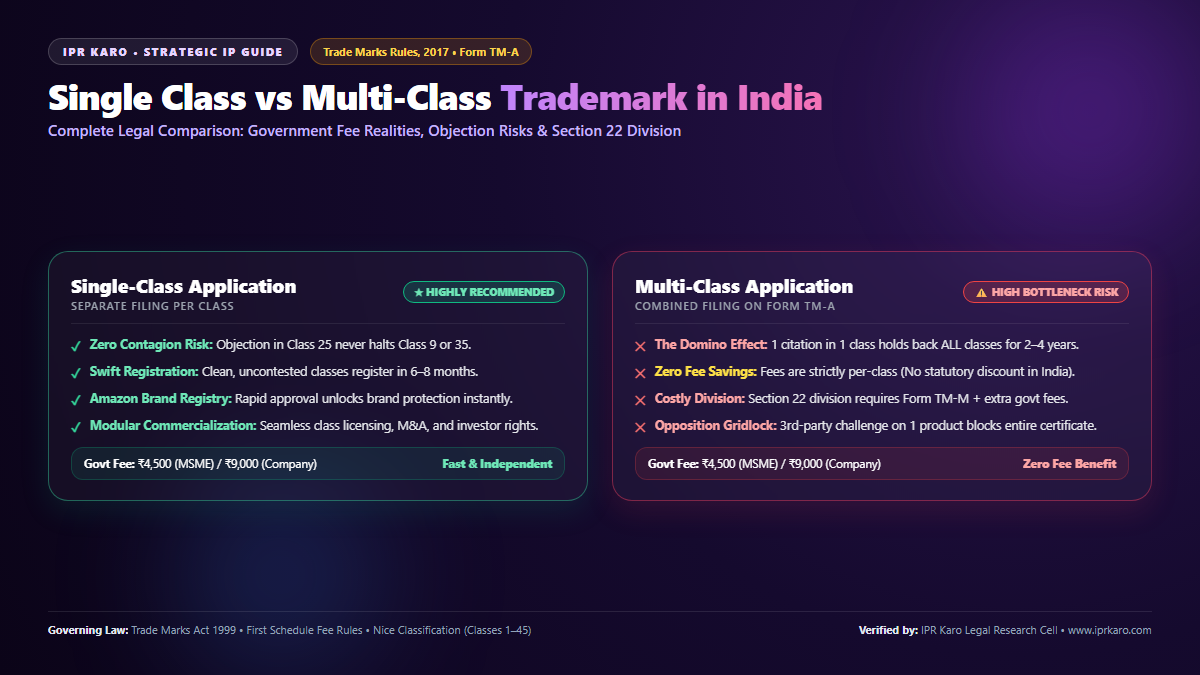
Single-Class Application
A dedicated application filed forone specific Nice class. Each filing receives its own unique 7-digit trademark application number, independent examination report, separate journal publication, and standalone registration certificate.
Multi-Class Application
A single consolidated application coveringtwo or more Nice classesunder a single 7-digit trademark application number. All classes are examined collectively, advertised together in the Trade Marks Journal, and granted a single master certificate.
The Government Fee Myth Debunked
The single most pervasive misconception among startup founders, D2C entrepreneurs, and business owners in India is the belief that"filing a multi-class trademark is cheaper than filing individual applications."
Statutory Fact Under Trade Marks Rules, 2017
The official government filing fee under the First Schedule of the Trade Marks Rules, 2017 is chargedstrictly per class. There isZERO statutory discountor government fee waiver for combining multiple classes into one Form TM-A.
Whether you file three separate single-class applications or one multi-class application covering three classes, the statutory fee payable to the Trade Marks Registry is identical:
| Applicant Category | Govt Fee (1 Class) | 3 Single-Class Applications | 1 Multi-Class (3 Classes) | Govt Fee Difference |
|---|---|---|---|---|
| Individual / Startup / MSME (Udyam) | ₹4,500 | 3 × ₹4,500 = ₹13,500 | ₹4,500 × 3 = ₹13,500 | ₹0 (Zero Savings) |
| Companies / LLPs / Large Enterprises | ₹9,000 | 3 × ₹9,000 = ₹27,000 | ₹9,000 × 3 = ₹27,000 | ₹0 (Zero Savings) |
| Physical Counter Filing (Non-Online) | ₹5,000 / ₹10,000 | 3 × ₹5,000 = ₹15,000 | ₹5,000 × 3 = ₹15,000 | ₹0 (Zero Savings) |
While some IP attorneys may offer marginal professional drafting discounts for a combined multi-class form due to reduced initial data entry, this minor upfront concession is heavily overshadowed by downstream legal costs if an objection or opposition arises.
Single Class vs Multi-Class Comparison
Evaluating the procedural, operational, and litigation differences between single-class and multi-class applications provides crucial clarity for long-term brand strategy:
| Evaluation Parameter | Single-Class Application | Multi-Class Application |
|---|---|---|
| Application Number & Tracking | Separate 7-digit application number per class | Single consolidated 7-digit application number |
| Official Government Fee | ₹4,500 (MSME) / ₹9,000 (Others) per class | ₹4,500 (MSME) / ₹9,000 (Others) per class (No discount) |
| Objection Impact (Sec 9 / Sec 11) | Isolated: Objections in Class A do not delay Class B or C | Contagion: Objection in any 1 class halts the entire application |
| Third-Party Opposition (Sec 21) | Only the contested class undergoes opposition hearings | Registration of all classes is blocked until opposition concludes |
| Registration Certificate Timeline | Uncontested classes register fast (6–8 months) | Delayed to match the slowest, contested class (2–5 years) |
| Unblocking Remedy (Section 22) | Not needed (applications are already separate) | Requires Form TM-M division + additional govt fees |
| Prior Use / User Affidavit (Rule 25) | Tailored user date & exhibits per product line | Single affidavit must reconcile differing class dates |
| Partial Assignment & Licensing | Seamless transfer of specific classes via Form TM-P | Complex class carve-out and division before transfer |
| 10-Year Renewal (Form TM-R) | Multiple renewal forms (can let weak classes lapse) | Single renewal form (₹9,000 per class total) |
| Madrid Protocol International Filing | Targeted basic registrations protect foreign rights | Central attack risk impacts all designated classes |
The Domino Effect: Multi-Class Risks
The legal phenomenon known as the"Domino Effect"or"Procedural Contagion"represents the single greatest vulnerability of multi-class trademark applications under the Trade Marks Act, 1999.
Real-World Scenario: The D2C Startup Dilemma
Imagine an omnichannel fashion brand named"VELVET OAK"filing a multi-class application covering three classes:
- Class 25:Ready-made clothing, footwear, and headgear.
- Class 9:Mobile e-commerce application and digital software.
- Class 35:Online retail store and marketplace services.
What Happens in a Multi-Class Filing:
During examination, the Trade Marks Examiner cites an earlier conflicting registration for "OAK APPAREL" in Class 25 under Section 11(1). Because the entire application shares one number, the status changes to"Objected"for all three classes. Even though Classes 9 and 35 have zero conflicts, the Trade Marks Registrycannot issue registration certificates for Class 9 or Class 35. The startup is blocked from enrolling inAmazon Brand Registryor executing investor warranties for up to 3 years while the Class 25 objection and hearing drag on.
Opposition Deadlock (Section 21)
If a competitor opposes your mark in just one product class after Trade Marks Journal publication, the opposition proceedings halt certificate issuance for every uncontested service class in that filing.
Commercial Stagnation
Without registered certificates for your clean classes, your business cannot issue formal legal notices, enforce rights against copycats, or license specific verticals to franchisees.
Section 22: Dividing an Application
When a multi-class application becomes stalled by an objection or opposition in a single class, the Trade Marks Act provides a statutory legal escape route:Division of Application.
UnderSection 22 of the Trade Marks Act, 1999read withRule 102 of the Trade Marks Rules, 2017, an applicant can file a formal interlocutory request onForm TM-Mto divide the initial multi-class application into two or more separate divisional applications.
The Hidden Costs of Section 22 Division
Additional Govt Fees
₹900 per divisional application for MSME / Individuals; ₹1,800 for Companies on Form TM-M.
Attorney Drafting Costs
Professional legal fees for drafting division requests, supporting affidavits, and representation.
Registry Delays
Processing Form TM-M division at the Trade Marks Registry typically takes 4 to 9 additional months.
The Strategic Reality:Filing a multi-class application to "save effort" often backfires. When an objection strikes, the applicant pays more in division fees, legal counsel charges, and administrative delays than if they had simply filed separate single-class applications on day one.
Pros & Cons of Single Class Filing
Filing individual, standalone trademark applications for each relevant Nice class is the gold-standard recommendation of experienced IP litigators across India. Here is a comprehensive breakdown of its merits and drawbacks:
Advantages (Pros)
- Zero Contagion Risk:An objection in Class 25 has zero legal effect on Class 9 or Class 35.
- Rapid Registration:Clean, uncontested classes receive registration certificates in as little as 6–8 months.
- Modular Commercialization:Seamlessly sell, license, or pledge specific classes to investors without dividing registrations.
- Class-Specific Prior Use:Easily attach distinct user affidavits and invoices matching true commercial launch dates per category.
- Selective Maintenance:If a product line is discontinued, you can simply let that specific class expire at renewal without altering other certificates.
Disadvantages (Cons)
- ✕Multiple Numbers to Track:Requires managing separate 7-digit application numbers and diary entries.
- ✕Multiple Certificates:Results in separate physical/digital registration certificates for corporate records.
- ✕Multiple Renewal Filings:Requires filing separate Form TM-R applications every 10 years (though statutory fee totals are identical).
Pros & Cons of Multi-Class Filing
Multi-class applications serve a specific purpose for certain enterprise brand owners. Understanding when this structure is advantageous—and when it poses severe risks—is essential:
Advantages (Pros)
- Unified Portfolio Tracking:Single 7-digit trademark application number across all registered classes.
- Single Registration Certificate:One master certificate enumerating all protected goods and services.
- Consolidated Renewals:Renew all classes simultaneously on a single Form TM-R every 10 years.
- Single Form TM-48:OnePower of Attorneycovers all classes in that application.
Disadvantages (Cons)
- ✕All-or-Nothing Delay:One citation or opposition halts certificate issuance for every single class.
- ✕Zero Govt Fee Discount:You pay the exact same ₹4,500/₹9,000 per class statutory rate.
- ✕Costly Application Division:Section 22 division on Form TM-M adds ₹900/₹1,800 plus legal fees.
- ✕Rigid Licensing & Assignment:Transferring one business unit to an acquirer requires complex register carving.
Strategic Decision Framework
To determine whether your enterprise should file single-class or multi-class applications on Form TM-A, apply this practical decision framework based on your business profile:
Early-Stage Startups & D2C Brands → File Single Class
If you sell across products (e.g. Clothing in Class 25) and services (e.g. E-commerce in Class 35), fileseparate single-class applications. Getting your Class 35 registration quickly allows you to enroll in Amazon Brand Registry, protect your domain, and secure investor funding without waiting for Class 25 clearance.
Different Commercial Launch Dates → File Single Class
If you began selling software in 2021 (Class 9) but launched consulting services in 2024 (Class 42), separate filings enable you to file preciseUser Affidavits (Rule 25)with clear, unclouded documentary proof for each class.
Conglomerates with Coined House Marks → File Multi-Class
Large corporate entities registering invented, highly distinctive coined words (e.g., "KODAK", "INFOSYS") across coordinated, non-contentious goods and services can leverage multi-class filings to minimize corporate docketing and manage a single master certificate.
Businesses Planning Future Spin-Offs or M&A → File Single Class
If you plan to sell one product line to an acquirer or raise vertical-specific venture funding, holding standalone single-class trademark certificates allows instantaneous assignment on Form TM-P without expensive registry division.
Frequently Asked Questions
Is a multi-class trademark application cheaper than filing single-class applications in India?↓
What is the biggest legal risk of filing a multi-class trademark application in India?↓
Can I separate or divide a stalled multi-class application into individual applications?↓
Which form is used for filing single-class and multi-class trademark applications on IP India?↓
How does trademark renewal work for a multi-class registration in India?↓
Can I transfer or assign only one class of a multi-class trademark to another company?↓
When is it recommended to file separate single-class trademark applications?↓
When does filing a multi-class trademark application make practical sense?↓
Can I claim different 'User Dates' (prior use) across different classes in a multi-class filing?↓
How does a multi-class Indian trademark affect international registration under the Madrid Protocol?↓
Strategic Advice & Action Plan
Protecting your brand across multiple business categories is essential for preventing competitor encroachment and securing market dominance. However, combining multiple classes into a single application creates severe legal vulnerabilities with zero government fee savings. For the vast majority of Indian businesses,filing separate single-class applications provides maximum legal protection, swift registration timelines, and uncompromised commercial agility.
Architect Your Multi-Class Brand Defense
Get comprehensive clearance searches across all 45 Nice classes, strategic Form TM-A classification, and end-to-end IP attorney representation with zero compliance errors.
Certified IP Advocates • Zero Hidden Costs • Same-Day Form TM-A E-Filing