
Written byRahul Roy
Trademark Research Specialist
Overview: Assignment vs Licensing
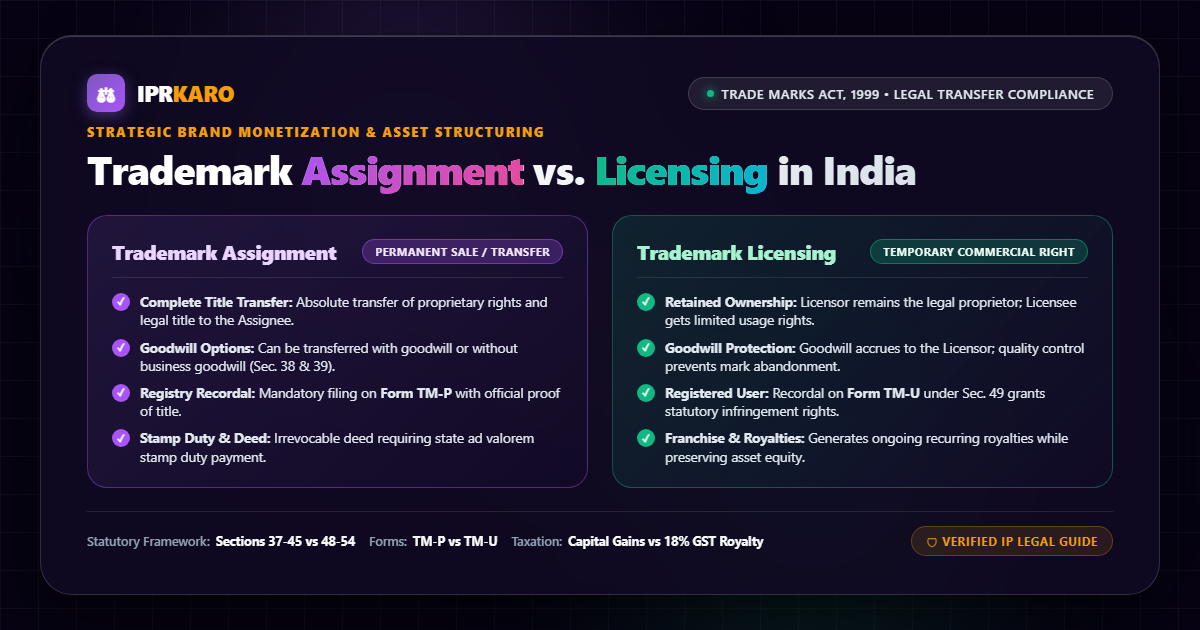
In India, trademark assignment is the complete and permanent sale of brand ownership, legal title, and goodwill from the assignor to the assignee under Sections 37 to 45 of the Trade Marks Act, 1999. This requires formal recording on Form TM-P. In contrast, trademark licensing is a temporary commercial authorization under Sections 48 to 54 permitting a licensee to use the mark while proprietary ownership, underlying equity, and goodwill remain strictly with the licensor, optionally recorded on Form TM-U as a Registered User.
A registered trademark represents far more than an artistic logo or a corporate name. It is an invaluable intangible commercial asset capable of being sold, pledged, mortgaged, franchised, or licensed. Under Indian intellectual property jurisprudence, brand proprietors frequently need to transfer rights during corporate mergers, acquisitions, venture capital financing rounds, joint ventures, and distribution agreements.
However, confusing anassignmentwith alicensecan trigger severe commercial and legal hazards. An inadvertent assignment permanently extinguishes the founder's title to the brand. Conversely, an improperly drafted license agreement lacking enforceable quality control covenants results in “naked licensing,&rdquo. Which can destroy the distinctiveness of the trademark and expose the registration to permanent rectification under Section 57.
Whether your organization is negotiating an asset buyout. This establishes a nationwide franchise network, or licensing software brand marks to subsidiaries, understanding the procedural mechanics under theTrade Marks Registry (CGPDTM)is mandatory to safeguard brand equity.
Trademark Assignment vs Licensing: Key Differences
To evaluate the structural, procedural, and commercial distinctions between trademark assignment and licensing under Indian law, review this comparative breakdown:
| Legal Parameter | Trademark Assignment | Trademark Licensing |
|---|---|---|
| Nature of Transfer | Permanent and absolute transfer of brand ownership and title (Sale). | Temporary, limited authorization to use the trademark (Lease / Permitted Use). |
| Governing Statutory Law | Sections 37 to 45, Trade Marks Act, 1999. | Sections 48 to 54, Trade Marks Act, 1999. |
| Statutory Form on IP India | Form TM-P (Application for change of registered proprietor). | Form TM-U (Application for registration as a Registered User). |
| Goodwill Allocation | Can be assigned either with goodwill or without goodwill. | Goodwill remains strictly with the Licensor; use by licensee accrues to owner. |
| Official Government E-Filing Fees | ₹9,000 per class (within 6 mos); escalating late surcharges apply. | ₹4,500 per mark per class for Registered User entry. |
| Quality Control Requirement | Not required; assignee obtains total editorial and production control. | Mandatory. Absence constitutes naked licensing, risking cancellation. |
| Right to Sue Infringers | Assignee steps into proprietor's shoes and can sue in their own name. | Only Registered Users under Sec. 52; unregistered licensees cannot (Sec. 53). |
| Stamp Duty Requirement | Ad valorem duty on consideration or goodwill value (State Stamp Acts). | Non-judicial stamp paper based on license tenure and royalty structure. |
| Taxation Framework | Capital Gains Tax (Sec. 55(2)(a) Income Tax Act) + 18% GST. | Revenue Income (Royalties) subject to TDS (Sec. 194J) + 18% GST. |
Trademark Assignment Under Section 37
Under Section 2(1)(b) of the Trade Marks Act, 1999, an“assignment”is defined as an assignment in writing by act of the parties concerned. It represents a permanent legal conveyance where the original brand owner (Assignor) completely divests all proprietary rights, title, and commercial interest in the trademark, transferring them unconditionally to the purchaser (Assignee).
Section 37 explicitly affirms the power of the registered proprietor to assign the trade mark and give effectual receipts for any consideration for such assignment. Once the assignment deed is finalized, the original owner ceases to possess any legal title to the mark and cannot subsequently restrict the assignee's use, alter its presentation, or demand royalties.
Complete Assignment
Transfers all rights, privileges, and exclusive ownership across all registered classes, goods, and commercial activities. The assignee assumes absolute ownership for all operational verticals without geographical reservations in India.
Partial Assignment
Transfers rights restricted to specific goods, services, or product categories. For instance, transferring a mark for clothing while retaining it for retail services, subject to statutory restrictions under Sections 40 and 41 to avoid public deception.
Before finalizing an assignment, the buyer must conduct due diligence by verifying the registry status on thetrademark application statusportal to ensure the mark is unencumbered, valid, and not facing rectification or non-use cancellation.
Assignment With vs Without Goodwill
Sections 38 and 39 of the Trade Marks Act, 1999 establish that both registered and unregistered trademarks are assignable eitherwith the goodwill of the businessorwithout the goodwill of the business. This distinction is critical in commercial valuation and procedural compliance.
1. Assignment With Goodwill (Business Transfer)
Under an assignment with goodwill, the assignee acquires not only the physical trademark and registration certificate, but also the entire established commercial reputation, customer base, prior trading history, and marketing equity built by the assignor.
Strategic Benefit:The assignee can directly claim the original applicant's priority filing date and historical prior commercial use. This provides bulletproof defense in opposition hearings and passing off disputes. To establish unbroken prior use, the assignee should review how evidence is presented in atrademark user affidavit.
2. Assignment Without Goodwill (Gross Assignment)
Under an assignment without goodwill, the brand mark is transferred for specific products or services, while the assignor retains the general commercial business goodwill or continues trading under related business lines.
Mandatory Section 42 Condition:Under Section 42, an assignment without goodwill does not take legal effect until the assignee applies to the Registrar within6 months(extendable up to 9 months) for directions to advertise the assignment. The assignee must publish the assignment notice in newspapers and the Trade Marks Journal as directed by the Registrar. Overlooking Section 42 renders the assignment legally void!
Form TM-P Assignment Procedure
Under Section 45 of the Trade Marks Act, 1999 and Rule 75 of the Trade Marks Rules, 2017, where a person becomes entitled by assignment or transmission to a registered trade mark, they must apply to the Registrar onForm TM-Pto register their title. Follow this 6-step statutory procedure:
Title Due Diligence & Trademark Audit
Audit the target trademark across the official register. Verify that the mark is in “Registered” status, check renewal dates under the decennial cycle (as detailed in ourhow to renew a trademark guide), and confirm whether any licensing agreements, hypothecations, or pending rectification proceedings exist.
Execution of Deed of Assignment
Draft a formal, comprehensive Deed of Assignment defining: (a) transfer of proprietary rights and title. (b) explicit specification of whether transfer is with or without goodwill. (c) consideration amount. (d) indemnification clauses protecting against prior infringements. And (e) no-objection declarations. Both parties execute the deed in the presence of two witnesses.
Stamp Duty Adjudication & Notarization
Pay statutory stamp duty on the assignment deed under the relevant State Stamp Act where the instrument is executed. The deed must be attested by a Notary Public. If executing through legal counsel, execute a stampedForm TM-48 Power of Attorney.
E-Filing Form TM-P on IP India Gateway
File Form TM-P electronically on the comprehensive e-filing gateway. Upload the stamped Assignment Deed, Statement of Case under Rule 76, original registration certificate copy, Form TM-48, and corporate resolution documents. Remit the statutory fee of ₹9,000 per class.
Registry Scrutiny & Journal Notification
The Trade Marks Registry scrutinizes the assignment documents. If compliant, the assignment details are published in the Trade Marks Journal. For assignments without goodwill, compliance with Section 42 directions and newspaper advertisement clippings must be filed on record.
Certificate of Assignment Recordal
Upon approval, the Registrar issues an official Certificate of Recordal of Assignment. The Assignee's legal name and address replace the original proprietor on the Register of Trade Marks. Under Section 45(2), this official recordal is essential to prove title before courts in trademark infringement litigation.
Trademark Licensing Under Section 48
Under Chapter VI of the Trade Marks Act, 1999,trademark licensingis an agreement whereby the trademark proprietor (Licensor) grants another commercial entity (Licensee) legal permission to use the trademark in commerce, subject to strict contractual conditions, territorial boundaries, and quality standards.
Crucially, in a licensing arrangement,ownership, legal title, and underlying brand equity are NEVER transferred. The licensor remains the sole registered proprietor on the Trade Marks Register. In return for usage rights, the licensee typically pays an upfront franchise fee, ongoing percentage royalties, or reciprocal commercial consideration.
Exclusive License
Grants rights solely to the licensee, excluding all other third parties and even prohibiting the licensor themselves from commercializing the mark in the designated territory or business vertical.
Sole License
Grants usage rights to the licensee while allowing the licensor to continue using the trademark concurrently. However, the licensor cannot license the mark to any other third-party competitors.
Non-Exclusive License
Allows the licensor to grant simultaneous usage rights to multiple licensees, franchisees, or distributors across different territories, maximizing market reach and recurring royalty inflows.
Registered User vs Permitted User
Indian trademark jurisprudence draws a sharp statutory distinction between aRegistered Userand aPermitted User. Understanding this distinction is vital when structuring franchising agreements or enforcing trademark rights against counterfeiters:
Registered User (Section 49 Formal Registration)
A Registered User is a licensee who has been officially registered with the Trade Marks Registry by filingForm TM-U. Once registered, the user is recorded on the Register of Trade Marks.
Litigation Power Under Section 52:A Registered User has the statutory right to call upon the proprietor to institute proceedings for infringement. If the proprietor refuses or neglects to do so withinthree months, the Registered User can institute infringement proceedings in their own name, making the proprietor a co-defendant!
Permitted User (Section 2(1)(r)(ii) Unregistered Licensee)
A Permitted User uses the registered mark under a written license agreement with the consent of the proprietor, but without recording their name on Form TM-U at the Trade Marks Registry.
Statutory Bar Under Section 53:Section 53 explicitly bars a permitted user from instituting infringement proceedings. Unregistered licensees cannot file trademark infringement lawsuits independently; all litigation must be instituted solely by the registered proprietor.
Under Section 54, commercial use by either a Registered User or a permitted user is deemed to be use by the proprietor himself. This protects the registered trademark against cancellation for non-use under Section 47 of the Trade Marks Act, 1999.
Form TM-U Licensing Procedure
To officially record a licensee as a Registered User on the Trade Marks Register, the licensor and licensee must jointly file Form TM-U under Rule 86 of the Trade Marks Rules, 2017. The process requires specific statutory documentation:
1. License Agreement Execution
A written Trademark License Agreement executed on non-judicial stamp paper, specifying exact goods/services, territorial limitations, royalty mechanics, and mandatory quality inspection mechanisms.
2. Statutory Section 49 Affidavit
An affidavit signed by the proprietor exhibiting details of the commercial relationship, terms of payment, degree of quality control, and whether the proposed user is an exclusive or non-exclusive licensee.
3. Form TM-U Online E-Filing
Submission of Form TM-U on the IP India gateway with the statutory fee of ₹4,500 per mark per class, supported by corporate resolutions and Form TM-48 legal authorization.
4. Journal Notification & Entry
The Registrar examines the application to ensure it does not facilitate trademark trafficking, advertises the user entry in the Trade Marks Journal, and issues the official Registered User Entry.
Stamp Duty & Mandatory Formalities
One of the most frequent legal reasons trademark assignment applications encounter objections or are rejected in commercial courts is the failure to pay adequate state stamp duty. Intellectual property is legally classified as movable property, and deeds transferring title or licensing usage must comply with the Indian Stamp Act, 1899 or specific State Stamp Acts.
State Stamp Duty Rates for Trademark Assignment Deeds:
- • Maharashtra:Governed by Article 25 of the Maharashtra Stamp Act. Stamp duty on an assignment deed transferring movable property/goodwill is typically levied at3% to 5%ad valorem based on the market value or consideration.
- • Delhi:Under the Delhi Stamp Rules, assignment of intellectual property is assessed as a conveyance deed on consideration or value of the asset (commonly3% to 5%depending on whether goodwill is included).
- • Karnataka:Article 20 of the Karnataka Stamp Act levies ad valorem conveyance duty on intellectual property assignments based on the declared consideration.
Evidentiary Consequence of Inadequate Stamp Duty:Under Section 35 of the Indian Stamp Act, 1899, an unstamped or understamped instrument cannot be admitted in evidence for any purpose, nor can it be acted upon, registered, or authenticated by any public officer or court. If an assignee attempts to enforce a trademark against an infringer using an understamped deed, the court will impound the deed until the deficit duty and a statutory penalty (up to 10 times the deficit) are deposited!
Tax Implications & GST Liability
Transferring trademark rights triggers immediate direct and indirect tax liabilities under Indian tax statutes. The tax treatment differs significantly between assignment and licensing:
Taxation on Trademark Assignment
- Capital Gains Tax:Under Section 55(2)(a) of the Income Tax Act, 1961, self-generated trademarks have a deemed acquisition cost of NIL. The entire consideration received is taxed as Capital Gains (Short-Term or Long-Term based on 24-month holding period).
- GST Rate:Permanent transfer of intellectual property rights is treated as a supply of goods or services taxed at18% GST.
- Depreciation for Assignee:The assignee can claim depreciation on acquired intangible trademark assets at 25% under Section 32 of the Income Tax Act.
Taxation on Trademark Licensing
- Revenue Income (Royalty):Royalties received by the licensor are treated as regular business income taxed at prevailing corporate or personal income tax rates.
- TDS Deductions:The licensee must deduct Tax Deducted at Source (TDS) under Section 194J at10% or 2%upon royalty payouts.
- GST on Services:Licensing services attract18% GST, payable by the licensor or via Reverse Charge Mechanism (RCM) if licensing from a foreign entity.
Common Pitfalls & Naked Licensing
When transferring or licensing brand rights in India, business owners frequently commit procedural and strategic mistakes that compromise their legal exclusivity:
1. Naked Licensing (Failure of Quality Control)
The primary legal purpose of a trademark is to guarantee the source and consistent quality of goods to consumers. If a licensor licenses a mark without active inspection, audit rights, and technical standards enforcement, the law deems this “naked licensing.&rdquo. Indian courts hold that uncontrolled licensing destroys the mark's distinctiveness, deceiving consumers and rendering the registration liable to cancellation under Section 57.
2. Section 40 & 41 Anti-Fragmentation Violations
Section 40 prohibits assignments that create multiple exclusive rights in different persons for identical or confusingly similar goods. Section 41 restricts territorial splitting within India. Any assignment deed that creates confusing market fragmentation will be refused registration by the Registrar.
3. Unregistered Licensees Attempting Infringement Litigation
Many franchisees or distributors attempt to file trademark infringement suits against local counterfeiters. However, under Section 53, an unregistered licensee has no locus standi to sue. All infringement suits filed without joining the registered proprietor or registering on Form TM-U are summarily dismissed.
Decision Matrix for Brand Owners
To determine whether your enterprise should execute a Trademark Assignment or Trademark License, apply this practical commercial decision framework:
Choose Trademark Assignment When:
- • Executing a complete corporate M&A, slump sale, or business buyout.
- • Exiting a brand completely to realize maximum upfront lump-sum capital.
- • Reorganizing group holding structures (assigning IP from individual promoters to an operating company or LLP).
- • Selling off non-core product verticals (e.g. Single-class brand assets as discussed in oursingle vs multi-class trademark guide).
- • Resolving brand dispute settlements with complete ownership severance.
Choose Trademark Licensing When:
- • Expanding rapidly through franchising networks (QSRs, gyms, retail chains).
- • Generating predictable, long-term recurring royalty cash flows.
- • Authorizing contract manufacturers, white-labelers, or regional distributors.
- • Licensing brand marks to foreign subsidiaries while keeping Indian IP centralized.
- • Preserving complete long-term ownership equity and brand control.
Frequently Asked Questions
Explore answers to the most critical legal and commercial queries regarding trademark assignment and licensing under Indian law:
Q1:What is the primary difference between trademark assignment and licensing?
Trademark assignment is an absolute, permanent transfer of proprietary title and brand ownership from the assignor to the assignee (comparable to selling real estate). In contrast, trademark licensing grants temporary, conditional permission to use the brand under specified terms while legal ownership and equity remain permanently with the licensor (comparable to leasing property).
Q2:Which official forms are required for assignment and licensing on IP India?
Trademark assignment must be recorded on Form TM-P (Application for change of proprietor) along with the stamped deed of assignment. Trademark licensing, when registering a licensee as an official Registered User under Section 49, is filed on Form TM-U jointly by the licensor and licensee accompanied by the license agreement and statutory affidavit.
Q3:What is the difference between assignment with goodwill and without goodwill?
Assignment 'with goodwill' transfers the entire commercial reputation, consumer recognition, and customer loyalty associated with the brand. This allows the assignee to claim prior use from day one. Assignment 'without goodwill' (gross assignment) transfers the mark for specific goods while the assignor retains general business goodwill. Under Section 42, an assignment without goodwill requires prior directions from the Registrar and mandatory public advertisement within 6 months.
Q4:Is registration of a trademark licensing agreement mandatory in India?
Recording a trademark license on Form TM-U as a 'Registered User' is optional but legally advantageous under the Trade Marks Act, 1999. If registered under Section 49, the licensee gains independent statutory rights under Section 52 to institute infringement proceedings if the proprietor fails to sue within three months. Common law permitted users (unregistered licensees) cannot sue infringers in their own name under Section 53.
Q5:What is naked licensing, and how can brand owners prevent it in India?
Naked licensing occurs when a trademark proprietor licenses their brand without exercising effective quality control, supervision, or standards compliance over the licensee's products or services. In Indian jurisprudence, naked licensing dilutes the mark's distinctiveness as a badge of origin. This leads to commercial deception and making the registration vulnerable to cancellation or rectification under Section 57.
Q6:How much stamp duty is payable on a trademark assignment deed in India?
Stamp duty on a trademark assignment deed is governed by State Stamp Acts and is typically levied on an ad valorem basis calculated on the consideration amount or the commercial market value of the transferred goodwill (commonly between 3% and 5% in commercial hubs like Maharashtra, Delhi, and Karnataka). Under Section 35 of the Indian Stamp Act, 1899, an unstamped or understamped assignment deed is inadmissible as legal evidence.
Q7:What are the official government fees for Form TM-P and Form TM-U?
Under the Trade Marks Rules, 2017, the official e-filing fee for Form TM-P (Assignment) is ₹9,000 per class if filed within 6 months from the date of the assignment deed. Filing between 6 and 12 months attracts an additional statutory fee of ₹4,500 per class, while filing after 12 months attracts an additional ₹9,000 per class. The official e-filing fee for Form TM-U (Registered User Licensing) is ₹4,500 per mark per class.
Q8:How does trademark commercialization impact taxation and GST in India?
Permanent transfer through trademark assignment constitutes a transfer of a capital asset subject to Capital Gains Tax under Section 55(2)(a) of the Income Tax Act, 1961, plus Goods and Services Tax (GST) at 18% on intellectual property transfers. Trademark licensing generates recurring royalty income classified as business revenue, subject to Tax Deducted at Source (TDS) under Section 194J and 18% GST under commercial service provisions.
Strategic Legal Recommendations
Transferring intellectual property brand rights is among the most consequential transactions in the lifecycle of any commercial enterprise. Executing an unvetted agreement or failing to record instruments on the official IP India register can irrevocably damage your asset valuation and leave your business defenseless against infringers.
Always partner with certified trademark attorneys to conduct due diligence, adjudicate correct state stamp duty, incorporate stringent quality control covenants, and file Form TM-P or Form TM-U within statutory timelines. Before drafting transfer agreements, ensure your logos and device marks comply with proper classifications andVienna code search standardsto ensure undisputed brand boundaries.
Transfer Your Brand Rights with Legal Certainty
Partner with expert IP attorneys at IPR Karo to structure your trademark assignment or licensing transaction. From due diligence and stamp duty adjudication to Form TM-P and Form TM-U recording on the IP India portal.
Certified IP Advocates • Form TM-P & TM-U Filing • Complete Stamp Duty Compliance