
Written byRahul Roy
Trademark Research Specialist
Overview: Prior User Rights Under Section 34
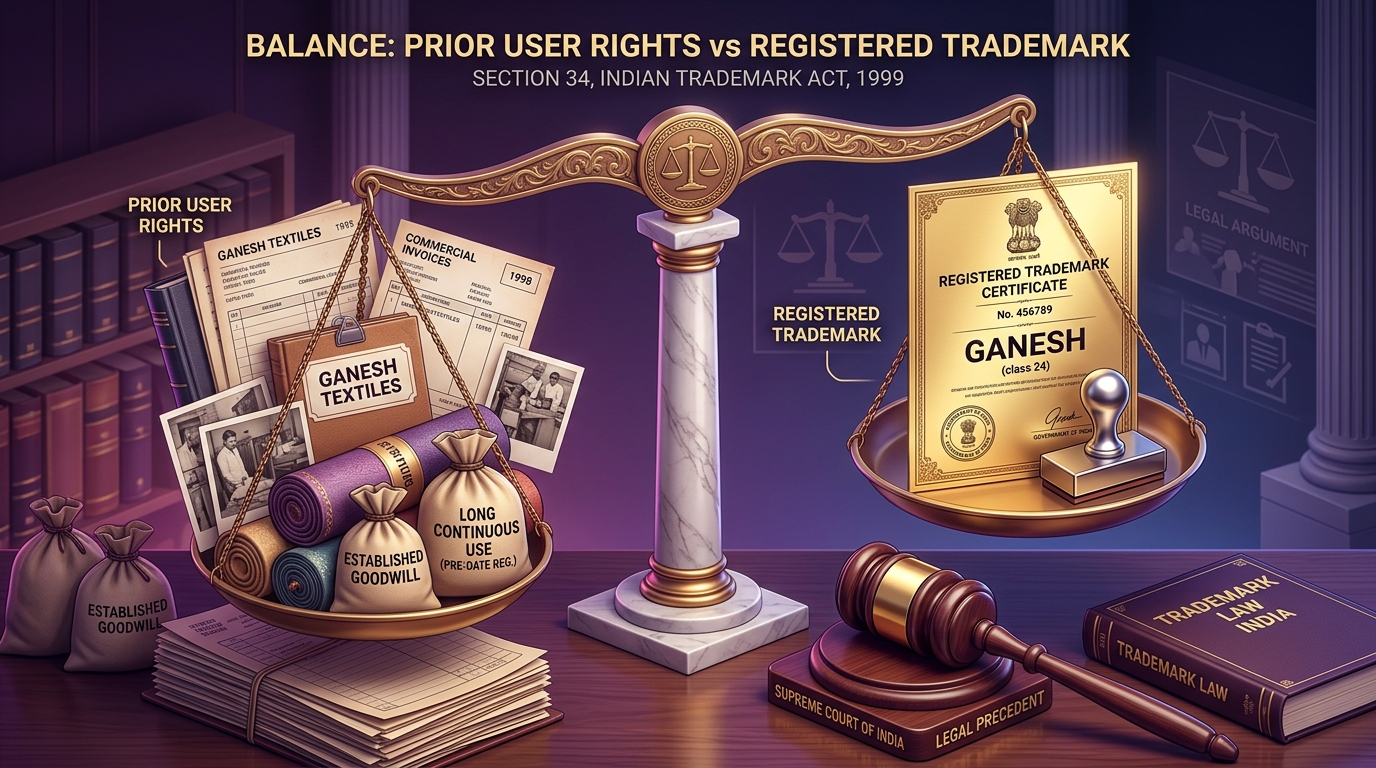
Under Section 34 of the Trade Marks Act, 1999 (“Saving for vested rights”), a registered trademark owner cannot prevent or restrain a prior continuous commercial user from using an identical or similar mark for the same goods or services. In Indian trademark law, the “First to Use” doctrine prevails over the “First to File / Register” rule. A prior user with earlier continuous commercial adoption holds superior common law rights and can successfully defend against infringement suits, vacate ex-parte injunctions, and petition for trademark cancellation under Section 57.
One of the most intense conflicts in intellectual property litigation occurs when an established business—operating continuously in regional or offline markets for decades—suddenly receives a threateningtrademark infringement legal noticeor ex-parte interim injunction from a newcomer who obtained a recent registration certificate from the Trade Marks Registry.
Under Indian jurisprudence, trademark registration does not grant an unassailable monopoly over existing market goodwill. While Section 28 of theTrade Marks Act, 1999confers statutory exclusive rights upon registered proprietors, that right is expressly subordinated by the opening words of the statute:“Subject to the other provisions of this Act.”
Foremost among those saving provisions isSection 34. This protects vested prior user rights. Understand how the landmark Supreme Court ruling inNeon Laboratories Ltd. V. Medical Technologies Ltd.permanently reshaped Indian trademark defense, how to establish chronological user evidence, and how prior users prevail in court over subsequent registered marks. Explore the essential distinction between statutory remedies and common law torts in our guide onpassing off vs trademark infringement.
First-to-Use vs First-to-File Doctrine
Globally, intellectual property regimes divide into two contrasting philosophies:
First-to-Use Principle (India, UK, USA)
Proprietary rights arise from actual commercial use and consumer goodwill created in the marketplace. Registration serves merely as formal statutory recognition of pre-existing rights. A prior user who established reputation first cannot be displaced by a subsequent registrant.
First-to-File Principle (China, EU Systems)
Proprietary rights belong strictly to the first entity that submits an application at the Trademark Office, regardless of who invented or used the mark first in the market. Unregistered prior users enjoy minimal protection against trademark squatters.
Because India inherits English common law equity, our judicial system rigorously rejects “trademark piracy” and opportunistic squatting. An applicant who rushes to the Registry with a fabricated “proposed to be used&rdquo. Application cannot suppress a bona fide manufacturer who has been retailing goods under that mark for years.
Section 34 Statutory Analysis & Elements
Section 34 of the Trade Marks Act, 1999 is titled“Saving for vested rights”. The statutory text states:
(a) to the use of the first-mentioned trade mark in relation to those goods or services by the proprietor or a predecessor in title of his; or
(b) to the date of registration of the first-mentioned trade mark in respect of those goods or services in the name of the proprietor or a predecessor in title of his,
whichever is the earlier, and the Registrar shall not refuse... to register the second-mentioned trade mark by reason only of the registration of the first-mentioned trade mark.”
To successfully establish a Section 34 defense in civil court or before the Trade Marks Registry, the defendant must satisfy three essential statutory ingredients:
1. Priority in Point of Time (Earlier Date)
The defendant's commercial use must predateboth: (i) the registered proprietor's actual commercial use, and (ii) the registered proprietor's filing / registration date, whichever occurred earlier.
2. Continuous Commercial Use
The prior use cannot be sporadic, secretive, experimental, or abandoned. The prior user must demonstrate an unbroken chain of commercial trade, invoicing, and marketing down to the present day.
3. Same or Closely Allied Goods / Services
The prior user's protection applies in relation to the specific goods or services on which the mark was continuously used (or closely related commercial categories within the same trade channel).
Interplay with Sections 27, 28, & 57
Understanding how Section 34 integrates into the broader statutory architecture is critical for IP litigation:
Section 27(2) — Common Law Passing Off Preserved
Section 27(2) explicitly provides that nothing in the Act affects the common law rights of action against passing off. A prior user can sue a subsequent registered owner for passing off and obtain an injunction restraining the registered owner from misleading consumers.
Section 28(1) — Registration Subordinated
Section 28(1) gives the registered owner the exclusive right to use the mark, but starts with:“Subject to the other provisions of this Act.”Thus, Section 28 rights are legally subject to Section 34 prior user rights and Section 27(2) passing off remedies.
Section 57 — Rectification & Cancellation
A prior user whose rights are threatened by an improper registration is a “person aggrieved&rdquo. Entitled to file a Rectification Petition under Section 57 before the High Court or Registry to expunge the conflicting trademark.
Landmark Prior User Rights Precedents
Indian trademark jurisprudence contains definitive Supreme Court and High Court authorities confirming the superiority of prior commercial use:
Neon Laboratories Ltd. v. Medical Technologies Ltd. (2016) 2 SCC 672
The Landmark Ruling:Neon applied for ‘ROFOL’ in 1992 on a “proposed to be used” basis and obtained registration in 2001, but did not commercially launch the drug until 2004. Meanwhile, Medical Technologies adopted ‘PROFOL’ in 1998 and built massive market presence. The Supreme Court upheld the interim injunction in favor of Medical Technologies (the prior commercial user), ruling that prior commercial adoption defeats a prior registration that remained dormant in the market.
S. Syed Mohideen v. P. Sulochana Bai (2016) 2 SCC 683
The Three-Judge Bench Authority:The Supreme Court resolved conflicts between registered owners, holding that registration does not grant an absolute right over common law goodwill. An action for passing off under Section 27(2) and prior user protection under Section 34 operates independently and overrides statutory registration rights under Section 28.
Century Traders v. Roshan Lal Duggar & Co. (AIR 1978 Del 250)
The Bedrock Common Law Rule:The Delhi High Court Division Bench held that for claiming trademark rights, registration is not essential. Proof of prior commercial use in the market establishes proprietary ownership, and the first user in point of time is entitled to restrain all subsequent adopters.
Milmet Oftho Industries v. Allergan Inc. (2004) 12 SCC 624
Transborder Prior Reputation:The Supreme Court held that prior global adoption and international reputation by a multinational brand can protect prior rights in India against domestic competitors who registered the mark first in India.
Evidentiary Proof Standards in Court
Asserting Section 34 in litigation is entirely an evidence-driven battle. Courts require concrete, contemporaneous documentary proof demonstrating unbroken commercial activity before the adversary's priority date:
| Evidence Class | Primary Documentary Artifacts | Evidentiary Weight in Court |
|---|---|---|
| Commercial Tax Invoices | Consecutively numbered sales invoices showing buyer names, dates, product descriptions, and the specific brand name. | Highest (Primary Admissible Proof) |
| Government Tax Clearances | Historical Sales Tax, VAT returns, Central Excise records, and GST filings detailing annual turnover. | Extremely High (Statutory Records) |
| Audited CA Certificates | Chartered Accountant certified turnover figures and promotional expenditure specifically allocated to the brand. | High (Corroborative Financials) |
| Logistics & Transport Receipts | Lorry receipts (LR bilties), toll passes, waybills, and railway freight receipts proving inter-state distribution. | Substantial Corroboration |
| Marketing & Media Specimen | Dated newspaper clippings, magazine features, television ad telecast certificates, and print trade catalogs. | Proves Public Association |
| Digital Footprint & Domains | WHOIS domain registration records, Internet Archive Wayback Machine captures, and dated e-commerce listings. | Critical for Digital Brands |
For detailed compliance on filing evidence before the Trade Marks Registry, review our guide ontrademark user affidavit format and rules.
Defense Against Infringement Notices
When served with a cease-and-desist letter or an ex-parte injunction, panicking or halting your factory operations is the worst mistake. Follow this strategic litigation roadmap:
1. Reply to Legal Notice with Ironclad Prior Evidence
Engage veteran IP litigators to draft a robust statutory reply under Section 34. Cite your earliest invoices, tax records, and landmark Supreme Court rulings (Neon Laboratories,S. Syed Mohideen). Warn the claimant that continuing litigation exposes them to damages for groundless threats under Section 142.
2. Vacate Ex-Parte Injunctions — Order 39 Rule 4 CPC
If the claimant obtained a stay order behind your back by suppressing your prior existence, immediately file an application underOrder 39 Rule 4 of the Code of Civil Procedure (CPC)for discharge of the injunction on grounds of material suppression and prima facie prior user immunity.
3. File Counterclaim for Passing Off & Permanent Injunction
Turn the tables in District Court or High Court Commercial Divisions by filing a Counterclaim under Section 27(2), praying for a permanent injunction restraining the registered owner from passing off their spurious goods as yours.
Rectification under Section 47 & 57
A defensive posture alone is insufficient. Prior users should proactively purge the fraudulent mark from the electronic Trade Marks Register:
- Section 57 Rectification (Bad Faith & Non-Distinctiveness):File a petition before the High Court Intellectual Property Division (IPD) or Registry to cancel the registration on grounds that the mark was registered without sufficient cause and remains an improper entry.
- Section 47 Cancellation (5 Years Non-Use):If the registered proprietor sat on the trademark for 5 years and 3 months without genuine commercial use, apply for complete removal for commercial non-use. Learn the step-by-step procedure in our guide ontrademark cancellation for non-use under Section 47.
- File Your Own Trademark Application:Concurrently file your own trademark registration on Form TM-A with an explicit User Affidavit claiming the original historical adoption date to obtain permanent statutory certificates.
Prior User vs Registered Owner Matrix
Understand the key legal distinctions, remedies, and burdens between prior unregistered users and subsequent registered proprietors:
| Legal Dimension | Prior User (Section 34 / Section 27(2)) | Subsequent Registered Proprietor (Section 28) |
|---|---|---|
| Source of Right | Common Law Goodwill & Market Priority | Statutory Certificate from Trade Marks Registry |
| Primary Cause of Action | Passing Off Action & Section 34 Statutory Shield | Statutory Infringement under Section 29 |
| Superiority in Conflict | Superior (Vested Rights Override Registration) | Subordinated by Section 28 & Section 34 |
| Evidentiary Burden | Must prove prior continuous commercial use & goodwill | Registration Certificate acts as prima facie proof |
| Right to Cancel Adverse Mark | Can file Section 57 Rectification Petition | Cannot cancel genuine prior user mark |
Prior User Action Checklist
- Collate Chronological Invoices:Extract commercial invoices for every year of operation from adoption date to present.
- Obtain CA Turnover Certificate:Secure chartered accountant certification of annual sales figures and advertising expenditure.
- Check Opponent's Priority Date:Scrutinize the conflicting trademark certificate on IP India to identify the user date claimed and application filing date.
- Issue Section 34 Legal Reply:Send a comprehensive advocate reply asserting prior user rights and threatening Section 142 damages for groundless threats.
- Initiate Section 57 Rectification:File for expunging and cancelling the conflicting registration before the High Court IPD or Registrar.
- File Defensive Trademark Application:Apply for formal registration with a User Affidavit to solidify future statutory title.
Frequently Asked Questions
Q.Can an unregistered prior user stop a registered trademark owner in India?
Yes. Under Section 34 of the Trade Marks Act, 1999 and the common law doctrine of passing off protected under Section 27(2), a prior continuous commercial user holds superior proprietary rights over a subsequent applicant who obtained formal registration. The Supreme Court of India in Neon Laboratories (2016) and S. Syed Mohideen (2016) firmly held that registration cannot defeat prior vested common law user rights.
Q.Is India a 'First to File' or 'First to Use' trademark jurisdiction?
India is primarily a 'First to Use' trademark jurisdiction. While registration confers prima facie statutory exclusivity under Section 28, Section 34 contains an express non-derogation clause ('Saving for vested rights') stating that a registered proprietor cannot interfere with or restrain the continuous commercial use of an identical or similar mark by a prior user.
Q.What must a prior user prove under Section 34 of the Trade Marks Act, 1999?
To claim the protection of Section 34, the prior user must establish: (1) Continuous commercial use of the identical or similar mark in India, (2) Use in relation to identical or similar goods/services, and (3) Use starting before the date of registration or the priority use date claimed by the registered proprietor, whichever is earlier.
Q.What did the Supreme Court hold in Neon Laboratories v. Medical Technologies Ltd.?
In Neon Laboratories Ltd. V. Medical Technologies Ltd. (2016) 2 SCC 672, the Supreme Court held that an unregistered prior user who actively introduced products in the market is entitled to an interim injunction against a registered owner whose mark remained dormant or was commercially launched after the prior user's market entry. Prior commercial use triumphs over a dormant prior registration.
Q.What documents serve as admissible evidence of prior continuous use in court?
Admissible evidence includes: (1) Commercial sales invoices with unbroken chronological dates, (2) Audited financial statements and CA turnover certificates, (3) GST returns, VAT records, and excise clearances, (4) Manufacturing batch sheets and lorry receipts (LR bilties), (5) Dated newspaper advertisements, brochures, and price lists, and (6) Domain registration records and historical website archives.
Q.Can a registered trademark owner sue a prior user for trademark infringement?
No. Section 34 explicitly bars a registered trademark proprietor from instituting an infringement suit or obtaining an injunction against a bona fide prior user. If sued, the prior user can plead Section 34 as a complete statutory defense and file a counter-claim for passing off and trademark rectification under Section 57.
Q.Can a prior user apply for cancellation or rectification of the registered trademark?
Yes. Under Section 57 of the Trade Marks Act, 1999, any 'person aggrieved' (including a prior continuous user) can file a Rectification Petition before the High Court or the Registrar of Trade Marks to cancel or expunge the subsequent registration on grounds of bad-faith filing, lack of distinctiveness, or deceptive similarity under Section 11.
Q.What is the difference between honest concurrent use (Section 12) and prior use (Section 34)?
Prior use under Section 34 grants complete immunity and superior proprietary rights to the party who used the mark before the registered owner's priority date. Honest concurrent use under Section 12 is an equitable registry discretion allowing two separate businesses to co-exist and hold simultaneous registrations when both adopted the mark honestly in parallel markets without intent to deceive.
Strategic Legal Advice for Prior Users
While Section 34 provides an unshakeable statutory shield for prior users, relying exclusively on common law defense without securing formal registration leaves your business vulnerable to repeated legal harassment, marketplace confusion, and expensive civil litigation.
The most effective commercial strategy is dual-pronged: fiercely enforce your Section 34 prior user rights to crush spurious infringement notices, while simultaneously filing your own formal trademark applications backed by comprehensive User Affidavits. For related litigation strategies, review our guides oncivil vs criminal trademark infringement,how to send trademark legal notices, andhow to file trademark rectification in India.
Defend Your Prior User Rights with Supreme Court Precedents
Facing a frivolous infringement notice or an ex-parte stay order? Deploy specialized IP litigators to assert Section 34, vacate injunctions under Order 39 Rule 4, and cancel conflicting trademarks under Section 57.
Supreme Court & High Court IP Litigators • Section 34 Defense • Order 39 Rule 4 CPC • Section 57 Rectification