
Written byRahul Roy
Trademark Research Specialist
Overview of Social Media Handle Squatting
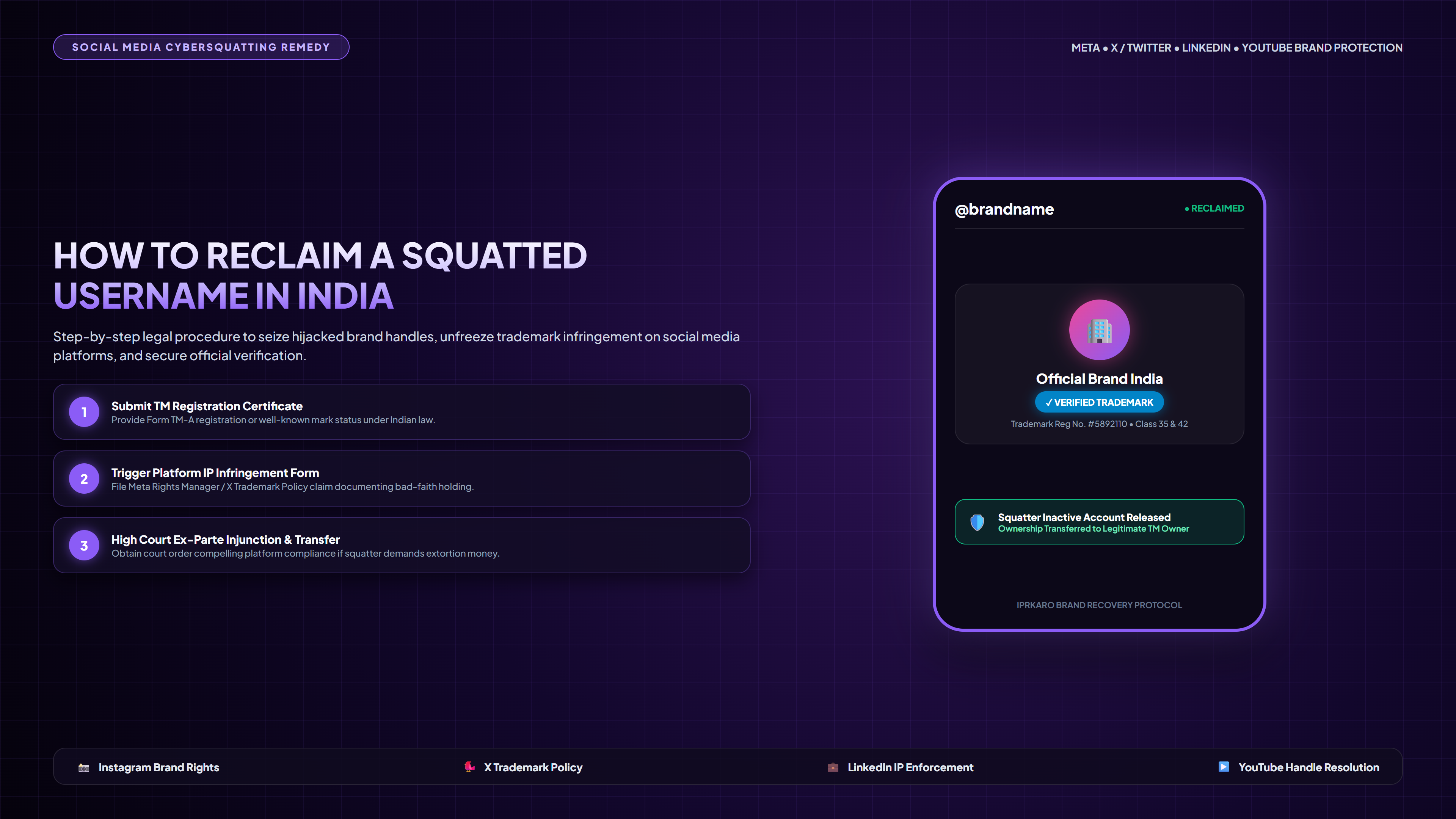
To reclaim a squatted social media username in India, a brand owner must hold a registered Trademark Registration Certificate (Form TM-RG) from IP India. Under Section 28 and Section 31 of the Trade Marks Act, 1999, registration grants exclusive statutory rights to use the mark across all commercial and digital channels. By submitting a formal Trademark Infringement Report via platform IP dispute forms (Meta IP Tool, X Trademark Complaint Form, YouTube IP Center) alongside statutory notices under Rule 3(1)(b) of the Information Technology (Intermediary Guidelines) Rules 2021, brand owners can compel platforms to reassign or release the squatted handle within 3 to 7 business days without paying extortion fees.
In the contemporary digital economy, a brand's social media handle (such as@brandnameon Instagram, X, Facebook, LinkedIn, YouTube, or Threads) serves as its primary public storefront, customer service desk, and advertising billboard. However, fast-growing Direct-to-Consumer (D2C) startups, FMCG companies, fintech enterprises, and individual creators frequently discover that their identical brand handle has been preemptively claimed by a cybersquatter, competitor, or domain broker.
Username squatters exploit brand inertia by holding digital handles hostage, demanding thousands of dollars in informal ransom, or worse, launching impersonation pages that harvest customer credentials and sell counterfeit products. Fortunately, Indian intellectual property jurisprudence and platform terms of service strictly prohibit bad-faith username holding. When backed by an official Indian trademark registration, brand owners hold absolute legal leverage to reclaim these assets.
For businesses seeking comprehensive digital asset protection, understanding the crossover between domain disputes and social media squatting is essential. Learn more in our definitive guides onINDRP domain name cybersquattingandhow to stop trademark infringement.
Legal Grounding: Section 31 & IT Rules
Digital handle reclamation relies on an interplay between statutory trademark law, Indian judicial precedents, and intermediary liability regulations:
1. Prima Facie Evidence of Validity — Section 31(1) Trade Marks Act
Section 31 of the Trade Marks Act, 1999 establishes that an official trademark registration certificate isprima facieconclusive evidence of the mark's validity and proprietary ownership. When submitted to social media platforms, it eliminates subjective ownership disputes and places the burden of proof squarely on the squatter.
2. Statutory Infringement & Unfair Advantage — Section 29
Under Section 29(1) and Section 29(8), using a registered trademark in advertising or commercial communications without authorization to take unfair advantage of its distinctive character or repute constitutes direct infringement. Squatting a brand handle to divert consumer traffic or harm brand goodwill directly attracts Section 29 remedies.
3. Intermediary Due Diligence — Rule 3(1)(b) IT Rules, 2021
Under theInformation Technology (Intermediary Guidelines and Digital Media Ethics Code) Rules, 2021, social media intermediaries (Meta, X, Google, ByteDance) must observe strict due diligence. Under Rule 3(1)(b)(iv), intermediaries are legally obligated not to host content that infringes any patent, trademark, copyright, or other proprietary rights.
4. 36-Hour Mandatory Takedown Window — Rule 3(2) IT Rules
Upon receiving a formal grievance or court order regarding intellectual property violation, intermediary platforms must acknowledge the complaint within 24 hours and disable access or reassign infringing handles within36 hoursto maintain their statutory “Safe Harbor” immunity under Section 79 of the Information Technology Act, 2000.
Handle Squatting vs Active Infringement
Different types of username usurpation require distinct recovery strategies. Understanding which category your target falls under determines your legal pathway:
Passive Handle Squatting
The account has zero posts, default avatar, no bio, and has been inactive for months/years. The creator registered it purely to hoard the username.
Bad-Faith Extortion
The account owner sends DMs or emails stating: “Buy this handle for ₹1,50,000 / $2,000 or I will sell it to your direct competitor.”
Impersonation & Scams
The account uses your official logo, publishes fake job postings, collects customer payments, or sells counterfeit merchandise under your name.
Why Simply Changing Your Handle is Dangerous for Brands
Many early-stage founders settle for compromised handles such as@brand_official_indiaor@get_brand_app. While workable initially, leaving the pristine handle@brandin unauthorized hands exposes customers to phishing, splits organic search traffic, and diminishes brand valuation during M&A due diligence. For actionable legal responses, review our guide onhow to respond to trademark infringement legal notices.
Platform-by-Platform Recovery Workflows
Each social network operates proprietary IP resolution desks with specific documentation requirements. Here is how to navigate the top platforms:
1. Meta (Instagram & Facebook) Handle Recovery
Meta provides theMeta IP Reporting Formand the enterprise-tierMeta Brand Rights Protection Tool. Select “I am the trademark owner”, provide your Indian Trademark Registration Number, Class, Goods/Services description, and upload a high-resolution PDF of Form TM-RG. Under “Specific Content”, select “The entire account” and request “Username Reassignment to my verified business account”. If the account is inactive, Meta releases the handle directly to your linked Facebook Business Manager.
2. X (formerly Twitter) Trademark Policy Dispute
X enforces a strictTrademark Policyagainst username squatting. Submit the officialX Trademark Complaint Form. You must establish that the squatted username causes consumer confusion or is being held for resale. X will evaluate the account's activity. If the squatter has no legitimate business association with the mark, X will either reassign the handle to your corporate email or permanently ban the squatter.
3. YouTube Custom URL & Handle Reclamation
Google handles YouTube handles (e.g.,youtube.com/@brand) through itsGoogle Trademark Infringement Webform. If an unauthorized channel utilizes your trademarked name in its custom handle or channel branding, submit your trademark credentials. YouTube reviews the complaint within 48 to 72 hours and strips the handle from the unauthorized uploader.
4. LinkedIn Corporate Page Handle Disputes
LinkedIn takes corporate impersonation very seriously. Submit theLinkedIn Trademark Infringement Noticealong with your company's Ministry of Corporate Affairs (MCA) Certificate of Incorporation and Trademark Certificate. LinkedIn will reassign thelinkedin.com/company/brandURL to your verified corporate administrator.
Evidence Dossier Required for Takedown
Platform automated filters reject incomplete or poorly documented complaints. Before initiating a dispute, compile an airtight digital evidence bundle:
1. Certified Trademark Certificate
Official Form TM-RG issued by the Trade Marks Registry of India, displaying your registration number, registered classes, date of application, and word/device mark representation.
2. Corporate Authorization / Power of Attorney
Form TM-48 or a formal Board Resolution authorizing your IP counsel or Brand Protection Officer to act on behalf of the registered proprietor.
3. Timestamped Screenshots & Web Archives
Full-page captures of the squatted profile showing handle URL, bio, follower count, post history (or lack thereof), and timestamped HTTP headers.
4. Commercial Extortion / Confusion Evidence
Exported chat logs, DM screenshots, or email correspondence demonstrating extortion demands, or customer support complaints showing actual consumer confusion.
Drafting Cease & Desist to Squatters
Serving a formal Cease and Desist Legal Notice before or concurrently with platform reporting puts the squatter on notice and creates invaluable documentary proof of bad faith. A robust legal notice drafted by an IP advocate should contain:
- Proof of Priority:Clear assertion of your prior user date and nationwide exclusive proprietary rights under Section 28 of the Trade Marks Act, 1999.
- Specific Violations:Explicit reference to Section 29 (infringement), common law passing off, and Rule 3(1)(b) of the IT Intermediary Rules 2021.
- Strict 48-Hour Ultimatum:Demand for immediate voluntary transfer of the handle credentials and complete cessation of brand name usage.
- Civil & Criminal Repercussions:Warning of potential damages suits under Commercial Courts Act 2015, John Doe injunctions, and criminal complaints under Section 420 IPC / Section 318(4) BNS for fraudulent impersonation.
To ensure compliance with statutory guidelines and avoid counter-claims of groundless threats under Section 142, explore our detailed guide onhow to send a trademark legal notice in India.
7-Step Social Media Handle Recovery
Follow this field-tested procedural workflow to secure handle reassignments systematically across digital platforms:
Digital Footprint Mapping & Timestamping
Audit all major platforms (Instagram, X, Facebook, LinkedIn, YouTube, TikTok, Telegram) to identify every unauthorized handle variant. Capture cryptographic web archive hashes of each profile.
Secure Certified Trademark Title (Form TM-RG)
Ensure your registered trademark certificate is active and properly matches your corporate entity name. If pending, expedite your application via fast-track channels or prepare common law passing-off evidence.
Issue Cease & Desist Demand to Squatter
Serve a formal legal notice via registered post, email, and social platform direct message demanding voluntary handover within 48 to 72 hours.
Submit Formal Platform IP Violation Form
Access Meta IP Reporting Tool, X Trademark Complaint Form, or Google IP Portal. Fill in trademark details, attach TM-RG certificate, and request handle transfer to your verified account.
Invoke IT Rules 2021 with Resident Grievance Officer
If automated systems stall, send a formal statutory letter to the platform's designated Resident Grievance Officer in India citing Rule 3(1)(b) and demanding compliance within 36 hours.
Enroll in Brand Protection Enterprise Portals
Register with Meta Brand Rights Protection and Amazon Brand Registry to automate trademark monitoring and instantly block future spoof handles.
High Court Commercial Litigation (If Required)
In stubborn cases involving bad-faith commercial impersonation or syndicate squatting, file a commercial suit to secure ex-parte ad-interim injunctions ordering immediate handle reallocation.
Platform Disputing Protocols Comparison
Evaluate the policy thresholds, processing timelines, and resolution mechanisms across leading digital intermediaries:
| Platform | Dispute Mechanism | Turnaround Time | Handle Transfer? | Pending TM Allowed? |
|---|---|---|---|---|
| Instagram / Meta | Meta IP Form / Brand Rights Protection | 3–7 Business Days | Yes (Direct Reassignment) | No (Registered TM Required) |
| X (Twitter) | Trademark Policy Violation Form | 5–10 Business Days | Yes (Reassignment or Release) | Rare (Court Order Needed) |
| YouTube / Google | Google Trademark Webform | 2–5 Business Days | Yes (Custom URL Reset) | No |
| LinkedIn Trademark Notice | 3–5 Business Days | Yes (Company Page URL) | Case-by-Case (With MCA Proof) | |
| Telegram | @notoscam / IP Email Portal | 7–14 Business Days | Yes (Channel/Bot Username) | No |
High Court Remedies & John Doe Orders
When automated portal complaints fail or when anonymous fraudsters operate multiple coordinated accounts across platforms, direct judicial intervention before the High Court Commercial Division provides swift, decisive relief.
UnderOrder 39 Rules 1 & 2 of the Code of Civil Procedure (CPC)read withSection 135 of the Trade Marks Act, 1999, Indian High Courts (such as Delhi High Court in numerous landmark rulings) routinely passex-parte ad-interim injunctionsagainst unknown defendants (John Doe / Ashok Kumar orders).
Such orders direct social media intermediaries to immediately suspend, block, and reassign infringing handles, disclose the registrant's IP logs, phone numbers, and KYC details, and freeze connected fraudulent payment gateways. Learn more about emergency judicial relief in our specialized guide onJohn Doe Ashok Kumar orders in Indian trademark lawandcivil vs criminal trademark enforcement.
Preemptive Brand Defense Checklist
Proactive asset protection prevents costly handle disputes. Implement these foundational measures before public launch:
Multi-Platform Defensive Reservation:Claim your exact username across Instagram, X, Facebook, LinkedIn, YouTube, Pinterest, Threads, TikTok, and Telegram on Day 1, even if you do not plan immediate content publishing.
Register Core & Ancillary Classes:File trademark applications in your primary commercial class as well as Class 35 (online retail, advertising) and Class 42 (software, digital services).
Secure Verified Badges:Obtain Meta Verified, X Premium Organizations, or LinkedIn Corporate verification to anchor brand authenticity and prevent spoofing.
Continuous IP Watch Services:Deploy automated trademark monitoring to catch typosquatting handles and fraudulent impersonators before they gain commercial traction.
Frequently Asked Questions
Can I reclaim a social media username if I only have a pending trademark application?
Generally no. Major platforms including Meta (Instagram & Facebook), X (formerly Twitter), and LinkedIn require a certified copy of an issued, registered Trademark Registration Certificate (Form TM-RG) to execute an administrative username reassignment. A pending application (TM-A with status 'Marked for Exam' or 'Objected') demonstrates an inchoate claim, which platforms rarely honor for handle transfer unless accompanied by a binding High Court ad-interim injunction order.
What is the difference between handle squatting and trademark infringement on social media?
Username squatting refers to registering a brand handle to hold it inactive, prevent the rightful owner from obtaining it, or extort financial compensation. Trademark infringement on social media involves active commercial misrepresentation—such as using the registered logo as an avatar, offering counterfeit products, running deceptive ad campaigns, or misleading consumers into believing the account is the official brand presence.
How long does Meta take to process a trademark handle reclamation request?
Meta typically processes verified trademark infringement complaints within 3 to 7 business days through its official IP Reporting Form or Meta Brand Rights Protection tool. If the report provides clear evidence of commercial bad faith or impersonation matching an active Trademark Certificate in the relevant class, the handle is either transferred to the applicant or released from the squatter.
Does an Indian trademark certificate give me global rights to reclaim international social media handles?
An Indian trademark registration provides statutory rights within India under Section 28 of the Trade Marks Act, 1999. However, major global digital intermediaries (Meta, X, Google, LinkedIn) operate under global Terms of Service and statutory safe harbor rules (such as US DMCA and Indian IT Intermediary Rules, 2021). They routinely recognize Indian national trademark registrations to resolve handle conflicts when target markets or users are located in India.
What should I do if a squatter demands money to transfer my brand username?
Never pay extortion fees to a username squatter. Document every communication, extortion demand, screenshot, and timestamp. Demanding money to sell a handle is explicit evidence of bad faith under both platform Terms of Service and Indian common law principles of passing off. Submit this extortion correspondence directly in your platform IP dispute report to expedite handle revocation.
Can a parody or fan account keep my registered trademark handle?
Platforms permit legitimate commentary, fan pages, or parodies under fair use policies provided the account clearly distinguishes itself in its bio, handle, and avatar (e.g., stating 'Unofficial Fan Page' or 'Parody Account'). However, if the account uses the exact unmodified brand name, displays the official logo, or sells competing goods, it crosses into trademark infringement and can be taken down.
What legal actions can I take in Indian courts if platforms refuse to release the handle?
If platform grievance mechanisms fail, brand owners can file a commercial intellectual property suit before the High Court Commercial Division (such as Delhi, Bombay, or Madras High Court). Courts can issue ex-parte ad-interim injunctions (John Doe / Ashok Kumar orders) directing intermediaries under Section 79 of the Information Technology Act and Order 39 of the CPC to suspend, block, or reassign the infringing account within 36 hours.
Which trademark classes are essential for reclaiming digital brand handles in India?
While your primary business class is vital (e.g., Class 25 for apparel, Class 5 for pharma, Class 3 for cosmetics), having trademark protection in Class 35 (advertising, e-commerce marketplaces, business management) and Class 42 (software, digital platforms, technology services) creates an unassailable legal basis when asserting brand authority across digital platforms.
Expert Legal Assistance & Recovery
Reclaiming a squatted social media handle is a time-sensitive legal operation. Allowing squatters or impersonators to hold your brand name diminishes customer trust, risks revenue loss from counterfeit sales, and creates needless brand confusion. With an active Indian trademark certificate and seasoned IP litigators, reclaiming your rightful digital identity is fast, structured, and conclusive.
Reclaim Your Brand Handles Across All Platforms
Don't let cybersquatters extort your business. Partner with certified IP attorneys to file verified platform takedown reports, serve statutory IT Rule notices, and secure prompt handle reassignments.
Registered IP Advocates • Meta & X Enterprise Portals • IT Rules 2021 Takedowns • Pan-India Enforcement