
Written byRahul Roy
Trademark Research Specialist
Overview of Ashok Kumar (John Doe) Orders
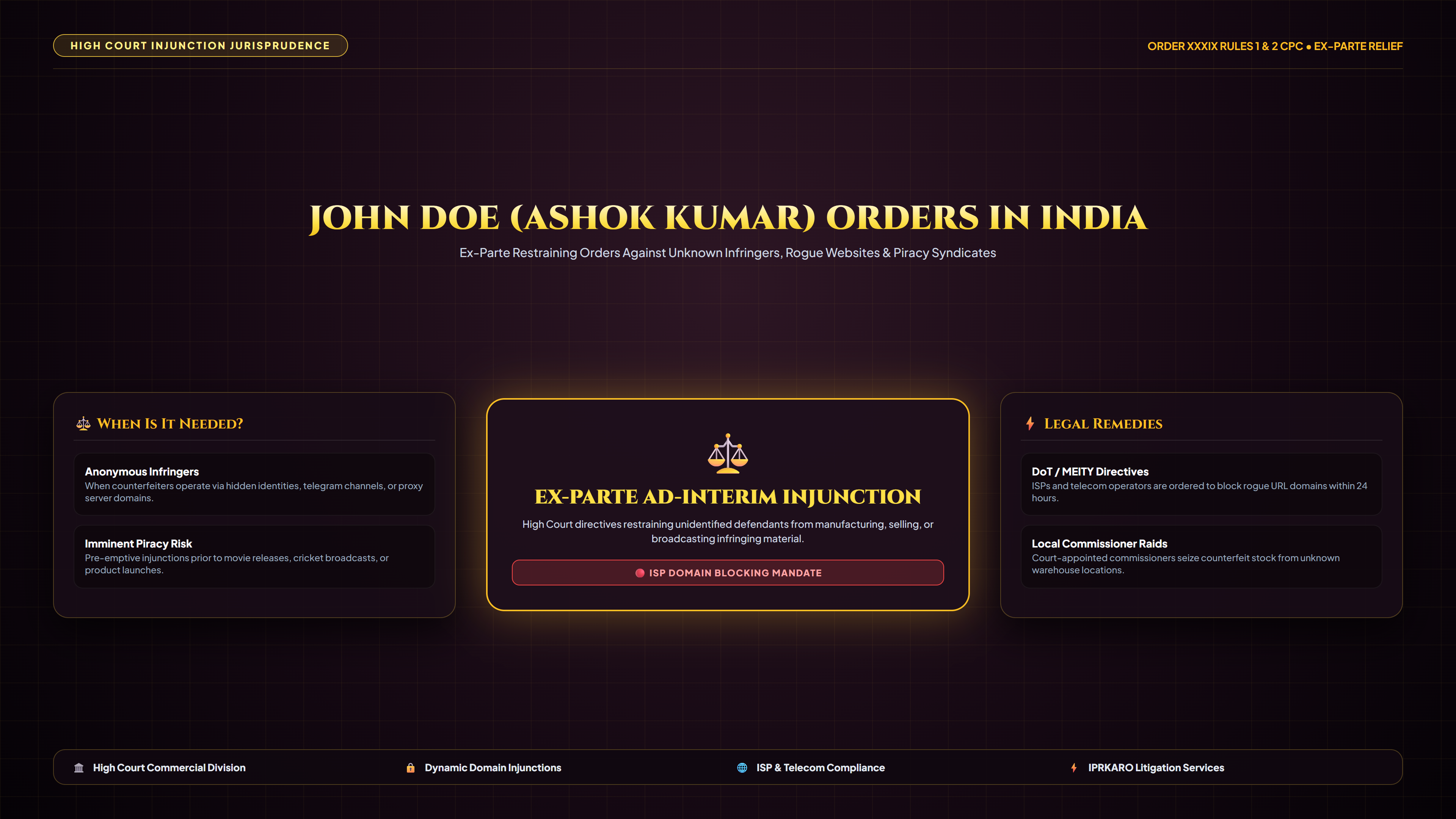
A John Doe order in Indian trademark law—judicially termed an “Ashok Kumar&rdquo. Order—is an ex-parte ad-interim injunction granted under Section 135 of the Trade Marks Act, 1999 and Order 39 Rules 1 &. 2 of the Code of Civil Procedure, 1908 (CPC). It restrains anonymous, unidentified, or clandestine infringers from manufacturing, selling, broadcasting, or digitally distributing counterfeit goods or impersonating brands. Indian High Courts pair John Doe injunctions with Local Commissioner search-and-seizure appointments, dynamic website blocking orders to ISPs, and bank account freeze directives.
In the modern globalized economy, intellectual property infringement has evolved into a sophisticated, decentralized enterprise. Counterfeiting syndicates, illicit broadcast streamers, and cyber-fraud networks operate anonymously through proxy domain registrations, encrypted messaging applications (Telegram, WhatsApp), shell trading companies, and clandestine physical godowns.
Under traditional civil litigation, a plaintiff must identify the full legal name and physical address of every defendant before serving a summons. If brand owners were required to identify every rogue distributor or clandestine manufacturer before approaching the court, infringers would simply move inventory, scrub electronic servers, and alter digital domain names before a hearing could occur.
TheAshok Kumar John Doe orderbridges this critical enforcement gap. It provides immediate judicial relief against the infringement itself, arming brand owners with court-backed enforcement tools to hunt down infringers, freeze assets, and dismantle illegal operations. Learn how this interacts with broader enforcement options in our comprehensive guide onpassing off vs trademark infringementandcivil vs criminal trademark infringement.
Origins of John Doe & Ashok Kumar Jurisprudence
The legal concept of issuing injunctions against unidentified parties traces its roots back to English equity courts and landmark common-law decisions:
1. The English Precedents: Anton Piller & Mareva Injunctions
InAnton Piller KG v. Manufacturing Processes Ltd. [1976], the English Court of Appeal established the right of a court to order unannounced search and preservation of evidence. Paired withMareva Compania Naviera SA v. International Bulkcarriers SA [1975](asset-freezing orders), equity jurisprudence recognized that stealth operations require pre-emptive, ex-parte judicial intervention.
2. India's Genesis: Taj Television Ltd. v. Rajan Mandal (2002)
The Delhi High Court introduced John Doe jurisprudence to India in the historicTaj Television Ltd. V. Rajan Mandal (2002)case. Taj Television (Ten Sports) held exclusive broadcast rights for the FIFA Football World Cup, which was being illegally transmitted by rogue, unregistered local cable operators across India. The Delhi High Court passed the country's first ex-parte ad-interim injunction against unidentified cable operators. This establishes the precedent.
3. Why the Name “Ashok Kumar”?
While American and British courts use “John Doe” or “Jane Doe”, Indian litigators and judges adopted “Ashok Kumar” as the standard generic Indian pseudonym. When filing a commercial plaint where certain infringers are unidentified, the caption reads:“[Plaintiff Brand] v. Ashok Kumar & Ors.”
Statutory Grounding under Indian Law
Ashok Kumar orders in India are backed by explicit statutory provisions spanning the Trade Marks Act, the Code of Civil Procedure, and the Commercial Courts Act:
Section 135(1) & (2) Trade Marks Act, 1999
Authorizes courts in trademark infringement or passing-off suits to grant ex-parte injunctions, order discovery of documents, preserve infringing goods/materials, and direct the seizure and destruction of counterfeit inventory.
Order 39 Rules 1 & 2 read with Section 151 CPC
Empowers the court to grant temporary restraining orders to prevent property from being damaged, alienated, or sold in bad faith. Section 151 enables inherent powers to ensure complete justice.
Order 26 Rule 9 CPC (Local Commissioners)
Empowers the Court to issue a commission appointing an independent advocate to execute on-the-spot physical investigations, take photographic evidence, and seize infringing stock without prior notice.
Section 12A Commercial Courts Act, 2015
While mandatory pre-institution mediation is generally required for commercial suits, Section 12A explicitly exempts suits that contemplate “urgent interim relief”. This allows direct listing of John Doe applications.
The Three-Prong Injunction Test in India
Because John Doe injunctions are grantedex-parte(without hearing the defendants in advance), Indian High Courts apply strict judicial standards before passing such extraordinary orders:
1. Irrefutable Prima Facie Case
The plaintiff must furnish unimpeachable proof of trademark registration (Legal Proceedings Certificate under Section 31), market goodwill, extensive sales figures, and clear photographic or digital evidence of the counterfeit mark being applied to inferior goods.
2. Balance of Convenience
The plaintiff must demonstrate that the balance of convenience lies overwhelmingly in their favour. An anonymous infringer has no legitimate right to trade on stolen brand equity. In contrast, the genuine proprietor suffers acute erosion of reputation and brand equity.
3. Irreparable Injury & Extreme Urgency
The plaintiff must convince the bench that issuing advance notice under Order 39 Rule 3 CPC would defeat the very purpose of the injunction. If warned in advance, rogue operators will instantly delete domain DNS records, transfer bank balances, or relocate counterfeit warehouses overnight.
4 Modern Types of Ashok Kumar Injunction Relief
In contemporary Indian litigation, Ashok Kumar orders are customized to combat both physical manufacturing cartels and cyber-enabled fraud:
1. Physical Anton Piller Seizure Orders
Directs court-appointed Local Commissioners to conduct unannounced raids on physical factories, markets, and godowns, confiscate spurious finished goods, packaging labels, and printing dies, and inventory financial registers.
2. Dynamic Injunctions (Mirror Domain Blocking)
Directs the Department of Telecommunications (DoT), MeitY, and Internet Service Providers (Jio, Airtel, Vodafone) to block rogue piracy websites and automatically extend blocking to future mirror, redirect, and alphanumeric variations.
3. Financial & Payment Gateway Freeze Orders
Restrains payment aggregators (Razorpay, Paytm, Cashfree, PhonePe) and scheduled banks from disbursing illicit customer funds collected through phishing websites impersonating the plaintiff brand.
4. Telecom & Domain Registrar Lockdown
Directs Domain Name Registrars (GoDaddy, Namecheap, Tucows) to lock and suspend infringing domain names, and compels Telecom Service Providers (TSPs) to deactivate fraudulent WhatsApp/calling numbers.
7-Step Ashok Kumar Injunction Procedure
Executing an Ashok Kumar commercial litigation before an Indian High Court involves strict adherence to procedural milestones:
Pre-Suit Cyber Forensics & Mystery Purchases
Private investigators capture timestamped screenshots, WHOIS records, IP server hosts, payment transaction UPI IDs, and execute test purchases with tax invoices to establish an unbroken chain of commercial infringement.
Drafting Commercial Plaint & Interim Applications
Legal counsel drafts the commercial plaint naming known entities alongside “Ashok Kumar / John Doe”. Applications are filed under Order 39 Rules 1 & 2 (Interim Injunction), Order 26 Rule 9 (Local Commissioner), and Order 39 Rule 3 (Exemption from Prior Notice).
Section 12A Mediation Exemption Application
File an urgent application under Section 12A of the Commercial Courts Act, 2015, satisfying the court that pre-institution mediation must be dispensed with due to imminent irreparable harm and ongoing fraud.
Ex-Parte Oral Arguments before High Court Bench
Senior counsel argues the ex-parte motion before the Commercial Division Bench. Present side-by-side authenticity comparisons, trademark certificates, and forensic evidence to satisfy the three-prong test.
Passing of Injunction Order & LC Appointment
The High Court passes an ex-parte ad-interim restraining order, directs DoT/MeitY/ISPs/banks to block assets, and appoints Local Commissioners with directions to the local Station House Officer (SHO) to provide armed police protection.
Execution of Local Commission & Evidence Seizure
The Local Commissioner arrives unannounced at target premises, serves the court order, inventories counterfeit goods, seizes machinery and computers, and seals the spurious stock under superdari.
LC Report Filing & Impleadment under Order 1 Rule 10
The LC files their official report with photographs in High Court. The plaintiff amends the memo of parties under Order 1 Rule 10 CPC, substituting “Ashok Kumar&rdquo. With the actual names of the infringers to pursue permanent injunctions and punitive damages.
Local Commissioner Raids & Powers
The Court-appointed Local Commissioner (LC) acts as the eyes and ears of the High Court. Their contemporaneous report is treated as prima facie evidence under Order 26 Rule 10(2) CPC:
Key Powers Conferred on Local Commissioners
- Unannounced Entry:Right to enter premises without prior notice or search warrant.
- Breaking Open Locks:Power to break open locks and godowns if the infringer refuses entry.
- Police Assistance:Mandatory police protection from local SHO / ACP as directed by the court.
- Digital Device Mirroring:Authority to copy hard drives, billing software, and customer ledgers.
- Seizure & Sealing:Confiscation of all spurious goods, packaging materials, and manufacturing dies.
- Superdari Custody:Releasing sealed stock to the plaintiff or defendant on undertaking for trial production.
For parallel criminal enforcement strategies, examine our detailed manual onanti-counterfeiting police raid procedure under Section 115.
Dynamic Injunctions & Website Blocking
Online brand piracy often involves rogue digital portals that instantly clone their operations across alphanumeric URL permutations whenever an original domain is blocked:
The UTV Software “Dynamic Injunction” Doctrine
InUTV Software Communication Ltd. V. 1337x.to (2019), the Delhi High Court resolved the “whack-a-mole” problem. Instead of requiring brand owners to file fresh suits or amend plaints every time an infringer launches a mirror domain (e.g., brand-fake1.com, brand-fake2.com), the court created theDynamic Injunction.
Affidavit before Court Joint Registrar
The plaintiff simply files an affidavit before the Joint Registrar of the High Court detailing newly discovered mirror websites that redirect to identical infringing content.
Direct DoT / ISP Enforcement
Upon registrar certification, DoT and MeitY immediately issue executive blocking orders to all internet service providers without re-arguing the main suit before a judge.
Learn more about resolving domain squatting through administrative arbitration in our guide ondomain name trademark disputes & INDRP rules.
Landmark Indian Ashok Kumar Precedents
Indian jurisprudence on John Doe injunctions has developed through landmark judgments that expanded protection across diverse commercial sectors:
| Landmark Case | Court / Year | Infringement Context | Key Legal Principle Established |
|---|---|---|---|
| Taj Television v. Rajan Mandal | Delhi HC (2002) | FIFA World Cup Broadcast Piracy | First John Doe injunction in Indian legal history. |
| ESPN Software v. Tudu Enterprise | Delhi HC (2011) | ICC Cricket World Cup Transmission | Blanket injunction against hundreds of unidentifiable cable operators. |
| UTV Software v. 1337x.to | Delhi HC (2019) | Digital Torrent & Streaming Portals | Created Dynamic Injunctions for automatic mirror domain blocking. |
| Tata Sky Ltd. V. Nimble TV | Delhi HC (2016) | Brand Impersonation & Over-the-Top App | Restrained anonymous mobile app developers from using registered marks. |
| Universal City Studios v. Dotmovies | Delhi HC (2023) | Rogue Websites & Phishing Networks | Real-time dynamic blocking extended to alphanumeric URL variations. |
Ashok Kumar Suits vs Traditional Litigation
Evaluate how John Doe actions compare with named commercial suits and criminal raids:
| Litigation Factor | Ashok Kumar (John Doe) Suit | Named Commercial Suit | Section 115 Police Raid |
|---|---|---|---|
| Defendant Identity | Unknown / Clandestine / Rogue | Known entity with verified address | Suspects identified via police intel |
| Prior Notice to Infringer | Dispensed With (Ex-Parte Relief) | Mandatory notice / advance copy | No advance notice (Secret raid) |
| Intermediary Directions | Broad (ISPs, Banks, DoT, Registrars) | Limited to named defendants | None (Police operational powers) |
| On-Site Evidence Seizure | Court-Appointed Local Commissioner | Requires specific LC motion | DSP/ACP Criminal Seizure Memo |
| Future Infringement Control | Dynamic Injunctions cover mirror URLs | Requires amending plaint | Requires fresh FIR / complaint |
John Doe Litigation Action Checklist
- Establish Statutory Title:Obtain certified Legal Proceedings Certificates from IP India verifying trademark validity.
- Collate Forensic Digital & Physical Evidence:Secure timestamped screen recordings, WHOIS logs, bank transaction trails, and mystery test purchases.
- Draft Urgent Interim Applications:Frame applications under Order 39 Rules 1 & 2, Order 26 Rule 9 (Local Commission), and Order 39 Rule 3 (Notice Exemption).
- File Section 12A Mediation Exemption:Plead urgent interim relief before the Commercial Court to dispense with mandatory pre-institution mediation.
- Serve Orders on Intermediaries:Transmit certified copies to DoT, MeitY, ISPs, Domain Registrars, and Payment Gateways for immediate compliance.
- Execute Local Commission Raids:Coordinate with court-appointed Local Commissioners and local police to seize physical counterfeit inventory.
- Implead Real Infringers:File Order 1 Rule 10 CPC applications substituting “Ashok Kumar” with actual accused entities for final trial and damages.
Frequently Asked Questions
Q.What is a John Doe (Ashok Kumar) order in Indian trademark law?
A John Doe order (judicially referred to in India as an 'Ashok Kumar' order) is an ex-parte ad-interim injunction granted by a High Court or Commercial Court against anonymous, unidentified, or clandestine infringers under Section 135 of the Trade Marks Act, 1999 and Order 39 Rules 1 & 2 of the Code of Civil Procedure, 1908 (CPC). It enables brand owners to restrain infringement, block rogue websites, freeze payment gateways, and execute surprise search and seizure raids even when the exact identities of the infringers are unknown at the time of filing the suit.
Q.Why are unknown defendants named 'Ashok Kumar' in Indian court suits?
In common law Western jurisdictions like the United States and United Kingdom, unidentified or anonymous defendants are traditionally designated as 'John Doe' or 'Jane Doe'. In Indian legal jurisprudence, the judiciary adopted the generic Indian name 'Ashok Kumar' as the standardized placeholder for unknown parties in civil suits, first popularized in landmark intellectual property litigations before the Delhi High Court.
Q.What legal elements must be established to obtain an ex-parte John Doe injunction?
Under Indian civil law, the plaintiff brand owner must satisfy the classic three-prong test: (1) A robust prima facie case demonstrating registered trademark ownership and blatant unauthorized commercial exploitation, (2) Balance of convenience tilting heavily in favour of the plaintiff, and (3) Irreparable injury, showing that giving advance notice to the infringers would result in immediate destruction of digital traces, clandestine relocation of inventory, or ongoing consumer deception.
Q.What powers does a Court-appointed Local Commissioner (LC) exercise during an Ashok Kumar raid?
Under Order 26 Rule 9 CPC, the High Court appoints a Local Commissioner (typically an independent advocate) who is vested with 'Anton Piller' powers to make unannounced visits to suspect factories, godowns, or premises. The LC is empowered to break open locks if obstructed, seek local police assistance under the court's direction, inspect inventory, seize counterfeit products, packaging, and manufacturing machinery, take custody of books of accounts, and seal the premises.
Q.What is a Dynamic Injunction and how does it apply to rogue online portals?
Originating in the Delhi High Court's landmark judgment in 'UTV Software Communication Ltd. V. 1337x.to (2019)', a Dynamic Injunction allows a trademark or copyright proprietor to block mirror, redirect, or alphanumeric variations of infringing websites without filing a fresh commercial suit each time. The plaintiff simply files an affidavit before the Court Registrar or Department of Telecommunications (DoT) to extend the existing injunction to newly surfaced rogue domain variations.
Q.Can an Ashok Kumar order direct banks, payment gateways, and telecom providers?
Yes. In modern trademark litigation involving phishing websites and fraudulent e-commerce portals, High Courts routinely issue directions to third-party intermediaries: directing Telecom Service Providers (TSPs) to suspend fraudulent phone numbers, Domain Name Registrars (DNRs) to lock domain names, Payment Gateways (Razorpay, Paytm, Cashfree) to freeze merchant balances, and scheduled commercial banks to freeze bank accounts receiving illicit funds.
Q.What happens after an unknown infringer is identified during the local commission?
Once the Local Commissioner executes the raid and discovers the true legal identity, company name, and addresses of the infringers, the plaintiff brand owner files an application under Order 1 Rule 10 CPC to amend the 'Memo of Parties'. The placeholder name 'Ashok Kumar' is formally substituted with the actual name of the infringing individual or corporate entity, and regular trial proceedings proceed against them.
Q.How does a John Doe civil injunction differ from a Section 115 criminal police raid?
A Section 115 criminal police raid is conducted by state police officers (DSP rank) resulting in arrest, FIR registration, and state criminal prosecution. An Ashok Kumar John Doe civil action is filed in the High Court / Commercial Court. This grants broader equitable remedies including nationwide website blocking, freezing of bank accounts, appointment of advocate Local Commissioners, and substantial financial damages and profits.
Strategic Litigation Advice
John Doe (Ashok Kumar) orders represent the pinnacle of judicial agility in Indian commercial jurisprudence. When anonymous infringers threaten your brand equity or defraud consumers through counterfeit physical goods or fraudulent websites, waiting to identify every infringer guarantees defeat.
By securing an ex-parte Ashok Kumar order from the High Court, you take immediate control of the battlefield: paralyzing rogue websites, freezing illicit bank accounts, and deploying Local Commissioners to seize counterfeit inventory unannounced. Partner with seasoned IP litigators to draft airtight pleadings, coordinate with cyber investigators, argue urgent ex-parte motions, and secure permanent commercial injunctions. For related enforcement workflows, review our guides onhow to send trademark legal notices,how to respond to trademark notices, andtrade dress protection in India.
Shut Down Anonymous Infringers with Ashok Kumar Orders
Deploy veteran High Court IP litigators to secure ex-parte John Doe injunctions, dynamic website blocking, Local Commissioner search raids, and multi-crore damages.
High Court Advocates • Ex-Parte Injunctions • Local Commissioners • Dynamic Blocking • Pan-India Relief