
Written byRahul Roy
Trademark Research Specialist
Overview of Customs Trademark Recordation
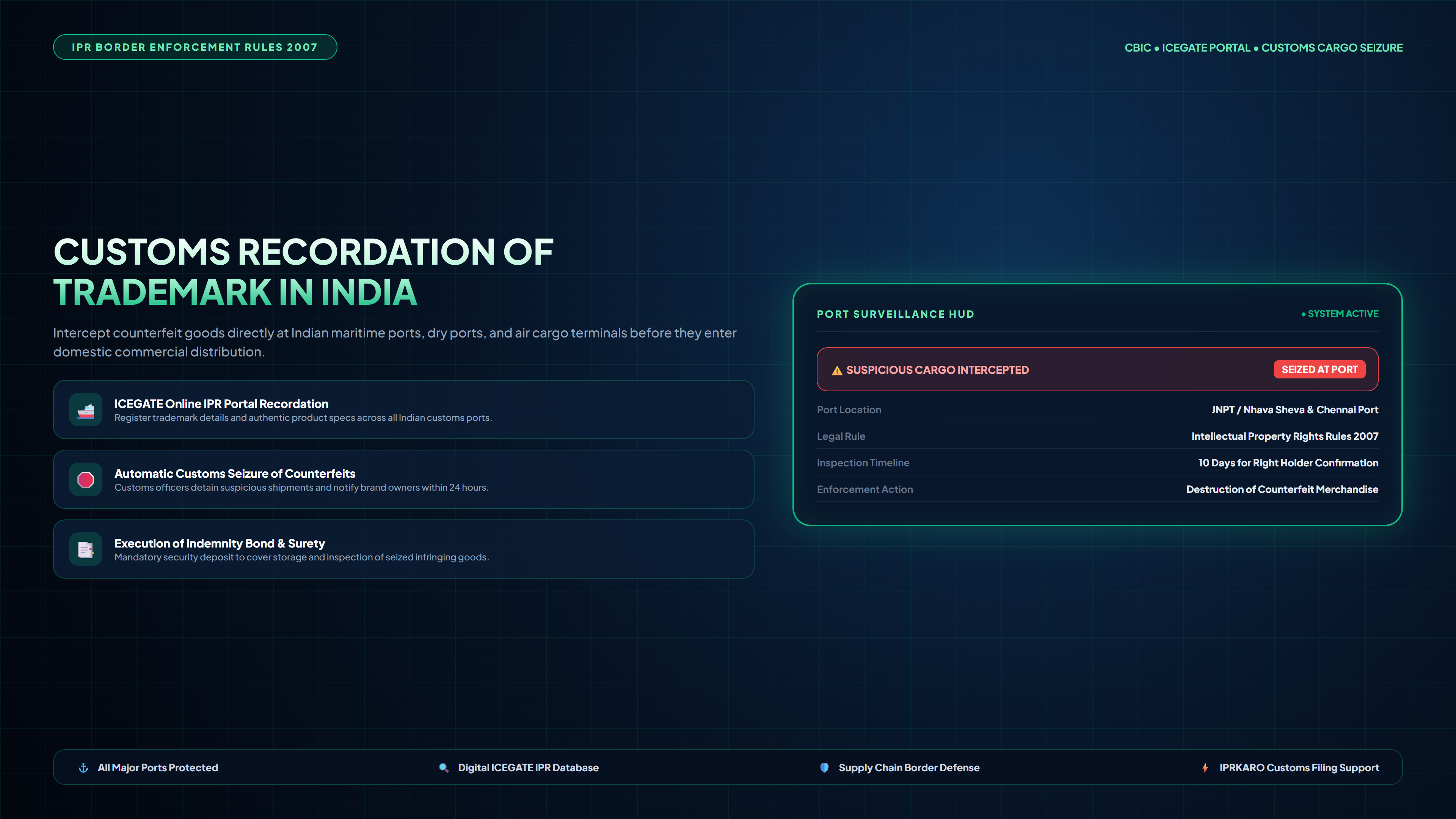
Customs Recordation of Trademarks in India is governed by the Intellectual Property Rights (Imported Goods) Enforcement Rules, 2007 under Section 11 of the Customs Act, 1962. By recording a registered trademark on the ICEGATE portal with the Central Board of Indirect Taxes and Customs (CBIC), brand owners empower customs officials across all Indian seaports, airports, and Inland Container Depots (ICDs) to automatically intercept, inspect, detain, and confiscate counterfeit goods before they clear customs. Registrations remain active for 1 year upon execution of an indemnity bond.
India is one of the world's largest consumer markets, making its international entry points prime targets for transnational counterfeiting syndicates. Spurious electronics, pharmaceuticals, cosmetics, automotive spare parts, and luxury consumer goods are routinely manufactured in foreign jurisdictions and shipped in massive cargo containers to Indian ports such as JNPT (Nhava Sheva), Mundra, Chennai, and Kolkata.
Once counterfeit cargo clears customs and enters domestic distribution channels, tracing and seizing the inventory becomes exponentially more expensive. This requires multi-state police raids underSection 115 criminal police raidsor complex high-court litigations. Customs border recordation stops infringement at the frontier, intercepting fake goods before they ever step onto Indian soil.
Understanding the statutory mechanism of border control allows brand owners to construct an impenetrable maritime and air defense. Learn how port protection integrates with broader enforcement strategies in our guides oncivil vs criminal trademark infringementandhow to stop trademark infringement.
Customs IPR Statutory Framework
Border enforcement of intellectual property in India operates at the intersection of international treaties, central customs statutes, and specialized procedural rules:
1. Section 11 of the Customs Act, 1962
Empowers the Central Government to prohibit the import or export of goods of any specified description for the protection of patents, trademarks, copyrights, and designs, or for the prevention of deceptive trade practices.
2. IPR (Imported Goods) Enforcement Rules, 2007
Notified vide Notification No. 47/2007-Customs (N.T.) on May 8, 2007. These rules lay down the procedural mechanism for right holders to give notice to the Commissioner of Customs, execute indemnity bonds, participate in joint cargo inspections, and secure final confiscation orders.
3. Section 140 of the Trade Marks Act, 1999
Empowers a registered trademark proprietor to serve written notice upon the Commissioner of Customs requesting the detention of imported goods suspected of bearing false or infringing trademarks.
4. WTO TRIPS Agreement (Articles 51 to 60)
India is a signatory to TRIPS, which mandates member states to establish effective border measures enabling right holders who suspect the importation of counterfeit trademark or pirated copyright goods to lodge an application for customs suspension of release.
ICEGATE Online IPR Recordation Protocol
The Central Board of Indirect Taxes and Customs (CBIC) maintains a digitized, centralized web portal via the Indian Customs Electronic Gateway (ICEGATE). Instead of approaching individual ports, brand owners execute a single centralized recordation that covers all Indian customs stations:
Step 1: Digital ICEGATE Registration
The brand owner or authorized IP attorney creates an account on the CBIC IPR portal. Details of the corporate entity, registered addresses, and authorized signatory contacts are validated through Digital Signature Certificates (DSC Class 3).
Step 2: Uploading Trademark Title
Submit certified copies of Trademark Registration Certificates from IP India. Provide exact Nice Classifications, depiction of device logos, word marks, and valid renewal certificates demonstrating active proprietary rights underregistered trademark rights.
Step 3: Technical Product Guide
Upload a comprehensive technical authenticity manual. This document educates Customs Appraisers on distinguishing genuine products from fakes (e.g., micro-text, QR codes, hologram features, typical country of origin, authorized packaging, and typical declared CIF pricing).
Step 4: UTR Number Generation
Upon scrutiny by the nodal Commissioner of Customs, the system issues aUnique Technical Reference (UTR)/ IPR Notice number. This UTR is integrated into the national Risk Management System (RMS) across all Indian customs EDI locations.
Required Documentation for Customs IPR Recordation
To ensure seamless approval by the Commissioner of Customs without deficiency requisitions, brand owners must compile the following mandatory evidentiary dossier:
- Certified Trademark Certificate:Form TM-RG or Legal Proceedings Certificate issued by IP India.
- Power of Attorney / TM-48:Stamped authorization in favor of legal counsel or port customs agent.
- Authorized Importer Whitelist:List of genuine overseas suppliers, authorized Indian importers, and their IEC codes.
- Known Counterfeiter Blacklist:Intelligence data on suspect foreign exporters, transhipment hubs, and suspicious Indian consignees.
- Technical Authenticity Guide:High-resolution side-by-side photographic comparison of real vs counterfeit markers.
- General Indemnity Bond:Executed on non-judicial stamp paper under Rule 5 of IPR Rules 2007.
Indemnity Bond & Bank Guarantee Rules (Rule 5)
A critical legal prerequisite under Rule 5 of the IPR (Imported Goods) Enforcement Rules, 2007 is the execution of statutory bonds by the trademark proprietor:
1. General Indemnity Bond (At Time of Recordation)
The right holder executes a general bond binding themselves to pay any demurrage, port storage fees, customs costs, or damages claimed by an importer in the event of an erroneous or wrongful detention.
2. Consignment-Specific Bond & Security (Upon Actual Detention)
When Customs intercepts a specific suspicious container, the Deputy/Assistant Commissioner of Customs issues an order requiring the brand owner to execute a consignment-specific bond along with aBank Guarantee or cash security(typically amounting to110% of the duty and CIF valueof the detained cargo). This guarantees compensation if the goods are ultimately adjudicated as authentic.
7-Step Port Detention & Seizure Procedure
The operational workflow from cargo arrival at an Indian port to final confiscation involves strictly monitored statutory steps:
Bill of Entry Filing & Automated RMS Interception
The overseas importer submits an electronic Bill of Entry. The Customs automated Risk Management System (RMS) matches the declared HS codes, trademark keywords, or consignor details against active IPR UTR notices and automatically flags the shipment for physical examination.
Notice of Cargo Suspension Issued (Rule 6)
The Proper Officer of Customs halts clearance and promptly serves a formal written Notice of Suspension of Clearance on both the Right Holder (or authorized attorney) and the Importer, stating reasons for suspension.
Right Holder Joins Joint Inspection within 10 Days
Under Rule 6, the brand owner or their technical expert must join the physical joint inspection within10 working days(extendable by 10 days upon reasonable cause, or 3 days for perishable goods). Right holders are permitted to draw representative samples for forensic examination.
Submission of Product Authenticity Report & Bond
The right holder submits a formal technical analysis report confirming whether the goods are counterfeit, accompanied by the consignment indemnity bond and bank guarantee. If the right holder confirms the goods are genuine or fails to respond, Customs releases the cargo.
Formal Seizure under Section 110 of Customs Act
Once infringement is substantiated, the Customs Appraiser passes a formal Seizure Order under Section 110 of the Customs Act, 1962. The entire consignment is confiscated and transferred to bonded customs warehouses.
Customs Adjudication Proceedings (Section 122)
The Commissioner or Additional Commissioner of Customs conducts quasi-judicial adjudication hearings. A Show Cause Notice (SCN) is issued to the rogue importer. This grants them an opportunity to prove legitimate authorization.
Final Confiscation & Imposition of Personal Penalties
The Adjudicating Authority orders absolute confiscation under Section 111(d) of the Customs Act, imposes heavy personal penalties under Section 112, and issues directions for the destruction of the counterfeit goods under Rule 9.
Destruction Protocols & Statutory Penalties
Indian law enforces stringent prohibitions against counterfeit goods re-entering the market:
Mandatory Destruction under Rule 9
Rule 9 of the IPR Rules 2007 explicitly states that confiscated infringing goods shall not be permitted to be re-exported in an unaltered state or sold at public customs auctions. Instead, they must be completely destroyed under customs supervision in environmentally approved facilities, or gifted to charitable institutions only after the counterfeit trademark has been permanently removed.
Customs Act Penalties (Section 112)
Personal monetary penalties on the importer up to five times the value of the goods or ₹5,000, whichever is greater, alongside permanent cancellation of their Import Export Code (IEC).
Trade Marks Act Criminal Sanctions
Importers face prosecution under Sections 103 and 104 carrying 6 months to 3 years imprisonment and fines up to ₹2,00,000. Review our detailed breakdown onpenalty for trademark infringement in India.
Parallel Imports vs Counterfeits (Kapil Wadhwa)
A crucial legal distinction exists under Indian trademark law betweencounterfeit (spurious) productsandparallel imports (grey market goods):
The Doctrine of International Exhaustion in India
UnderSection 30(3)(b) of the Trade Marks Act, 1999, once genuine trademarked goods have been lawfully put on the market anywhere in the world by the proprietor or with their consent, the exclusive right to control further distribution is exhausted.
- Kapil Wadhwa v. Samsung Electronics Co. Ltd. (Delhi High Court Division Bench, 2012):The High Court held that India recognizes the principle ofInternational Exhaustion. Importing genuine Samsung printers from foreign markets without authorization from Samsung India did not constitute trademark infringement, provided the importer clearly disclaimed that after-sales services and warranties were not provided by the official Indian distributor.
- Customs Circular No. 13/2012-Customs:CBIC clarified that Customs IPR Rules 2007 cannot be used by brand owners to block legitimate parallel imports of genuine goods, unless the goods have been materially altered, impaired, or violate mandatory domestic legal standards (e.g., Legal Metrology Act, BIS standards).
Customs Recordation vs Police Raids vs Civil Suits
Compare the three primary enforcement pillars available to brand owners in India:
| Feature / Parameter | Customs Recordation (IPR Rules) | Police Raid (Section 115) | Civil Suit (Order 39 CPC) |
|---|---|---|---|
| Enforcement Stage | Border Entry (Seaports & Air Cargo) | Domestic Factories & Godowns | Commercial Courts / High Court |
| Primary Authority | Customs Officers (CBIC / EDI System) | State Police (DSP/ACP & EOW) | Local Commissioner & High Court Judge |
| Cost Efficiency | Extremely High (Proactive Centralized Hold) | Moderate (Requires Ground Intel) | High (Court Fees & Litigation Costs) |
| Destruction Mandate | Mandatory Eco-Friendly Destruction | Trial Court Order under Section 111 | Final Decree for Delivery-Up |
| Monetary Damages | Customs Fines Only (To Government) | Criminal Penalties Only | Substantial Enterprise Damages & Profits |
Vulnerable Port-Import Industry Matrix
Customs seizure patterns in India demonstrate high vulnerability across specific consumer goods classes:
| Commercial Sector | Class | Major Entry Ports | Typical Counterfeit Modus |
|---|---|---|---|
| Consumer Electronics & Mobile Spares | Class 9 | Nhava Sheva (JNPT), Chennai, Delhi Air Cargo | Unbranded items with loose brand stickers, fake BIS marks, spurious batteries |
| Cosmetics, Fragrances & Personal Care | Class 3 | Mundra, JNPT, Kolkata Sea Port | Misdeclared toxic formulations, cloned luxury perfume bottles, missing batch data |
| Automotive Bearings & Critical Spares | Classes 7, 12 | Pipavav, JNPT, ICD Tughlakabad | Substandard recycled steel bearings packed in counterfeit OEM cardboard boxes |
| Apparel, Footwear & Luxury Fashion | Classes 18, 25 | Mumbai Air Cargo, Chennai Sea, Cochin | First-copy designer handbags, fake sports shoes, cloned designer logos |
| Toys, Video Games & Merchandise | Class 28 | Nhava Sheva, Tuticorin, Kolkata Port | Toxic plastic character figurines, unlicensed anime merchandise, fake gaming accessories |
Explore sector-specific brand strategies in our guides ontrademark for pharmaceuticals,trademark for clothing brands, andtrademark for D2C brands.
Customs Recordation Action Checklist
- Audit Registered Trademarks:Verify active trademark certificates on Form TM-RG from IP India for all critical product lines.
- Compile Technical Authenticity Dossier:Document micro-printing, security packaging, and authorized overseas consignor data.
- Execute ICEGATE Online Recordation:Submit centralized electronic IPR notice with CBIC and obtain your Unique UTR number.
- Furnish General Indemnity Bond:Execute statutory stamp bond with the Nodal Commissioner of Customs under Rule 5.
- Establish Rapid Port Response Protocol:Designate authorized local counsel at JNPT, Chennai, Mundra, and Delhi to join 10-day joint inspections.
- Submit Consignment Security:Furnish consignment bond and 110% bank guarantee promptly upon receiving detention notices.
- Secure Final Destruction & Importer Prosecution:Ensure absolute customs confiscation, eco-friendly destruction, and criminal FIR registration.
Frequently Asked Questions
Q.What is Customs Recordation of Trademarks in India?
Customs Recordation is the official legal process under the Intellectual Property Rights (Imported Goods) Enforcement Rules, 2007. Under this process, a registered trademark owner registers their IP rights with the Central Board of Indirect Taxes and Customs (CBIC) via the online ICEGATE portal. This enables Indian Customs border officers at all seaports, international airports, and Inland Container Depots (ICDs) to proactively intercept, detain, and confiscate counterfeit consignments entering India before they clear customs.
Q.Can an unregistered or pending trademark be recorded with Indian Customs?
No. Customs recordation strictly requires a valid, active Registered Trademark Certificate (Form TM-RG) issued by the Trade Marks Registry of India. Pending trademark applications or common law unregistered marks cannot be registered under the IPR (Imported Goods) Enforcement Rules, 2007.
Q.What is the validity period of a Customs IPR Recordation in India?
A Customs IPR Recordation in India is valid for a period of 1 year from the date of registration approval by the Commissioner of Customs (or the validity of the underlying trademark registration, whichever is shorter). Brand owners must submit a renewal application at least 30 days before expiry via the ICEGATE portal along with updated product authentication guidelines.
Q.What is the role of an Indemnity Bond and Bank Guarantee under IPR Rules 2007?
Under Rule 5 of the IPR Rules 2007, the trademark owner must execute a general Indemnity Bond undertaking to protect the Customs Department against any claim or damages resulting from wrongful or mistaken detention of genuine goods. Furthermore, upon specific detention of a suspicious consignment, the brand owner must furnish a consignment-specific bond and security (usually 110% of the duty/CIF value) within statutory timelines to maintain the hold.
Q.What are the statutory timelines for inspecting detained goods at Indian ports?
Upon receiving written notice of detention from the Customs Officer under Rule 6, the trademark proprietor or their authorized legal counsel must join the physical joint inspection within 10 working days (or 3 working days for perishable commodities). If the right holder fails to join or furnish the required bond/security within this window, Customs authorities are obligated to release the detained consignment to the importer.
Q.What happens to the counterfeit goods once confiscated by Indian Customs?
Under Rule 9 of the IPR (Imported Goods) Enforcement Rules 2007 and Section 111 of the Customs Act 1962, confiscated counterfeit goods are strictly prohibited from being re-exported or auctioned back into commercial trade channels. They must be destroyed in an eco-friendly manner under the supervision of Customs officials or disposed of outside commercial channels without causing harm to the trademark owner.
Q.Can parallel imports (grey market goods) be blocked through Customs Recordation in India?
Generally no, unless the goods are materially altered. The Delhi High Court Division Bench in the landmark 'Kapil Wadhwa v. Samsung Electronics' judgment held that India adheres to the principle of International Exhaustion under Section 30(3)(b) of the Trade Marks Act, 1999. Authentic goods legally manufactured abroad and imported without the local distributor's consent cannot be blocked as counterfeit unless they have been altered or lack mandatory statutory compliances.
Q.Can brand owners pursue criminal or civil action after a Customs port seizure?
Yes. In addition to customs confiscation and statutory penalties under Section 112 of the Customs Act 1962, brand owners can initiate criminal complaints under Section 115 of the Trade Marks Act 1999 and Section 420 IPC / Section 318(4) BNS against the importing entity, or file commercial suits for permanent injunction and punitive damages in High Court.
Strategic Border Enforcement Advice
Customs recordation is the single most cost-effective brand protection instrument for enterprises operating in India. By establishing automated Risk Management System (RMS) filters at Indian borders, you intercept entire shipping containers of counterfeit inventory before they inflict catastrophic financial and reputational harm on your domestic market.
Never wait for counterfeit goods to saturate Indian retail markets or online e-commerce platforms. Partner with veteran intellectual property attorneys and customs practitioners to manage your ICEGATE IPR filings, liaise with Customs Appraising Groups, execute port sampling, and ensure total destruction of spurious consignments. For multi-channel brand defense, explore our specialized guides onhow to send trademark legal notices,Flipkart brand approval, andAmazon Brand Registry requirements.
Block Counterfeit Imports with Indian Customs Recordation
Deploy seasoned IP attorneys to record your trademarks on ICEGATE, execute customs indemnity bonds, intercept suspicious port cargo, and shut down overseas counterfeiting syndicates.
Registered IP Advocates • ICEGATE IPR Notices • Port Sampling • Pan-India Border Defense