
Written by Rahul Roy
Senior Trademark Litigator & IP Strategist
The Digital Transformation of Trademark Hearings in India
For decades, attending a trademark hearing in India required applicants and legal attorneys to physically travel to one of the five zonal Trade Marks Registry offices: Delhi, Mumbai, Chennai, Kolkata, or Ahmedabad. An advocate in Bengaluru or Guwahati had to spend days traveling and sitting in crowded registry corridors to present a 10-minute legal argument before a Hearing Officer.
In a transformative leap toward paperless, transparent, and expedited justice, the Controller General of Patents, Designs and Trade Marks (CGPDTM) officially transitioned all show-cause and post-examination hearings to Video Conferencing (VC) via Cisco Webex. Governed by Section 18(4), Section 128, and Rule 115 of the Trade Marks Rules, 2017, virtual hearings ensure that every applicant, whether an early-stage startup or a global corporation, receives equal, transparent, and prompt opportunity to defend their brand rights without geographic barriers.
Statutory Right to be Heard under Section 18(4)
Under the Trade Marks Act, 1999, the Registrar cannot unilaterally refuse a trademark application without offering the applicant a formal opportunity to be heard. The video hearing is your statutory oral trial where you or your appointed advocate present live evidence, explain distinctiveness, distinguish conflicting citations, and convince the Hearing Officer to grant publication in the Trade Marks Journal.
While video hearings have made participation immensely accessible, they demand strict digital etiquette, disciplined file management, precise time management, and flawless compliance with official cause list protocols. Arriving unprepared or misformatting your screen name can result in technical abandonment or outright refusal of your valuable trademark.
Why is a Trademark Video Hearing Scheduled?
A virtual hearing is not triggered automatically for every trademark filing. It occurs when procedural or substantive legal hurdles cannot be resolved through written correspondence alone. The three primary legal triggers include:
Show-Cause Examination Hearing
You filed a written reply to the Examination Report contesting Section 9 or Section 11 objections, but the Examiner remained unconvinced. Status updates to “Ready for Show Cause Hearing”.
Opposition Final Hearing (Sec 21)
A third party filed a Form TM-O Notice of Opposition against your published brand. Both parties completed Rule 45, 46, and 47 evidentiary affidavits, and the matter is listed for final oral trial.
Non-Use Cancellation Hearing
A competitor filed a petition under Section 47 for 5 years non-use or Section 57 for invalidity before the Registrar seeking removal of a registered mark.
Crucial Distinction: Objection vs Hearing
Receiving an Examination Report is an “Objection” handled via a written response (MIS-R). A “Hearing” is the secondary, oral trial stage when the written response fails to satisfy the examiner. Failing to appear at the hearing results in immediate statutory abandonment under Section 132.
How to Check Hearing Cause List & Download Hearing Notice
The Trade Marks Registry publishes scheduled hearings weeks in advance through the Dynamic Cause List on the official portal (ipindiaonline.gov.in). Tracking this cause list ensures you do not miss your allotted date, session slot, or serial number.
Step-by-Step Method to Retrieve Your Hearing Details
- • Morning Session: 10:30 AM to 01:30 PM (Items 1 to 40 approx)
- • Afternoon Session: 02:30 PM to 05:30 PM (Items 41 to 80 approx)
Cisco Webex Setup, Hardware & Display Name Protocol
The Trade Marks Registry enforces strict technical and decorum rules for virtual proceedings. Failing to adhere to the naming convention is the single most common reason applicants remain stranded in the Webex waiting lobby without being admitted by the court master.
Item 14 - App No 5678912 - Rahul Roy, AdvocateItem 29 - App No 4981234 - Priya Sharma, DirectorHardware & Device Requirements
Always use a desktop or laptop equipped with an HD webcam and noise-canceling headset. Representation via smartphones is strongly discouraged by the Registry.
Dual Internet Connectivity
Ensure a stable high-speed broadband connection (minimum 20 Mbps) paired with a standby 4G/5G mobile hotspot to prevent abrupt mid-argument disconnections.
Audio/Video Decorum & Dress Code
Advocates must wear formal court attire (white shirt, black coat, neckband/tie). Direct applicants must dress in neat business formals with a neutral background.
Microphone Mute Protocol
Keep your microphone muted at all times in the virtual hearing room until the Hearing Officer calls your item serial number to prevent audio feedback.
Essential Document Checklist & Digital Evidence Dossier
During a video hearing, the Hearing Officer typically reviews dozens of applications within a single 3-hour session. You have approximately 5 to 10 minutes to articulate your position. Having a pre-indexed, consolidated PDF folder ready on your screen is mandatory for persuasive advocacy.
- 1.Form TM-A & Acknowledgement: Showing exact date of filing and user date claimed.
- 2.Official Examination Report: Pinpointing the exact sections cited (Sec 9(1)(a), 9(1)(b), 11(1)).
- 3.Written Reply Filed (MIS-R): Your initial written defense submitted on record.
- 4.Form TM-48 Power of Attorney: Duly stamped and signed authorizing your advocate.
- 5.Trademark User Affidavit (Rule 25): Sworn by proprietor with first commercial invoice date.
- 6.Commercial Tax Invoices (GST): Invoices establishing continuous commercial turnover across India.
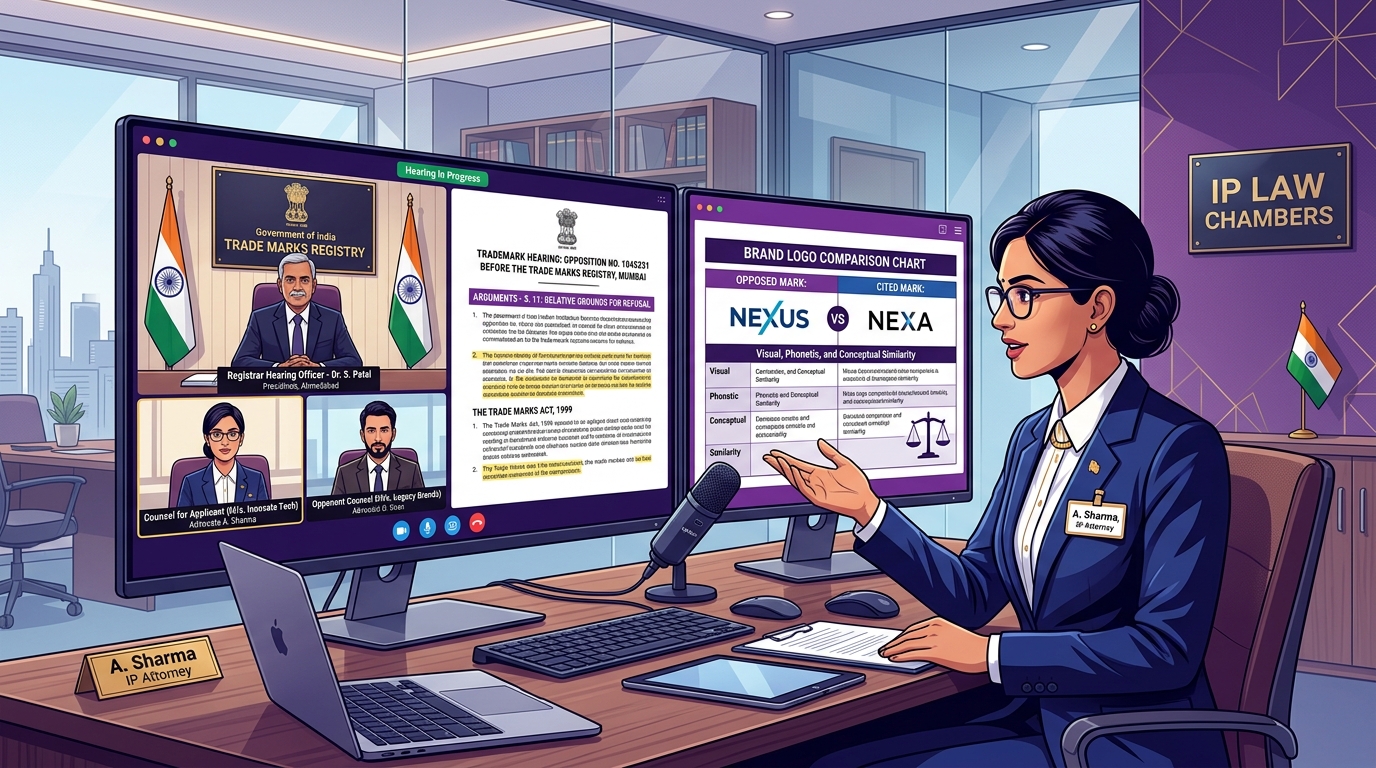
- 7.Side-by-Side Comparison Chart: Visual matrix proving phonetic, visual, and conceptual dissimilarity with cited marks.
- 8.Consent Letter / Coexistence Deed: If relying on coexistence with prior mark owner.
Step-by-Step Walkthrough on the Day of the Hearing
Executing a flawless virtual appearance requires following a systematic chronological workflow on the hearing date:
Pre-Hearing System Check (30 Mins Prior)
Re-test your camera, microphone, and internet bandwidth. Launch Cisco Webex Meetings application and verify that your screen name matches the required format: Item [No] - App [No] - [Name].
Join the Virtual Lobby (15 Mins Prior)
Click the official Webex link from your Hearing Notice. You will be placed in the “Virtual Waiting Lobby”. Do not disconnect; the registry moderator monitors the lobby and admits parties based on the dynamic cause list order.
Admission into the Hearing Courtroom
When your cause list item number is called, the moderator admits you into the main virtual room. Ensure your camera is immediately switched ON and your microphone remains muted until addressed.
Formal Appearance & Identity Recording
Unmute and announce your formal appearance: “Good morning / afternoon Officer, I am appearing on behalf of the Applicant in Item Number 14, Application Number 5678912 for the mark [Brand Name].”
Crisp Oral Submissions & Screen Sharing
Address the specific objection cited. Ask the officer: “May I share my screen to display our user invoices and comparison chart?” Present your strongest points within 3 to 5 minutes without reading lengthy paragraphs.
Responding to Officer Queries & Conditions
The Hearing Officer may propose standard conditions, such as: (a) Disclaimer of generic terms, (b) Restriction of goods specification, or (c) Association with an earlier mark under Section 16. Carefully accept reasonable conditions to secure acceptance.
Order Pronouncement & Post-Hearing Directions
The officer will verbally pronounce whether the application is Accepted, Directed for Written Arguments, or Refused. Note the directions, thank the Officer, and disconnect from the call.
Effective Oral Advocacy: Tackling Section 9 & Section 11 Objections
To win a show-cause hearing, your oral submissions must be structured around settled principles of Indian trademark jurisprudence:
Absolute Grounds (Non-Distinctive / Descriptive)
- • Arbitrary or Coined Mark: Demonstrate that the mark is an invented word having no direct dictionary meaning to the goods (e.g., KODAK or EXXON).
- • Acquired Distinctiveness (Sec 9 Proviso): Present audited turnover and continuous commercial use establishing that consumers exclusively associate the mark with your company.
- • Anti-Dissection Rule: Cite Supreme Court ruling in Cadila Healthcare that composite logos must be judged as a whole, not broken down into isolated components.
Relative Grounds (Conflict with Prior Marks)
- • Phonetic & Visual Dissimilarity: Walk the Officer through syllable counts, prefix/suffix distinctions, visual font logos, and color differences.
- • Different Trade Channels & Class Specialization: Prove that although goods share a class, customer profiles, price points, and retail channels are entirely distinct.
- • Honest Concurrent Use (Section 12): If you have used the mark in good faith alongside the cited mark for years, invoke statutory honest concurrent use protection.
- • Prior Adoption (Section 34): If your use date predates the cited mark’s registration or user claim, your common law rights take precedence.
Postponing a Hearing: Form TM-M Adjournment Rules
If the applicant or their authorized advocate cannot attend the scheduled hearing due to unavoidable emergencies, an official adjournment must be sought under Rule 115 of the Trade Marks Rules, 2017.
Statutory Protocol for Adjournment on Form TM-M
- • Mandatory Form: File Form TM-M electronically under the sub-category “Request for Adjournment of Hearing”.
- • Statutory Government Fee: ₹900 per application for e-filing (₹1,000 for physical filing).
- • Filing Window: Must be filed at least 3 to 7 working days prior to the scheduled hearing date to allow the Registry clerk to update the cause list.
- • Valid Legal Grounds: Medical hospitalization, bereavement, listing before the Supreme Court / High Court on the same day, or non-receipt of the hearing notice link.
- • Adjournment Limits: The Registrar exercises discretionary powers and will generally not grant more than two adjournments per matter.
Handling Technical Glitches, Disconnections & Dropped Calls
In virtual courtrooms, sudden bandwidth drops, audio feedback, or Webex server errors can occasionally occur. The Trade Marks Registry provides defined contingency mechanisms to safeguard applicant rights:
Immediately re-join the meeting. Post a polite message in the Webex public chat mentioning your item number and that you experienced a temporary disconnection.
Send an immediate email to the designated zonal registry hearing email attaching a timestamped screenshot of the login failure.
Within 24 to 48 hours, file a comprehensive Written Arguments dossier on Form TM-M stating the technical disconnection to ensure the matter is not marked abandoned.
Post-Hearing Orders, Status Tracking & High Court Appeals
Following the conclusion of oral arguments, the Hearing Officer updates the application status on the IP India database within 3 to 15 working days. The possible statutory outcomes include:
| Post-Hearing Status | Legal Meaning | Action Required |
|---|---|---|
| Accepted & Advertised | The Hearing Officer accepted your oral submissions without condition. The mark moves for 4-month Journal publication. | Monitor Trade Marks Journal for third-party opposition window. |
| Advertised Before Acc | The mark is advertised subject to specific conditions or user proof verification. | Ensure compliance with any specific disclaimer or class restrictions. |
| Submissions Awaited | The officer requested written notes of arguments or additional invoices before pronouncing order. | File comprehensive Written Arguments on Form TM-M within 15 days. |
| Refused (Section 18(4)) | The application is formally rejected by the Hearing Officer on statutory grounds. | Apply for Grounds of Decision under Section 18(5) on Form TM-M and file Appeal before the High Court IPD within 3 months under Section 91. |
Comparison Matrix: Virtual Video Hearing vs Physical Appearance
Evaluating the procedural and strategic parameters of the current virtual hearing mechanism against historical physical courtroom hearings:
| Operational Parameter | Video Hearing (Cisco Webex) | Physical In-Person Hearing (Legacy) |
|---|---|---|
| Geographic Accessibility | 100% remote across India and overseas. Zero travel required. | Mandatory travel to Delhi, Mumbai, Chennai, Kolkata, or Ahmedabad. |
| Document Demonstration | Instant digital screen-sharing of PDFs, comparison charts, and GST invoices. | Carrying heavy physical paper bundles and physical invoice files. |
| Waiting Time & Efficiency | Attend from desk while tracking real-time dynamic cause list queue. | Entire working day spent waiting in crowded registry corridors. |
| Adjournment Filing | Electronic submission via Form TM-M on IP India portal. | Physical counter filing at registry cash counter before 1 PM. |
| Cost to Applicant | Significantly lower; eliminates outstation advocate travel and hotel expenses. | Substantially higher due to flight, transit, and outstation litigation fees. |
Official Statutory Fee Schedule & Forms
Statutory government fees related to trademark hearing proceedings under the First Schedule of the Trade Marks Rules, 2017:
Hearing Adjournment Request
Official fee for seeking formal postponement of a scheduled virtual hearing date. Physical filing fee is ₹1,000 per application.
Grounds of Refusal Decision
Required to obtain the official written speaking order from the Hearing Officer before filing a High Court IPD appeal. Physical filing fee is ₹2,000.
Frequently Asked Questions
Why was my trademark application marked 'Ready for Show Cause Hearing'?
Which video conferencing platform is used by the Trade Marks Registry of India?
How do I find my trademark hearing date, time slot, and Webex meeting link?
What is the mandatory display name format required when joining the Cisco Webex hearing?
Can an applicant attend the trademark video hearing personally without an attorney?
What critical documents must be kept ready in digital format during the hearing?
What should I do if I face technical glitches, audio failure, or internet disconnection during the hearing?
How do I apply for an adjournment if I or my attorney cannot attend the scheduled hearing date?
What happens if neither the applicant nor the attorney joins the Webex hearing?
What post-hearing steps are required after concluding the oral video hearing?
Strategic Legal Counsel for Founders & Brand Custodians
A trademark hearing before the Trade Marks Registry is not a casual meeting; it is a formal statutory quasi-judicial proceeding that permanently determines whether your brand secures exclusive proprietary rights or suffers statutory abandonment.
Winning a show-cause hearing requires combining sharp knowledge of Indian trademark jurisprudence with disciplined virtual presentation skills. From setting up the mandatory Webex display name to presenting side-by-side logo comparison charts and citing binding High Court precedents on acquired distinctiveness, thorough preparation separates successful brand registrations from costly refusals.
If your trademark application has been posted for a show-cause hearing, avoid taking chances with inexperienced representation. Collaborate with seasoned intellectual property litigators who understand the nuances of the Delhi, Mumbai, Chennai, Kolkata, and Ahmedabad hearing boards.
Need Senior Counsel for Your Upcoming Trademark Video Hearing?
Our team of senior trademark litigators and registered attorneys represent applicants across all zonal Trade Marks Registry boards via Cisco Webex, handling dossier preparation, oral advocacy, and written arguments.