
Written byRahul Roy
Trademark Research Specialist
Overview of Trademark Consent & Coexistence
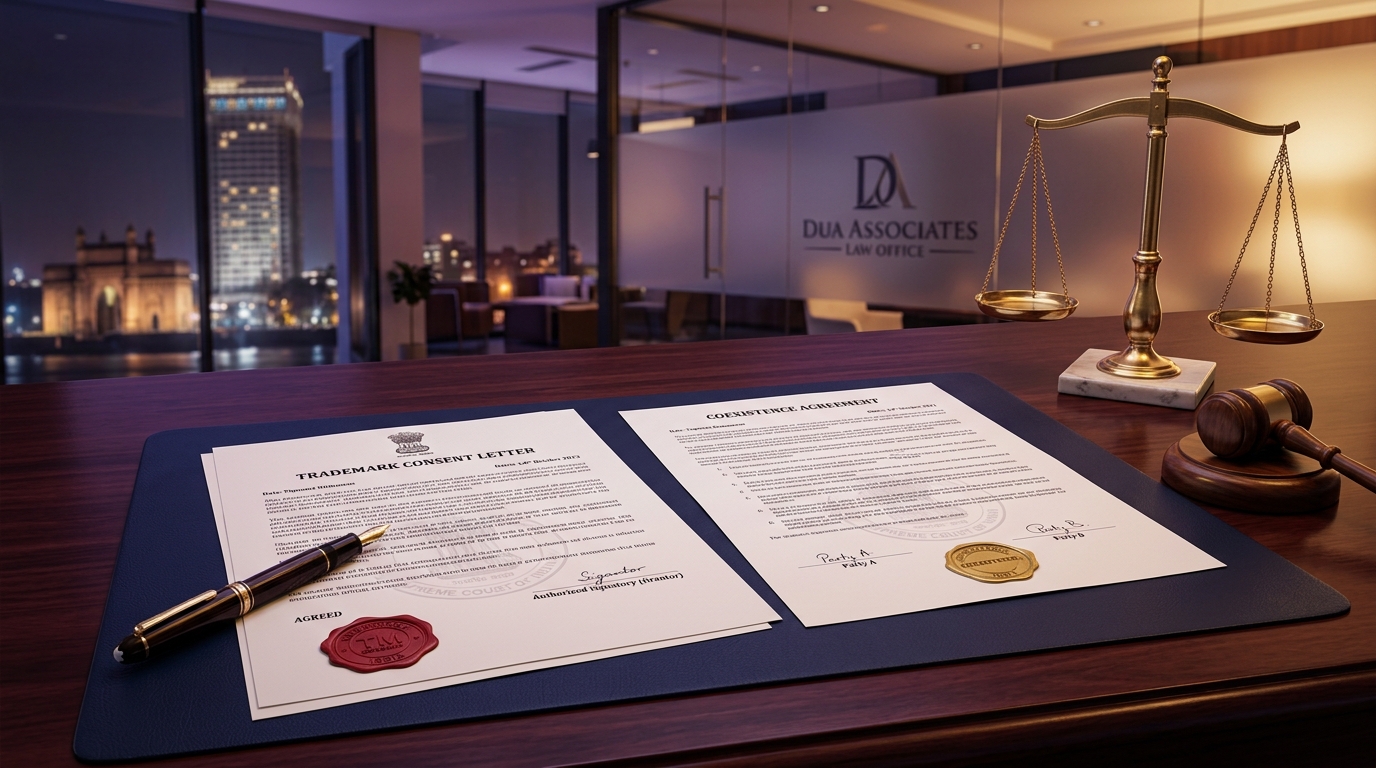
A Trademark Consent Letter (NOC) is a formal declaration from the owner of an earlier cited trademark authorizing the registration of a newer, similar mark under Section 12 of the Trade Marks Act, 1999. When commercial relations require detailed operational boundaries (such as distinct product lines, non-overlapping territories, or specific marketing channels), parties execute a bilateralTrademark Coexistence Agreement. While private consent significantly strengthens an objection defense, the Indian Trade Marks Registry retains absolute statutory discretion to ensure that public interest and consumer clarity remain uncompromised.
During the official examination of a trademark application in India, the most frequent roadblock faced by entrepreneurs is an objection raised underSection 11(1) of the Trade Marks Act, 1999(Relative Grounds of Refusal). The Examiner searches the national database and cites one or more prior pending or registered marks that bear phonetic, visual, or conceptual similarities in identical or allied classes.
Rather than engaging in years of adversarial opposition or costly High Court litigation, modern corporate strategy favors negotiated settlement. When both businesses recognize that their customer bases do not collide or when the cited mark belongs to a sister company, vendor, or global affiliate, they use two vital legal instruments:
- Letter of Consent (NOC):A unilateral instrument executed by the registered owner of the cited mark granting unequivocal permission to the Trade Marks Registry to register the applicant's mark.
- Trademark Coexistence Agreement:A comprehensive, legally binding contract governing operational rules, trade dress differences, product delimitations, negative covenants, and dispute settlement mechanisms between two commercial entities.
Leveraging these instruments alongsidestandard trademark registration stepstransforms a potential application rejection into a secure, collaborative brand coexistence framework.
Overcoming Section 11 Relative Grounds
Section 11(1) of the Trade Marks Act, 1999 creates a statutory bar against the registration of a trademark if:
(a) Its identity with an earlier trade mark and similarity of goods or services covered; or
(b) Its similarity to an earlier trade mark and the identity or similarity of goods or services,
creates a likelihood of confusion on the part of the public, including the likelihood of association with the earlier trade mark.
When an Examination Report cites a prior mark, an applicant can conventionally argue visual distinctions, phonetic dissimilarity, or distinct consumer demographics. However, if the marks are substantially similar, purely rhetorical arguments rarely convince the Hearing Officer.
This is where securing aLetter of Consent / NOCfrom the proprietor of the cited mark changes the trajectory of the prosecution. By producing formal written acquiescence, the applicant dismantles the assumption of commercial injury to the prior owner, opening the gateway to statutory registration under Section 12.
Section 12: Honest Concurrent Use & Discretion
The Trade Marks Act, 1999 recognizes that in a dynamic, continent-sized economy, multiple businesses may adopt similar marks in good faith without deceitful intent. To address this reality,Section 12provides:
“In the case of honest concurrent use or of other special circumstances which in the opinion of the Registrar, make it proper so to do, the Registrar may permit the registration of trade marks which are identical or similar in respect of the same or similar goods or services, subject to such conditions and limitations, if any, as the Registrar may think fit to impose.”
Indian trademark jurisprudence establishes that aLetter of Consent or Coexistence Agreement constitutes “other special circumstances”within the meaning of Section 12. When the prior registered proprietor certifies in writing that both marks have coexisted or can operate simultaneously without market conflict, the statutory threshold for the Registrar to exercise discretionary approval is fully met.
To maximize success under Section 12, the consent letter should always be reinforced by a sworntrademark user affidavitdocumenting prior commercial sales, marketing expenditures, and parallel market adoption.
Consent Letter (NOC) vs Coexistence Agreement
While practitioners often use the terms interchangeably, a Letter of Consent and a Trademark Coexistence Agreement serve distinct legal functions and carry differing levels of complexity:
Letter of Consent (NOC)
A formal written declaration signed solely by the cited proprietor confirming they have examined the applicant's mark and raise no objection to its registration.
- Ideal for sister entities, group subsidiaries, or holding companies.
- Straightforward to draft, execute, and submit on Form TM-M.
- Focuses exclusively on Registry proceedings without governing operational trade terms.
Coexistence Agreement
A bilateral contract between independent commercial competitors defining strict market, visual, territorial, and digital boundaries for long-term coexistence.
- Essential for unrelated businesses operating in adjacent markets.
- Includes covenants not to challenge, sue, or oppose each other.
- Enforceable in Indian civil courts under the Indian Contract Act, 1872.
In practice, corporate applicants negotiating with external competitors often execute a privateTrademark Coexistence Agreement, and as an agreed deliverable under that contract, the cited party executes a cleanLetter of Consent (NOC)that is submitted directly to the Trade Marks Registry.
Legal Comparison Matrix
The table below provides a comprehensive comparison across key legal, procedural, and commercial parameters under Indian intellectual property law:
| Parameter | Letter of Consent (NOC) | Coexistence Agreement |
|---|---|---|
| Legal Nature | Unilateral declaration / No-Objection certificate | Bilateral commercial contract under Contract Act, 1872 |
| Executing Parties | Signed solely by the prior registered proprietor | Signed by both the applicant and prior proprietor |
| Primary Objective | Overcoming Section 11(1) examination objections | Preventing future disputes, infringement, and oppositions |
| Public Filing Status | Uploaded to Registry portal (becomes part of public record) | Maintained as confidential private contract (or filed redacted) |
| Scope of Terms | Limited to registration consent for specific mark/class | Covers territories, trade dress, domains, non-compete, breach |
| Stamp Duty & Notarization | Affidavit format on stamp paper / notarized declaration | Stamped under State Stamp Act as commercial agreement |
| Binding on Registrar? | No, subject to Section 12 public interest review | No, but serves as conclusive evidence of special circumstances |
| Breach Remedies | Withdrawal of consent (difficult once advertised) | Specific performance, civil injunctions, damages, arbitration |
Will the Registry Accept an NOC? (Public Interest Test)
A critical misconception among businesses is that obtaining a consent letter guarantees immediate registration. Under Indian law,the Registrar is not a mere passive recorder of private contracts. The Registrar of Trade Marks is a statutory authority charged with protecting the general purchasing public from confusion and deceptive association.
The Delhi High Court and IPAB (Intellectual Property Appellate Board) have consistently held that private parties cannot contract out of statutory confusion. When evaluating a Letter of Consent or Coexistence Agreement under Section 12, the Registry applies a three-foldPublic Interest Test:
1Degree of Mark Similarity & Visual Distinctiveness
If the marks are identical wordmarks with identical spellings, the Registry will be highly skeptical. However, if the marks share a common prefix or suffix but possess distinctive logos, stylized fonts, or device elements, the consent letter carries substantial persuasive weight.
2Nature of Goods, Services & Trade Channels
Consent letters succeed easily when goods within the same broad class serve distinct consumer segments (e.g., luxury industrial machinery vs consumer hand tools in Class 7, or enterprise B2B software vs casual mobile games in Class 9).
3Sophistication of the Relevant Purchasing Public
Specialized business buyers, engineers, and corporate procurement heads exercise higher discernment and are unlikely to be confused. Conversely, ordinary retail consumers purchasing low-cost FMCG products are deemed more susceptible to casual deception.
Strict Scrutiny: The Pharmaceutical Exception
WARNING FOR CLASS 5 APPLICANTS: The Trade Marks Registry and Indian Courts virtually never accept consent letters or coexistence agreements for pharmaceutical, medicinal, and healthcare preparations.
In the landmark rulingCadila Health Care Ltd. V. Cadila Pharmaceuticals Ltd. (2001) 5 SCC 73, the Supreme Court of India established the doctrine ofstrict scrutinyfor medicinal products. The Supreme Court underscored that confusion in commercial goods merely results in financial loss. In contrast, confusion in medicines can result in life-threatening health risks, incorrect treatment, and fatal dosage errors.
Because medicines are dispensed across India by busy chemists with varying handwriting legibility and language capabilities, private consent between two pharmaceutical companies cannot override the paramount safety of patients. Consequently, if your mark is in Class 5 and faces Section 11 citations for identical or similar drug names, relying on a consent letter will almost certainly fail. You must rebrand or pursue cancellation of the cited mark if abandoned.
10 Crucial Coexistence Agreement Clauses
A robust Trademark Coexistence Agreement must balance immediate registration objectives with long-term brand equity protection. When drafting the contract, ensure the following 10 clauses are meticulously defined:
1. Recitals & Title Verification
Accurately details the application numbers, registration certificates, filing dates, and current business activities of both parties.
2. Delimitation of Goods/Services
Defines exact carve-outs, class specifications, and negative covenants barring expansion into the other party's commercial domain.
3. Territorial & Geographic Allocation
Restricts sales, distribution channels, or physical store operations to specific domestic states or international jurisdictions.
4. Visual Trade Dress & Logo Restraints
Mandates distinct font typography, color combinations, house-mark prefix additions, and logo stylization rules.
5. Digital, Domain & Social Media Rules
Governs top-level domain names, social media handles, e-commerce keywords, and paid Google Ads bidding parameters.
6. Covenant Not to Oppose or Cancel
Mutual undertaking not to file Section 21 oppositions, Section 57 rectifications, or civil infringement lawsuits against compliant use.
7. Registry Cooperation & NOC Execution
Express obligation on the prior owner to execute and notarize the standalone Letter of Consent for filing before the Trade Marks Registry.
8. Third-Party Enforcement Coordination
Mechanisms for dealing with third-party copycats, including joint policing, unilateral enforcement rights, or mutual notifications.
9. Assignment & Successor Binding
Ensures that in the event oftrademark assignment or licensing, the agreement remains binding on future acquirers.
10. Dispute Resolution & Seat of Arbitration
Specifies governing Indian law, commercial court jurisdiction, and fast-track arbitration under the Arbitration & Conciliation Act, 1996.
Standard Format & Sample NOC Template
Below is a standard, verified template for aLetter of Consent / No Objection Certificate (NOC)to be submitted to the Trade Marks Registry on the official letterhead of the consenting proprietor (duly stamped and notarized):
IN THE MATTER OF TRADEMARK APPLICATION NO. [________] IN CLASS [__]
IN THE NAME OF [APPLICANT ENTITY NAME]
LETTER OF CONSENT / NO OBJECTION CERTIFICATE
To,
The Registrar of Trade Marks,
Trade Marks Registry at [Mumbai / Delhi / Kolkata / Chennai / Ahmedabad]
We,[CONSENTING COMPANY NAME], a company incorporated under the Companies Act, having our registered office at [Registered Address] (hereinafter referred to as the “Consenting Proprietor”), through our authorized signatory [Name and Designation], do hereby solemnly affirm, declare, and state as under:
1. That we are the absolute registered proprietor / prior applicant of the trademark“[CITED TRADEMARK]”registered / pending under Application/Registration No.[________]in Class[__]for [Brief description of goods/services].
2. That we have been apprised of the trademark application filed by[APPLICANT ENTITY NAME], having their principal place of business at [Applicant Address], for the trademark“[APPLICANT TRADEMARK]”under Application No.[________]in Class[__]for the specification of [Specify agreed goods/services].
3. That we have thoroughly examined the mark and goods/services of the Applicant and have satisfied ourselves that the commercial activities, marketing channels, and consumer profiles of the two entities are distinct and that no consumer confusion or public deception shall arise from the concurrent operation and registration of the said marks.
4. That in terms ofSection 12 of the Trade Marks Act, 1999, we haveNO OBJECTION WHATSOEVERto the acceptance, advertisement, and final registration of the trademark“[APPLICANT TRADEMARK]”under Application No.[________]in Class[__]in the name of the Applicant.
5. That we request the learned Registrar of Trade Marks to kindly waive the objection cited under Section 11(1) of the Trade Marks Act, 1999 for our cited mark and proceed with the registration of the Applicant's mark.
IN WITNESS WHEREOF, the Consenting Proprietor has executed this Letter of Consent through its Authorized Signatory on this [Date] day of [Month], 20[__].
________________________
Authorized Signatory
Name: [Name]
Designation: [Director / Authorized Officer]
Note: Ensure the document is printed on corporate letterhead, affixed with appropriate stamp duty, accompanied by a certified copy of the Board Resolution /Form TM-48 Power of Attorney, and notarized by a certified Notary Public.
7-Step Objection Resolution Workflow
Follow this systematic legal roadmap to successfully negotiate, execute, and file a Trademark Consent Letter before the Trade Marks Registry:
Analyze Section 11 Citations
Examine the official Examination Report. Note all cited application/registration numbers, owner names, class classifications, and cited mark representations.
Conduct Commercial & Legal Diligence
Conduct an IP audit to verify if the cited mark is actively used, renewed, abandoned, or belonging to a corporate entity with whom your business maintains commercial relations.
Initiate Constructive Dialogue
Engage senior leadership or IP counsel of the cited entity. Offer clear commercial delimitations (such as restricting your goods specification) to assure them of zero market conflict.
Draft Coexistence Terms & Standalone NOC
Draft the bilateral Coexistence Agreement incorporating trade dress rules, digital boundaries, and dispute terms alongside the clean standalone Letter of Consent for the Registry.
Formal Execution & Stamping
Execute the documents on appropriate stamp paper with corporate seals, Board Resolutions of authorized signatories, and formal notarization.
File Form TM-M & Written Examination Reply
Submit the formal written response on the IP India portal. Upload the notarized Consent Letter on Form TM-M alongside Section 12 user evidence and amended class specifications if required.
Advocate at Show Cause Hearing
Your trademark attorney appears before the Hearing Officer to establish honest concurrent use and special circumstances, securing the order for journal advertisement.
Documentation & Procedural Checklist
Before submitting your consent package to the Trade Marks Registry, ensure the evidentiary dossier contains every mandatory compliance item:
- Executed Consent Letter:Original or notarized copy on corporate letterhead with full class details.
- Board Resolution / Authorization:Document proving the signatory possesses legal authority to bind the consenting entity.
- Section 12 User Affidavit:Sworn affidavit under Rule 25 demonstrating commercial adoption, sales figures, and invoices.
- Form TM-M Miscellaneous Receipt:Government fee receipt (₹900 e-filing) for document recordal.
- Amended Goods Specification (if applicable):Form TM-M request restricting overlapping products.
- Foreign Execution Apostille:If executed abroad, notarization and apostille/consular legalization under the Hague Convention.
Landmark Indian Judicial Precedents
Indian High Courts and the Supreme Court have shaped the doctrine of honest concurrent use and trademark coexistence through foundational rulings:
1. Cadila Health Care Ltd. v. Cadila Pharmaceuticals Ltd. (2001)
Supreme CourtPrinciple: Paramount Public Interest in Medicinal Brands
The Supreme Court ruled that in medicinal and pharmaceutical trademarks, public interest strictly prohibits deceptive similarity. This establishes that private commercial consent cannot validate concurrent registrations where patient health could be compromised.
2. Century Traders v. Roshan Lal Duggar & Co. (1977)
Delhi High CourtPrinciple: Foundations of Honest Concurrent Adoption
The Division Bench affirmed that prior commercial use and good-faith parallel adoption create protectable rights under Indian trademark law. This provides the foundational doctrine for Section 12 honest concurrent use registrations.
3. Stiefel Laboratories Inc. v. Registrar of Trade Marks (2014)
IPAB RulingPrinciple: Weight of Consent Letters in Allied Commercial Lines
The IPAB held that where sophisticated commercial entities operating in non-competing product categories enter into a bona fide coexistence framework, the Registrar ought to give substantial weight to the Letter of Consent under Section 12 “special circumstances”.
Frequently Asked Questions
Q.Will the Indian Trade Marks Registry automatically accept a Letter of Consent from a cited mark owner?
No. Unlike some foreign jurisdictions (such as the US or EU where consent letters are given substantial weight), the Indian Trade Marks Registry is not bound by private agreements. Under Section 11 and Section 12 of the Trade Marks Act, 1999, the Registrar acts as a trustee of public interest to prevent consumer deception. If the Registrar determines that two marks are identical or confusingly similar for identical goods—especially in sensitive sectors like food, healthcare, or consumer pharmaceuticals—the objection may still be sustained despite an undisputed consent letter.
Q.How does Section 12 Honest Concurrent Use support a trademark consent letter?
Section 12 of the Trade Marks Act, 1999 grants statutory discretion to the Registrar to permit the registration of identical or similar trademarks by more than one proprietor in cases of honest concurrent use or other special circumstances. A Letter of Consent or Coexistence Agreement serves as conclusive evidence of 'special circumstances' and mutual commercial acquiescence. When paired with a comprehensive user affidavit and historical sales records showing parallel market presence, Section 12 provides the legal vehicle for the examiner to waive the Section 11(1) citation.
Q.Can a Letter of Consent or Coexistence Agreement overcome Section 9 objections?
No. Consent letters and coexistence agreements are strictly designed to resolve Section 11 Relative Grounds of Refusal (conflicts with prior cited third-party trademarks). They have no legal effect on Section 9 Absolute Grounds of Refusal, which relate to a mark's intrinsic lack of distinctiveness, descriptive character, generic nature, or customary commercial usage. An applicant facing a Section 9 objection must prove acquired distinctiveness or secondary meaning independently.
Q.Are consent letters accepted for pharmaceutical and medicinal trademarks in Class 5?
In pharmaceutical and medicinal products, Indian courts and the Trade Marks Registry apply the doctrine of strict scrutiny established in Cadila Health Care v. Cadila Pharmaceuticals. Because phonetic or visual similarity in medicines can lead to catastrophic health consequences and fatal dispensing errors, public interest strictly overrides private commercial consent. Consequently, the Registry routinely rejects consent letters in Class 5 if there is any plausible risk of patient confusion.
Q.What is the legal difference between a Letter of Consent (NOC) and a Trademark Coexistence Agreement?
A Letter of Consent (often called an NOC) is a unilateral declaration executed by the cited proprietor confirming they have no objection to the applicant's registration of the specific mark for designated goods or services. In contrast, a Trademark Coexistence Agreement is a formal bilateral contract outlining comprehensive commercial boundaries—such as geographical territorial divisions, specific trade channels, restrictions on future expansion, digital branding rules, visual trade dress distinctions, and dispute resolution mechanisms.
Q.How is a Trademark Consent Letter filed with the Indian Trade Marks Registry?
A Trademark Consent Letter is typically filed online through the IP India e-filing portal either as part of the formal written Reply to the Examination Report or uploaded on Form TM-M with the prescribed official fee (₹900 for online filing) under the category of 'Miscellaneous Request / Submission of Documents'. It must be accompanied by an affidavit of the authorized signatory, board resolutions (if applicable), and an amended goods/services specification if conditioned upon class delimitations.
Q.What stamp duty is required for a Trademark Coexistence Agreement in India?
A Trademark Coexistence Agreement is a commercial contract and must be executed on non-judicial stamp paper or e-stamped under the Stamp Act of the state where it is executed (e.g., Maharashtra, Delhi, Karnataka, or Tamil Nadu). Stamp duty typically ranges from ₹100 to ₹1,000 depending on state-specific schedules for general commercial agreements without consideration. If executed outside India, it must be notarized and apostilled/stamped within three months of receipt in India.
Q.What legal remedies exist if a party breaches a Trademark Coexistence Agreement?
If a party violates the agreed boundaries of a coexistence agreement (for example, by expanding into an excluded product category, using prohibited trade dress, or filing trademark applications in restricted territories), the aggrieved party can enforce the contract through commercial dispute resolution mechanisms. This includes filing a civil suit for breach of contract and permanent injunction, invoking arbitration under the Indian Arbitration and Conciliation Act, 1996, or filing a Section 57 rectification petition to cancel the infringing trademark registration.
Strategic Brand & Legal Takeaway
A Section 11 Examination Objection should never be viewed as a dead end. In commercial brand building, discovering an earlier cited trademark often represents an opportunity to establish constructive industry relationships through a negotiatedTrademark Coexistence AgreementorLetter of Consent (NOC).
By formally bounding product specifications, trade dress packaging, and digital marketing channels, both businesses can coexist harmoniously without incurring the paralyzing costs of High Courtpassing off and trademark infringement litigation.
If your trademark application is currently marked as “Objected” on the Trade Marks Registry portal, do not attempt informal or unvetted responses. Consult experienced intellectual property attorneys to evaluate whether your cited mark can be resolved via Section 12 honest concurrent use, negotiate formal coexistence terms, and secure the legal exclusivity your business deserves.
Resolve Section 11 Trademark Objections
Facing conflicting mark citations? Partner with registered trademark attorneys to draft airtight Coexistence Agreements, secure valid Consent NOCs, and achieve Section 12 registry acceptance.
Certified IP Advocates • Expert Section 12 Reply Drafting • Fixed Transparent Pricing