
Written by Rahul Roy
Trademark Research Specialist
Overview of Indian Trademark Deadlines
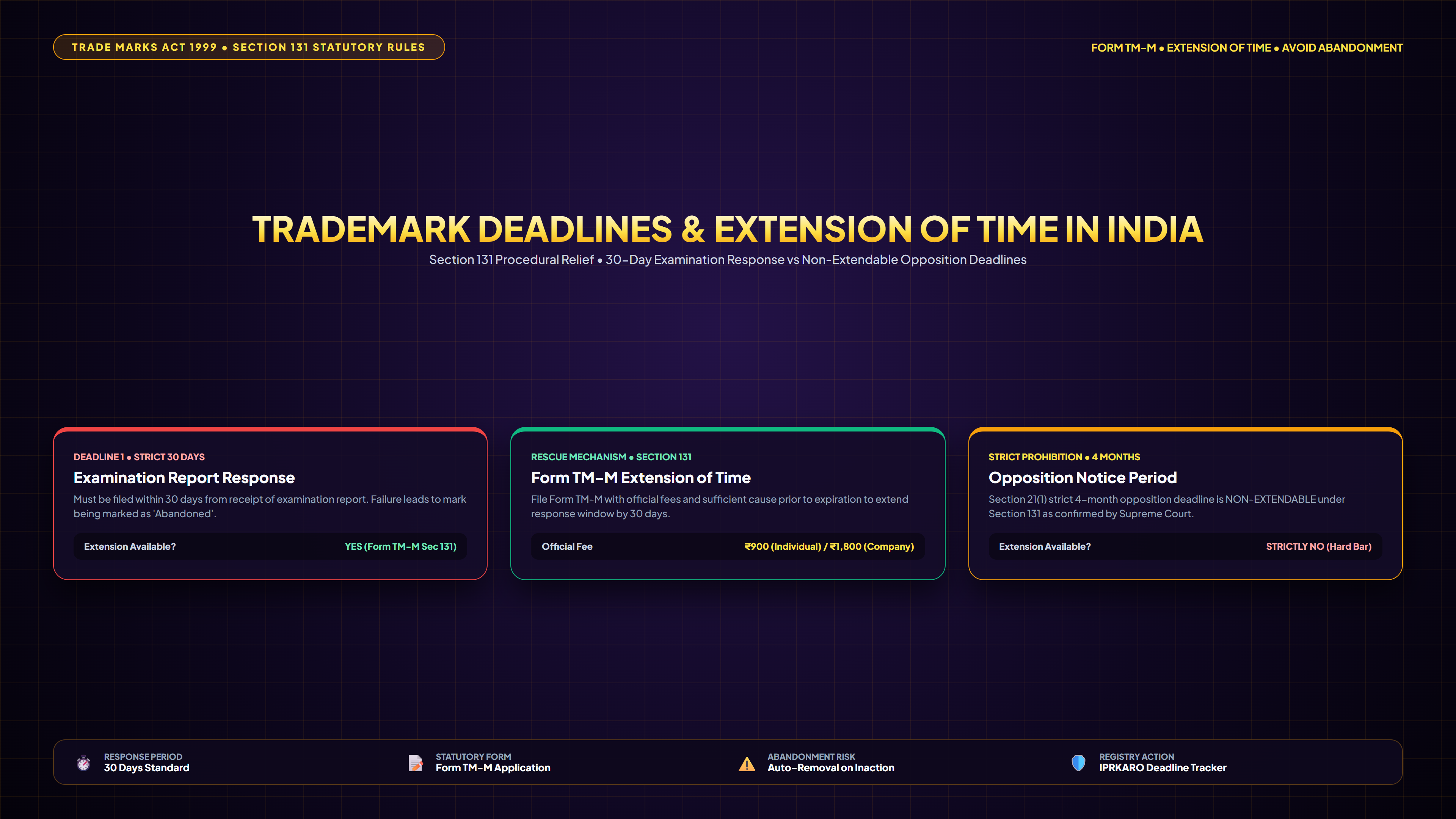
Trademark deadlines in India are strictly governed by the Trade Marks Act, 1999 and the Trade Marks Rules, 2017. While procedural steps—such as replying to an Examination Report (30 days) and requesting hearing adjournments (Rule 50)—can be extended under Section 131 and Rule 109 by filing Form TM-M with prescribed fees (₹900 for MSME/Individuals, ₹1,800 for Others), statutory deadlines such as the 4-month trademark opposition period under Section 21(1) and the 2-month counter-statement filing window under Section 21(2) are non-extendable by law. Missing these strict dates triggers automatic statutory abandonment.
In trademark prosecution, time is of the essence. The Indian Trade Marks Registry enforces rigid timelines across every stage of the brand registration lifecycle. When an applicant misses a statutory deadline, the online automated portal of the Intellectual Property India (IP India) office marks the application as “Abandoned” under Section 21(2) or Rule 33. Understanding how to navigate these dates—and knowing precisely when and how to invoke Section 131 for an extension of time—is what separates protected brand portfolios from catastrophic loss of trademark rights.
Whether you are dealing with an impending trademark examination report reply, coordinating an urgent trademark opposition counter-statement, or seeking restoration of an abandoned trademark, this comprehensive guide breaks down the exact statutory limits, extension protocols, judicial precedents, and action frameworks you need to protect your intellectual property.
Statutory Time Limits Across All Stages
Every procedural step in Indian trademark law operates on a defined statutory timeline. The table below outlines all primary milestones, their governing sections/rules, official deadlines, and whether an extension under Section 131 is legally permissible:
| Prosecution Stage | Governing Provision | Statutory Deadline | Section 131 Extendable? | Consequence of Missing |
|---|---|---|---|---|
| Formality Check Correction | Rule 29 | 30 Days from Notice | Yes (Form TM-M) | Application Abandoned |
| Examination Report Reply | Section 18 / Rule 33 | 30 Days from Dispatch | Yes (30-day ext. on TM-M) | Marked Abandoned under Rule 33 |
| Notice of Opposition Filing | Section 21(1) | 4 Months from TM Journal | STRICTLY NO (Non-Extendable) | Mark Proceeds to Registration |
| Counter-Statement (Form TM-O) | Section 21(2) / Rule 44 | 2 Months from Receipt of Notice | STRICTLY NO (Non-Extendable) | Deemed Abandoned by Law |
| Evidence in Support of Opposition | Rule 45 | 2 Months from Counter-Statement | Strict Rule (Waiver required) | Opposition Deemed Abandoned |
| Evidence in Support of Application | Rule 46 | 2 Months from Opponent Evidence | Strict Rule (Waiver required) | Application Deemed Abandoned |
| Hearing Adjournment Request | Rule 50 | Min. 3 Days Before Hearing | Yes (Max 2 times, ≤30 days each) | Order Passed Ex-Parte / Refused |
| Trademark Renewal (Standard) | Section 25(1) / Rule 57 | Within 1 Year Prior to Expiry | Standard Filing Window | Enters Surcharge Period |
| Renewal Grace Period (Surcharge) | Section 25(3) / Rule 58 | Up to 6 Months After Expiry | No (Statutory Grace Only) | Mark Removed from Register |
| Restoration of Expired Mark | Section 25(4) / Rule 60 | 6 Months to 1 Year After Expiry | Discretionary (Form TM-R) | Permanent Lapse of Trademark |
Section 131: Extension of Time Power
Section 131 of the Trade Marks Act, 1999 is the foundational statutory provision granting the Registrar discretionary authority to extend procedural timelines. The text of Section 131 states:
“131. Extension of time.—(1) If the Registrar is satisfied, on application made to him in the prescribed manner and on payment of the prescribed fee, that there is sufficient cause for extending the time for doing any act (not being a time expressly provided in this Act), whether the time so specified has expired or not, he may, subject to such conditions as he may think fit to impose, extend the time and notify the parties accordingly.”
Three critical legal principles emerge from Section 131(1):
1. “Sufficient Cause” Test
The applicant must substantiate genuine reasons—such as foreign documentary legalisation, collecting verified sales turnover affidavits, or medical emergencies—showing no willful negligence.
2. “Not Expressly Provided”
Section 131 cannot override time limits explicitly fixed in the primary Act (such as the 4-month opposition bar in Section 21(1) and the 2-month counter-statement bar in Section 21(2)).
3. Discretionary Imposition
The Registrar may impose reasonable conditions, including costs or time caps (typically 30 additional days), and must notify opposing parties where inter-partes proceedings are ongoing.
Extendable vs Non-Extendable Deadlines
Indian trademark jurisprudence distinguishes between substantive statutory time bars (which cannot be extended by any administrative authority) and procedural registry timelines (which can be extended under Section 131 and Rule 109).
Extendable Timelines (Section 131)
- Examination Report Reply: Additional 30 days grantable via Form TM-M under Rule 109.
- Formality Check Requirements: Curing discrepancies, Form TM-48 submission, or translation certificates.
- Hearing Adjournment: Postponement of show-cause or opposition hearing under Rule 50 (max 2 times).
- Filing Power of Attorney (Form TM-48): Can be filed subsequent to application with an extension request. Learn more in our Form TM-48 legal guide.
Strictly Non-Extendable Deadlines
- Section 21(1) Notice of Opposition: 4 months strictly non-extendable by the Registrar under any circumstance.
- Section 21(2) Counter-Statement: 2 months strictly non-extendable; failure results in immediate deemed abandonment.
- Rule 45 Opposition Evidence: 2 months to file affidavit or letter relying on facts stated in notice.
- Section 25(3) Renewal Surcharge Limit: 6-month grace window is a statutory cap that cannot be enlarged by Form TM-M.
Form TM-M Extension Filing Procedure
Under Rule 109 of the Trade Marks Rules, 2017, any application for an extension of time under Section 131 must be submitted electronically through the IP India Comprehensive E-Filing portal on Form TM-M. Follow this step-by-step workflow:
Step 1: Track Impending Expiration Date
Determine the exact calendar date when your 30-day or hearing timeline expires based on the dispatch date or registry record.
Step 2: Draft Sufficient Cause Petition
Prepare a formal legal application detailing the genuine factual impediment preventing compliance within the regular timeline.
Step 3: Access Form TM-M on IP India Gateway
Log into your attorney or applicant digital signature portal, select Form TM-M, and select category “Application for Extension of Time (Rule 109 / Section 131)”.
Step 4: Pay Prescribed Government Fee
Pay ₹900 (for Individuals, Startups, and MSMEs with valid Udyam certificates) or ₹1,800 (for Other Corporate Entities) via the Bharatkosh payment gateway.
Step 5: File Substantive Response Within Extended Window
Once the extension is filed, submit your substantive reply, evidence affidavit, or documentation before the 30-day extended window lapses.
Objection Reply: 30-Day Rule & Extension
When the Trade Marks Registry issues an Examination Report citing objections under Section 9 (Absolute Grounds) or Section 11 (Relative Grounds), Rule 33(1) mandates that the applicant file a formal written response within 30 days from the date of receipt of the report.
In practice, brand owners often require additional time to:
- Execute and notarize a comprehensive Trademark User Affidavit under Rule 25 establishing prior continuous commercial use.
- Obtain a formal Trademark Consent Letter or Coexistence Agreement from a cited proprietor.
- Collect statutory consent affidavits under Section 14 for names of living or deceased persons.
- Secure legalized foreign registration certificates for claiming international priority.
Crucial Practice Tip: File Form TM-M BEFORE the 30-Day Expiry Date
Although Section 131 allows an extension application “whether the time so specified has expired or not”, the IP India online system automatically triggers abandonment flags upon the 31st day. Filing Form TM-M prior to day 30 prevents automated algorithmic abandonment and preserves the application in “Objected” status.
Opposition: 4-Month Strict Statutory Bar
Under Section 21(1) of the Trade Marks Act, 1999, any person may give notice in writing on Form TM-O to the Registrar of opposition to the registration of an advertised mark “within four months from the date of the advertisement or re-advertisement of an application for registration”.
Historically under the 1958 Act and early 2002 rules, an opponent could seek an extension of 1 month beyond the initial 3 months upon showing good cause. However, the Trade Marks Rules, 2017 completely eliminated the extendable 1-month provision and established a single, fixed 4-month statutory window.
Landmark Judicial Precedents on Non-Extendability of Section 21(1)
The Delhi High Court, Intellectual Property Appellate Board (IPAB), and various High Courts have repeatedly held that the period of 4 months under Section 21(1) is a mandatory statutory period of limitation.
In Delta Dental Plan Association v. Registrar of Trade Marks and Sunrider Corporation, the courts ruled that the Registrar lacks jurisdiction under Section 131 to entertain any Notice of Opposition received even a single day after the expiry of the 4-month window. If you miss this deadline, your sole legal remedy is to wait for registration and file a Trademark Rectification / Cancellation petition under Section 57.
Hearing Adjournments under Rule 50
When an application is scheduled for a show-cause hearing (before the Hearing Officer) or an inter-partes opposition hearing via video conferencing, either party can seek an adjournment under Rule 50 of the Trade Marks Rules, 2017.
The strict conditions governing hearing adjournments include:
Timing Rule
The Form TM-M requesting adjournment must be filed at least 3 days prior to the scheduled hearing date.
Adjournment Cap
No party shall be given more than 2 adjournments throughout the entire proceeding.
Duration Cap
Each adjournment granted by the Hearing Officer shall not exceed 30 days.
Fee Obligation
Official Form TM-M fee of ₹900 (MSME/Individual) or ₹1,800 (Large Entity) must accompany the request.
Learn the full step-by-step hearing preparation protocol in our detailed guide on trademark hearing video conferencing procedure.
Renewal & Restoration Timelines
Under Section 25 of the Trade Marks Act, 1999, trademark registrations are valid for a duration of 10 years from the date of application, renewable indefinitely in successive 10-year periods. The three distinct renewal phases are:
Phase 1: Standard Renewal Window (1 Year Before Expiry)
The proprietor can file Form TM-R at any time within 1 year before the expiration of the last registration. Standard e-filing fee is ₹9,000 per class (or ₹4,500 if applicable) without any penalty. See our trademark renewal guide.
Phase 2: Grace Period Renewal with Surcharge (0 to 6 Months After Expiry)
Under Section 25(3) and Rule 58, if the mark is not renewed before expiry, the proprietor has a statutory grace period of 6 months to file Form TM-R along with the prescribed late renewal surcharge.
Phase 3: Restoration & Renewal (6 Months to 1 Year After Expiry)
Under Section 25(4) and Rule 60, if the mark has been removed from the register for non-payment of renewal fees, the proprietor can apply for Restoration and Renewal on Form TM-R within 1 year from the expiration date, supported by an affidavit demonstrating valid reasons for the lapse. Learn more in our expired trademark restoration guide.
Remedies for Abandoned Trademark Marks
If your trademark application has been marked as “Abandoned” due to a missed deadline, all hope is not lost. The following legal remedies exist depending on why the deadline was missed:
1. Registry Restoration Petition
If the examination report or hearing notice was never served on the applicant or agent of record, file a Petition under Section 131 / Rule 109 on Form TM-M supported by an affidavit proving non-receipt and breach of natural justice principles.
2. Review Petition (Sec. 127)
Under Section 127(c) and Rule 119, file a formal Application for Review of the Registrar's decision within 30 days of the abandonment order, citing errors apparent on the face of the record.
3. High Court Writ Petition
In landmark cases like Tata Motors Ltd. v. Registrar of Trade Marks, the Delhi High Court set aside arbitrary online abandonment orders where the Registry failed to provide a mandatory personal hearing under Section 18(4).
Deadline Compliance Action Checklist
Protect your brand from accidental abandonment by executing this rigorous statutory compliance checklist:
Implement Automated Docketing Systems
Track every application status weekly to catch examination reports and journal publications the moment they are generated.
Verify Attorney & Correspondence Email Addresses
Ensure your Form TM-48 contains active email addresses so notices sent via IP India automated servers are not lost to spam filters. If you need to update counsel, read how to change trademark attorney.
File TM-M Extension on Day 20-25
Never wait until Day 30 to file an extension request. Server timeouts or payment gateway reconciliation delays can result in irreparable abandonment.
Audit 10-Year Renewal Calendars
Initiate renewal instructions 11 months before the 10-year expiry to avoid the need for surcharges or high-risk restoration proceedings.
Frequently Asked Questions
Find definitive legal answers to the most common queries regarding trademark deadlines, Section 131 extensions, and abandonment rules in India:
1. Can the 4-month trademark opposition filing deadline be extended under Section 131?
No. The 4-month statutory deadline under Section 21(1) of the Trade Marks Act, 1999 for filing a Notice of Opposition (Form TM-O) against an advertised mark is strictly non-extendable. The Supreme Court of India and High Courts have settled that the Registrar of Trade Marks has zero discretionary power under Section 131 to grant extensions for filing opposition notices once the 4-month journal advertisement window expires.
2. How do I request an extension of time to reply to a Trademark Examination Report?
If you cannot file your response to an Examination Report within the statutory 30-day window under Rule 33, you must file an application for extension of time on Form TM-M under Section 131 and Rule 109 of the Trade Marks Rules, 2017 before the 30-day period expires. You must state bona fide reasons (such as gathering user affidavits, prior sales records, or foreign certificates) and pay the prescribed official fee.
3. What is the official government fee for Form TM-M for an extension of time?
Under the Trade Marks Rules, 2017, the official government e-filing fee for filing an Extension of Time request on Form TM-M under Rule 109 is ₹900 for Individuals, Startups, and MSMEs/Small Enterprises. For all other corporate entities (Large Enterprises, LLPs, Private Limiteds without MSME/Startup recognition), the e-filing fee is ₹1,800.
4. What happens if I miss the 2-month deadline to file a Counter-Statement under Section 21(2)?
Under Section 21(2) of the Trade Marks Act, 1999, if the applicant fails to file a Counter-Statement on Form TM-O within exactly 2 months from the date of receipt of the copy of the Notice of Opposition from the Trade Marks Registry, the application is deemed to have been abandoned by operation of statutory law. This deadline cannot be extended under Section 131.
5. How many times can a trademark hearing be adjourned under Rule 50?
Under Rule 50(1) of the Trade Marks Rules, 2017, a trademark hearing can be adjourned for a maximum of 2 times upon a formal application filed on Form TM-M along with the prescribed fee. Each adjournment granted by the Hearing Officer cannot exceed 30 days. The adjournment application must be submitted at least 3 days before the scheduled hearing date.
6. What are the time limits for filing evidence during trademark opposition proceedings?
Under Rules 45, 46, and 47 of the Trade Marks Rules, 2017: (1) Opponent must file Evidence in Support of Opposition within 2 months of receiving the Counter-Statement (or file a waiver letter), failing which the opposition is deemed abandoned; (2) Applicant must file Evidence in Support of Application within 2 months of receiving opponent's evidence; and (3) Opponent may file Evidence in Reply within 1 month thereafter.
7. Can an abandoned trademark application be restored in India?
Yes, in specific circumstances. If a trademark application was abandoned due to non-receipt of the Examination Report or Hearing Notice, postal delivery failure, or a proven technical server glitch on the IP India portal, the applicant can file a Petition for Restoration on Form TM-M along with a detailed affidavit explaining the bona fide delay within 30 days of learning of the abandonment order.
8. What are the deadlines and grace periods for trademark renewal under Section 25?
A registered trademark must be renewed every 10 years under Section 25. The renewal application on Form TM-R can be filed within 1 year before the expiration date. If missed, a grace period of 6 months after expiry allows renewal with a statutory late surcharge. If still unrenewed, the mark is removed from the register, but can be restored and renewed between 6 months and 1 year post-expiry under Section 25(4).
Strategic Advice from IP Litigators
Statutory deadlines in Indian trademark law are unyielding guardrails designed to maintain registry integrity. While Section 131 offers vital relief for procedural bottlenecks, relying on last-minute extensions carries substantial risk. A single day of delay in a Section 21 opposition or Section 21(2) counter-statement permanently forfeits your brand's statutory protections.
At IPR Karo, our senior IP litigators and registered trademark attorneys manage proactive docketing, execute rapid Form TM-M extension petitions, and successfully contest arbitrary abandonment orders before the Registrar and High Courts nationwide.
Facing an Impending Trademark Deadline?
Don't let procedural delays destroy your brand equity. Speak with our senior trademark attorneys to file urgent Form TM-M extension requests, draft solid objection replies, or restore abandoned applications.
Registered IP Advocates • Section 131 Extension Filing • Hearing Representation • Restoration Petitions