
Written by Rahul Roy
Trademark Research Specialist
Overview of Trademark Rights for Dropshipping & POD
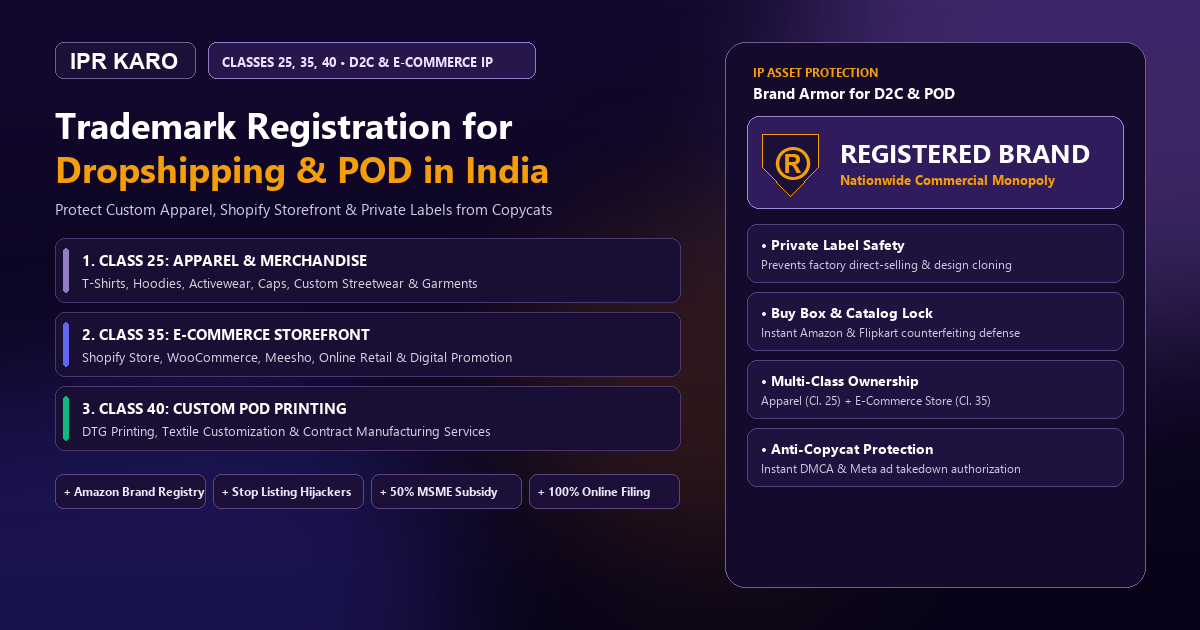
In India, dropshipping and Print-on-Demand (POD) entrepreneurs own full legal entitlement to register trademarks for their brand names, logos, and digital storefronts under the Trade Marks Act, 1999, regardless of whether they manufacture the goods themselves. To achieve comprehensive brand security, founders must implement a multi-class registration strategy covering physical merchandise (Class 25 for apparel, Class 21 for mugs, Class 14 for jewellery), e-commerce retail storefront services (Class 35), and custom printing services (Class 40). Registration is the prerequisite to locking Amazon Brand Registry 2.0, gaining Buy Box immunity, executing counterfeit takedowns, and safeguarding private-label margins from copycat manufacturers.
The Indian Direct-to-Consumer (D2C) and e-commerce ecosystem has undergone an unprecedented transformation. Driven by platforms like Shopify, WooCommerce, Meesho, Amazon India, and automated POD fulfillment hubs like Printrove, Qikink, Blinkstore, Gelato, and Printful, entrepreneurs can launch scalable consumer brands with zero inventory and zero manufacturing infrastructure.
However, this asset-light advantage creates a severe intellectual property vulnerability. In dropshipping and POD, you do not control the manufacturing line. Your winning product ideas, custom merchandise designs, and brand identities are constantly visible to third-party factories, dropshipping suppliers, and aggressive competitors running automated ad-scraping tools.
Without a registered trademark under theTrade Marks Act, 1999, the goodwill generated by your Meta and Google ad spends belongs to whoever files the trademark first. Discover how proactive IP prosecution protects your brand assets in our comprehensive analysis ofAmazon Brand Registry trademark requirementsandword mark vs device mark filing strategies.
The Unique IP Vulnerability of Dropshipping Businesses
Traditional manufacturing brands build physical moats through proprietary tooling, factory infrastructure, and localized distribution networks. Dropshipping and POD brands operate in a fundamentally different reality characterized by four major structural IP hazards:
1. Supplier & Factory Poaching
When your Shopify store begins generating 500+ daily orders for a specific custom hoodie, coffee mug, or phone accessory, your contract manufacturer or POD partner sees your exact sales volume, customer demographics, and margin spread. Without an enforceable trademark and NDA, unethical suppliers often duplicate the listing and sell directly to consumers at cut-rate prices.
2. Listing Hijacking & Buy Box Theft
On Amazon India, Flipkart, and Meesho, unscrupulous competitors map directly to your established product ASINs. They source identical generic white-label items and undercut your price by ₹10, capturing your Buy Box and ruining your seller rating with substandard product quality.
3. Trademark Squatting & Hostile Reverse Takedowns
Competitors monitoring viral Meta / TikTok / Instagram ad trends routinely identify rising D2C brand names and file preemptive trademark applications on the IP India portal. Once their application is indexed, they issue bad-faith intellectual property infringement notices to Shopify, Meta Ads Manager, and payment gateways, shutting down your store overnight.
4. Zero Equity Valuation without Registered Trademarks
When seeking venture capital, strategic angel investment, or selling your Shopify store via e-commerce aggregators (like Mensa Brands, UpScalio, or Goat Brand Labs), unregistered brand names are valued at zero. A registered trademark converts temporary ad revenue into a legally transferable commercial asset under Section 37 and Section 38.
Multi-Class Strategy for Custom Merchandise & Apparel
The most fatal mistake made by dropshipping founders is filing in only a single Nice class. Indian trademark classification separates physical goods (Classes 1–34) from services (Classes 35–45). A robust defense requires a synchronized multi-class structure:
Class 25: Apparel
Covers all wearable merchandise: t-shirts, graphic tees, hoodies, oversized sweatshirts, activewear, jackets, trousers, caps, hats, socks, and footwear.
Class 35: Retail Store
Covers online marketplace operations, e-commerce retail store services, digital catalog hosting, sales promotion, digital advertising, and mail order services.
Class 40: Custom Print
Covers custom manufacturing, direct-to-garment (DTG) textile printing, screen printing, embroidery, laser engraving, sublimation, and material treatment.
Ancillary Merchandise Classes for Diversified D2C Catalogs
As your dropshipping storefront expands beyond clothing into high-margin gift items and accessories, you must secure secondary classes under Nice Classification:
| Nice Class | Merchandise & Product Category | Typical Dropship / POD Items Covered | Priority Level |
|---|---|---|---|
| Class 21 | Drinkware & Household Utensils | Custom printed ceramic mugs, steel tumblers, water bottles, coasters | High (Core POD) |
| Class 14 | Jewellery & Precious Accessories | Custom engraved pendants, artificial jewellery, watches, charms | High (D2C Jewellery) |
| Class 18 | Leather Goods & Bags | Canvas tote bags, backpacks, duffle bags, wallets, passport holders | Medium-High |
| Class 16 | Stationery & Paper Merchandise | Custom stickers, vinyl decals, diaries, art posters, notebooks, calendars | High (Core POD) |
| Class 9 | Tech Accessories & Digital Goods | Custom phone cases, mousepads, wireless charger pads, downloadable digital art | Medium-High |
Amazon Brand Registry & Marketplace Protection in India
For e-commerce entrepreneurs, trademark registration is not merely a legal defense tool—it is the prerequisite growth key required to unlock premier commercial features across top e-commerce marketplaces:
1. Amazon Brand Registry 2.0 (Enrollment on Pending TM)
Amazon India permits brand owners to enroll in Brand Registry as soon as Form TM-A is submitted and assigned an application number. You do not need to wait for final registration. Brand Registry grants exclusive ownership over your product detail pages, blocks unauthorized hijackers from attaching to your ASINs, and unlocks high-converting A+ Enhanced Marketing Content, custom Brand Stores, and Sponsored Brands advertising video units.
2. Flipkart Brand Approval & Listing Gating
Flipkart enforces strict brand authorization tiers. Holding a registered trademark or pending application in the appropriate class enables you to secure Flipkart Brand Approval. This locks your product catalog against unauthorized resellers who attempt to sell counterfeit or unauthorized white-label versions under your listing.
3. Meesho Brand Hub & Anti-Counterfeiting Takedowns
Social commerce platforms like Meesho frequently suffer from rampant image scraping and design cloning. A registered trademark empowers you to file automated IP infringement complaints via Meesho's legal grievance portal, triggering rapid delisting of infringing seller accounts within 48 to 72 hours.
4. Meta, Instagram & Shopify Brand Enforcement
When rogue dropshippers clone your Shopify website theme, rip your product photos, or run deceptive Instagram / Facebook ad campaigns using your brand name, Meta and Shopify's Trust & Safety teams require your official trademark registration number to execute instant domain suspensions and page deletions under global IP protection rules.
White-Label vs Private-Label vs POD IP Ownership
Understanding what you can and cannot protect under Indian intellectual property law is critical for structuring profitable commercial agreements with suppliers:
White-Label Dropshipping IP Rights
In white-label dropshipping, the underlying physical product (e.g., a generic posture corrector, stainless steel water bottle, or basic blender) is generic. You cannot claim trademark or patent rights over the product mechanism itself.
Private-Label & POD IP Rights
In private-label and POD, the product incorporates custom specifications, proprietary artwork, branded neck labels, custom unboxing mailers, or bespoke colorways manufactured exclusively for you.
Mandatory Clause: Contract Manufacturing & Supplier NDA
Always execute a written Supplier Agreement with your contract manufacturer or POD printing hub. The contract must explicitly state: (a) All customer designs, artwork, and branding remain your exclusive intellectual property; (b) The supplier cannot manufacture or distribute overruns or rejected units bearing your trademark; and (c) The supplier is legally barred from listing your private-label items on B2B portals like IndiaMART, Alibaba, or Udaan.
Word Mark vs Logo Strategy & Prior User Evidence
Deploying the proper technical filing strategy on Form TM-A determines whether your trademark will withstand registry examination and future litigation challenges:
1. Prioritize a Word Mark (Standard Character Filing)
A Word Mark protects the text string and spelling of your brand name regardless of font style, capitalization, colour combination, or graphic stylization. If you change your Shopify store logo or packaging typography later, a Word Mark continues to provide 100% full coverage. Always file a Word Mark first before investing in separate Device Mark (Logo) applications.
2. Device Mark (Composite Logo) for Unique Brand Emblems
If your POD brand features an iconic graphic mascot, abstract emblem, or distinctive typography crest (e.g., printed on chest pockets, sleeve labels, or product tags), file a separate Device Mark under the appropriate Vienna Classification codes to prevent visual copycats.
3. ‘Proposed to be Used’ vs ‘Claiming Prior Commercial Use’
If your dropshipping store is brand new, file as “Proposed to be Used”. However, if you have already been running ads and generating sales, claim your exact inception date by submitting a notarized User Affidavit under Rule 25. Prior use gives you superior common law priority under Section 34 of the Trade Marks Act against late-filing imitators.
Acceptable User Evidence for Dropshippers under Rule 25
- Dated Shopify / WooCommerce order confirmation invoices
- Payment gateway settlement reports (Razorpay, Cashfree, Stripe)
- Meta Ads Manager / Google Ads invoices mentioning the brand
- Domain registration certificate (Whois lookup / GoDaddy receipt)
- GST tax returns and shipping partner manifests (Shiprocket, Delhivery)
- High-resolution photographs of products bearing printed brand tags
Overcoming Section 9 & Section 11 TM Objections
During trademark prosecution, examiners at the Trade Marks Registry frequently issue Examination Reports containing statutory objections under Sections 9 and 11. Overcoming them requires specialized legal drafting:
1. Overcoming Section 9(1)(b) Descriptive & Generic Objections
Examiners raise Section 9 if your brand name describes the nature, quality, or function of your goods (e.g., “Custom Cotton Tees”, “Quick Dropship Hub”, or “Daily Print Wear”). To prevent or overcome this objection:
- Choose arbitrary, suggestive, or completely coined/fanciful names.
- Submit evidence of acquired distinctiveness and commercial recognition through sales volume and social media followings.
- Argue that the combination creates an indivisible, distinctive whole under Section 17.
2. Overcoming Section 11(1) Relative Similarity Objections
If the Registry cites an earlier identical or deceptively similar trademark in Class 25 or Class 35, deploy established judicial frameworks:
- Apply the Supreme Court's 7-factor test fromCadila Health Care (2001)to prove phonetic, visual, and conceptual dissimilarity.
- Apply the Anti-Dissection Rule (comparing marks as unified wholes rather than breaking them into syllables).
- Demonstrate clear disparity in target consumer profiles, pricing tiers, and e-commerce distribution channels.
- Plead prior commercial use under Section 34 or honest concurrent adoption under Section 12.
Step-by-Step Trademark Registration Process & Fees
The statutory journey from brand conception to official Form O-2 certificate follows a structured 6-step lifecycle on the IP India e-filing gateway:
Comprehensive Trademark Clearance Search
Conduct phonetic, visual, and semantic searches across Classes 25, 35, 40, and related classes on the IP India public search portal and international trademark registries to confirm 100% brand availability.
Application Filing via Form TM-A (Instant TM Symbol)
Submit the electronic application with proper applicant classification. The instant Form TM-A receipt generates an official 7-digit application number, granting immediate legal right to display the ™ symbol and enroll in Amazon Brand Registry.
Registry Examination & Written Response
The Registry examiner scrutinizes the mark for absolute (Section 9) and relative (Section 11) conflicts within 1 to 3 months. If an Examination Report is issued, a formal legal reply must be filed within 30 days.
Show Cause Hearing (If Required)
If the written response does not fully satisfy the Hearing Officer, an online video conference (VC) show-cause hearing is scheduled under Rule 115, where your registered trademark attorney presents oral legal arguments.
Publication in Trade Marks Journal (4 Months)
Upon acceptance, the mark is published in the weekly Trade Marks Journal for a statutory 4-month opposition period under Section 20, allowing third parties to review potential conflicts.
Issuance of Registration Certificate (Form O-2 & ® Symbol)
If no opposition is filed within 4 months, the CGPDTM generates your official digitally signed Trademark Registration Certificate (Form O-2) under Section 23, conferring nationwide exclusive rights and full authorization to use the prestigious ® symbol.
Official Government Fee Structure & 50% MSME Subsidy
| Applicant Category | Government Fee (Per Class) | Eligibility Requirement | Cost Advantage |
|---|---|---|---|
| Individual / Proprietorship | ₹4,500 | PAN Card + Aadhaar Card | Standard 50% Base |
| Startup India / MSME (Udyam) | ₹4,500 | Udyam Certificate / DPIIT Recognition | 50% Government Subsidy |
| Private Limited / LLP (Non-MSME) | ₹9,000 | Certificate of Incorporation without Udyam | Full Standard Fee |
E-Commerce Business Model vs Trademark Class Matrix
Determine your mandatory trademark registration scope based on your active operational model in the Indian e-commerce marketplace:
| Business Model | Primary TM Classes | Ancillary TM Classes | Primary IP Risk Factor |
|---|---|---|---|
| Apparel Print-on-Demand (POD) | Class 25 & Class 35 | Class 40 (Custom DTG Printing) | Graphic artwork theft & supplier copycats |
| Shopify Dropshipping (Gadgets/Home) | Class 35 & Class 9/21 | Class 11 (Appliances), Class 28 (Toys) | Shopify domain cloning & fake ad pages |
| Custom Jewellery & Gifts D2C | Class 14 & Class 35 | Class 16 (Gift boxes), Class 40 (Engraving) | Counterfeit imitation on Meesho/Amazon |
| Custom Merchandise & Drinkware | Class 21 & Class 16 | Class 35 (Online Retail), Class 40 (Printing) | Listing hijacking on marketplace catalog |
| POD Fulfillment & Printing B2B | Class 40 & Class 35 | Class 42 (Custom software/API integration) | B2B platform imitation & software cloning |
Critical Intellectual Property Mistakes to Avoid
Dropshipping and POD founders frequently encounter costly brand destruction by committing four preventable IP errors:
1. Scaling Ad Spend Before Trademark Clearance
Spending ₹5,00,000 to ₹50,00,000 on Meta and Google ad campaigns to scale an unregistered brand name is catastrophic if a prior trademark registrant sends a cease-and-desist letter under Section 29. You will be forced to rebrand, surrender your domain, abandon all social media handles, and potentially pay damages.
2. Printing Trademarked Characters & Celebrity Memes
Printing Marvel, Disney, anime, gaming characters, or IPL sports logos without official licensing constitutes willful trademark and copyright infringement. Rights holders aggressively file John Doe (Ashok Kumar) injunctions in Delhi High Court, seizing stock, freezing bank accounts, and disabling payment gateway merchant IDs.
3. Filing Only for Physical Goods and Ignoring Class 35
If you file exclusively in Class 25 (Apparel), a competitor can register your identical brand name in Class 35 (E-commerce retail services). They can then operate an online fashion aggregator under your name without infringing your Class 25 registration, creating permanent market confusion.
4. Relying on Unregistered Partnership Agreements
When two or three co-founders launch a dropshipping venture, failing to execute a formal Joint Ownership Agreement under Section 24 or assigning the trademark to an incorporated entity (Pvt Ltd / LLP) leads to catastrophic deadlocks if a founder departs.
Frequently Asked Questions
Q.Can I register a trademark if I don't manufacture my own products?
Yes, absolutely. Under Indian trademark law (Trade Marks Act, 1999), trademark ownership belongs to the entity that markets, brands, and sells the goods under its proprietary commercial identifier, not the contract manufacturer or third-party fulfillment vendor. Even if 100% of your products are sourced via dropshipping suppliers (AliExpress, CJ Dropshipping, Indian wholesalers) or printed on-demand (Printrove, Qikink, Gelato), you can register the brand name under your name or company.
Q.Which trademark class is mandatory for dropshipping and POD businesses in India?
Dropshipping and POD businesses typically require a multi-class filing strategy. The core classes are: (1) Class 25 for apparel, t-shirts, hoodies, and wearable merchandise; (2) Class 35 for online e-commerce retail store services, marketplace sales, and advertising; and (3) Class 40 for custom printing, direct-to-garment (DTG) printing, and garment customization services. Additional product classes such as Class 21 (mugs/drinkware), Class 14 (jewellery), Class 18 (bags), or Class 16 (stickers/stationery) apply depending on your product catalog.
Q.Why is Class 35 essential even if I already registered Class 25 for clothing?
Class 25 protects only the physical garments and apparel items bearing your label. It does not protect your e-commerce storefront name, website domain identity, or online retail services. If a competitor opens a competing Shopify store or marketplace storefront under your exact brand name selling accessories or third-party goods, Class 25 alone cannot stop them. Class 35 gives you exclusive rights over e-commerce retail services and online store operations.
Q.Can I get Amazon Brand Registry 2.0 with a pending trademark application?
Yes. Amazon Brand Registry India accepts trademark applications with a valid application number in 'Pending' status (Form TM-A acknowledgment from IP India). You do not need to wait 8 to 18 months for the final registration certificate (Form O-2). Once your application is filed and indexed on the IP India portal, you can immediately enroll in Amazon Brand Registry to unlock A+ content, Brand Store, and listing protection.
Q.How do I protect my unique graphic POD designs from being copied by competitors?
While trademark registration protects your brand name, store name, and logo (source identifier), your individual graphic artwork, illustrations, and t-shirt print graphics are protected under Copyright Law (The Copyright Act, 1957). For complete IP defense, register your brand name as a Trademark and secure Copyright registration for your original visual graphics and artistic prints to initiate swift DMCA and IP takedowns.
Q.What is the difference between white-labeling and private-labeling for trademarks?
In white-labeling, a manufacturer produces generic, unbranded goods sold to multiple retailers who simply resell them. You cannot monopolize the generic product design itself, but you can trademark your unique brand name. In private-labeling, the manufacturer produces goods exclusively customized and packaged under your proprietary brand identity. In both models, a registered trademark is the sole legal mechanism that gives you exclusive rights to the commercial label and prevents listing hijacking.
Q.What evidence is required to claim 'Prior Commercial Use' in a trademark application?
Under Rule 25 of the Trade Marks Rules, 2017, if you claim use prior to the filing date, you must submit a notarized User Affidavit accompanied by dated documentary evidence. For dropshippers, acceptable evidence includes: Shopify / WooCommerce order export invoices, payment gateway settlement summaries (Razorpay, Cashfree, Stripe), Meta/Google ad spend invoices displaying the brand name, GST returns, and domain name registration receipts.
Q.How can I prevent my POD fulfillment partner or factory from selling my branded merchandise?
To prevent POD hubs or contract manufacturers from selling overruns, rejected batches, or counterfeit copies of your merchandise: (1) Secure a registered trademark in India; (2) Execute a robust Manufacturing & Non-Disclosure Agreement (NDA) containing strict IP assignment and anti-circumvention clauses; and (3) Explicitly prohibit the supplier from displaying your branded products in their public portfolios or wholesale catalogs.
Strategic D2C Brand Scaling Advice
In the ultra-competitive Indian e-commerce landscape, marketing expertise drives initial sales velocity, but intellectual property protection determines long-term enterprise equity. A dropshipping or POD store with a registered trademark transforms from a fragile transactional shop into a defensible, venture-backable digital consumer brand.
Partner with dedicated e-commerce trademark attorneys to conduct clearance searches, file multi-class applications under MSME subsidies, and establish comprehensive brand gating. Explore our specialized guides onAmazon Brand Registry requirements,Flipkart Brand Approval guide, andMSME trademark fee concessions.
Protect Your Dropshipping & POD Brand Today
Deploy registered trademark attorneys to secure Class 25, 35 & 40 protection, unlock Amazon Brand Registry 2.0, and shield your brand from supplier copycats.
Registered Trademark Attorneys • 50% MSME Subsidy • Amazon Brand Registry • Pan-India