
Written by Rahul Roy
Advocate & Non-Profit Intellectual Property Counsel
Overview of Non-Profit Trademark Registration
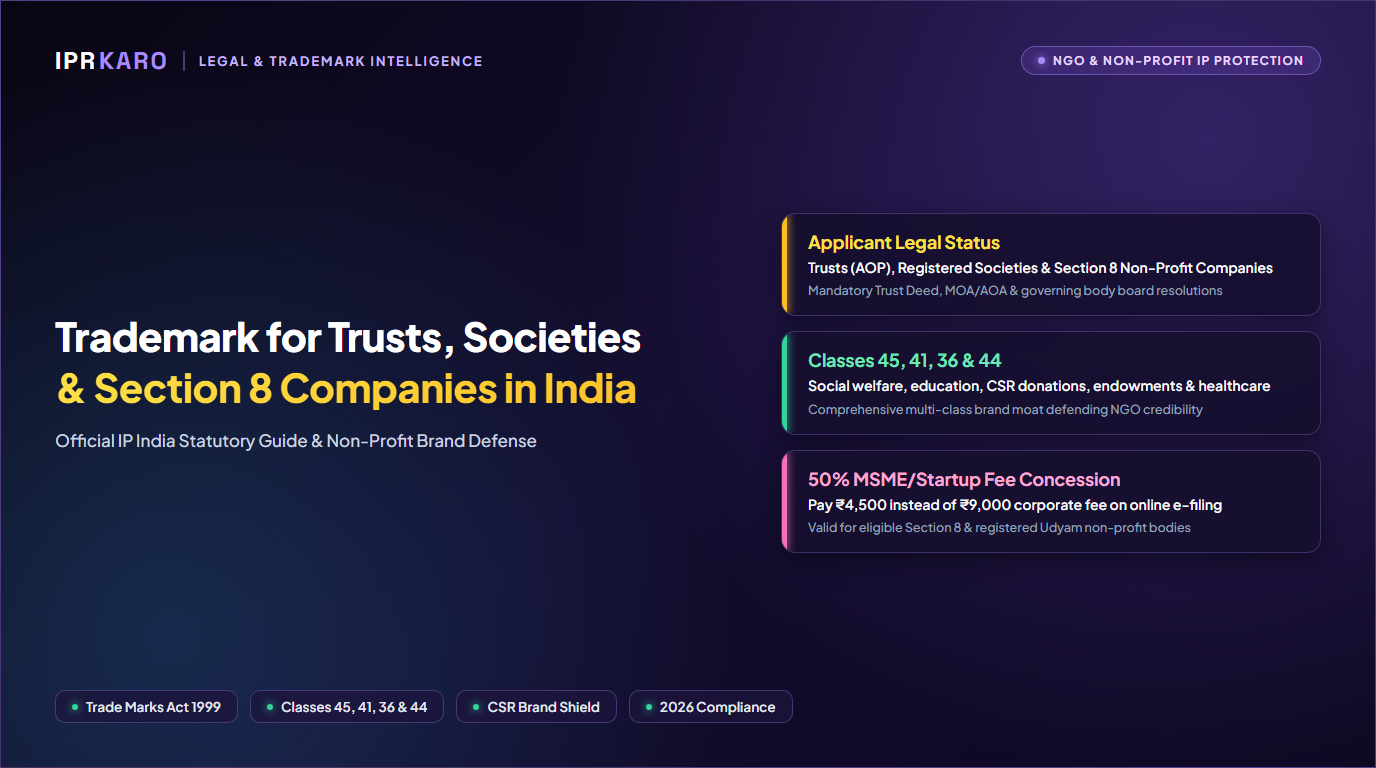
Under the Indian Trade Marks Act, 1999, Trusts (as Associations of Persons represented by Managing Trustees), Societies (registered under Societies Registration Act, 1860), and Section 8 Companies (Body Corporate under Companies Act, 2013) can legally register word marks, emblems, and service names. Registration across Class 45 (Charitable & Social Welfare), Class 41 (Education & Skill Development), and Class 36 (Fundraising & Philanthropy) grants nationwide exclusive monopoly, prevents donation scams, and creates legal standing to obtain injunctions against fake NGOs.
India hosts over three million non-governmental organizations, religious trusts, charitable foundations, and Section 8 companies dedicated to healthcare, education, environmental conservation, and social welfare. While these entities operate without a profit motive, their greatest institutional capital is their goodwill, donor trust, and public reputation.
Unfortunately, unscrupulous individuals often exploit non-profit goodwill by floating copycat trusts, cloning charity websites, and soliciting fraudulent donations using confusingly similar logos. A registered trademark under Section 23 of the Trade Marks Act provides statutory immunity against brand dilution, empowers fast-track bank account freezes of fraudsters, and preserves corporate CSR partnerships.
Learn more about related business registrations in our detailed guides on who can apply for a trademark in India, MSME trademark fee concessions, and responding to trademark legal notices.
Applicant Legal Status on the IP India Portal
When filing Form TM-A on the IP India e-filing portal, selecting the correct legal applicant classification is critical. Selecting the wrong category triggers fatal Formalities Check Fail (FCF) objections under Rule 23 of the Trade Marks Rules, 2017:
1. Public Charitable & Religious Trusts
A Trust is not an incorporated body or separate legal juristic person under the Indian Trusts Act, 1882. Therefore, the application is filed under the category of 'Trust' or 'Association of Persons (AOP)'. The applicant name must be formatted as: "[Name of Trust] represented by its Managing Trustee, [Name of Trustee]".
Filing Status: Association of Persons (AOP) / Trust2. Registered Societies
Societies registered under the Societies Registration Act, 1860 (or relevant State Society Registration Acts) have statutory standing to sue and be sued through their President or General Secretary. The applicant category on the IP portal is 'Society' or 'Body Corporate', represented by the authorized Governing Body signatory.
Filing Status: Registered Society / Body of Individuals3. Section 8 Non-Profit Companies
Section 8 companies incorporated under the Companies Act, 2013 hold complete juristic personality with perpetual succession. The application is filed under the category of 'Body Corporate' using the company's Corporate Identification Number (CIN) and registered office address, executed by a Director via Board Resolution.
Filing Status: Body Corporate (Company)Trust Deed, MOA & TM-48 Checklist
Trademark examiners scrutinize non-profit applications with heightened rigor to verify that the authorized signatory possesses lawful governance mandate. The following evidentiary documents must be prepared and uploaded:
For Trusts & Foundations
- ✓ Certified copy of Registered Trust Deed signed before Sub-Registrar.
- ✓ Board of Trustees Resolution authorizing Managing Trustee to apply.
- ✓ PAN Card copy of the Trust and Identity Proof of Managing Trustee.
- ✓ Form TM-48 (Power of Attorney) on State Stamp Paper.
- ✓ 12A/12AB & 80G Income Tax Exemption orders (if claiming prior use).
For Societies & Section 8 Companies
- ✓ Certificate of Registration / Incorporation (ROC COI).
- ✓ Memorandum of Association (MOA) and Articles of Association (AOA).
- ✓ Governing Body / Board Resolution authorizing authorized director/officer.
- ✓ Udyam MSME Certificate (if claiming 50% statutory fee rebate).
- ✓ High-resolution graphic artwork of Logo/Emblem in JPEG/PNG format.
Pro Tip on Form TM-48: Ensure that the Power of Attorney explicitly names the authorized trademark agent/advocate and is executed on non-judicial stamp paper of appropriate value as prescribed by the respective State Stamp Act (typically ₹100 in Maharashtra, Delhi, Karnataka, and Uttar Pradesh).
Government Fees & 50% MSME Fee Subsidy
Understanding the statutory fee schedule under the First Schedule of Trade Marks Rules, 2017 enables non-profits to save substantial filing budgets across multiple classes:
| Applicant Entity Type | Standard E-Filing Fee | Subsidized Fee (with MSME / Startup) | Physical Filing Fee |
|---|---|---|---|
| Section 8 Company | ₹9,000 per class | ₹4,500 per class (via Udyam MSME) | ₹10,000 per class |
| Registered Society | ₹9,000 per class | ₹4,500 per class (via Udyam MSME) | ₹10,000 per class |
| Public Charitable Trust | ₹9,000 per class | ₹4,500 per class (via Udyam MSME) | ₹10,000 per class |
| Individual Trustee (in personal capacity) | ₹4,500 per class | ₹4,500 per class | ₹5,000 per class |
How to Claim the 50% Subsidy: Non-profit educational institutions, social healthcare organizations, and skill development trusts can obtain an Udyam MSME Registration Certificate under service activities (e.g., educational support, social work activities without accommodation). Attaching the valid Udyam certificate directly entitles the applicant to the ₹4,500 fee slab on Form TM-A.
Multi-Class Strategy: Classes 45, 41, 36, 44 & 35
Non-profit activities rarely fit into a single classification. To build an unassailable institutional brand moat, trustees must adopt a coordinated cross-class filing strategy:
Class 45: Social Welfare & Charity
The cornerstone class for non-profit operations. Covers charitable and humanitarian services, social advocacy, orphan care, disaster relief coordination, civil society services, and community welfare programs.
Class 41: Education & Training
Covers running non-profit schools, colleges, vocational skilling academies, cultural seminars, spiritual discourses, public awareness lectures, and sports coaching for underprivileged youth.
Class 36: Fundraising & Donations
Covers charitable fundraising campaigns, financial sponsorship management, non-profit microfinance initiatives, scholarship disbursement, and managing endowment trusts.
Class 44: Healthcare & Medical Relief
Covers charitable hospitals, free dispensaries, rural health screening camps, blood donation drives, ayurvedic relief centers, and animal rescue shelters.
Additionally, non-profits issuing extensive literature, books, donation receipt booklets, and prayer guides should register under Class 16 (Printed Publications & Stationery), while those managing volunteer recruitment and NGO merchandise distribution should secure Class 35 (Advertising & Association Management).
Emblems & Names Act Restrictions
Under Section 9(2)(d) of the Trade Marks Act, 1999, a mark is barred from registration if its use is prohibited under the Emblems and Names (Prevention of Improper Use) Act, 1950. This is one of the most common grounds for objection faced by trusts and societies:
Strictly Prohibited Marks & Symbols:
- National Symbols: Indian National Flag, Ashoka Chakra, Lions Capital of Sarnath (Ashoka Pillar), and official Government seals.
- International Dignitary Emblems: Official seal of the United Nations (UN), World Health Organization (WHO), and Red Cross / Red Crescent emblem.
- National Figures & Leaders: Names, titles, or pictorial likenesses of Mahatma Gandhi, Jawaharlal Nehru, Sardar Patel, or the Prime Minister/President of India without prior sanction from the Central Government.
- Misleading Deceptive State Patronage: Use of words like 'National', 'Indian', 'Government', 'Rashtrapati', or 'State' that falsely imply official government sponsorship or ministry affiliation.
How to Avoid Refusal: When designing NGO crests and logos, avoid incorporating the Ashoka Pillar or tri-colour flag motifs. If your trust name contains 'Bharat' or 'National', ensure the logo incorporates distinct, coined visual elements and file a formal disclaimer that no exclusive claim is made over the sovereign geographical term.
Overcoming Section 9 & 11 Objections
Non-profit applications frequently encounter examination objections under Section 9 (Absolute Grounds for Refusal) and Section 11 (Relative Grounds for Refusal):
Overcoming Section 9(1)(b) Descriptive Term Objections
Examiners routinely object that names like "Manav Seva Trust" or "Gyan Foundation" are descriptive of charitable services. To overcome this:
- • Device Mark / Logo Registration: Register as a composite device mark featuring unique typography, crest artwork, and distinct colour palettes.
- • Rule 25(2) Prior User Affidavit: If the NGO has been active for years, file a detailed User Affidavit proving that the mark has acquired secondary meaning through extensive public philanthropy, newspaper coverage, and CSR audit reports.
Overcoming Section 11(1) Confusingly Similar Marks
If the examination report cites prior registered trademarks containing similar words in Class 45 or Class 41:
- • Anti-Dissection Rule: Argue that the composite mark must be evaluated as a commercial whole rather than dissecting individual generic syllables (relying on Cadila Health Care principles).
- • Prior Continuous Use under Section 34: Demonstrate that your Trust adopted and utilized the mark continuously before the cited mark's registration date.
Trustee Succession & Form TM-P Transmission
A unique legal challenge in Trust trademarks arises when the Managing Trustee retires, resigns, or passes away. Since the trademark application was represented by that specific trustee, the Register of Trade Marks must be updated to maintain chain of legal title:
Statutory Procedure under Section 45:
- Board Resolution on Succession: The continuing Board of Trustees convenes a formal meeting and passes a unanimous resolution appointing the new Managing Trustee.
- Deed of Transmission: A legal Deed of Transmission or Supplementary Trust Deed is executed, recording the devolution of administrative authority.
- Filing Form TM-P: An application on Form TM-P is submitted on the IP India portal along with a statutory fee of ₹9,000 (standard) or ₹4,500 (MSME), requesting the Registrar to update the authorized representative records.
- Issuance of Certificate of Change: The Trade Marks Registry issues a certified extract reflecting the updated representative in the Register.
Tax Exemption (12AB/80G) & FCRA Brand Synergy
A non-profit's brand name is directly tied to its statutory regulatory licenses. Unchecked trademark infringement creates catastrophic compliance risks:
Section 12AB & 80G Defense
If fraudsters use your exact brand name to issue fake tax deduction receipts under Section 80G, the Income Tax Department may issue show-cause notices for tax avoidance. Holding a registered trademark certificate gives you instant standing to lodge cybercrime FIRs and prove you are the victim of identity theft.
Foreign Contribution (FCRA) Security
The Ministry of Home Affairs (MHA) strictly audits foreign donation inflows. Protecting your official website domain and logo with trademark registration prevents rogue imposters from diverting international grant funds into unauthorized non-FCRA bank accounts.
Non-Profit Entity IP Comparison Matrix
Review how legal structure, governing statute, and applicant representation differ across non-profit forms in India:
| Entity Type | Governing Statute | Applicant Status | Signatory Mandate | Succession Protocol |
|---|---|---|---|---|
| Charitable Trust | Indian Trusts Act, 1882 / State Public Trusts Act | Association of Persons (AOP) | Managing Trustee (via Trust Deed) | Form TM-P upon trustee change |
| Registered Society | Societies Registration Act, 1860 | Society / Body of Individuals | President / Secretary (Governing Body) | Form TM-P via AGM resolution |
| Section 8 Company | Companies Act, 2013 | Body Corporate (Pvt Ltd / Ltd) | Authorized Director (Board Resolution) | Perpetual Succession (No TM-P needed) |
Step-by-Step Filing Workflow
Navigating non-profit trademark registration requires meticulous procedural accuracy across six distinct stages:
Clearance Search & Emblems Act Audit
Conduct cross-class search across Classes 45, 41, 36, and 44 on IP India Public Search to ensure no identical marks exist. Verify compliance with the Emblems and Names Act, 1950.
Drafting Board Resolution & Form TM-48
Execute official resolution authorizing the designated trustee or officer. Print and execute Power of Attorney (Form TM-48) on required state non-judicial stamp paper.
Filing Form TM-A with User Date Claim
Submit Form TM-A on the IP India e-portal. If claiming prior charitable use, attach a notarized Rule 25(2) User Affidavit with historical donation receipts, 12A registration date, and newspaper clippings.
Examination Report & Legal Reply
Upon issuance of the Examination Report (within 1–3 months), draft and file a comprehensive statutory reply within 30 days addressing Section 9 descriptive terms and Section 11 cited marks.
Journal Publication & 4-Month Opposition Window
The mark is published in the official Trade Marks Journal. Third parties have 4 months under Section 21 to file oppositions on Form TM-O.
Registration Certificate & 10-Year Protection
If unopposed, the Registrar issues the official Registration Certificate (Form RG-2). The Trust gains the legal right to affix the ® symbol, valid for 10 years and perpetually renewable.
Frequently Asked Questions
Q.Can an unregistered or registered charitable trust register a trademark in India?
Yes. Under the Trade Marks Act, 1999, a Trust can apply for trademark registration. A registered trust files under the applicant category of 'Trust' or 'Association of Persons' (AOP) through its Managing Trustee or designated authorized trustee, supported by a registered Trust Deed and a formal resolution passed by the Board of Trustees.
Q.Which trademark classes are most crucial for NGOs, foundations, and Section 8 companies?
The primary trademark classes include: Class 45 (Charitable services, social welfare, humanitarian aid, advocacy, and community outreach), Class 41 (Educational programs, skill training, workshops, and cultural seminars), Class 36 (Charitable fundraising, donation collection, microfinance, and endowment management), Class 44 (Charitable healthcare, medical relief camps, and dispensaries), and Class 35 (NGO volunteer coordination, NGO marketing campaigns, and distribution of aid supplies).
Q.Can a Section 8 company or Trust avail the 50% government fee concession?
A Section 8 company, Trust, or Society qualifies for the subsidized official government filing fee of ₹4,500 per class (e-filing) instead of the standard ₹9,000 corporate fee IF it holds a valid Udyam MSME Registration Certificate or DPIIT Startup Recognition Certificate. Without an MSME or Startup certificate, non-profit institutions are classified under 'Others' / 'Body Corporate' paying ₹9,000 per class.
Q.Who is listed as the applicant for a Trust trademark on the IP India portal?
Because a Trust is not a separate legal corporate entity (unlike a Section 8 company), the trademark application on Form TM-A is filed in the name of the Trust represented by its Managing Trustee (e.g., 'XYZ Charitable Trust represented by its Managing Trustee, Mr. ABC'), accompanied by the registered Trust Deed and Board Resolution.
Q.What happens to a registered trademark when a Managing Trustee changes or passes away?
When a trustee retires, resigns, or passes away, the registered trademark does not expire. The continuing Board of Trustees executes a Deed of Transmission or Succession Resolution, and an application is submitted on Form TM-P under Section 45 of the Trade Marks Act to record the new Managing Trustee or change of title in the Register of Trade Marks.
Q.Can an NGO trademark descriptive religious, charitable, or national terms?
No. Generic, laudatory, or descriptive words such as 'Seva', 'Trust', 'Charity', 'Bharat', or 'Samaj' cannot be monopolized as standalone word marks under Section 9(1)(b). However, NGOs can register composite device marks, distinctive logo emblems, or coined brand names containing such words by disclaiming exclusive rights to the descriptive terms.
Q.What are the restrictions under the Emblems and Names (Prevention of Improper Use) Act, 1950?
Under Section 9(2)(d) of the Trade Marks Act read with the Emblems and Names Act, 1950, trademark registration is strictly prohibited for marks containing the Indian National Flag, Ashoka Pillar / State Emblem, official UN insignia, Red Cross symbol, or names/photographs of national leaders (such as Mahatma Gandhi or Jawaharlal Nehru) without prior sanction from the Central Government.
Q.Why is trademark registration vital for preserving 12AB/80G tax exemptions and FCRA compliance?
Trademark registration gives non-profits exclusive legal standing to shut down fraudulent imposter websites, fake UPI donation QR codes, and counterfeit NGO campaigns. By stopping financial fraud in your name, you protect your institutional integrity, prevent donor misdirection, and safeguard your mandatory Income Tax Section 12AB/80G status and FCRA license from regulatory scrutiny.
Enforcement Strategies for Non-Profit Brands
Holding a registered trademark certificate is the single most effective legal mechanism to protect donor trust and eliminate counterfeit charitable appeals. In cases of online donation fraud, trademark owners can issue immediate intermediary notices to domain registrars, payment gateways (Razorpay, Paytm, Cashfree), and social media platforms for immediate takedown under Section 79 of the IT Act.
For persistent bad-faith infringers, trustees can file a civil suit for trademark infringement and passing off under Sections 29 and 135, seeking interim injunctions, delivery of infringing materials, and punitive damages. Consult our legal guides on passing off vs trademark infringement, John Doe injunctions in Indian courts, and sending trademark legal notices.
Protect Your Trust, Society & Foundation Brand
Secure exclusive nationwide trademark monopoly across Classes 45, 41 & 36. Defend your donations, NGO goodwill, and tax exemption credentials from copycats.
Specialized Non-Profit Counsel • Trust Deed & MOA Scrutiny • 50% MSME Subsidy • Pan-India