
Written by Rahul Roy
Senior Trademark Attorney & IP Litigator
Overview & Quick Answer on Section 25(3) Renewal
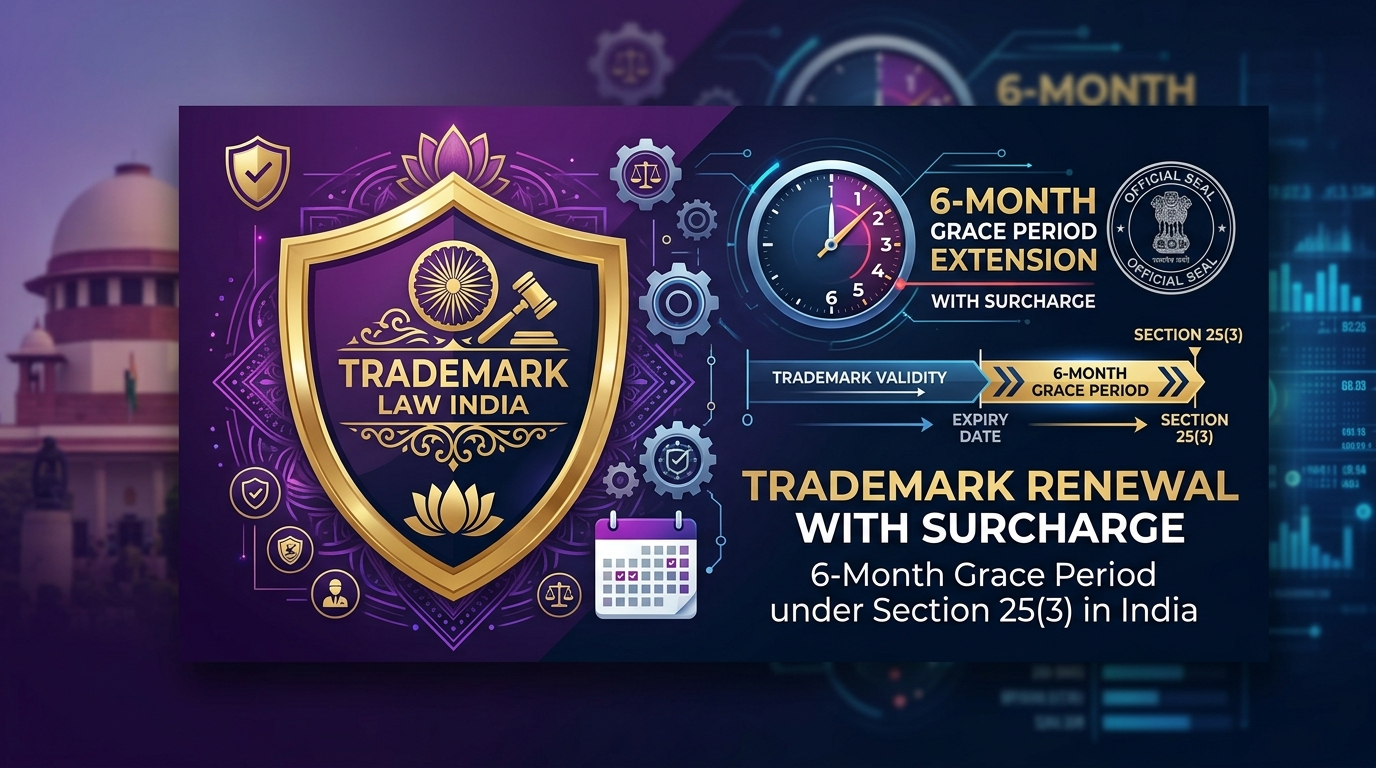
Under Section 25(3) of the Trade Marks Act, 1999 and Rule 58 of the Trade Marks Rules, 2017, if a trademark proprietor fails to renew their mark on or before the 10-year expiration date, they are entitled to an unconditional 6-month statutory grace period. Within these 6 months post-expiry, the mark can be renewed by filing Form TM-R with the standard renewal fee plus a prescribed late surcharge (₹4,500 renewal + ₹4,500 surcharge for MSME/Individuals; ₹9,000 renewal + ₹9,000 surcharge for large enterprises). The renewal takes retroactive effect from the expiration date, guaranteeing unbroken legal protection.
A registered trademark in India is granted for an initial term of 10 years computed from the application filing date. Unlike patents or designs that irrevocably lapse into the public domain upon term expiration, trademarks can be maintained indefinitely through successive 10-year renewals. However, due to administrative oversights, corporate restructuring, or attorney changes, businesses frequently miss their standard renewal deadline.
The Indian Trade Marks Act recognizes the commercial disruption caused by unintended expirations. ThroughSection 25(3), the legislature provides a built-in safety net. It allows late renewal as a matter of statutory right—without requiring formal affidavits of explanation, condonation of delay petitions, or discretionary hearings by the Registrar.
Explore how trademark validity interacts with other statutory timelines in our guides on how to renew a registered trademark in India, restoring expired trademarks under Section 25(4), and consequences of trademark expiration.
Section 25(3) & Rule 58 Statutory Framework
The Trade Marks Act, 1999 structures trademark life-cycle maintenance under three distinct subsections of Section 25:
“Section 25(3): At the prescribed time before the expiration of the last registration of a trade mark, the Registrar shall send notice in the prescribed manner to the registered proprietor of the date of expiration and the conditions as to payment of fees and otherwise upon which a renewal of registration may be obtained, and, if at the expiration of the time prescribed in that behalf those conditions have not been duly complied with, the Registrar may remove the trade mark from the register: Provided that the Registrar shall not remove the trade mark from the register if an application is made in the prescribed form and the prescribed fee and surcharge are paid within six months from the expiration of the last registration.”
1. The Mandatory Proviso to Section 25(3)
The statutory proviso strictly prohibits the Registrar from removing the mark from the Register if an application is made in Form TM-R with the surcharge within 6 months of expiration. This creates an absolute legal right for the applicant, overriding administrative removal discretion.
2. Rule 58 of Trade Marks Rules, 2017
Rule 58 sets out the procedural mechanics: An application for the renewal of the registration of a trade mark made within six months from the expiration of the last registration shall be in Form TM-R accompanied by the prescribed renewal fee and the late filing surcharge fee specified in the First Schedule.
3. Retroactive Continuity of Protection
Once processed, the renewal certificate explicitly confirms that the renewed registration is effective from the date of expiration of the previous 10-year term. There is no lapse in legal title, ensuring ongoing enforcement under Section 28 and Section 29.
Trademark Renewal Timelines in India
Trademark renewal in India operates across three distinct time windows, each carrying different procedural requirements, legal rights, and financial obligations:
1. On-Time Renewal
Window: 1 Year Prior to Expiry
Filed under Section 25(2) and Rule 57. Standard official fee applies with zero surcharge. Mark remains completely active without administrative scrutiny.
2. Grace Period with Surcharge
Window: 0 to 6 Months Post-Expiry
Filed under Section 25(3) and Rule 58. Mandatory grace period. Standard renewal fee plus statutory surcharge. Automatic right to renewal.
3. Restoration & Renewal
Window: 6 to 12 Months Post-Expiry
Filed under Section 25(4) and Rule 60. Mark removed from register. Requires Form TM-R with renewal + restoration fee and justification affidavit.
Official Government Fee Structure for Section 25(3)
Under the First Schedule of the Trade Marks Rules, 2017, official fees are structured based on applicant entity classification (Individual / Startup / Small Enterprise vs Large Body Corporate) and filing method (Online E-Filing vs Physical Counter Submission):
| Applicant Category | Standard Renewal Fee | Section 25(3) Surcharge | Total E-Filing Fee | Physical Filing Fee |
|---|---|---|---|---|
| Individual / Sole Proprietor | ₹4,500 | ₹4,500 | ₹9,000 | ₹10,000 |
| Startup (DPIIT Recognised) | ₹4,500 | ₹4,500 | ₹9,000 | ₹10,000 |
| Small Enterprise (Udyam MSME) | ₹4,500 | ₹4,500 | ₹9,000 | ₹10,000 |
| Others (Large Co. / LLP / Pvt Ltd) | ₹9,000 | ₹9,000 | ₹18,000 | ₹20,000 |
* Note: Fees listed above are per class. For multi-class registrations, the renewal and surcharge fees are multiplied by the number of registered classes. Learn more about fee relief in our guide on MSME Udyam trademark fee concessions.
Form O-3 Notice & Statutory Protection
A crucial protection under Indian trademark jurisprudence is the statutory obligation placed on the Registrar before any mark can be removed from the Register:
1. Mandatory Issuance of Form O-3
Under Rule 57, the Registrar must send an official notice inForm O-3to the registered proprietor's address for service not less than one month and not more than three months before the expiration of the last registration. The notice must explicitly state the expiry date and renewal fee terms.
2. Consequences of Registry Failure to Issue Form O-3
In landmark rulings such asCipla Ltd. v. Registrar of Trade MarksandUnion of India v. Malhotra Book Depot, the Delhi High Court and IPAB established that the issuance of Form O-3 is a condition precedent. If the Trade Marks Registry fails to issue Form O-3 or cannot prove service on the proprietor, the removal of the trademark is deemed illegal and void ab initio.
3. Maintaining Updated Address for Service
To guarantee receipt of Form O-3, proprietors must ensure their Address for Service on the IP India portal is current. If you have changed your attorney or registered office, fileForm TM-PorForm TM-Mpromptly. Review our guide on how to change trademark attorney in India.
Step-by-Step Filing of Form TM-R with Surcharge
Executing late trademark renewal under Section 25(3) requires navigating the official IP India Comprehensive E-Filing System (ipindiaonline.gov.in). Follow this streamlined 6-step procedure:
Audit Application Status on E-Register
Log in to the IP India portal or search the Public Trademark E-Register. Confirm the exact registered filing date, expiry date, and verify that the current date falls strictly within the 6-month grace window.
Select Form TM-R on E-Filing Dashboard
Under the ‘New Application Filing’ tab, select ‘Form TM-R (Application for Renewal of Registration of Trade Mark / Restoration)’. Choose the specific radio button: ‘Renewal of Registration with Surcharge (Section 25(3))’.
Enter Application Details & Auto-Fetch
Input your Trademark Application Number and Registered Class. The system automatically populates proprietor details, word mark title, device artwork, and expiration history.
Upload Supporting Documents & Authorisation
Attach Form TM-48 (Power of Attorney) if filed through an attorney, along with the Udyam MSME Certificate or Startup recognition certificate to claim the 50% fee concession.
Sign with Class 3 DSC & Complete Payment
Digitally sign the application using a valid Class 3 Digital Signature Certificate (DSC). Pay the statutory renewal fee and surcharge via the payment gateway.
Download Central Blue Receipt (CBR)
Generate and save the official CBR containing the TM-R receipt number. Monitor status updates until the portal reflects ‘Renewed’ with the new 10-year validity milestone.
Section 25(3) Grace vs Section 25(4) Restoration
Understanding the fundamental legal distinction between renewal with surcharge and post-removal restoration is essential for choosing the correct procedural strategy:
| Parameter | Renewal with Surcharge (Sec 25(3)) | Restoration & Renewal (Sec 25(4)) |
|---|---|---|
| Eligibility Window | 0 to 6 months post-expiry | 6 to 12 months post-expiry |
| Trademark Status | Expired (Not yet removed) | Removed from Register / Advertised in O-3 |
| Affidavit of Reasons | Not Required (Statutory Right) | Mandatory (Affidavit justifying delay) |
| Registrar's Discretion | Mandatory acceptance upon fee | Discretionary (May reject if delay unjustified) |
| Risk of Third-Party Opposition | Extremely Low | High (Subject to public advertisement) |
Risks of Missing the 6-Month Grace Window
Failing to utilize the Section 25(3) grace period exposes your company to severe commercial vulnerabilities and legal risks:
Loss of Amazon Brand Registry & E-Commerce Badges
Marketplaces like Amazon Brand Registry and Flipkart verify registered status regularly. When a mark shifts from ‘Registered’ to ‘Expired/Removed’, brand protection gates and Buy Box privileges are immediately revoked. Review our guide on Amazon Brand Registry requirements.
Third-Party Brand Squatting & Trademark Filings
Under Section 25(4) proviso, a removed trade mark is cited as an obstacle against third-party filings for only one year. After that, competitors can legally file your brand name, forcing you into expensive litigation under passing off and common law rights.
Landmark Judgments on Trademark Renewal & Removal
Indian courts have consistently guarded trademark owners against premature or unlawful removal by administrative authorities:
1. Cipla Limited v. Registrar of Trade Marks (2013)
The Intellectual Property Appellate Board (IPAB) held that the removal of a trademark without issuing statutory notice in Form O-3 under Section 25(3) violates natural justice. The removal was quashed and the mark restored.
2. Malhotra Book Depot v. Union of India (2012) DHC
The Delhi High Court affirmed that issuance of notice in Form O-3 is a mandatory statutory duty. Removal of a mark from the Register without fulfilling this condition cannot deprive the proprietor of their valuable IP property.
3. Gufic Ltd. v. Clinique Laboratories LLC (2010)
The court held that late renewal under Section 25(3) with surcharge cures the temporal defect and restores all statutory remedies of infringement with retroactive effect from the original date of lapse.
Filing Checklist for Form TM-R with Surcharge
Keep the following documentation and metadata ready before initiating late renewal on the portal:
Application Number & Class
Exact 7-digit trademark registration number and registered class specification.
MSME / Startup Certificate
Valid Udyam Certificate or DPIIT Recognition letter to secure ₹4,500 fee concession.
Form TM-48 Power of Attorney
Duly executed and stamped POA if filing through a registered trademark agent or attorney.
Class 3 Digital Signature (DSC)
Valid USB token DSC of the applicant or authorized attorney for portal signing.
Frequently Asked Questions on Trademark Surcharge Renewal
Q.What is the 6-month grace period for trademark renewal under Section 25(3)?
Section 25(3) of the Trade Marks Act, 1999 grants a statutory 6-month grace period immediately following the expiration of a trademark's 10-year validity. During this 6-month window, the proprietor can renew the trademark by filing Form TM-R along with the standard renewal fee plus a prescribed late filing surcharge, without needing to prove special failure reasons or petition for formal restoration.
Q.What is the government fee for trademark renewal with surcharge under Section 25(3)?
For Individuals, Startups, and MSME/Udyam registered enterprises, the official e-filing fee is ₹9,000 per class (comprising the standard renewal fee of ₹4,500 plus the statutory surcharge of ₹4,500). For non-MSME corporate bodies, partnerships, and large companies, the official e-filing fee is ₹18,000 per class (comprising ₹9,000 standard renewal fee plus ₹9,000 surcharge).
Q.What is the difference between Section 25(3) renewal with surcharge and Section 25(4) restoration?
Renewal with surcharge under Section 25(3) applies within the first 6 months post-expiry as a statutory right upon paying the surcharge fee. Restoration under Section 25(4) applies when the mark has expired beyond 6 months (up to 12 months post-expiry) and has been removed from the register. Restoration requires filing Form TM-R with renewal fee, restoration fee, and a comprehensive affidavit proving that the failure to renew was unintentional.
Q.What form is filed for renewing an expired trademark with surcharge in India?
Form TM-R is filed online on the IP India e-filing portal (ipindiaonline.gov.in). The applicant selects the filing category 'Renewal of Registration with Surcharge (Section 25(3))', specifies the trademark application number and class, and completes the payment of the renewal fee and late surcharge.
Q.Can the Trademark Registry remove a trademark without sending Form O-3 notice?
No. Under Section 25(3) and Rule 57 of the Trade Marks Rules 2017, the Registrar is statutorily obligated to issue a notice in Form O-3 between 1 to 3 months prior to expiration notifying the proprietor of the approaching expiry. Landmark High Court rulings establish that if the Registry fails to serve the Form O-3 notice, the trademark cannot be lawfully removed from the register.
Q.Can an expired trademark enforce infringement rights during the 6-month grace period?
While the trademark's legal status is vulnerable during the expired lapse period, once renewed with surcharge under Section 25(3), the renewal takes retroactive effect from the original date of expiration. The proprietor's 10-year monopoly is preserved without any statutory break in continuity, maintaining uninterrupted rights to enforce against infringers.
Q.What happens if a trademark is not renewed within the 6-month grace period?
If the proprietor fails to file within the 6-month Section 25(3) window, the trademark is listed for removal from the Register of Trade Marks and advertised in the Trade Marks Journal (O-3 list). The proprietor must then resort to the more cumbersome, discretionary restoration process under Section 25(4) within 1 year of expiry.
Q.Does an MSME certificate provide a 50% discount on the renewal surcharge fee?
Yes. Under the First Schedule of the Trade Marks Rules 2017, valid Udyam MSME registration certificates or DPIIT Startup recognitions entitle the applicant to a 50% statutory fee concession across both the primary renewal fee and the late filing surcharge.
Strategic Brand Maintenance & Docketing Advice
Allowing a trademark to enter the Section 25(3) grace period doubles your statutory fee outlay and exposes your brand to unnecessary operational risks. Enterprise brand owners and fast-scaling startups should implement centralized IP docketing systems to trigger automated renewal alerts 12 months, 6 months, and 3 months prior to expiration.
If your trademark has already expired within the last 6 months, immediate action is paramount. Working with seasoned trademark attorneys ensures that Form TM-R is filed accurately with full surcharge compliance, protecting your continuous 10-year rights. Explore our related resources on Form TM-48 Power of Attorney guidelines, stopping trademark infringement, and AI-powered trademark clearance search.
Renew Your Expired Trademark under Section 25(3)
Don't risk brand abandonment or third-party squatting. File Form TM-R with surcharge today and secure unbroken 10-year trademark protection across India.
Registered Trademark Attorneys • Same-Day Form TM-R Filing • Retrospective Validity • Pan-India