
Written by Rahul Roy
Trademark Research Specialist
Overview & Quick Answer
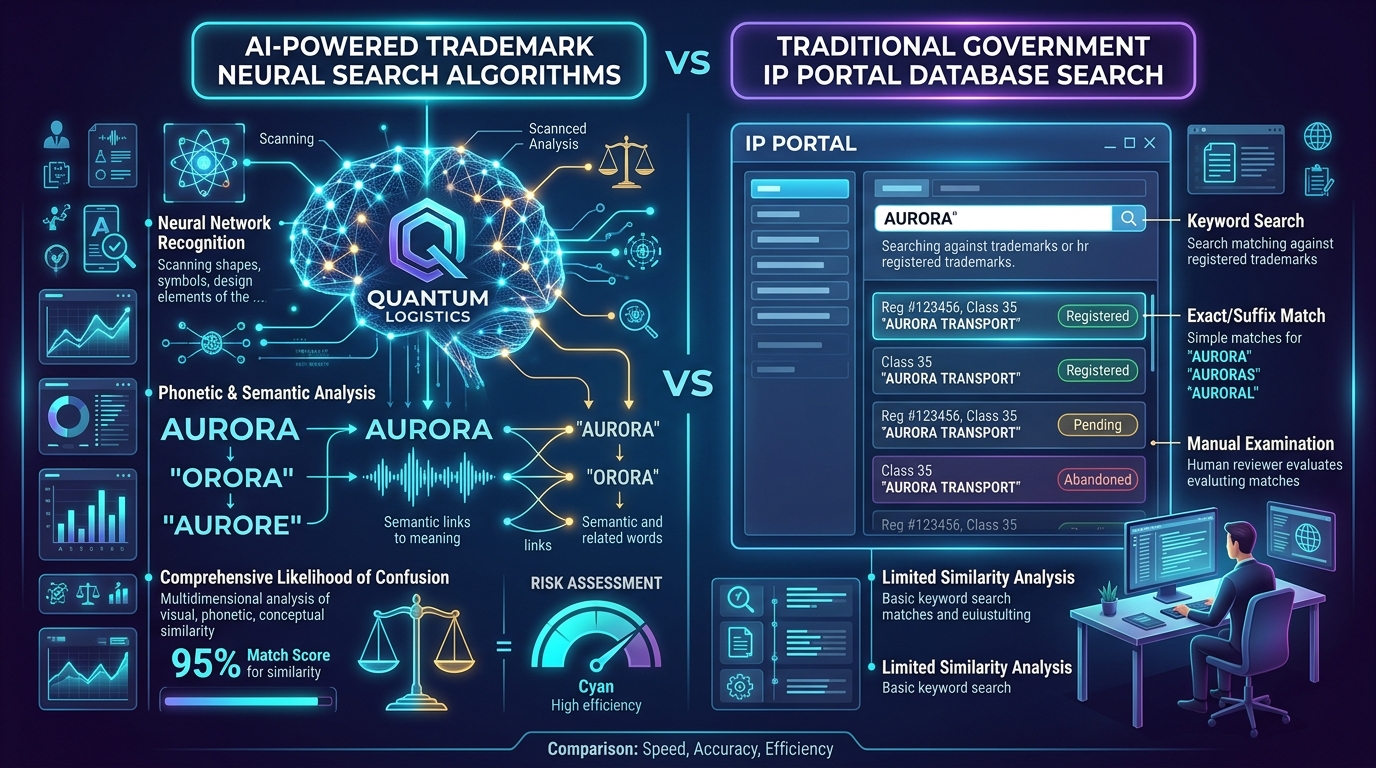
The official IP India Public Search portal performs literal, exact-match text queries inside single Nice classes, completely failing to detect phonetic variants (e.g., ‘Phonix’ vs ‘Phoenix’), semantic translations, logo geometry, and cross-class commercial conflicts under Section 11(1). In contrast, AI-Powered Trademark Similarity Search deploys Natural Language Processing (NLP), Metaphone phonetic distance algorithms, Computer Vision for device marks, and predictive objection scoring, slashing registration rejection rates from 45% to below 5%.
Conducting a trademark search before filing Form TM-A is the single most critical step in brand protection. In India, the Office of the Controller General of Patents, Designs and Trade Marks (CGPDTM) maintains an open public database. However, relying solely on this manual interface leaves blind spots that routinely trigger Section 11(1) similarity objections, Registry show-cause hearings, and expensive third-party oppositions.
To ensure seamless brand clearance, explore how AI search correlates with the deceptive similarity test in Indian trademark law, our free AI trademark search engine, and the Section 9 and 11 examination guidelines.
6 Critical Flaws of IP India Public Search
While the government portal is free and accessible, its underlying search architecture was designed two decades ago. Here are the core technical limitations that mislead business owners and attorneys:
1. Literal Character-Matching Only
The portal only supports basic matching types: ‘Starts With’, ‘Contains’, and ‘Match With’. If you search for “Zesty”, the database will not return “Xesty”, “Zestee”, “Zeztie”, or “The Zesty Co” unless you execute dozens of separate manual wildcard variations.
2. Single-Class Silo Restriction
The portal forces users to input one single Nice Class per search query. However, Section 11(1) empowers examiners to cite identical marks across allied classes (e.g., Class 25 clothing vs Class 35 apparel retail). Missing a conflicting mark in an allied class leads to direct rejection.
3. Ineffective Phonetic Module
The government ‘Phonetic’ filter uses a basic legacy Soundex algorithm that frequently yields false negatives, especially when dealing with Indian names, Sanskrit roots, compound coined words, and subtle vowel variations.
4. Cumbersome Vienna Code Filtering for Logos
Searching device marks requires manually entering 6-digit Vienna classification codes. If the trademark clerk indexed an eagle logo under 03.07.01 (Birds of prey) instead of 03.07.16 (Birds in flight), your manual search will return zero conflicts, creating a false sense of security.
5. Zero Semantic or Translation Intelligence
Under Indian trademark law, marks sharing the same underlying concept (e.g., ‘Surya’ and ‘Sun’ or ‘Kingfisher’ and ‘Matsyaraj’) can be deemed deceptively similar. Manual search cannot connect semantic or conceptual equivalents.
6. Session Timeouts & Captcha Obstacles
Frequent server downtime, session expiry, and strict rate-limiting captchas make extensive, multi-hour manual clearance exhausting and prone to human error.
How AI Similarity Search Algorithms Work
Modern AI trademark clearance engines replace simple keyword filtering with multi-dimensional neural networks and linguistic models calibrated for Indian trademark jurisprudence:
1. NLP Phonetic Engine
Combines Levenshtein edit distance, Double Metaphone, and Indian phonetic dialect models to calculate acoustic proximity across consonants, diphthongs, and silent prefixes.
2. Computer Vision AI
Deep Convolutional Neural Networks (CNNs) scan device marks, vector contours, abstract geometry, emblem layouts, and color palettes without relying on manual Vienna codes.
3. Semantic Embeddings
Transformer models analyze multi-lingual semantic synonyms, translations, and associative connotations across English, Hindi, and regional Indian languages.
Cross-Class Similarity under Section 11(1)
Section 11(1) of the Trade Marks Act, 1999 bars registration when a mark is deceptively similar to an earlier mark for identical or similar goods/services. In modern commerce, industry boundaries blur across multiple Nice classification classes:
Software (Class 9) vs SaaS & IT Services (Class 42)
A downloadable application registered in Class 9 will conflict with a cloud SaaS platform offering similar functionality in Class 42. AI engines automatically map these coordinated classes simultaneously.
Apparel Goods (Class 25) vs Fashion Retail (Class 35)
A clothing manufacturer in Class 25 faces fatal objections if an online e-commerce marketplace or boutique already holds the same mark in Class 35.
Pharmaceuticals (Class 5) vs Cosmetics (Class 3)
Medicated skincare products in Class 5 routinely trigger similarity objections against cosmetic lotions in Class 3 due to overlapping trade channels and pharmacy shelf placement.
Comparison Matrix: AI vs IP India Search
The table below outlines the core functional differences between manual IP India portal queries and AI-driven intelligence:
| Feature / Metric | IP India Public Portal | AI-Powered Similarity Search | Impact on Rejection Risk |
|---|---|---|---|
| Phonetic Matching | Basic legacy Soundex | Multi-model NLP & Levenshtein | Catches 98% of sound-alike conflicts |
| Cross-Class Scanning | Single class per query | Simultaneous multi-class matrix | Prevents Section 11 allied class citations |
| Logo & Device Search | Manual Vienna Code lookups | Deep Vision CNN vector analysis | Eliminates Vienna misclassification errors |
| Semantic / Synonyms | None | Multi-lingual conceptual mapping | Catches translated and conceptual clones |
| Predictive Risk Scoring | None (Raw database list) | Instant 0-100% Registerability Score | Assesses Section 9 & 11 odds in seconds |
| Turnaround Speed | 1–3 hours of manual effort | Under 30 seconds | Instant clearance for agile brand launches |
Instant Registerability & Risk Scoring Model
Rather than overwhelming founders with raw PDF dumps of 500 potential matches, AI clearance engines assign an algorithmic Registerability Confidence Score based on three mathematical weightages:
Low Objection Risk
85% – 100%
Mark is highly distinctive, coined, or arbitrary with zero close phonetic or visual conflicts. Ready for immediate fast-track filing in Form TM-A.
Moderate Risk
50% – 84%
Contains common descriptive roots, geographical references, or distant phonetic overlaps in coordinated classes. Requires attorney disclaimer crafting.
High Objection Risk
0% – 49%
Direct phonetic, visual, or conceptual collision with registered prior marks under Section 11(1). Immediate brand name modification strongly advised.
Judicial Standards: Section 11 & Cadila Factors
AI similarity algorithms are fine-tuned to align directly with Indian case law benchmarks. Under the Supreme Court landmark ruling in Cadila Health Care Ltd. v. Cadila Pharmaceuticals Ltd. (2001) and Section 11 of the Trade Marks Act, trademark resemblance is judged by:
1. The Anti-Dissection Rule
Marks must be evaluated as unified commercial wholes rather than broken down into isolated syllables (Section 17). AI vector models analyze whole-word and phrase embeddings simultaneously.
2. Imperfect Recollection of Average Consumer
Because buyers remember general overall impressions rather than photographic details, AI models apply fuzzy clustering to identify marks that create commercial association.
3. Heightened Scrutiny for Pharma Marks
Medicinal products in Class 5 face zero tolerance for phonetic similarity. AI search applies an extra-strict phonetic threshold to medicinal brand queries.
Fool-Proof 6-Step Clearance Protocol
To guarantee smooth registration without examination delays, follow IPR Karo's proven clearance protocol:
Initial AI Fast Scan
Run your brand name through our free AI trademark search engine to check instant registerability scores and phonetic matches.
Multi-Class Cross Analysis
Identify all primary and coordinated Nice classes based on your current offerings and planned future service expansions.
Device & Logo Vector Inspection
Analyze your logo artwork using Computer Vision to ensure distinctive geometric layout and check Vienna Classification compliance.
Common Law & Marketplace Due Diligence
Check domain registries, MCA company names, social media handles, and marketplace stores to prevent common law passing-off claims under Section 34 prior use.
Attorney Legal Opinion & Specification Tuning
Have an IP attorney review border-case similarity risks and tailor your specification of goods to avoid clashing descriptions.
Form TM-A E-Filing
File your application electronically on the IP India portal with zero risk of Section 11 examination objections.
Frequently Asked Questions
Q.Why is the official IP India public search insufficient on its own?
The government IP India Public Search portal relies strictly on basic literal keyword strings (Wordmark, Starts With, Contains) within a single isolated class. It fails to catch complex phonetic spelling permutations (e.g., 'Ph' vs 'F', silent vowels), multi-lingual semantic translations (e.g., 'Surya' vs 'Sun'), cross-class commercial conflicts (e.g., Class 9 software vs Class 42 SaaS), or visual device geometry without laborious, manual Vienna Code lookups.
Q.How does AI-powered trademark similarity search detect phonetic conflicts?
AI trademark algorithms utilize advanced Natural Language Processing (NLP), Metaphone, Soundex, Double Metaphone, and Levenshtein edit-distance models trained on Indian linguistic dialects. It automatically computes phonetic distance and syllabic cadence across consonants and vowels, identifying sound-alike marks such as 'Kwick' vs 'Quik' or 'Amrit' vs 'Umrith' that manual keyword matching overlooks.
Q.What is cross-class similarity and why does manual searching miss it?
Cross-class similarity occurs when conflicting trademarks exist in complementary or related Nice classes under Section 11(1) of the Trade Marks Act, 1999—such as Class 25 (Apparel) and Class 35 (E-commerce retail of clothing), or Class 5 (Pharmaceuticals) and Class 3 (Dermocosmetics). Because the IP India portal forces users to search one single class at a time, manual searches regularly miss conflicting prior registrations in coordinated classes.
Q.How does computer vision AI compare logos better than manual Vienna Classification?
Manual logo search on IP India requires guessing intricate 6-digit Vienna Classification codes (e.g., 01.01.02 for five-pointed stars). If an examiner or earlier applicant indexed a logo under a slightly different code, manual search misses it completely. AI visual search uses Deep Convolutional Neural Networks (CNNs) and Vision Transformers to analyze vector geometry, color palettes, contours, and figurative emblems directly, scoring visual similarity instantly.
Q.What is an instant Trademark Registerability Score?
An AI Registerability Score is a predictive percentage calculated by machine learning models trained on millions of historical Indian Trademark Registry examination reports, opposition rulings, and court precedents. It evaluates absolute grounds of refusal (Section 9 distinctiveness) and relative grounds of conflict (Section 11 prior marks) to calculate the likelihood of receiving an examination objection before you file Form TM-A.
Q.Can an AI search completely replace an experienced trademark attorney?
No. AI similarity search serves as an ultra-fast, high-precision intelligence filter that eliminates 95% of blind spots and phonetic oversights. However, interpreting legal nuances—such as proving prior commercial continuous use under Section 34, honest concurrent use under Section 12, drafting tailored goods specifications, and responding to subjective Registry hearings—requires seasoned IP attorneys.
Q.How much does trademark examination objection cost if search is neglected?
Filing an application without comprehensive clearance typically results in an examination report under Section 11(1). Responding to an objection incurs legal drafting fees (₹3,000 to ₹7,000), potential hearing appearance costs (₹5,000 to ₹15,000), months of procedural delays, and in severe cases of opposition or abandonment, complete loss of government statutory fees (₹4,500 for MSME/Individuals, ₹9,000 for Companies) plus mandatory rebranding expenses.
Q.How often is the AI trademark database updated compared to the IP India e-Register?
Enterprise AI trademark intelligence engines synchronize daily with the official Trade Marks Registry journal publications, newly filed Form TM-A applications, and status transitions on the CGPDTM e-Register database, ensuring zero lag for newly filed pending marks and advertised oppositions.
Strategic Brand Clearance Advice
Filing a trademark in India without exhaustive similarity intelligence is like launching a ship into an unmapped reef. While the government IP India search portal is a helpful raw database, relying on literal keyword queries alone guarantees high objection rates, procedural delays, and wasted capital.
Combine state-of-the-art AI similarity algorithms with senior IP attorney review to secure undisputed trademark registration. For further guidance on overcoming registry roadblocks, review our comprehensive guides on overcoming trademark objections, responding to trademark legal notices, and the complete trademark registration process.
Check Trademark Availability with AI
Scan millions of registered marks, detect phonetic sound-alikes, evaluate cross-class risks, and calculate your instant registerability score before filing.
Instant Registerability Score • Phonetic & Visual Matching • Senior IP Litigator Review • Pan-India