
Written byRahul Roy
Trademark Research Specialist
Overview of Deceptive Similarity Tests
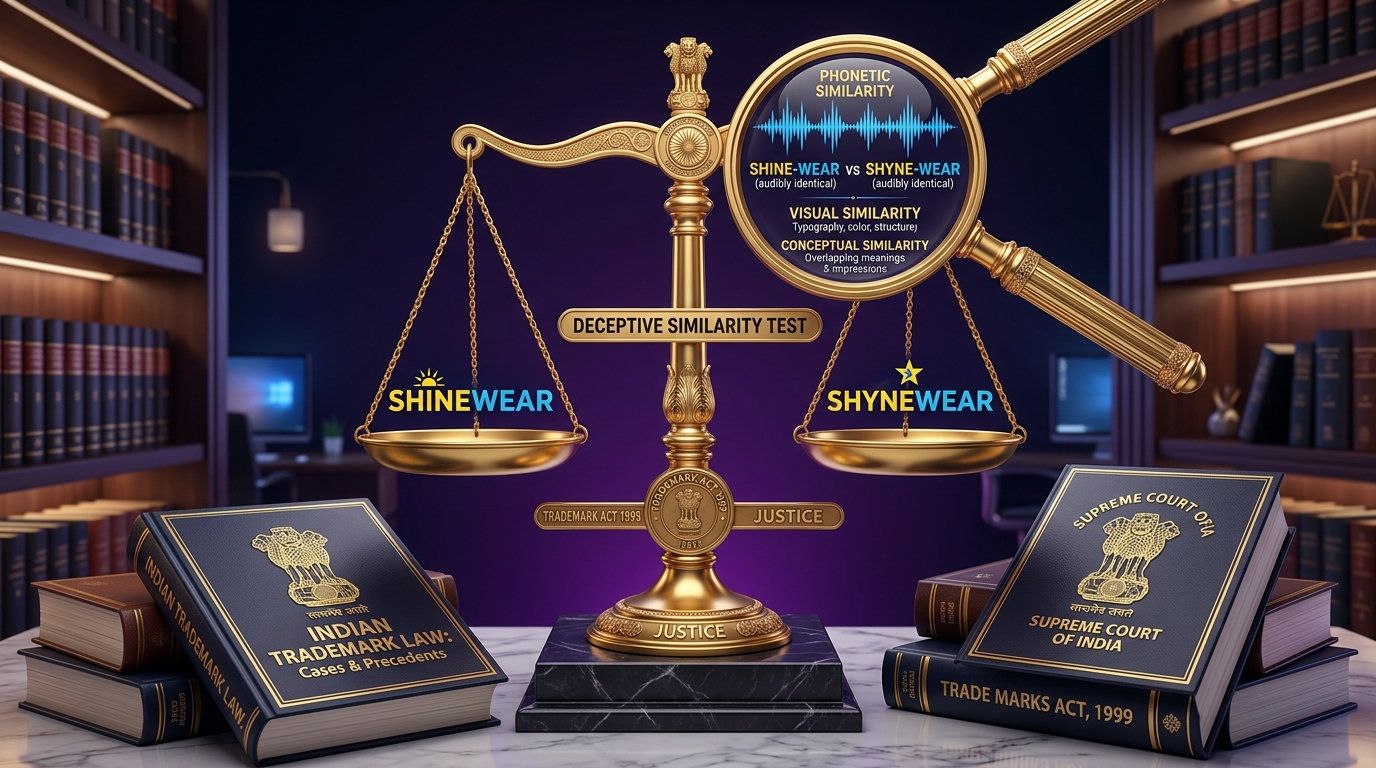
In Indian trademark law, deceptive similarity under Section 2(1)(h) occurs when a contested mark so nearly resembles an existing mark as to be likely to deceive or cause confusion among consumers. It is determined through a tripartite test evaluating: (1) Phonetic similarity (sound-alike qualities), (2) Visual similarity (structural typography and logo layout), and (3) Conceptual similarity (overlapping meanings or ideas). Under the Supreme Court's landmark Cadila Health Care (2001) precedent and Parker J.'s Pianotist test, the comparison is made from the perspective of an average consumer with imperfect recollection, comparing composite marks as unbroken wholes rather than dissecting individual syllables.
The fundamental purpose of a trademark is to act as a distinctive badge of commercial origin, guaranteeing quality and preventing consumer deception. When two marks in the marketplace sound identical, look strikingly similar, or convey the exact same commercial impression, consumers are misled into believing that the goods originate from the same enterprise or share a licensed corporate affiliation.
Under theTrade Marks Act, 1999, deceptive similarity serves as the primary gateway for examination objections underSection 11(1)(relative grounds for refusal), third-party opposition proceedings underSection 21, rectification actions underSection 57, and civil infringement suits underSection 29.
Understanding the judicial principles governing deceptive similarity enables founders to conduct risk-free brand naming clearances and empowers attorneys to build winning legal strategies. Learn how deceptive similarity interfaces with statutory claims in our guides onpassing off vs trademark infringementandSection 9 vs Section 11 grounds for rejection.
Section 2(1)(h) Statutory Definition
Section 2(1)(h) of the Trade Marks Act, 1999 provides the foundational statutory definition of deceptive similarity in India:
“A mark shall be deemed to be deceptively similar to another mark if it so nearly resembles that other mark as to be likely to deceive or cause confusion.”
1. ‘Deceive’ vs ‘Cause Confusion’
Indian courts draw a subtle but crucial distinction:Deceptionimplies a false representation that actually induces a consumer to buy product B thinking it is product A.Confusionis a broader state of uncertainty, where the consumer wonders whether product B is affiliated with, licensed by, or a line extension of product A.
2. Likelihood of Confusion (Section 11(1))
Under Section 11(1), a mark cannot be registered if its identity or similarity to an earlier trade mark, coupled with the identity or similarity of goods/services, creates alikelihood of confusion on the part of the public, which explicitly includes thelikelihood of associationwith the earlier trademark.
3. Probability vs Mere Possibility
The test is not whether confusion is remotely possible under bizarre or contrived scenarios, but whether there is a real, tangible commercial probability of confusion occurring in the normal course of trade.
The Tripartite Test of Similarity
Indian jurisprudence evaluates deceptive similarity across three mutually reinforcing dimensions. A fatal conflict under any one of these prongs is sufficient to establish deceptive resemblance:
1. Phonetic (Auditory)
Compares spoken pronunciation, syllabic emphasis, consonant cadence, and vowel sounds. Critical in India where goods are ordered verbally across noisy retail counters.
2. Visual (Ocular)
Evaluates letter arrangements, prefix/suffix symmetry, typeface stylization, colour combinations, device logos, and packaging get-up (trade dress).
3. Conceptual (Semantic)
Analyzes whether the two marks evoke the exact same central concept, mental imagery, translation, or semantic meaning, even if spelling and sounds differ.
Average Consumer & Imperfect Recollection
The benchmark against which similarity is tested is neither an intellectual property lawyer nor an expert technician with microscopic precision. The Supreme Court has repeatedly affirmed theStandard of an Average Consumer of Ordinary Prudence:
1. The ‘Fleeting Glance’ Principle
Consumers do not conduct side-by-side microscopic comparisons in stores or online marketplaces. They see a mark, form a general overall impression, and days or weeks later encounter the competing mark. They rely on an imperfect, fading mental memory.
2. Target Consumer Sophistication Varies by Product Class
The expected level of buyer care depends entirely on the nature of goods. Buyers of everyday FMCG products, confectionery, biscuits, and daily groceries exercise minimal caution. In contrast, corporate procurement heads purchasing industrial generators or enterprise ERP software exercise heightened diligence.
3. Linguistic & Cultural Diversity in India
Given India's multi-lingual fabric, varying literacy levels, and diverse regional dialects, pronunciation nuances and imperfect English comprehension among rural consumers are given significant weight by Indian courts.
Parker J.'s Classic Pianotist Test (1906)
Formulated by Lord Parker in the historic English caseRe Pianotist Co.'s Application (1906) 23 RPC 774, this four-pillar test remains bedrock doctrine cited in hundreds of Indian Supreme Court and High Court judgments:
“You must take the two words. You must judge them, both by their look and by their sound. You must consider the goods to which they are to be applied. You must consider the nature and kind of customer who would be likely to buy those goods. In fact you must consider all the surrounding circumstances; and you must further consider what is likely to happen if each of those trade marks is used in a normal way as a trade mark for the goods of the respective owners of the marks.”
Look and Sound
Visual structural appearance combined with auditory phonetic pronunciation.
Nature of Goods
Whether the products are identical, substitute goods, or complementary in use.
Nature of Purchasers
Degree of literacy, socioeconomic status, and consumer purchasing environment.
Surrounding Circumstances
Trade channels, retail store display, online ordering, and packaging trade dress.
Landmark Supreme Court Precedents on Deceptive Similarity
The Supreme Court of India has evolved a comprehensive body of jurisprudence defining deceptive similarity across five decades:
1. Cadila Health Care Ltd. v. Cadila Pharmaceuticals Ltd. (2001) 5 SCC 73
The definitive ruling on deceptive similarity in India. The Supreme Court laid down the7-Factor Testfor evaluating competing marks, emphasizing that in a country like India with diverse languages and varied literacy, marks must be tested from the viewpoint of an ordinary consumer, with an exceptionally strict standard applied to pharmaceuticals.
2. Amritdhara Pharmacy v. Satya Deo Gupta (1963) AIR SC 449
Comparing Ayurvedic medicinal preparationsAmritdharaandLakshmandhara(later Satyadhara), the court held that an ordinary villager or town purchaser would remember only the broad overall sound and meaning (“Dhara&rdquo. With an auspicious prefix). This establishes the doctrine of imperfect recollection in Indian law.
3. Corn Products Refining Co. v. Shangrila Food Products Ltd. (1960) AIR SC 142
ComparingGlucovita(glucose powder) andGluvita(biscuits), the Supreme Court ruled that trade connection exists between glucose and biscuits because both are food products purchased by the general public. This creates clear deceptive similarity.
4. Parle Products (P) Ltd. v. J.P. & Co. (1972) AIR SC 1359
The landmark decision establishing theAnti-Dissection Rule. Comparing biscuit wrappers with a farm girl device, the court held:“It is not possible to dissect a mark and say that one part is identical and another is different. The broad and salient features must be compared.”
5. Nandhini Deluxe v. Karnataka Cooperative Milk Federation (2018) 9 SCC 183
The Supreme Court permitted the registration ofNandhinifor restaurant services despite the well-known dairy trademarkNandini, observing distinct artistic stylization, non-competing goods, and bona fide concurrent adoption under Section 12.
Anti-Dissection Rule vs Dominant Feature
A recurring debate in trademark litigation involves balancing Section 17 (registration of parts of marks) with the common law principle of overall commercial impression:
The Anti-Dissection Rule
Derived from Section 17(1), this rule dictates that a trademark must be viewed as an indivisible composite whole. An examiner or court cannot split a mark into separate descriptive syllables or prefixes to manufacture difference or similarity. The total commercial impression governs.
The Dominant Feature Doctrine
While marks are compared as wholes, courts recognize that an average consumer naturally anchors their memory to the most distinctive, prominent, or essential feature of a mark. If the dominant element is copied, deceptive similarity exists even if minor surrounding matter varies.
Heightened Scrutiny for Pharmaceutical Marks
In Indian trademark practice, medicinal and pharmaceutical brand names are held to an extraordinarily rigorous legal standard compared to ordinary consumer goods:
1. Life-Threatening Public Health Consequences
InCadila Health Care, the Supreme Court ruled that while confusion between competing soaps or biscuits merely causes economic loss, confusion between two pharmaceutical products with similar names can lead to grave physical harm or death if a patient consumes cardiac medicine instead of an antibiotic.
2. Prescriptions Do Not Eliminate Confusion
Courts have rejected the defense that prescription-only medicines (Schedule H/X) cannot confuse consumers because doctors write them. Given illegible handwriting, overworked dispensary staff, telephonic orders, and over-the-counter substitution, strict phonetic dissimilarity is mandatory.
3. Generic Stems & Active Ingredients (Publici Juris)
Where pharma marks derive from international non-proprietary names (INN) or chemical molecules (e.g., “Cef&rdquo. For Cephalosporin or “Lox&rdquo. For Ofloxacin), the prefix is common to the trade (publici juris). In such cases, distinctiveness shifts to the remaining coined syllables and overall packaging get-up.
Deceptive Similarity Judicial Matrix
The table below provides a quick reference matrix summarizing seminal Indian judicial determinations on deceptive similarity across varied industry sectors:
| Competing Marks | Goods / Sector | Judicial Finding | Primary Legal Ground |
|---|---|---|---|
| Amritdhara vs Lakshmandhara | Ayurvedic Medicine | Deceptively Similar | Overall phonetic impression & imperfect memory |
| Glucovita vs Gluvita | Glucose / Biscuits | Deceptively Similar | Trade connection & shared customer base |
| Falcigo vs Falcitab | Anti-Malarial Drugs | Deceptively Similar | Cadila 7-factor test & pharma heightened scrutiny |
| Nandini vs Nandhini Deluxe | Milk vs Restaurant | Not Deceptively Similar | Non-competing goods, visual style & Section 12 |
| Piknik vs Picnic | Confectionery Snack | Deceptively Similar | Exact phonetic identity despite alternate spelling |
Overcoming Section 11 Similarity Objections
When the Trademark Registry cites a prior registered or pending mark under Section 11(1), applicants can deploy proven statutory and evidentiary arguments to secure acceptance:
1. Highlight Structural & Visual Differentiation
Demonstrate that your mark possesses distinctive logo artwork, colour schemes, font typography, and unique prefixes/suffixes that prevent visual confusion under the Anti-Dissection Rule.
2. Demonstrate Disparity in Goods, Services & Trade Channels
Prove that although both marks fall in the same broad Nice Class, the specific products cater to completely different consumer segments, price tiers, and distribution channels. This eliminates likelihood of confusion.
3. Plead Honest Concurrent Use under Section 12
If both marks have coexisted in the market for several years without actual consumer confusion, submit sales invoices, tax records, and CA certificates to claim honest concurrent adoption under Section 12.
4. Secure Coexistence Agreement / Consent Letter
Negotiate a formal Trademark Coexistence Agreement or obtain a written Consent Letter from the proprietor of the cited mark. The Indian Trade Marks Registry accepts consent letters to waive Section 11 objections.
Frequently Asked Questions
Q.What is deceptive similarity under Section 2(1)(h) of the Trade Marks Act, 1999?
Under Section 2(1)(h) of the Trade Marks Act, 1999, a mark is deemed to be deceptively similar to another mark if it so nearly resembles that other mark as to be likely to deceive or cause confusion among consumers. It serves as the primary ground for refusal under Section 11(1) and the core standard for proving trademark infringement under Section 29.
Q.What are the three core prongs of the deceptive similarity test in India?
The three foundational prongs are: (1) Phonetic (auditory) similarity: examining whether the spoken sound, rhythm, or pronunciation of the marks causes confusion. (2) Visual (ocular/structural) similarity: comparing the typography, lettering, colour scheme, and overall layout. And (3) Conceptual (semantic) similarity: evaluating whether the marks convey the same underlying idea or mental impression.
Q.What is the 7-factor Cadila Health Care test laid down by the Supreme Court?
In Cadila Health Care Ltd. V. Cadila Pharmaceuticals Ltd. (2001), the Supreme Court established 7 authoritative factors: (1) Nature of the marks (words, labels, or composite devices), (2) Degree of resemblance (phonetic, visual, and conceptual), (3) Nature of goods/services, (4) Similarity in nature, character, and performance, (5) Class of purchasers and their education/care, (6) Mode of purchasing and channels of trade, and (7) Any other surrounding circumstances.
Q.What is the 'Doctrine of Imperfect Recollection'?
Originating from English law and adopted in Amritdhara Pharmacy (1963), the doctrine requires judges and examiners to evaluate trademark similarity from the perspective of an average consumer with ordinary intelligence and imperfect memory. The consumer does not compare both marks side by side, but relies on a vague, general mental recollection when encountering the second mark.
Q.What is the Anti-Dissection Rule under Indian trademark law?
The Anti-Dissection Rule mandates that composite trademarks must be compared in their entirety as unified commercial wholes, rather than being dissected into microscopic elements or syllables. While the Dominant Feature Rule permits identifying the prominent, essential feature that creates the commercial impression, the ultimate comparison must evaluate the overall net impression.
Q.Why do pharmaceutical and medicinal trademarks face stricter scrutiny?
The Supreme Court in Cadila Health Care held that confusion in medicinal and pharmaceutical products carries severe, life-threatening risks. Because doctors may write illegible prescriptions, dispensing chemists may err, and consumers may ingest wrong medications for critical ailments, courts apply an extraordinarily stringent standard of deceptive similarity for pharma marks, regardless of whether they are prescription (Schedule H) or over-the-counter (OTC).
Q.What is Parker J.'s classic 'Pianotist Test'?
Formulated in Re Pianotist Co.'s Application (1906), the Pianotist Test requires comparing two words by considering: (1) their appearance and sound, (2) the goods to which they are applied, (3) the nature and kind of customers who purchase them, and (4) all surrounding circumstances of the trade. Indian courts consistently apply this test in Section 11 hearings and infringement suits.
Q.How can an applicant overcome a Section 11 deceptive similarity objection?
An applicant can overcome Section 11 objections by: (1) Establishing structural, phonetic, and conceptual distinctiveness, (2) Applying the Anti-Dissection Rule, (3) Demonstrating prior commercial use under Section 34, (4) Proving honest concurrent adoption under Section 12, (5) Restricting the specification of goods/services, or (6) Submitting a Coexistence Agreement / Consent Letter from the prior cited proprietor.
Strategic Deceptive Similarity Defense Advice
Evaluating deceptive similarity requires a sophisticated synthesis of statutory analysis, phonetic metrics, visual typography, and commercial context. A trademark clearance search conducted before filing saves millions in rebranding expenses, while authoritative legal drafting overcomes relative grounds examination objections with ease.
Work with veteran IP litigators and trademark search specialists to assess potential conflicts, draft Section 11 examination replies, and enforce your exclusive brand rights across India. For related trademark prosecution strategies, review our guides onhow to overcome trademark objections,free AI trademark search tool, andfamous trademark infringement cases in India.
Overcome Deceptive Similarity Objections
Deploy expert IP litigators to conduct phonetic & visual clearance searches, draft airtight Section 11 objection replies, and defend your brand in Registry hearings.
Registered Trademark Attorneys • Cadila Similarity Analysis • Section 11 Hearing Representation • Pan-India