
Written by Rahul Roy
Trademark Research Specialist
Overview: Protecting Podcast Names in India
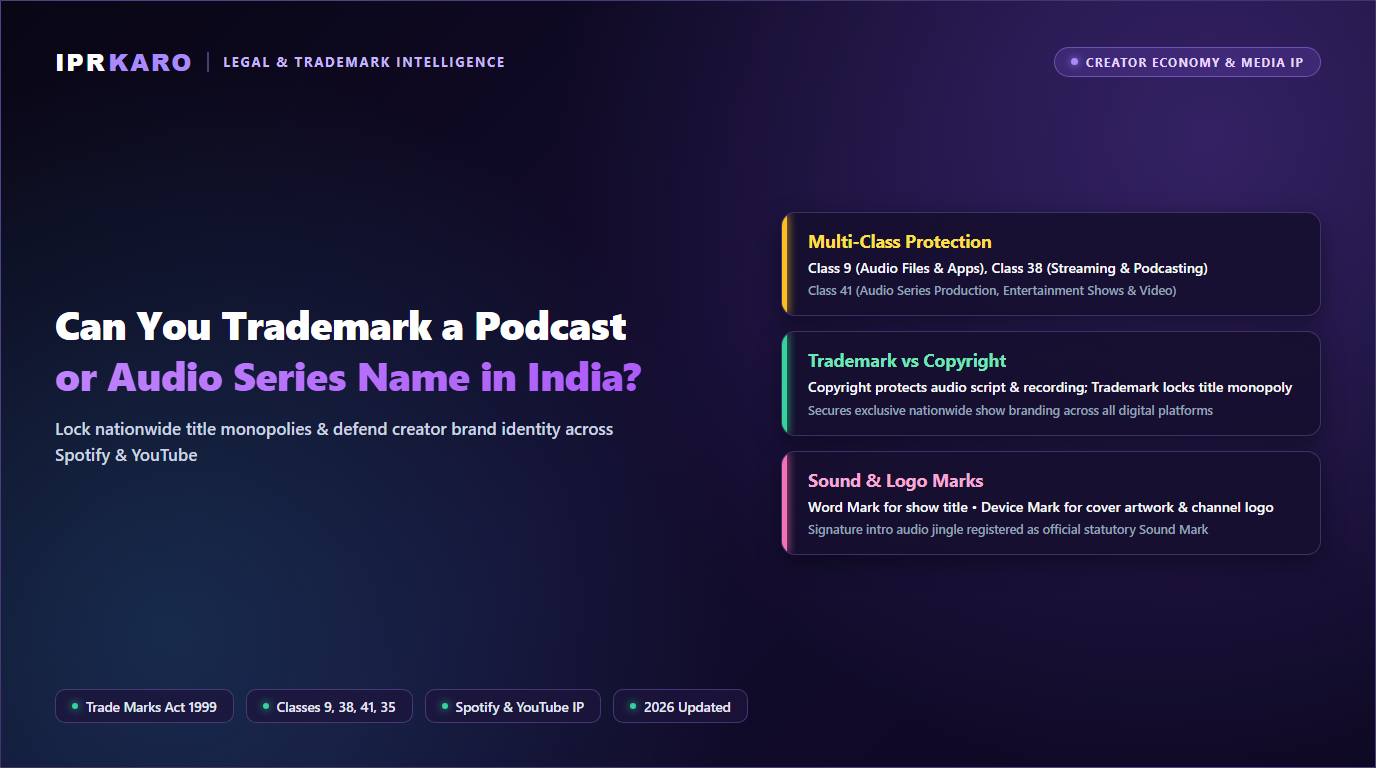
Yes, you can trademark a podcast title or audio series name in India under the Trade Marks Act, 1999, provided the title is used for an ongoing or recurring series rather than a single standalone episode. Complete brand protection requires a multi-class filing strategy across Class 9 (downloadable audio files & MP3s), Class 38 (audio streaming & telecommunication transmission), and Class 41 (production of podcast shows, entertainment & audio storytelling). While copyright law under the Copyright Act, 1957 protects the underlying script, sound recording, and musical composition, it does not grant proprietary title monopolies. Trademarking secures the exclusive right to the show title, square cover artwork (Device Mark), and signature intro jingles (Sound Mark) across Spotify, Apple Podcasts, YouTube, and Amazon Music.
The Indian creator economy is experiencing exponential growth in audio storytelling, interview podcasts, investigative true-crime docuseries, and business talk shows. With millions of downloads across Spotify, Apple Podcasts, JioSaavn, Gaana, and YouTube Music, top-tier audio series have transformed into multi-crore intellectual property assets.
However, many creators mistakenly assume that uploading an audio episode or registering copyright on their script automatically secures their show name against copycats. In Indian intellectual property jurisprudence, titles and names are not protected under copyright law. Without a registered trademark under theTrade Marks Act, 1999, another creator or production house can launch a show with a confusingly similar name, cannibalize your audience, and dilute your sponsorship valuation.
Learn how trademark law intersects with creative media assets in our guides on trademark vs copyright registration, trademark registration for YouTube channel names, and trademarking book and movie titles in India.
Copyright vs Trademark for Audio Content
Understanding the distinct spheres of copyright and trademark protection is foundational for digital audio creators:
Copyright Protection
Copyright Act, 1957- Script & Text: Protects original written scripts, show notes, and research as literary works.
- Sound Recording: Protects the recorded voice tracks, mastered audio files, and episode stems.
- Original Music: Protects background scores, theme songs, and instrumental sound beds.
- Title Limitation: Under Supreme Court rulings (Krishika Lulla v. Shyam Vithalrao Devkatta), copyright does not protect short titles or brand names.
Trademark Protection
Trade Marks Act, 1999- Show Title Monopoly: Grants exclusive nationwide rights over the podcast title and audio show brand.
- Cover Artwork: Protects the square 1:1 graphic logo, visual layout, typography, and color palette.
- Sonic Branding: Protects unique 5–15 second intro audio chimes and signature stings as Sound Marks.
- Commercial Merchandising: Secures licensing rights for apparel, events, and brand sponsorships.
Nice Classification: Classes 9, 38 & 41
Under the international Nice Classification system adopted by IP India, podcasting spans hardware, telecommunications, and entertainment production. A comprehensive filing strategy requires registration across multiple core classes:
Downloadable Digital Media & Audio Recordings
Covers downloadable audio files, podcasts, MP3 recordings, digital audiobooks, downloadable media players, mobile application software for streaming, and recorded media formats.
Key Specification Drafting: “Downloadable audio and video podcasts in the field of entertainment, news, business, and storytelling; downloadable sound recordings; digital media software.”
Telecommunications & Audio Broadcasting Services
Covers digital transmission and broadcasting of podcasts, streaming audio over the internet, digital telecommunications, webcasting services, and electronic delivery of audio programming.
Key Specification Drafting: “Broadcasting of audio and video programming via the internet; streaming of audio material on digital networks; podcast transmission services.”
Entertainment, Production & Live Shows
The primary service class for creators. Covers production and distribution of podcast shows, audio drama series, interview programs, non-downloadable streaming entertainment, live stage shows, and sound studio production.
Key Specification Drafting: “Production of podcasts and audio series; entertainment services, namely, providing ongoing audio and video programs; live performance events.”
Classes 35 & 25: Advertising, Sponsorships & Merch
Class 35: Advertising services, influencer marketing, podcast sponsorship monetization, and online retail store services for podcast merchandise.
Class 25: Apparel, printed t-shirts, caps, hoodies, and promotional clothing bearing the podcast logo.
Single Episode vs Ongoing Series Rule
In trademark jurisprudence across common law jurisdictions and the Indian Registry, there is a fundamental legal distinction between asingle standalone creative workand anongoing series of works:
The “Series of Works” Distinctiveness Doctrine
A single book title or single episode title indicates the content of that specific creative output rather than pointing to a continuous commercial source. However, when a title is applied to arecurring audio series, episodic podcast, or multi-season show(such as The Ranveer Show, Cyrus Says, or Finshots Daily), the name indicates that all episodes originate from the same production source. It functions as a true trademark underSection 2(1)(zb)of the Trade Marks Act, 1999.
Proving Secondary Meaning for Descriptive Titles
If your podcast title incorporates common industry terms (e.g., “The AI Startup Podcast” or “Daily Tech Pulse”), the Trademark Examiner may issue an objection underSection 9(1)(b)for descriptive character. To secure registration, creators must submit a comprehensive User Affidavit underRule 25with verifiable listenership analytics, Spotify wrapped summaries, Apple Podcasts ranking charts, media press mentions, and sponsorship invoices proving that the show has acquired distinctiveness through extensive commercial use.
Word Mark, Cover Artwork & Sound Marks
Top-tier podcast brands deploy a three-tier asset registration strategy to create an unbreachable IP perimeter:
1. Word Mark
Protects the text and phonetic pronunciation of your show name across all fonts, styles, languages, and platforms. Highest statutory protection against copycat titles.
2. Device (Cover Art)
Protects the square 1:1 podcast cover artwork, thumbnail illustration, custom lettering, typography, and graphic layout displayed on streaming directories.
3. Sound Mark
Registered under Rule 26 of Trade Marks Rules, 2017. Protects your show's signature audio intro jingle, theme chords, or sonic sting (e.g., Netflix ta-dum or HBO static intro).
Explore the procedural rules for registering audio marks in our detailed guide on sound trademark registration in India and word mark vs device mark strategies.
Trademark Clearance for Audio Shows
Before investing thousands in audio recording equipment, branding studios, and launch marketing, conducting a rigorous trademark clearance search is critical to avoid infringement lawsuits and Section 11 objections:
Official IP India Portal Search across Classes 9, 38, 41 & 35
Check for identical, phonetically similar, or deceptively similar registered and pending marks. Use our free AI trademark search tool to uncover hidden phonetic conflicts.
Common Law & Streaming Directory Search
Search Spotify, Apple Podcasts, YouTube, Audible, and Podchaser. In India, prior unregistered users possess common law rights under Section 34 and can institute passing off actions against late filers.
Domain Name & Social Handle Clearance
Verify availability of .com / .in domains and primary handles on Instagram, YouTube, X (Twitter), and LinkedIn to ensure total cross-platform brand alignment.
Filing Workflow: Step-by-Step Guide
Registering your podcast trademark through the CGPDTM IP India portal follows a structured legal workflow:
Step 1: Determine Applicant Category & Claim MSME Fee Subsidy
Individual creators, sole proprietorships, and startups with an Udyam Registration Certificate pay a subsidized government fee of₹4,500 per class(a 50% discount compared to ₹9,000 for standard companies). Learn more in our guide on trademark fee concession for MSME & startups.
Step 2: Draft Precise Goods & Services Specification in Form TM-A
File Form TM-A online. Ensure multi-class or single-class specifications accurately describe downloadable digital audio (Class 9), telecommunications broadcasting (Class 38), and entertainment production (Class 41).
Step 3: Execute User Affidavit with Prior Commercial Use Evidence
If your podcast has already aired, claim the exact first broadcast date. Submit a notarized User Affidavit under Rule 25 accompanied by dated screenshots of episode 1 on Spotify, RSS feed logs, listener stats, and press coverage.
Step 4: Examination & Show-Cause Hearing Defense
If the Registry issues an Examination Report citing Section 9 (distinctiveness) or Section 11 (similar marks), file a comprehensive legal reply within 30 days. Represent your matter through video conferencing show-cause hearings if required.
Step 5: Journal Publication & Statutory Registration Certificate
Upon acceptance, the mark is advertised in the Trade Marks Journal for a 4-month opposition window. If unopposed, IP India issues the official Registration Certificate under Section 23(2), valid for 10 years and renewable indefinitely.
Digital Platform Take-Downs & Disputes
Holding a registered trademark unlocks powerful automated enforcement mechanisms on major global and domestic streaming platforms:
Spotify Intellectual Property Takedown Portal
Spotify maintains an expedited IP infringement reporting system. By providing your Indian Trademark Registration Number, you can have unauthorized audio clones, squatted show names, and infringing artwork removed within 48 to 72 hours.
Apple Podcasts & YouTube Copyright / Trademark Dispute Mechanisms
Apple Legal and YouTube Brand Protection accept registered trademark claims to de-list infringing RSS feeds, transfer squatted custom handles, and prevent bad-faith impersonation across audio and video directories.
Civil Court Injunctions & Damages under Section 29
If a competing creator refuses to cease using your brand name after a formal Cease & Desist notice, you can file an infringement suit under Section 29 of the Trade Marks Act, 1999 in the Commercial Court or High Court to obtain interim injunctions and account of profits.
Podcast Licensing & Merchandising IP
As audio shows scale, monetization expands beyond programmatic ads into exclusive platform deals, live tours, brand sponsorships, and physical merchandise. Your registered trademark is the legal foundation for all commercial transactions:
Platform Exclusivity Licensing
When licensing your show exclusively to Spotify, Audible, or Luminary, the license agreement is structured as a Trademark & Content Licensing Agreement under Sections 48 and 49 of the Trade Marks Act, 1999, ensuring you retain core ownership while licensing broadcast rights.
Merchandise & Event IP Licensing
Licensing your show name for live comedy/storytelling tours, branded apparel (Class 25), or consumer packaged goods requires strict quality control clauses to prevent brand dilution and naked licensing risks.
Podcast IP Protection Class Matrix
A complete reference guide for podcasters and audio media enterprises:
| Podcast Asset | Nice Class | IP Protection Type | Key Legal Benefit |
|---|---|---|---|
| Show Title / Series Name | Class 41 | Word Mark | Nationwide title monopoly across all streaming platforms |
| Downloadable Audio / MP3s | Class 9 | Word / Device Mark | Prevents pirate audio downloads & copycat media apps |
| Streaming & Webcasting | Class 38 | Service Mark | Protects digital broadcast & telecommunication delivery |
| Square Cover Artwork | Classes 9 & 41 | Device Mark | Protects visual logo, thumbnail layout & color get-up |
| Intro Audio Jingle / Sting | Classes 38 & 41 | Sound Mark (Rule 26) | Monopoly over signature audio chords and sonic branding |
| Apparel & Merch | Class 25 | Device / Word Mark | Exclusive commercial monetization for hoodies, tees & caps |
Frequently Asked Questions
Q.Can I trademark a single podcast episode title in India?
No, a single standalone podcast episode title generally cannot be registered as a trademark because it serves merely as a descriptive identifier of one piece of content. However, an overarching podcast show title or recurring audio series name that identifies multiple episodes across seasons acts as a distinctive badge of commercial origin and is fully registrable under the Trade Marks Act, 1999.
Q.Which trademark classes apply to podcasts and audio series in India?
Podcasts require a multi-class filing approach: Class 9 covers downloadable audio files, MP3 podcasts, and digital media software; Class 38 covers telecommunication services, streaming audio over the internet, and digital audio broadcasting; and Class 41 covers entertainment services, podcast production, live storytelling, and audio programming.
Q.What is the difference between copyright and trademark for a podcast?
Copyright under the Copyright Act, 1957 automatically protects the underlying creative expression—such as the spoken script (literary work), background score (musical work), and final audio master (sound recording). However, copyright does not protect short titles or brand names. A trademark registered under the Trade Marks Act, 1999 is essential to secure exclusive proprietary rights over the show's name, cover art, and sonic logo.
Q.Can I register a podcast's theme music or intro jingle as a sound trademark?
Yes, signature intro jingles, recurring theme music, or distinct sonic chimes can be registered as Sound Marks in India under Rule 26 of the Trade Marks Rules, 2017. The applicant must submit an MP3 recording not exceeding 30 seconds along with precise musical notation (stave notation) demonstrating that the sound uniquely identifies the podcast.
Q.Should I register my podcast name as a Word Mark or a Device (Logo) Mark?
For maximum legal protection, creators should first file a Word Mark for the show's title to monopolize the name regardless of visual styling, font, or color. Additionally, filing a Device Mark for the podcast's square cover artwork protects the visual typography, graphic illustrations, and distinctive brand aesthetics on Spotify and Apple Podcasts.
Q.What classes are needed if I sell branded merchandise for my podcast?
If you monetize your podcast by selling branded merchandise, you should expand your trademark coverage to Class 25 for apparel (t-shirts, hoodies, caps), Class 21 for coffee mugs and drinkware, and Class 35 for operating an e-commerce online retail store or managing podcast advertising and sponsorship campaigns.
Q.How much does it cost to register a trademark for a podcast in India?
The official IP India government statutory fee for an Individual creator, Sole Proprietor, or recognized Startup/MSME (with Udyam certificate) is ₹4,500 per class for online e-filing (Form TM-A). For corporate entities and LLPs without MSME status, the statutory fee is ₹9,000 per class.
Q.How do I take down a copycat podcast infringing on my registered trademark?
With a registered trademark (or established prior user rights), you can issue a formal Notice of Infringement to the infringer and submit an official IP infringement takedown request to digital streaming platforms (including Spotify, Apple Podcasts, YouTube Music, and Amazon Music). You can also file a civil suit under Section 29 of the Trade Marks Act, 1999 for permanent injunctions and damages.
Strategic Creator IP Protection Advice
In the digital media landscape, your podcast title is the primary anchor of your brand value, listener loyalty, and advertising revenue. Relying solely on copyright leaves your show title vulnerable to copycats and platform hijackers. Securing multi-class trademark registrations across Classes 9, 38, and 41 guarantees nationwide legal exclusivity, elevates your show's commercial valuation, and empowers instantaneous takedowns on Spotify, Apple Podcasts, and YouTube.
Partner with dedicated media trademark attorneys to conduct pre-launch clearance searches, claim MSME fee concessions, and build an airtight intellectual property fortress. For related creator brand strategies, explore our guides on how to overcome trademark objections, series trademark applications in India, and stopping trademark infringement.
Protect Your Podcast Brand in India
Deploy registered trademark attorneys to secure nationwide title monopolies, protect cover artwork, register sound marks, and handle platform infringements.
Registered Trademark Attorneys • Multi-Class Strategy • Spotify/Apple Takedowns • Pan-India