
Written by Rahul Roy
Trademark Research Specialist
Overview of Series Trademark Filing
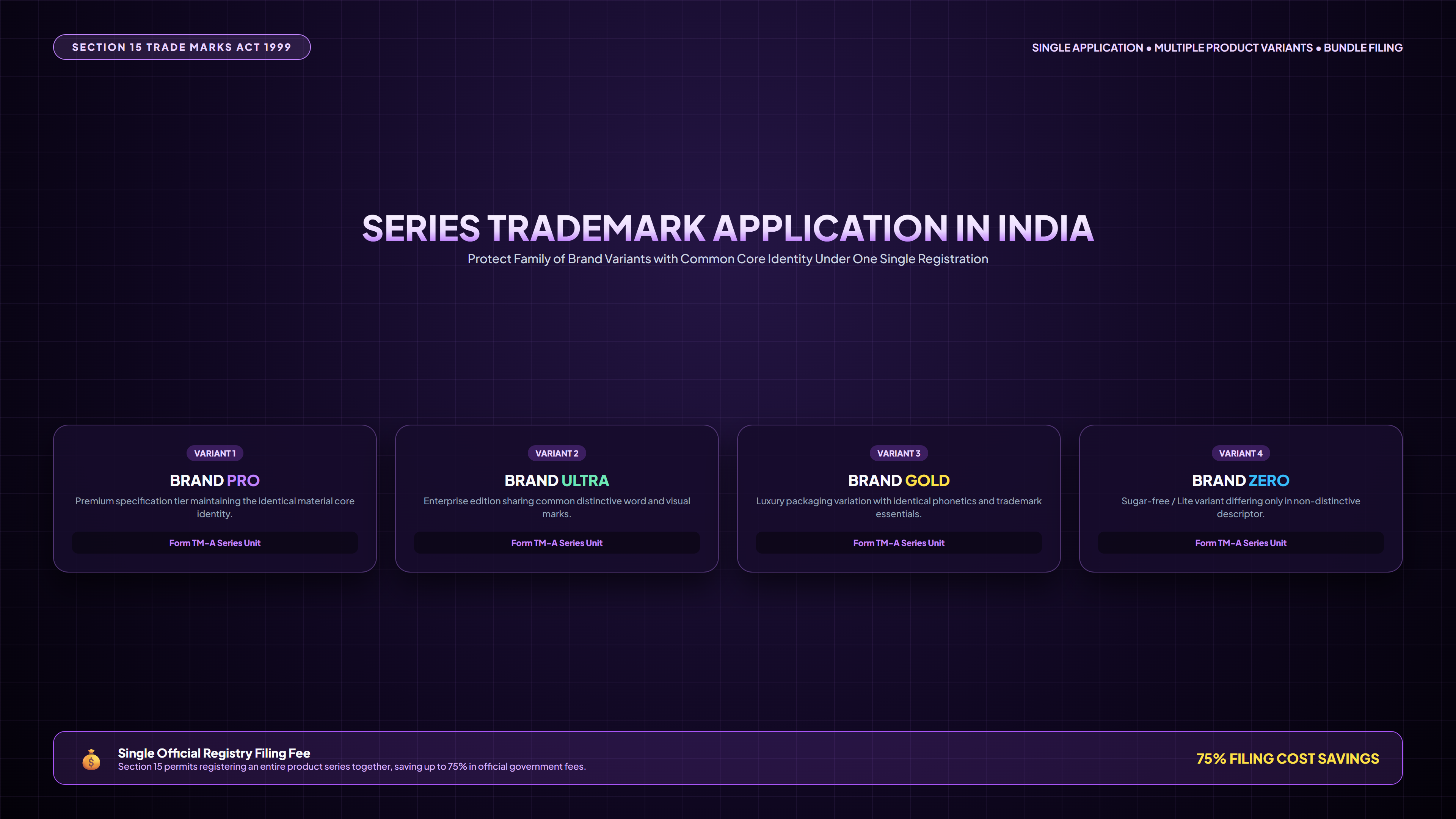
A Series Trademark Application under Section 15 of the Trade Marks Act, 1999 enables a brand owner to register a group of marks sharing an identical material distinctive core in one single application on Form TM-A. To qualify, the marks must belong to the same class and differ only in non-distinctive particulars such as color, size, price, quality, flavor, or destination statements. By filing a series application, businesses pay a single official filing fee (₹4,500 for MSMEs/Startups, ₹9,000 for Large Enterprises) for all variants, saving up to 80% in government fees compared to filing multiple standalone applications.
Modern consumer brands rarely sell a single, static product. A beverage company launches variants like “Brand Mango”, “Brand Lemon”, and “Brand Berry”; a cosmetic line markets “Glow Velvet 50ml” and “Glow Velvet 100ml” in pink, gold, and bronze packaging; an apparel label designs its core monogram across red, blue, and black labels.
Filing individual trademark applications for every variant creates immense administrative overhead and costs tens of thousands in official fees. Section 15(3) of the Trade Marks Act, 1999 and Rule 25 of the Trade Marks Rules, 2017 provide an elegant statutory solution: the Series Trademark Registration.
Understanding how to structure a series application allows brand owners to maximize legal protection across entire product families. Learn how series filing contrasts with other portfolio strategies in our guides on single vs multi-class trademark filing, associated trademarks under Section 16, and trade dress packaging protection.
Section 15 Statutory Framework
Section 15 of the Trade Marks Act, 1999 governs both the registration of parts of trademarks and the registration of trademarks as a series. The specific statutory provisions governing series marks are:
Section 15(3): The Series Definition & Scope
“Where a person claiming to be the proprietor of several trade marks in respect of the same or similar goods or services, which, while resembling each other in the material particulars thereof, yet differ in respect of—
(a) statements of the goods or services in relation to which they are respectively used or proposed to be used; or
(b) statements of number, price, quality or names of places; or
(c) other matter of a non-distinctive character which does not substantially affect the identity of the trade mark; or
(d) colour;
seeks to register them, they may be registered as a series in one registration.”
Section 15(4): Deemed Association
“All trade marks so registered as a series in one registration shall be deemed to be, and shall be treated as, associated trade marks.”
This statutory wording creates a clear legal requirement: every mark in the series must share the same dominant distinctive identifier, differing solely in auxiliary, non-distinctive descriptive elements.
Eligibility Criteria for Series Marks
To successfully secure registration of a series of trademarks before the Indian Trade Marks Registry, the application must satisfy four mandatory statutory tests:
Identical Material Particulars
The primary distinctive word, logo, or figurative device must be identical across all marks in the series. The core identifier that creates brand recall cannot change between variants.
Single Trademark Class
All goods or services covered by the series must fall strictly under a single trademark class (e.g., Class 30 for confectioneries, Class 3 for cosmetics, Class 25 for apparel). Multi-class series applications are impermissible.
Non-Distinctive Differences
The variations must be limited to descriptive elements—such as flavor names, packaging sizes, colors, grades, or geographical locations—that do not alter the commercial identity of the mark.
Common Proprietary Ownership
All marks in the series must be owned by the exact same legal entity (proprietor, company, or partnership firm). Co-applicants cannot file separate marks under one series.
Permissible Non-Distinctive Variations
Section 15(3) specifically lists the types of differences allowed between marks in a series application. The table below details real-world commercial examples:
| Statutory Category | Permissible Variation | Commercial Example | Class |
|---|---|---|---|
| Statements of Goods / Flavours | Different flavour or ingredient descriptors | “NUTRIBAR Almond”, “NUTRIBAR Berry”, “NUTRIBAR Chocolate” | Class 30 |
| Statements of Number / Size | Quantities, volume, weight, or unit numbers | “AQUA PURA 500ml”, “AQUA PURA 1 Litre”, “AQUA PURA 5 Litre” | Class 32 |
| Statements of Quality / Grade | Quality markers (Gold, Silver, Premium, Eco) | “TEXO Gold”, “TEXO Silver”, “TEXO Platinum” | Class 24 |
| Names of Places / Destination | Geographical branch or destination names | “GRAND STAY Delhi”, “GRAND STAY Mumbai”, “GRAND STAY Goa” | Class 43 |
| Colour Variations | Identical logo rendered in different color schemes | Monogram in Red/White, Blue/White, and Black/Gold | Class 25 |
Prohibited Differences in Series Marks
The Trade Marks Registry strictly rejects series applications where the differences are substantive, distinctive, or alter consumer perception. Prohibited differences include:
Different Distinctive Words
Attempting to bundle “ROYAL FEAST” and “REGAL FEAST” under one application is prohibited because “ROYAL” and “REGAL” are distinct verbal words.
Substantially Different Graphic Devices or Logos
Using a Lion emblem in Mark A and an Eagle emblem in Mark B with the same wordmark creates visual divergence that destroys series eligibility.
Different Trademark Classes
A single series application cannot protect biscuits in Class 30 and fruit juices in Class 32. Each class requires an independent series application.
Invented Sub-Brands with Independent Distinctiveness
Adding coined distinctive words like “ZYPHER” or “NEXUS” to the main mark creates independent sub-brands that must be registered separately.
Filing Cost Savings: Series vs Separate
The financial benefits of utilizing Section 15 series applications are dramatic. Under the Trade Marks Rules, 2017, the official filing fee for a series trademark on Form TM-A is identical to the fee for a standard single application, regardless of whether you include 3, 5, or 8 variants.
For Startups & MSMEs (5 Product Variants)
For Large Enterprises (6 Product Variants)
Learn how to claim MSME government fee concessions in our comprehensive guide on trademark fee concessions for Udyam and Startups.
Step-by-Step Form TM-A Series Filing
Under Rule 25 of the Trade Marks Rules, 2017, filing a series application requires specific formatting on Form TM-A. Follow this 6-step protocol:
Step 1: Conduct Comprehensive Clearance Search
Perform clearance searches on the core wordmark and all variant names using our free AI trademark search tool to ensure no conflicting registrations exist.
Step 2: Prepare Consolidated Representation Sheet
Under Rule 25(1), prepare a visual representation document displaying each mark in the series clearly in a sequential grid or numbered list.
Step 3: Select “Series Trade Mark” on Form TM-A
In the IP India e-filing gateway, open Form TM-A, select standard filing, and check the checkbox designated for “Series Application under Section 15(3)”.
Step 4: Draft Consolidated Goods & Services Description
Define the specification of goods/services accurately under the relevant class, reflecting the scope of all variants in the series.
Step 5: Execute User Affidavit (If Claiming Prior Use)
If the series marks have been used in commerce prior to filing, attach a User Affidavit under Rule 25 evidencing commercial usage of the series.
Step 6: Pay Government Fee & Generate CBR
Submit the single class official fee and generate your permanent Application Number and Central Book Receipt (CBR).
Series Examination & Division Process
During substantive examination, the Examiner evaluates the entire series as a unit while assessing each individual variant for registrability under Sections 9 and 11.
Scenario A: Variant Objection Cured via Deletion
If the Examiner objects to Mark 3 (e.g., “Brand Gold”) due to a cited prior mark, the applicant can file Form TM-M to delete “Brand Gold” from the series. The remaining marks (“Brand Silver”, “Brand Bronze”) then proceed smoothly to journal advertisement.
Scenario B: Division of Series Application
Under Rule 25(2), the applicant may apply to the Registrar on Form TM-M to divide the series application into independent individual applications. The divided marks retain the original filing priority date upon payment of applicable division fees.
Series vs Associated vs Multi-Class
Brand proprietors frequently confuse Series Trademarks with Associated Trademarks and Multi-Class Applications. Here is the definitive legal comparison:
| Feature | Series Trademark (Sec. 15) | Associated TM (Sec. 16) | Multi-Class TM (Sec. 18(2)) |
|---|---|---|---|
| Application Form | Single Form TM-A | Separate Form TM-As | Single Form TM-A |
| Government Fee | Single Class Fee Only | Fee for Each Mark | Multiplied by No. of Classes |
| Class Scope | Strictly 1 Class | Same or Different Classes | Multiple Classes (1-45) |
| Assignment Scope | Must be Assigned Together | Must be Assigned Together | Can be Assigned or Divided |
Commercial Brand Case Studies
Examine how top industries deploy Section 15 Series Trademark applications to establish impenetrable brand monopolies:
1. D2C FMCG & Packaged Foods
A snack manufacturer filed a series application for “CRUNCHY BITES Peri Peri”, “CRUNCHY BITES Sour Cream”, “CRUNCHY BITES Salted”, and “CRUNCHY BITES Wasabi” in Class 30. The common material distinctive core “CRUNCHY BITES” combined with non-distinctive seasoning descriptors secured 4 variant monopolies for a single ₹4,500 government fee.
2. Hospitality & Hotel Chains
A boutique resort brand filed a series application in Class 43 for “HERITAGE HAVEN Jaipur”, “HERITAGE HAVEN Udaipur”, “HERITAGE HAVEN Jodhpur”, and “HERITAGE HAVEN Varanasi”, safeguarding its city expansions under one registration certificate.
3. Cosmetics & Skincare Lines
A skincare brand registered its core monogram logo in three packaging colour variants (Rose Gold label, Matte Black label, Pure White label) in Class 3, preventing counterfeiters from copying specific bottle colour combinations.
Series Application Strategic Checklist
Ensure flawless execution of your Section 15 Series Trademark Application with this pre-filing compliance checklist:
Verify Identity of Material Particulars
Ensure the dominant wordmark, font styling, and logo structure are 100% identical across all variant representations.
Confirm All Goods Belong to One Class
Never mix classes in a series application. Audit your goods list to ensure every variant operates under the exact same class number.
Confirm Differences are Purely Non-Distinctive
Ensure variation text consists only of descriptive terms (flavors, numbers, weights, colors, places) without secondary coined words.
Maintain Unified Portfolio Assignment Records
Remember that Section 15(4) creates mandatory association. If you ever license or assign your brand via a trademark assignment agreement, the entire series must be transferred together.
Frequently Asked Questions
Explore expert answers to the most frequent questions regarding Section 15 Series Trademark applications in India:
1. What is a Series Trademark under Section 15 of the Trade Marks Act, 1999?
A Series Trademark allows an applicant to register multiple variations of a brand under a single trademark registration application. Under Section 15(3), the marks in the series must share the same material distinctive core and relate to the same or similar goods/services within the same class, differing only in non-distinctive elements such as color, size, price, quantity, flavor, destination, or geographic location.
2. How does filing a Series Trademark save government filing fees in India?
Instead of filing 5 separate trademark applications at ₹4,500 each (for MSME/Startup) totaling ₹22,500, or ₹9,000 each (for Large Enterprises) totaling ₹45,000 in official fees, a Series Trademark Application bundles all eligible variants into one single application on Form TM-A with only one standard official filing fee (₹4,500 for MSME/Individual or ₹9,000 for Others), delivering up to 80% direct savings in government fees.
3. What variations are legally permissible within a Series Trademark?
Under Section 15(3) of the Trade Marks Act, permissible differences are strictly non-distinctive: (1) Statements of goods or services, (2) Statements of number, price, or quality, (3) Geographic names or places of destination, (4) Colour combinations or monochrome variations, and (5) Other non-distinctive descriptors (such as packaging sizes, flavours like 'Vanilla' / 'Chocolate', or product formats like 'Gold' / 'Silver').
4. Can a Series Trademark application cover goods across multiple classes?
No. A Series Trademark Application under Section 15 and Rule 25 must strictly belong to a single trademark class. All variant representations within the series must cover the same or similar goods or services classified under that single Nice classification. If you require multi-class protection, you must file a separate multi-class application or individual class series filings.
5. Are series trademarks automatically treated as associated trademarks?
Yes. Under Section 15(4) of the Trade Marks Act, 1999, all trademarks registered as a series in one registration are deemed to be, and are statutorily treated as, associated trademarks under Section 16. This means they cannot be assigned or transferred separately to different proprietors; the entire series must be assigned together as a bundle.
6. What happens if the Registrar objects to one mark in a Series Trademark application?
If the Trade Marks Registry raises an objection against one particular variant within a series (e.g., citing a conflicting third-party mark for one colour or flavor name), the applicant has two options: (1) Delete the objectionable variant from the series by filing Form TM-M, allowing the remaining series marks to proceed to registration; or (2) Apply to divide the series application under Rule 25(2) into separate standalone applications.
7. Can different brand names or distinctive words be registered as a series?
No. The primary statutory requirement under Section 15(3) is that all marks must resemble each other in their material particulars. If two marks have distinct verbal elements (e.g., 'Aura Luxe' and 'Nova Luxe') or substantially different graphic logos, they do not qualify as a series and will be rejected by the Registrar during examination.
8. How do you maintain and renew a Series Trademark registration after 10 years?
A Series Trademark registration is renewed as a single registration certificate on Form TM-R every 10 years under Section 25. The applicant pays the standard single-class renewal fee (₹9,000 standard e-filing fee), renewing the entire bundle of series marks simultaneously without paying recurring renewal fees for each variant.
Strategic Brand Portfolio Advice
Series Trademark filing under Section 15 is one of the most powerful, under-utilized cost-saving tools in Indian intellectual property law. When structured correctly by experienced trademark attorneys, a single application provides total defensive protection across all SKU variants without inflating your legal budget.
At IPR Karo, our registered trademark attorneys audit your complete product lineup, design eligible series representation sheets, and ensure seamless Form TM-A prosecution before the Trade Marks Registry.
Ready to Protect Your Product Lineup & Save 80%?
Consult with our senior trademark attorneys to evaluate your product variants for Section 15 Series filing and secure unified brand protection across India.
Registered Trademark Attorneys • Section 15 Series Filing • Form TM-A Drafting • Pan-India Prosecution