
Written byRahul Roy
Trademark Research Specialist
Overview of Comparative Advertising Law
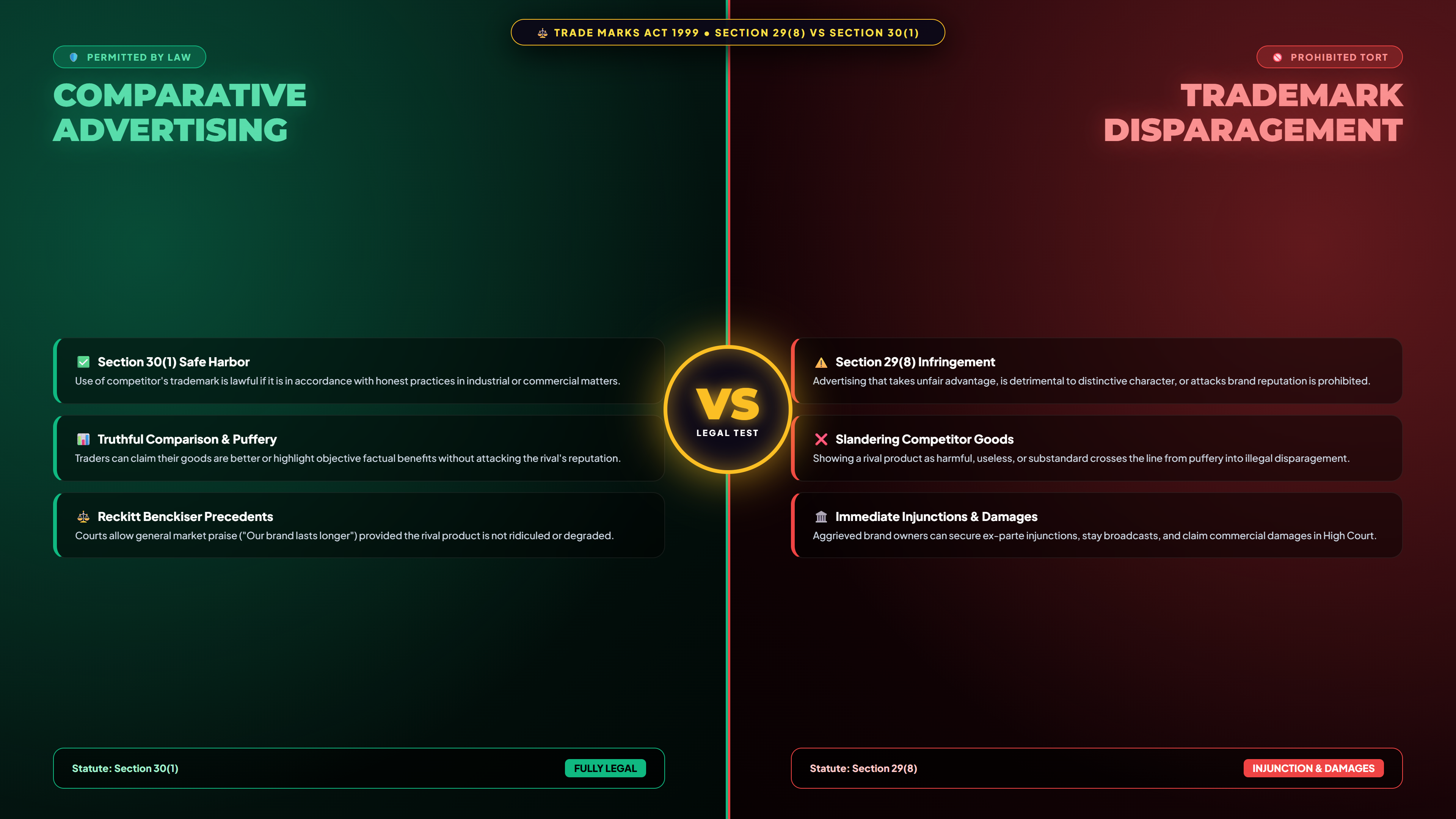
Comparative advertising is legally permissible in India under Section 30(1) of the Trade Marks Act, 1999 and constitutional commercial speech protections. Advertisers may reference a competitor's trademark to highlight honest, verifiable, and truthful product differences. However, under Section 29(8), advertising becomes illegal trademark disparagement if it takes unfair advantage, defames or ridicules the competitor, makes unsubstantiated claims, or asserts that the competitor's product is inferior, substandard, or toxic.
From television commercials (TVCs) and billboard wars between FMCG giants (like HUL vs Reckitt Benckiser or Pepsi vs Coca-Cola) to aggressive digital comparison campaigns by modern D2C startups, comparative advertising is a high-stakes marketing battleground.
While consumers benefit from transparent price, ingredient, and performance comparisons, brand owners invest immense capital building brand goodwill and trademark equity. When an aggressive competitor crosses the boundary from trade puffery into product denigration, Indian Commercial Courts step in decisively with swift interim injunctions, mandatory takedowns, and heavy punitive damages.
Understanding the statutory interplay betweenSection 29(8)andSection 30(1), the judicial three-factor disparagement test, ASCI codes, and the 2022 CCPA Guidelines is essential for chief marketing officers, creative agencies, and in-house legal counsels. For related digital marketing IP rules, review our guides oncompetitor bidding on trademarks in Google Adsandtrade dress protection under Indian law.
Commercial Speech vs Intellectual Property
The legal foundation of comparative advertising in India rests on the constitutional balance between two competing legal rights:
Commercial Speech (Article 19(1)(a))
In the historicTata Press Ltd. V. MTNL (1995 5 SCC 139)ruling, the Supreme Court of India held that commercial advertising is a protected form of commercial speech underArticle 19(1)(a)of the Constitution.
Consumers have a fundamental right to receive truthful commercial information regarding product quality, price, efficiency, and comparative specifications.
Trademark Protection (Section 28 & 29)
Under the Trade Marks Act, 1999, registration grants exclusive commercial monopoly and protects proprietary brand goodwill against unfair competition, trademark dilution, and tortious slander of goods.
Competitors cannot piggyback on established reputation, create consumer confusion, or damage brand value through defamatory commercials.
Section 29(8): Statutory Disparagement
Section 29(8) of the Trade Marks Act, 1999 explicitly defines when advertising constitutes statutory trademark infringement:
“Section 29(8) — A registered trade mark is infringed by any advertising of that trade mark if such advertising—
- (a) takes unfair advantage of and is contrary to honest practices in industrial or commercial matters; or
- (b) is detrimental to its distinctive character; or
- (c) is against the reputation of the trade mark.”
If an advertisement satisfies any of these three prongs, the plaintiff does not need to prove actual confusion among consumers. The statutory violation of Section 29(8) itself establishes actionable infringement and entitles the trademark owner to immediate interim relief.
Section 30(1): Honest Practice Safe Harbor
To prevent trademark rights from creating anticompetitive monopolies that silence fair market comparisons,Section 30(1) of the Trade Marks Act, 1999carves out a statutory safe harbor for legitimate comparative advertising:
Section 30(1) Statutory Exception
“Nothing in Section 29 shall be construed as preventing the use of a registered trade mark by any person for the purposes of identifying goods or services as those of the proprietor, provided the use is under honest practices in industrial or commercial matters, and is not such as to take unfair advantage of or be detrimental to the distinctive character or repute of the trade mark.”
Under Section 30(1), naming a rival brand (e.g., “Brand X costs ₹500 while our product delivers the same active ingredient for ₹250”) does not infringe the rival's trademark as long as the comparison is strictly factual, substantiated, and free of pejorative or ridiculing undertones.
Puffery vs Product Denigration Rules
Indian courts draw a sharp distinction between permissible marketing puffery and unlawful product disparagement:
| Legal Characteristic | Permissible Trade Puffery | Illegal Product Disparagement |
|---|---|---|
| Legal Definition | Subjective hyperbole boasting one's own product is the best or superior | Statements or visual depictions asserting the competitor's product is bad, useless, or harmful |
| Target of Message | Focused entirely on promoting the advertiser's own features and benefits | Focused on denigrating, mocking, or rubbishing the competitor's goods |
| Judicial Permissibility | Fully Lawful | Strictly Illegal |
| Consumer Perception Test | Reasonable buyers recognize subjective sales talk as commercial exaggeration | Consumers believe competitor's product poses health, safety, or quality defects |
| Classic Industry Example | “Our soap gives the freshest morning glow in India” | “Ordinary red antiseptic soap leaves behind toxic bacteria and burns skin” |
The Generic Disparagement Doctrine
Advertisers often attempt to evade trademark infringement lawsuits by blurring out the competitor's registered logo or labeling the rival product simply as “Ordinary Product X&rdquo. Or “Leading Market Brand”.
Under theDoctrine of Generic Disparagement, established in landmark rulings includingDabur India Ltd. V. Colgate Palmolive (India) Ltd.andReckitt Benckiser v. HUL, Indian courts hold that:
1. Attack on Entire Product Genre is Actionable
An advertiser cannot trash an entire class or genre of goods (e.g., claiming all Ayurvedic toothpowders cause dental abrasion) when the market leader accounts for the vast majority of that market share.
2. Distinctive Trade Dress Mimicry Constitutes Disparagement
If the commercial depicts an unnamed product whose packaging shape, distinctive bottle silhouette, cap contour, or color combination is identical to the market leader, viewers instantly identify the rival, making the denigration actionable.
Landmark Delhi High Court Judgments
The Delhi High Court is the premier intellectual property forum shaping comparative advertising jurisprudence in India:
Pepsi Co. Inc. v. Hindustan Coca Cola Ltd. (2003 (27) PTC 305 Del DB)
3-Factor TestThe Dispute:Coca-Cola ran a commercial mocking Pepsi's tagline “Yeh Dil Maange More&rdquo. By depicting a boy calling Pepsi a drink meant for children while choosing Thums Up as a “grown-up&rdquo. Drink.
The Ruling:The Division Bench granted an injunction. This establishes the definitive 3-Factor Test for disparagement: (1)Mannerof the commercial (is it ridiculing?), (2)Intentof the commercial, and (3)Storylineand overall impact on average viewers.
Havells India Ltd. v. Amritanshu Khaitan (2015 SCC OnLine Del 8115)
Truthful ComparisonThe Dispute:Havells challenged an advertisement by Eveready comparing LED bulb brightness (lumens) and pricing.
The Ruling:The Delhi High Court held that advertisers are entitled to highlight specific factual advantages, provided the claims are truthful, verifiable, and do not falsely misrepresent the competitor's product as defective.
Reckitt Benckiser v. Hindustan Unilever Ltd. (Dettol vs Lifebuoy/Domex Wars)
FMCG InjunctionsThe Dispute:Multiple battles regarding soap bars, dishwashing liquids, and toilet cleaners depicting competitors' distinctive amber antiseptic bottles or iconic red soap shapes.
The Ruling:The High Court repeatedly restrained commercials that visually denigrated competitors by portraying their products as ineffective or hazardous, reiterating that while a trader can claim superiority, they cannot defame rival formulations.
ASCI Code & CCPA 2022 Regulatory Guidelines
In addition to judicial litigation under the Trade Marks Act, advertisers must comply with strict self-regulatory and statutory guidelines:
ASCI Code Chapter IV (Comparative Advertising)
The Advertising Standards Council of India (ASCI) mandates that comparative advertisements must: (1) compare products meeting identical consumer needs, (2) compare relevant, verifiable, and representative features, (3) not create consumer confusion between the advertiser and competitors, and (4) not discredit, ridicule, or denigrate other products, trademarks, or trade names.
CCPA Guidelines for Misleading Advertisements, 2022
Issued under theConsumer Protection Act, 2019, the Central Consumer Protection Authority (CCPA) penalizes comparative advertisements that mislead consumers regarding performance, warranty, or test certifications. Disclaimers must be clearly legible, presented in the same font size and language as the primary claim, and must not contradict the main advertisement message.
Injunctions & Legal Remedies for Disparagement
When a competitor launches a disparaging ad campaign, aggrieved brand owners have immediate civil and commercial remedies:
Ex-Parte Ad-Interim Injunctions
Under Order 39 Rules 1 &. 2 CPC read with the Commercial Courts Act 2015, courts grant emergency injunctions restraining TV broadcast, OTT streaming, and digital distribution within 24 to 48 hours of filing.
Mandatory Digital Takedown Orders
Directing social media platforms (YouTube, Meta, X, Instagram) and intermediary ad servers to immediately take down the offending video or banner assets.
Compensatory & Punitive Damages
Awarding actual commercial losses, loss of goodwill, and exemplary punitive damages under Section 135 of the Trade Marks Act against repeat offenders.
ASCI Fast-Track Complaint Panel
Filing an expedited industry complaint with ASCI for swift ad modification or suspension within 5 working days.
Learn how to draft formal notices and court pleadings in our guide onhow to send trademark legal noticesandhow to respond to trademark infringement notices.
Comparative Advertising Risk Matrix
Evaluate proposed advertising storylines against Indian judicial risk benchmarks:
| Advertising Scenario | Legal Risk Level | Judicial Assessment & Outcome |
|---|---|---|
| “Our protein bar contains 25g protein vs Competitor's 10g (Lab Certified)” | Low (Permissible) | Lawful under Section 30(1) & Havells ruling. Truthful, factual metric comparison supported by laboratory data. |
| “Why buy Brand X when our product costs 50% less?” | Low (Permissible) | Price comparisons are protected commercial speech under Tata Press if actual MRPs are accurately cited. |
| “Competitor's cream contains harsh chemicals that damage child skin” | Critical (Instant Injunction) | Blatant Section 29(8) disparagement. Claims rival product is toxic or defective trigger immediate High Court stay orders. |
| Showing competitor's distinctive container being thrown into trash can | High (Disparagement) | Violates Pepsi Co Manner and Storyline test. Derogatory or mocking visual treatment constitutes trade libel. |
7-Step Brand Pre-Clearance Checklist
Brand marketing teams and creative agencies should execute this legal clearance protocol before broadcasting comparative ads:
Audit Against Pepsi Co 3-Factor Test
Critique the manner, intent, and overall storyline. Ensure the script focuses on your strengths rather than ridiculing the competitor.
Commission NABL Laboratory Testing
Secure independent, accredited scientific lab certificates verifying all nutritional, chemical, or performance claims before ad release.
Verify Parameter Equivalence
Compare like-with-like parameters (e.g., standard serving sizes, identical wattages, or equivalent package weights).
Eliminate Pejorative Imagery & Mockery
Remove visual tropes depicting competitor products as dirty, decaying, useless, or being dumped into garbage bins.
Ensure CCPA 2022 Disclaimer Compliance
Format on-screen supers and footnotes in clear font, adequate screen duration, and high contrast as required by the CCPA.
Review ASCI Chapter IV Rules
Align creative treatments with self-regulatory advertising industry codes to avoid negative public rulings and complaints.
Secure IP Litigation Counsel Clearance
Obtain a written risk assessment and formal clearance opinion from IP litigators before committing multimillion-rupee media spends.
Frequently Asked Questions
Q.Is comparative advertising legal under Indian trademark law?
Yes. Comparative advertising is lawful in India under Section 30(1) of the Trade Marks Act, 1999 and protected as commercial speech under Article 19(1)(a) of the Constitution. An advertiser can use a competitor's registered trademark to identify their goods or services, provided the comparison is truthful, verifiable, conforms to honest commercial practices, and does not take unfair advantage or damage the distinctive character or reputation of the competitor's mark.
Q.What constitutes trademark disparagement under Section 29(8)?
Under Section 29(8) of the Trade Marks Act, 1999, advertising constitutes trademark infringement and actionable disparagement if it: (a) takes unfair advantage of and is contrary to honest practices in industrial or commercial matters, (b) is detrimental to the distinctive character of the trade mark, or (c) is detrimental to the reputation of the trade mark. Disparagement occurs when an advertisement crosses the line from boasting about one's own product to denigrating, defaming, or rubbishing a competitor's goods.
Q.What is the legal difference between 'Puffery' and 'Disparagement'?
Trade Puffery refers to exaggerated, hyperbole-driven claims where a seller boasts 'My product is the best in the world' or 'Superior to all others'. Indian courts consider puffery permissible marketing hyperbole that ordinary consumers take with a grain of salt. Product Disparagement, by contrast, occurs when a trader asserts that a competitor's product is bad, ineffective, toxic, defective, or harmful. Disparagement is illegal and triggers civil injunctions and damages.
Q.What is the 'Generic Disparagement' doctrine?
Generic Disparagement occurs when an advertisement attacks or discredits an entire category of goods or depicts an unbranded product that clearly mimics the unique shape, color scheme, trade dress, or container of a market leader without explicitly naming their trademark (e.g., attacking toothpowder in favor of toothpaste, or showing a distinctively shaped orange antiseptic bottle). Indian courts grant injunctions against generic disparagement to protect market reputation.
Q.What three-factor test was laid down in Pepsi Co. v. Hindustan Coca Cola?
In Pepsi Co. Inc. V. Hindustan Coca Cola Ltd. (2003 (27) PTC 305 Del DB), the Delhi High Court established a seminal three-factor test for determining advertising disparagement: (1) The Manner of the commercial (is it ridiculing, mocking, or honestly comparing?), (2) The Intent of the commercial (is it to inform consumers or discredit a competitor?), and (3) The Storyline and overall message conveyed to the average viewer.
Q.Can an advertiser compare specific parameters like price or ingredients?
Yes. In Havells India Ltd. V. Amritanshu Khaitan (2015) and Horlicks Ltd. V. Heinz India (2018), the Delhi High Court confirmed that advertisers are fully entitled to highlight specific factual advantages, such as price differences, lumen output, energy efficiency, or protein grams per serving, provided the data is backed by independent scientific testing and does not falsely imply the competitor's product is unsafe or inferior overall.
Q.What role does the ASCI Code play in comparative advertising?
The Advertising Standards Council of India (ASCI) Code under Chapter IV mandates that comparative advertisements must: (1) compare clear, verifiable, and identical product parameters, (2) not mislead consumers about either product, (3) be supported by independent laboratory substantiation, and (4) not unfairly attack, discredit, or denigrate other products, brands, or advertisers directly or by implication.
Q.What immediate legal remedies are available against a disparaging advertisement in India?
An aggrieved brand owner can immediately file a commercial suit under the Commercial Courts Act, 2015 and Trade Marks Act, 1999 before the High Court or Commercial District Court seeking: (1) Ex-parte ad-interim injunctions under Order 39 Rules 1 & 2 CPC restraining broadcast on TV, YouTube, social media, and print, (2) Mandatory takedown directions to broadcasters and digital intermediaries, (3) Punitive and compensatory damages, and (4) Complaints before the Central Consumer Protection Authority (CCPA) and ASCI Fast-Track Complaints Panel.
Strategic Advisory for Brand Marketing Teams
Comparative advertising can rapidly expand market share when executed with factual accuracy and scientific rigor. However, crossing the line into trademark disparagement risks crippling commercial injunctions, costly media write-offs, and severe reputational fallout in High Court litigation.
Partner with intellectual property litigators at IPR Karo to conduct pre-broadcast ad audits, vet comparative scripts, defend against aggressive competitor lawsuits, and secure commercial injunctions against disparaging competitor campaigns. Review our guides onpassing off vs trademark infringement,trademark penalties in India, andhow to stop trademark infringement.
Protect Your Brand from Disparagement & Injunctions
Deploy veteran IP litigators to pre-clear comparative advertising campaigns, obtain emergency High Court injunctions, and safeguard market reputation.
Registered IP Advocates • High Court Injunctions • ASCI Fast-Track Defense • Pan-India Commercial Litigation