
Table of ContentsQuick Navigation (12 Sections)Expand
Quick Answer
How to Obtain Well-Known Trademark Status in India?
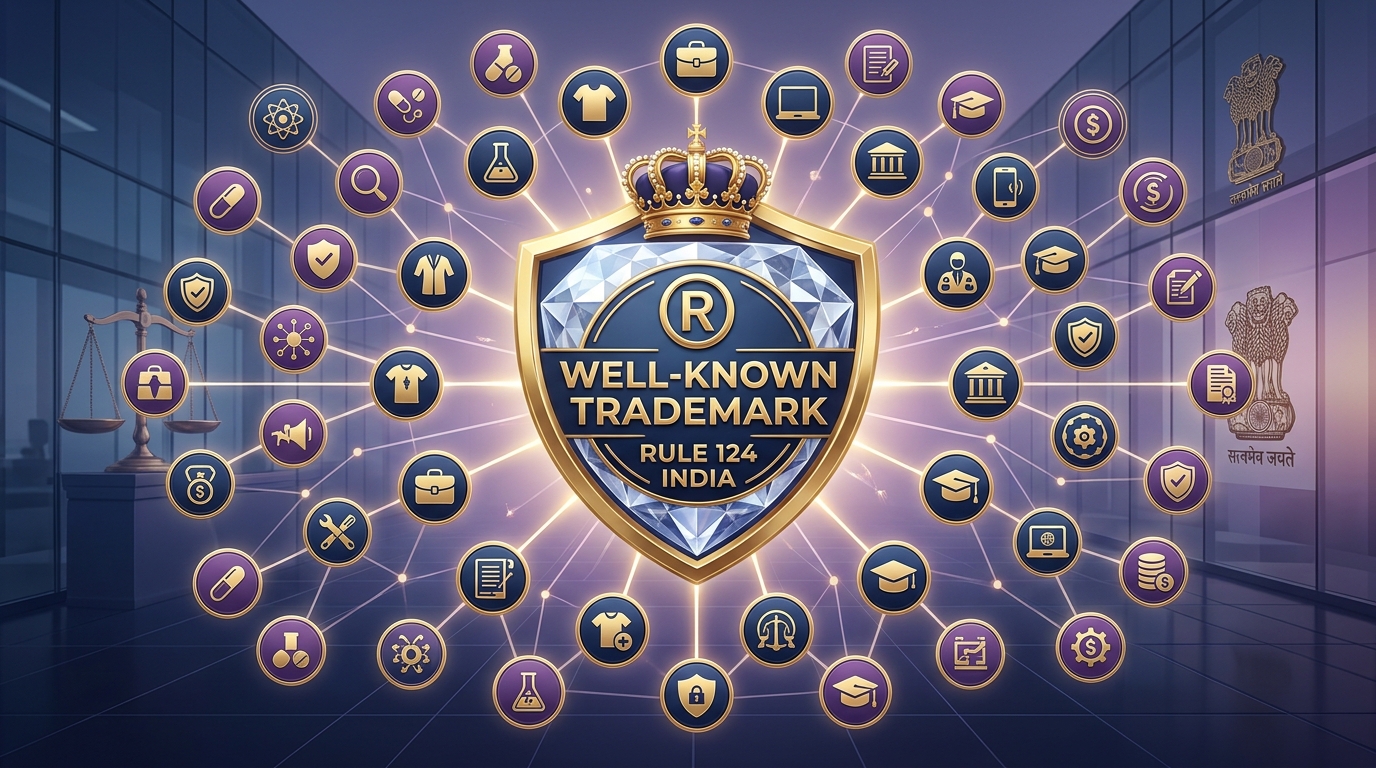
UnderRule 124 of the Trade Marks Rules, 2017, any trademark owner can apply directly to the Registrar of Trade Marks onForm TM-Malong with a statutory government fee of₹1,00,000to get their brand officially recognized as aWell-Known Trademark. The applicant must submit a comprehensive evidentiary dossier proving widespread consumer recognition, extensive sales turnover, advertising expenditure, court judgments, and multi-jurisdictional use underSection 11(6). Once granted, the mark receives automaticcross-class protection across all 45 trademark classes, blocking copycats in completely unrelated industries.
What is a Well-Known Trademark in India?
In conventional intellectual property law, trademark rights are strictly limited by the“Principle of Specificity”(also known as the specialty rule). This means that if you register a trademark inClass 25 for clothing, your legal protection prevents others from selling identical or similar apparel. However, it may not automatically stop someone from using the same brand name for steel manufacturing, cement, or hospitality.
AWell-Known Trademarkrepresents the pinnacle of trademark defense. It completely shatters the barrier of classes. UnderSection 2(1)(zg) of the Trade Marks Act, 1999:
“A well-known trade mark in relation to any goods or services, means a mark which has become so to the substantial segment of the public which uses such goods or receives such services that the use of such mark in relation to other goods or services would be likely to be taken as indicating a connection in the course of trade between those goods or services and a person using the mark in relation to the first-mentioned goods or services.”
Universal Exclusivity
Complete protection across all 45 classes of goods and services, regardless of your primary line of trade.
Anti-Dilution Shield
Prevents dilution by blurring (loss of distinctiveness) and tarnishment (use on low-quality, offensive goods).
Official Registry Listing
Published in the prestigious “List of Well-Known Trade Marks” maintained on the official IP India registry portal.
Rule 124 Framework: Direct Registrar Filing
Before 2017, there was no direct administrative mechanism in India to request well-known recognition. A trademark owner had to wait until an infringer copied their mark, institute an expensive lawsuit in the High Court, or fight a contested opposition before the Intellectual Property Appellate Board (IPAB). Only when a judge explicitly declared the mark as “well-known” in a final decree could the Registrar record it.
TheTrade Marks Rules, 2017revolutionized this landscape by enactingRule 124. Under this provision, brand owners can bypass protracted litigation and proactively apply directly to the Registrar of Trade Marks for formal determination.
Core Provisions of Rule 124 (Trade Marks Rules, 2017)
- 124(1):Any person may make an application inForm TM-Mto the Registrar for determination of a trademark as well-known, accompanied by a detailed statement of case and documentary evidence.
- 124(2):The application must be filed strictly throughonline e-filing, accompanied by the prescribed statutory fee of₹1,00,000.
- 124(3):The Registrar shall determine the application considering the mandatory criteria laid down underSection 11(6) to 11(9)of the Act.
- 124(4):Before finalizing determination, the Registrar publishes the mark in theTrade Marks Journalto invite objections from the public within 30 days.
- 124(5):Upon favorable determination, the trademark is formally notified in the Trade Marks Journal and added to the officialWell-Known Trade Marks List.
Section 11 Criteria for Determination
The Registrar does not grant well-known status casually. The application must satisfy the stringent statutory standards codified underSection 11(6), 11(7), 11(8), and 11(9)of theTrade Marks Act, 1999.
1Section 11(6): Mandatory Determination Factors
The Registrar must evaluate the following five evidentiary pillars:
- Public Knowledge:Knowledge or recognition of the mark in the relevant section of the public in India.
- Duration & Extent of Use:Years of continuous commercial use, sales volume, and geographical spread across India.
- Promotional Scope:Duration, extent, and geographical area of advertising, sponsorships, and marketing spend.
- Registration Footprint:Number of registrations and applications in India and overseas jurisdictions.
- Record of Successful Enforcement:Prior court judgments, IPAB orders, and opposition rulings defending the mark.
2Section 11(7): Who Constitutes the “Relevant Public”?
The mark does not need to be known to every citizen in India. Recognition is tested among:
- Actual and potential consumers of the specific goods or services.
- Persons involved in channels of distribution (distributors, wholesalers, retailers).
- Business circles dealing with the goods or services to which that mark applies.
3Section 11(9): What is NOT Required (Global Brand Rule)
To facilitate protection for multinational enterprises and famous foreign marks, Section 11(9) explicitly provides that the Registrar shallNOTrequire:
Cross-Class Protection Across All 45 Classes
The hallmark legal superpower of a Well-Known Trademark isSection 11(2)of the Trade Marks Act. This section mandates that a trademark application submitted by any third partyshall be refused registrationif it is identical or similar to an earlier well-known trademark, even if the goods or services are completely dissimilar!
Restricted Class Monopoly
A standard trademark registered in Class 9 (Software) cannot prevent a competitor from registering the exact same name in Class 33 (Alcohol) or Class 43 (Restaurants) unless the owner proves confusing similarity or passing off in court.
Scope: Only Registered Class(es)Omnipresent 45-Class Monopoly
Once listed as well-known, the Trade Marks Registry's automated examination software directly flags and refuses any third-party application across all 45 classes during initial examination, saving millions in litigation costs.
Scope: All 45 Nice Classification ClassesEvidentiary Dossier & Document Checklist
A Rule 124 application succeeds or fails entirely on the quality, structure, and depth of theEvidentiary Dossier. Indian trademark examiners thoroughly review every page. A typical dossier spans 500 to 2,000 pages, organized into a searchable, bookmarked PDF.
1. Formal Statement of Case & Sworn User Affidavit
A comprehensive petition drafted by your IP attorney, accompanied by a sworn affidavit executed by the Managing Director or authorized signatory underTrademark User Affidavit rules, narrating the brand's history, origin, global footprint, and reputation milestones.
2. CA-Certified Turnover & Financial Balance Sheets
Audited balance sheets, profit-and-loss statements, and an independent Chartered Accountant (CA) certificate detailing year-wise sales revenue and turnover generated under the trademark for at least the past 5 to 15 years across different Indian states.
3. Advertising & Marketing Expenditure Invoices
CA-certified advertising expenditure summaries supported by representative sample invoices of television commercials, digital campaigns (Google Ads, Meta), print media ads, billboards, sponsorships, and celebrity endorsement contracts.
4. Domestic & International Registration Certificates
Copies of Trademark Registration Certificates in India across all registered classes, along with international registration certificates under theMadrid Protocolor national IP registries (USPTO, EUIPO, UKIPO, JPO, etc.).
5. Judicial Orders, Decrees & Enforcement Records
Certified copies of High Court injunction orders, settlement decrees, Trade Marks Registry opposition decisions, or domain dispute awards underNIXI INDRPdemonstrating active defense and judicial recognition of your mark.
6. Power of Attorney on Form TM-48
Duly executedForm TM-48 (Power of Attorney)on appropriate non-judicial stamp paper authorizing your registered trademark attorney or agent to represent the enterprise before the CGPDTM.
7-Step Procedure to Obtain Rule 124 Status
Navigating a Rule 124 determination requires meticulous legal precision. Follow this proven 7-step roadmap:
Brand Audit & Pre-Filing Clearance
Conduct a thorough evaluation of your brand's geographical reach, market share, consumer perception, and historical trademark records. Ensure the mark has clean title without pending revocations or title disputes.
Dossier Compilation & CA Certification
Gather certified turnover figures, tax records, sample invoices, marketing budgets, and media features. Index and digitally bookmark every exhibit into a structured, high-resolution PDF document under 10MB (or split into sequential volumes).
Drafting Statement of Case & Legal Grounds
Your IP attorney drafts the formal petition under Rule 124(1), meticulously mapping your evidence against every single statutory requirement of Section 11(6) to 11(9) and citing supporting judicial precedents.
Online E-Filing of Form TM-M
Submit Form TM-M on the official IP India Trade Marks portal under the “Determination of Well-Known Mark&rdquo. Category using a Class 3 Digital Signature Certificate (DSC) and pay the official statutory fee of ₹1,00,000.
Registry Scrutiny & Committee Evaluation
The application is assigned to a high-level Well-Known Trademark Committee or Joint Registrar at the Trade Marks Registry. The committee evaluates the veracity of evidence, reputation claims, and distinctiveness.
Trade Marks Journal Publication (30 Days)
If prima facie satisfied, the Registrar publishes the proposed well-known trademark in the Trade Marks Journal inviting objections or representations from the public within a statutory 30-day window under Rule 124(4).
Hearing, Final Order & Gazette Notification
If objections are raised, the Registrar conducts a formal hearing (in person or viavideo conference). Upon satisfaction, the Registrar passes a reasoned order and adds the brand to the official List of Well-Known Trade Marks.
Official Government Fees and Timeline
Applying for well-known status is an enterprise-level legal investment. Unlike standard Form TM-A filings, there are no fee concessions for startups or MSMEs under Rule 124.
| Item / Milestone | Statutory Cost / Timeline | Legal Remarks |
|---|---|---|
| Form TM-M Government Fee | ₹1,00,000 | Uniform fee for all applicants (No MSME/Startup discount). |
| Mode of Filing | Online E-Filing Only | Mandatory Class 3 Digital Signature Certificate (DSC). |
| Dossier Preparation | 3 to 6 Weeks | Collating nationwide invoices, balance sheets, and CA certificates. |
| Registry Scrutiny Period | 3 to 6 Months | Detailed evaluation by Well-Known Examination Committee. |
| Public Objections Window | 30 Days | Statutory opposition window in Trade Marks Journal. |
| Total Completion Timeline | 6 to 18 Months | From initial e-filing to official Gazette inclusion. |
Standard Trademark vs Well-Known Trademark
Understanding the strategic difference between an ordinary registered trademark and a Rule 124 Well-Known Trademark is vital for corporate legal planning:
| Feature | Standard Registered Trademark | Well-Known Trademark (Rule 124) |
|---|---|---|
| Statutory Basis | Section 18 / Section 28 (TM-A) | Section 2(1)(zg) & Rule 124 (TM-M) |
| Scope of Protection | Limited to registered class(es) | Universal across all 45 classes |
| Filing Government Fee | ₹4,500 (Ind/MSME) / ₹9,000 (Co.) | ₹1,00,000 flat fee |
| Registry Refusal Power | Refuses marks only in same/similar class | Automatically blocks copycats across any class |
| Proof of Reputation | Basic use affidavit or proposed to be used | Exhaustive multi-year evidentiary dossier |
| Anti-Dilution Remedy | Requires proving direct consumer confusion | Protects against blurring & tarnishment per se |
Landmark Judicial Precedents & Case Laws
Indian courts have developed rich jurisprudence granting extensive cross-border and cross-class protections to iconic brand names:
1. Daimler Benz v. Hybo Hindustan (Delhi HC)
Mercedes-BenzThe defendant used the mark “BENZ” along with the three-pointed star logo for men's undergarments. The Delhi High Court held that the name “BENZ&rdquo. Possesses world-class reputation and cannot be appropriated by a third party for completely unrelated consumer goods. This establishes the foundation oftrademark tarnishment and dilutionin India.
2. Tata Sons Ltd. v. Manoj Dodia (Delhi HC)
TATA MarkThe High Court laid down comprehensive guidelines on the factors that constitute a well-known trademark under Section 11(6), affirming that the “TATA&rdquo. Brand enjoys omni-present cross-class protection against any entity attempting to ride upon its goodwill.
3. Rolex SA v. Alex Jewellery Pvt. Ltd. (Delhi HC)
ROLEXThe defendant used the trademark “ROLEX” for artificial fashion jewellery. The court held that Rolex had acquired widespread fame in luxury watches, and consumers seeing “Rolex&rdquo. Jewellery would assume a trade connection. This grants an injunction despite watches and artificial jewellery being different trade channels.
4. N.R. Dongre v. Whirlpool Corporation (Supreme Court)
WhirlpoolThe Supreme Court recognized the“Doctrine of Trans-Border Reputation”, ruling that a foreign trademark owner can enforce well-known rights in India even without physical product sales in the country, provided the brand's reputation has spilled over into India through international publications and media.
Common Rejection Pitfalls and Prevention
Due to the ₹1,00,000 non-refundable statutory fee, a Rule 124 application must be prepared with extreme diligence. Avoid these 5 common mistakes that lead to rejection:
1. Purely Localized or Regional Recognition
Being famous in a single city or state is insufficient for national well-known status. You must present multi-state distribution records, pan-India invoices, and national media coverage.
2. Missing CA Certification for Financial Figures
Submitting unaudited internal spreadsheets without independent Chartered Accountant certification on official letterhead will lead to immediate evidentiary rejection during examination.
3. Failure to Show Active Trademark Enforcement
A well-known brand must demonstrate vigilance. If numerous third-party infringers operate freely without opposition or legal action from your end, the Registrar may infer lack of secondary meaning.
4. Applying for Inherently Generic or Descriptive Terms
Terms that are purely descriptive of product characteristics face severe scrutiny unless overwhelming evidence of acquired distinctiveness is documented over decades.
5. Neglecting the 30-Day Journal Objections Window
Failing to monitor the Trade Marks Journal after publication or missing deadlines to respond to third-party representations can result in the application being abandoned.
Frequently Asked Questions (Rule 124)
Q1.What is a Well-Known Trademark in India?
Under Section 2(1)(zg) of the Trade Marks Act, 1999, a well-known trademark is a mark that has become so widely recognized by the substantial segment of the public that uses such goods or services that the use of such a mark on any other goods or services by a third party would immediately be perceived as indicating a connection in trade with the original brand proprietor.
Q2.What is the primary benefit of getting Well-Known Trademark status under Rule 124?
The greatest advantage is universal cross-class protection across all 45 trademark classes. An ordinary trademark is restricted only to the specific goods or services registered. In contrast, a well-known trademark prevents any third party from registering or using an identical or deceptively similar mark for completely unrelated industries (for example. This prevents a third party from using 'Tata' for footwear or 'Rolex' for clothing).
Q3.What is the official government fee for filing a Well-Known Trademark application under Rule 124?
The statutory government fee for filing a request for determination of a well-known trademark on Form TM-M under Rule 124 of the Trade Marks Rules, 2017 is ₹1,00,000 (Rupees One Lakh). This fee must be paid strictly via online e-filing through the IP India Trade Marks portal.
Q4.Can a foreign brand with no physical sales in India apply for Well-Known status?
Yes. Under Section 11(9) of the Trade Marks Act, 1999, it is not mandatory that the trademark has been used in India, registered in India, or that an application for registration has been filed in India. Foreign marks can establish 'trans-border reputation' and 'spillover goodwill' in India through international exposure, cross-border advertising, internet presence, and global traveler awareness, as established in landmark rulings like Whirlpool and Cartier.
Q5.What documents and evidence are required in the Rule 124 evidentiary dossier?
Applicants must submit a comprehensive statement of case accompanied by: (1) CA-certified annual turnover and balance sheets demonstrating commercial scale. (2) Invoices and promotional expenditure bills across multiple Indian states or countries. (3) Copies of domestic and international trademark registration certificates. (4) Court judgments, decree sheets, or Registry opposition orders acknowledging the brand's reputation. (5) Media clippings, awards, consumer recognition surveys. And (6) Form TM-48 Power of Attorney.
Q6.How long does it take for IP India to determine and publish a Well-Known Trademark?
The complete determination process under Rule 124 generally takes between 6 to 18 months. This timeline includes administrative scrutiny by the Registrar's committee, publication of the proposed mark in the official Trade Marks Journal for public objections (30-day window), hearing on objections (if any), and official inclusion in the published List of Well-Known Trade Marks.
Q7.What happens if a third party files an objection to our Rule 124 application?
When a proposed well-known mark is advertised in the Trade Marks Journal, any member of the public can submit representations or objections within 30 days under Rule 124(4). If objections are filed, the Registrar serves a copy on the applicant, provides an opportunity to file a written rebuttal, and schedules a formal hearing before passing a final reasoned order.
Q8.Can a Well-Known Trademark status ever be removed or cancelled from the official list?
Yes. Under Rule 124(6), if the Registrar subsequently finds that a trademark was erroneously included in the well-known list, was obtained through fraudulent misrepresentation of facts, or if a competent court rules that the mark has lost its distinctiveness or well-known character, the Registrar can remove the mark after giving the proprietor a fair opportunity of being heard.
Strategic Legal Action for Enterprise Brands
Acquiring Well-Known Trademark Status under Rule 124 is the ultimate milestone in corporate brand protection. It multiplies your enterprise valuation, eliminates the continuous expense of filing oppositions across 45 classes, and gives your brand unassailable legal monopoly in Indian courts. Partner with the senior trademark attorneys at IPR Karo to build a watertight evidentiary dossier and secure your rightful place on India's official Well-Known Trademark registry.