
Written by Rahul Roy
Senior Trademark Prosecution Counsel
Overview: Proving Prior Continuous Use under Rule 25(2)
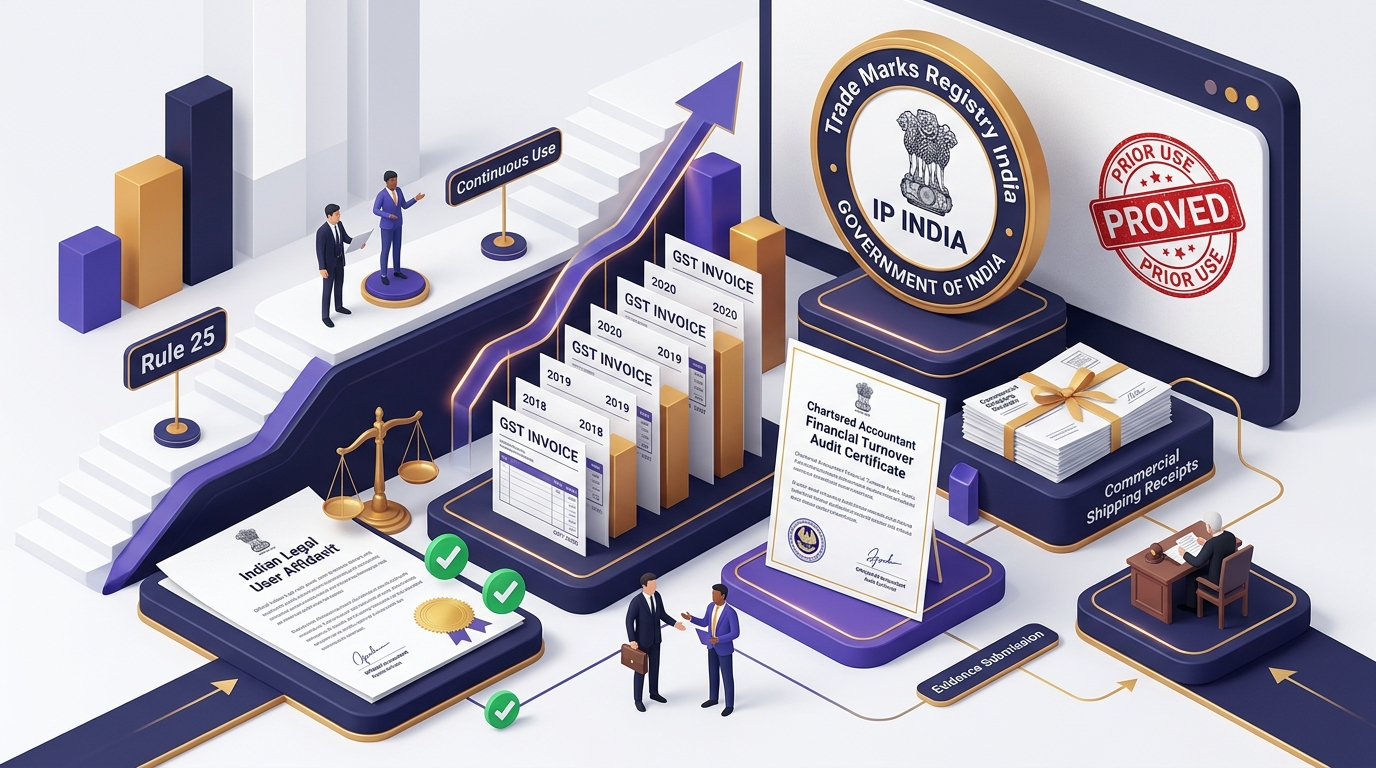
Under Rule 25(2) of the Trade Marks Rules, 2017, whenever an applicant claims a prior user date in Form TM-A, they must submit a notarized User Affidavit accompanied by documentary proof of continuous commercial use from that date. Accepted evidence includes: (1) Chronologically unbroken GST/VAT tax invoices clearly displaying the trademark, (2) A Chartered Accountant Turnover Certificate with valid UDIN certifying year-by-year brand revenue, (3) Advertising invoices, digital ad bills & PR clippings, (4) Statutory government licenses (FSSAI, MSME, AYUSH, IEC), and (5) Timestamped e-commerce seller records and domain WHOIS history.
Unlike civil law jurisdictions governed by the rigid "first-to-file" principle, Indian trademark jurisprudence is anchored in the common law doctrine of "first-to-use" (priority of adoption). Under Section 34 of the Trade Marks Act, 1999, a senior prior user of a mark possesses vested proprietary rights that cannot be defeated even by a subsequently registered proprietor of an identical mark.
However, claiming a prior user date is not a mere formality. The Trade Marks Registry exercises stringent scrutiny under Rule 25(2). If an applicant claims commercial adoption from 2018 but submits invoices starting only from 2022, or provides generic invoices lacking the brand name, the Registry will issue severe examination objections, refuse the user claim, or convert the status to "Proposed to be Used", potentially destroying the applicant's seniority in pending infringement and opposition disputes.
Review our foundational guides on prior user rights under Section 34, trademark user affidavit formatting rules, and how to overcome trademark examination objections.
The Statutory Framework: Rule 25 & Section 34
Understanding the statutory machinery governing trademark user claims requires analyzing the interaction between the substantive Act and the procedural Rules:
Rule 25(1) & 25(2), Trade Marks Rules, 2017
Rule 25(1): An application claiming user date prior to filing must specify the exact day, month, and year of commencement. Vague claims such as "since 2015" without specific dates are legally non-compliant.
Rule 25(2): In every application containing a user claim, the applicant must file an affidavit testifying to such user along with supporting documentary evidence demonstrating continuous use.
Section 34, Trade Marks Act, 1999 — Saving for Prior User
Explicitly prevents a registered proprietor or registered user from interfering with or restraining the use of an identical or similar mark by a person who has continuously used that mark from a date prior to the registration or the registered proprietor's user date.
Section 12, Trade Marks Act, 1999 — Honest Concurrent Use
Empowers the Registrar to permit registration of identical or similar marks for identical goods/services by more than one proprietor in cases of honest concurrent use supported by continuous historical sales.
Section 9(1) Proviso — Acquired Distinctiveness
Allows registration of descriptive, geographical, or laudatory marks if extensive prior use before the application date has established that the mark has acquired secondary meaning and distinctive character.
Commercial Tax Invoices: The Gold Standard Checklist
Commercial tax invoices represent the single most authoritative evidence of commercial adoption in Indian trademark prosecution. However, not all invoices are legally valid. The Trade Marks Registry strictly enforces the following evidentiary standards:
- Brand Name Prominently Displayed: The trademark is printed on the invoice header, product description line, or model name.
- Chronological Continuity: Invoices span evenly across all years from claimed user date to present (at least 2-4 sample invoices per calendar year).
- Valid Tax Registration: Invoices bear registered GSTIN, VAT, CST, or Service Tax registration details matching the applicant entity.
- Inter-State & Pan-India Sales: Invoices addressed to customers across multiple Indian states proving wide geographic goodwill.
- Consecutive Numbering: Sequential invoice numbering reflecting regular and genuine commercial transactions.
- Generic Descriptions Only: Invoices stating only "Cotton T-Shirts" or "Consulting Services" without mentioning the specific trademark.
- Unnumbered Rough Receipts: Hand-written, unauthenticated cash memos without buyer details or tax identification.
- Post-Dated Invoices: Invoices dated after the claimed user date or after the date of application filing.
- Sporadic Single-Year Invoices: Invoices for only Year 1 followed by a complete 5-year gap (fails the "continuous use" mandate).
- Entity Mismatch: Invoices issued under an unrelated third-party entity without a formal registered assignment or user license.
Chartered Accountant (CA) Turnover & Sales Certificate
A Chartered Accountant Turnover Certificate translates voluminous stacks of thousands of sales bills into a certified, legally conclusive financial summary that examiners, Hearing Officers, and High Court judges rely upon:
Mandatory Elements of a Valid CA Certificate:
Advertising, Promotional & PR Documentation
To demonstrate public recognition, brand equity, and secondary meaning under the Section 9(1) proviso, promotional evidence is vital:
Print Media Clippings & Advertisements
Newspaper advertisements, trade magazine features, and industry journal articles showing the published date and circulation figures.
Digital Ad Spend Tax Invoices
Official GST tax invoices issued by Google Ads (Google India), Meta Platforms (Facebook/Instagram), LinkedIn, and Amazon Sponsored Products showing campaigns for the brand.
Trade Fair & Exhibition Participation
Stall booking invoices, event directory listings, and participant badges from national or international trade expos, industry summits, and buyer-seller meets.
Physical Packaging, Labels & Batch Records
Original product packaging containers, labels, batch manufacturing records, barcode registrations (GS1 India), and tamper-evident seals displaying the mark.
Government Registrations & Statutory Licenses
Government-issued licenses provide incontrovertible, third-party state authentication of when a business formally commercialized a specific brand name:
GST Registration Certificate
Shows the trade name and principal place of business date of registration with the Department of Revenue.
FSSAI License / Registration
Crucial for food, beverage, and dietary supplement brands in Class 29, 30, 31, and 32 displaying product formulations.
AYUSH & Drug Licenses
Manufacturing licenses under Form 25/25D for pharmaceutical and herbal brands in Class 5 establishing lawful commercial inception.
Udyam MSME & IEC Certificates
Ministry of MSME and Directorate General of Foreign Trade (DGFT) Import Export Code certificates substantiating enterprise activities.
Digital Footprints, E-Commerce & Domain Evidence
Modern trademark prosecution heavily relies on electronic records. Under Section 63 of the Bharatiya Sakshya Adhiniyam, 2023, the following digital evidence is routinely admitted:
- WHOIS Domain Registration History: Original invoice and domain registrar record proving the exact creation date of the brand's website.
- Internet Archive (Wayback Machine) Snapshots: Timestamped historical snapshots showing that the trademark, logos, and product offerings were publicly accessible online on specific historical dates.
- Marketplace Onboarding Reports: Amazon Brand Registry approval dates, Flipkart seller onboarding letters, Myntra vendor master agreements, and earliest buyer review timestamps.
- Social Media Handle Creation Dates: Account inception logs and dated posts on Instagram, YouTube, LinkedIn, and Facebook with engagement metrics.
Drafting the Form TM-A User Affidavit
The User Affidavit is the formal legal backbone that ties all documentary exhibits together into an admissible sworn statement:
Structural Architecture of a Flawless User Affidavit:
Landmark Precedents on Prior Continuous Use
The Indian judiciary has repeatedly upheld the supremacy of prior continuous commercial use over mere paper registrations:
Century Traders v. Roshan Lal Duggar & Co. (AIR 1978 Del 250)
Delhi High Court Full BenchThe Ruling: The Court established the foundational principle that to acquire trademark rights through prior use, long or prolonged usage is not essential. Even a single bona fide transaction or initial commercial adoption accompanied by genuine sales suffices to confer common law rights against a subsequent adopter.
Key Principle: Priority in adoption and market use precedes registration.
Neon Laboratories Ltd. v. Medical Technologies Ltd. (2016) 2 SCC 672
Supreme Court of IndiaThe Ruling: The Supreme Court held that prior continuous commercial user under Section 34 overrides a prior registered proprietor if the registered owner remained dormant and failed to actually commercialize the mark in the market before the prior user commenced sales.
Key Principle: Prior registration is ineffective against a senior active commercial user.
Uniply Industries Ltd. v. Unicorn Plywood Pvt. Ltd. (2001) 5 SCC 95
Supreme Court of IndiaThe Ruling: The Supreme Court emphasized that bald claims of prior use in affidavits carry no evidentiary weight unless corroborated by contemporaneous, verifiable commercial invoices, sales ledgers, and advertising accounts.
Key Principle: Affidavits without primary invoice corroboration are legally worthless.
Common Evidentiary Pitfalls & How to Avoid Them
Examiners and opposition opponents aggressively scrutinize Rule 25(2) submissions for weaknesses:
| Evidentiary Mistake | Legal Impact on Application | Correct Legal Remedy |
|---|---|---|
| Multi-Year Evidentiary Gap | Destroys claim of "continuous use"; treated as temporary abandonment | Supplement with secondary promotional bills, tax returns, or bank statements for gap years |
| Trademark Representation Mismatch | Evidence rejected if invoice shows a substantially different logo/name | Establish series mark connection or file separate application for modified variants |
| Third-Party Invoicing Entity | Invoices dismissed if issued by sister firm or director without legal nexus | Submit Registered User License Agreement or Deed of Assignment transferring goodwill |
| Unnotarized User Affidavit | Registry issues Section 25 formal defect notice; application delayed | Ensure proper notary seal, stamp duty denomination, and deponent verification |
Frequently Asked Questions
Q.What is mandatory under Rule 25(2) of the Trade Marks Rules, 2017 when claiming a prior user date?
Under Rule 25(2) of the Trade Marks Rules, 2017, whenever an applicant claims a date of trademark use prior to the date of filing the application, they must file a formal User Affidavit (Form TM-A User Affidavit) affirmed by the applicant or authorized signatory, supported by documentary evidence proving continuous commercial use of the mark from the exact claimed date. Failure to submit this affidavit results in the Registry issuing a formal objection or treating the application as 'Proposed to be Used'.
Q.What specific details must be visible on tax invoices to be accepted by a Trademark Examiner?
To be accepted as valid proof of prior use, commercial tax invoices must satisfy 4 essential criteria: (1) The exact trademark/brand name must be clearly printed in the invoice header, line-item description, or product model name, (2) The invoice must bear a chronological date on or after the claimed user date, (3) It must display genuine buyer and seller credentials with valid statutory tax identifiers (GSTIN, VAT, CST, or Service Tax numbers), and (4) Consecutive invoice numbering matching historical accounting records.
Q.Is a Chartered Accountant (CA) Turnover Certificate mandatory, and what must it contain?
While not strictly mandatory for every initial application, a CA Turnover Certificate is the most persuasive financial document to establish extensive and continuous use in examination hearings and opposition proceedings. The certificate must be issued on the CA firm's official letterhead with a valid Unique Document Identification Number (UDIN), specifying the annual, year-by-year sales turnover and promotional expenditure strictly generated under the specific trademark from inception to the present date.
Q.How does proving prior continuous use help overcome Section 11 and Section 9 objections?
Demonstrating prior continuous use provides a dual statutory shield: (1) Under the proviso to Section 9(1), prior usage evidence proves that an otherwise descriptive or laudatory mark has 'acquired distinctiveness' in the eyes of the purchasing public. (2) Under Section 12 and Section 34, establishing prior continuous use allows an applicant to overcome Section 11 relative grounds objections by demonstrating 'honest concurrent use' or seniority over a cited conflicting trademark.
Q.What is the legal difference between 'continuous use' and 'sporadic use' under Indian trademark law?
Indian courts draw a sharp distinction between continuous commercial adoption and sporadic, isolated transactions. As held in Uniply Industries and Neon Laboratories, 'continuous use' requires an ongoing, unbroken commercial presence where goods or services are regularly offered in the market. 'Sporadic use'—such as a single isolated invoice followed by a 4-year hiatus—is treated as token usage and fails to confer priority or distinctiveness under Section 34.
Q.Can online marketplace seller listings and digital invoices prove prior continuous use?
Yes. In the digital economy, timestamped Amazon/Flipkart seller invoices, e-commerce order fulfillment reports, domain registration receipts (WHOIS history), Internet Archive (Wayback Machine) dated snapshots, and Google/Meta advertising tax invoices are fully admissible as secondary digital evidence under Section 63 of the Bharatiya Sakshya Adhiniyam, 2023.
Q.What value of non-judicial stamp paper is required for a Rule 25(2) User Affidavit?
The stamp duty value for a User Affidavit is determined by the State Stamp Act of the jurisdiction where the affidavit is executed. Typically, in states like Delhi, Maharashtra, Karnataka, and Uttar Pradesh, non-judicial stamp paper of ₹10, ₹50, or ₹100 denomination is used. The affidavit must be duly signed by the deponent on each page and attested before an authorized Notary Public or Oath Commissioner.
Q.What happens if an applicant submits fabricated or backdated invoices to prove prior use?
Submitting forged, backdated, or fabricated invoices to the Trade Marks Registry constitutes a grave criminal offense under Section 103 and 104 of the Trade Marks Act, 1999, Section 208 and 336 of the Bharatiya Nyaya Sanhita, 2023 (forgery and fabricating false evidence), and Section 66D of the IT Act. Examiners frequently cross-reference invoice GSTINs on the GST portal; if fraud is uncovered, the application is summarily rejected, the mark is invalidated, and the applicant faces criminal prosecution.
Strategic Prior Use Evidentiary Advice
Proving prior continuous use under Rule 25(2) is the ultimate legal trump card in Indian trademark practice. When executed with precision, an airtight evidentiary portfolio overrides conflicting citations under Section 11, overcomes descriptiveness hurdles under Section 9, and defeats aggressive oppositions under Section 34.
Work with seasoned trademark prosecution attorneys to audit historical tax records, secure CA turnover certificates with valid UDIN, and draft watertight Rule 25(2) User Affidavits. For related prosecution insights, review our guides on overcoming trademark objections, Section 9 and 11 refusal grounds, and famous trademark cases in India.
Prove Unshakeable Prior Use Rights
Deploy registered trademark attorneys to audit your invoices, draft airtight Rule 25(2) User Affidavits, and establish prior user seniority across IP India registries.
Registered Trademark Attorneys • Rule 25(2) User Affidavits • Section 34 Prior User Defense • Pan-India