
Written by Rahul Roy
Senior IP & Cyber Litigation Specialist
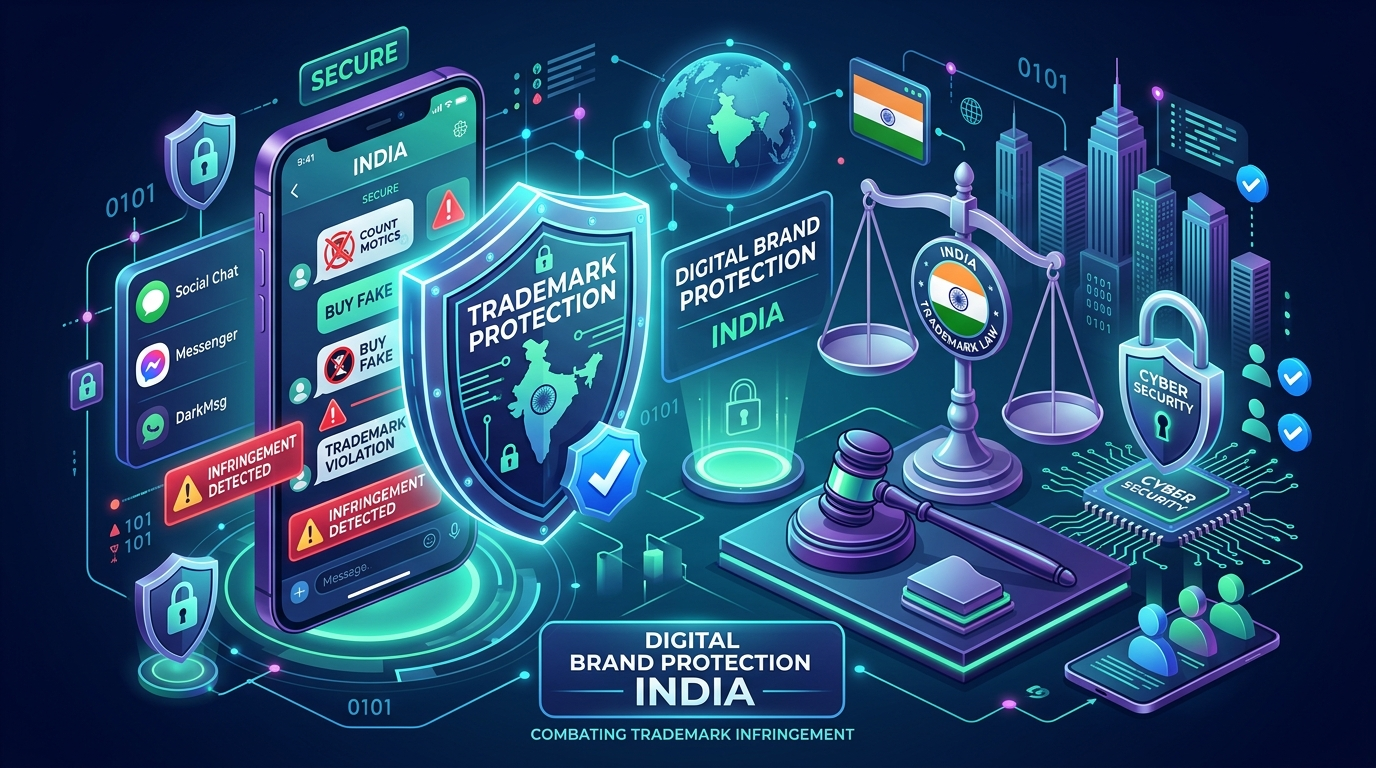
Overview: Dark Social Trademark Infringement
To protect your brand against WhatsApp and Telegram trademark infringement in India, brand owners must deploy a 3-tier strategy: (1) Serve statutory intermediary grievance notices under Rule 3(2) of the Information Technology Rules, 2021 to enforce mandatory 36-hour content takedowns, (2) File criminal complaints on the National Cyber Crime Portal (cybercrime.gov.in) to freeze linked fraudulent UPI handles and mule bank accounts, and (3) Obtain Dynamic "John Doe" (Ashok Kumar) injunctions from the High Court under Section 134/135 of the Trade Marks Act, 1999 to compel messaging platforms to disclose administrator KYC records and block newly created mirror groups in real time.
India represents the single largest user base globally for both WhatsApp (over 500 million active users) and Telegram (over 150 million users). While these messaging applications provide unparalleled reach for legitimate business communication, their core technical architecture—end-to-end encryption, ephemeral group links, disposable virtual numbers, and anonymous mega-channels accommodating up to 200,000 members—has created an underground ecosystem termed "Dark Social Piracy."
Infringers routinely misappropriate registered brand names, corporate logos, executive headshots, and copyrighted trademarks to operate illicit operations ranging from counterfeit luxury apparel sales and pirated course distributions to high-stakes financial advisory scams. When victims lose funds or receive counterfeit goods, the primary brand suffers catastrophic reputational harm, regulatory scrutiny from bodies like SEBI and RBI, and costly customer churn.
Understanding how Indian trademark jurisprudence intersects with cyber laws and intermediary guidelines is vital for brand counsel and founders. Review our foundational guides on how to stop trademark infringement, John Doe Ashok Kumar court orders, and reclaiming squatted usernames.
Statutory Legal Framework in India
Combating dark social brand infringement requires integrating intellectual property statutes with cybercrime provisions and procedural codes. The primary legislative provisions include:
Section 29, Trade Marks Act, 1999 — Statutory Infringement
Prohibits the unauthorized commercial use of an identical or deceptively similar mark in the course of trade, including digital advertising, promotional broadcasts, catalog displays, and social messaging handles (Section 29(6)).
Section 135, Trade Marks Act, 1999 — Civil Reliefs
Empowers Commercial Courts to grant perpetual and interlocutory injunctions, Anton Piller orders (search and seizure of counterfeit stock/digital devices), delivery-up of infringing materials, and damages or an account of profits.
Sections 66C & 66D, Information Technology Act, 2000 — Cyber Fraud
Imposes up to 3 years imprisonment and statutory fines for identity theft (Section 66C) and cheating by personation through computer resources or communication devices (Section 66D).
Section 318, Bharatiya Nyaya Sanhita, 2023 (BNS) — Cheating & Fraud
Replaces erstwhile Section 420 IPC, punishing fraudulent misrepresentation, brand deception, and dishonest inducement of property/money through electronic mediums.
Intermediary Liability & The 36-Hour Takedown Rule
Under Section 79(1) of the Information Technology Act, 2000, network service providers and messaging platforms enjoy "Safe Harbor" immunity against liability for third-party communications. However, this immunity is strictly contingent upon continuous adherence to statutory due diligence under the Information Technology (Intermediary Guidelines and Digital Media Ethics Code) Rules, 2021.
Key Intermediary Obligations under Rule 3:
- Rule 3(1)(b)(iv): The intermediary must publish terms and rules explicitly prohibiting users from hosting, displaying, uploading, modifying, publishing, or sharing any information that infringes any patent, trademark, copyright, or other proprietary rights.
- Rule 3(1)(d) — 36-Hour Mandatory Takedown: Upon receiving "actual knowledge" in the form of a court order or formal notice from an authorized brand representative, the intermediary must remove or disable access to the infringing material within 36 hours.
- Rule 3(2) — Grievance Redressal Mechanism: Intermediaries with over 5 million Indian users (Significant Social Media Intermediaries / SSMIs like Meta and Telegram) must appoint a designated Resident Grievance Officer in India, acknowledge complaints within 24 hours, and resolve them within 15 days.
- Rule 3(1)(h) — Data Preservation: The platform must preserve user registration data, IP logs, and communication metadata for a minimum period of 180 days after account deactivation for cyber investigation by law enforcement.
If WhatsApp or Telegram fails to act upon receiving a verified trademark infringement notice accompanied by an official trademark registration certificate or High Court injunction, the platform loses its statutory safe harbor immunity and can be impleaded as a co-defendant or held in contempt of court.
Dynamic "John Doe" (Ashok Kumar) Injunctions
The primary procedural hurdle in dark social brand litigation is that infringing channel administrators operate under pseudonyms (e.g., "Admin_99", "VIP_Stock_King") with unregistered virtual phone numbers. Indian courts overcome this impasse through John Doe (or Ashok Kumar) orders under Order 39 Rules 1 and 2 of the Code of Civil Procedure, 1908.
Originally popularized in film copyright cases, Indian High Courts (led by the Delhi and Bombay High Courts) have expanded this doctrine into "Dynamic Injunctions" for trademark enforcement.
How a Dynamic Injunction Operates in Real Time:
The High Court grants an ex-parte ad-interim injunction restraining unknown defendants from using the registered brand name or logo.
When new mirror channels or WhatsApp groups emerge, counsel files a simple supplementary affidavit with the Court Registry without instituting new suits.
Court orders are served directly upon Telegram, Meta, DoT, and Telecom Service Providers to terminate channels and suspend SIM cards within 24 hours.
Landmark High Court Precedents on Messaging App Infringement
Indian High Courts have established formidable jurisprudence establishing platform accountability and unmasking cyber infringers:
Neetu Singh & Anr. v. Telegram FZ LLC (2022 SCC OnLine Del 2987)
Delhi High CourtThe Ruling: Telegram argued that disclosing administrator information would violate Singapore privacy laws and the Personal Data Protection Act (PDPA). Justice Pratibha M. Singh rejected Telegram's defense, holding that Indian courts have complete territorial jurisdiction when infringement occurs in India. Telegram was directed to disclose the IP addresses, registered mobile phone numbers, and associated email accounts of all infringing channel operators in sealed cover.
Key Principle: Foreign intermediaries cannot cite foreign data privacy regulations to shelter intellectual property infringers targeting Indian consumers.
National Stock Exchange of India (NSE) v. Telegram Channels & Ors. (2023)
Delhi High CourtThe Ruling: In a suit filed by the NSE against fake Telegram groups offering illegal dabba trading and unauthorized derivative tips under the NSE trademark, the Court passed sweeping John Doe directions ordering Telegram to immediately deactivate dozens of channels, freeze linked UPI handles with NPCI, and directed telecom providers to block associated phone numbers.
Key Principle: Financial market infrastructure marks enjoy heightened protection against deceptive dark social impersonation.
Kotak Mahindra Bank Ltd. v. Ashok Kumar & Ors. (2023)
Bombay High CourtThe Ruling: The Court restrained unauthorized WhatsApp and Telegram channels masquerading as Kotak customer service and loan disbursement executives, ordering Meta and Telegram to freeze the accounts and directing banks to freeze all inward remittance credit in beneficiary accounts.
Key Principle: Injunctions extend beyond mere takedowns to encompass freezing financial settlement conduits.
5-Step Strategic Enforcement Roadmap
When dark social brand infringement is detected, rapid and methodical legal execution prevents financial loss and preserves evidentiary integrity:
Cryptographic Digital Forensics & Evidence Capture
Capture timestamped full-screen captures of channel description, profile picture, group invite URL (e.g., t.me/...), administrator handles, catalog PDF files, linked external website URLs, and payment QR codes. Generate hash values or Section 63 BSA / Section 65B IT Act electronic certificates.
Statutory Intermediary Grievance Notice
Submit a comprehensive legal notice to the Resident Grievance Officer of Meta (WhatsApp) and Telegram Legal under Rule 3(2) of the IT Rules, 2021, appending your trademark certificate, authorization letter, and specific URL/phone endpoints, triggering the 36-hour takedown clock.
Cybercrime Portal Complaint & Payment Freezes
Lodge an electronic complaint on the National Cyber Crime Reporting Portal (cybercrime.gov.in) citing Sections 66C/66D IT Act and trademark violations. Serve formal alerts to the acquiring banks and NPCI to freeze linked beneficiary UPI Virtual Payment Addresses (VPAs).
Commercial Suit for Dynamic John Doe Injunction
Institute a Commercial Suit under Section 134 of the Trade Marks Act before the High Court Commercial Division seeking an ex-parte ad-interim John Doe injunction, admin KYC disclosures from Telegram/Meta, and dynamic blocking directions to the Department of Telecommunications (DoT).
Physical Law Enforcement Action & Police Raids
Utilize the court-mandated KYC disclosures (subscriber identity, billing address, bank records) to register regular FIRs under Section 103/104 Trade Marks Act and Section 318 BNS, enabling police cyber cells to conduct search, seizure, and arrest operations.
WhatsApp vs Telegram: Legal & Technical Enforcement Matrix
Enforcing trademark rights across WhatsApp and Telegram involves distinct technological architectures and legal response parameters:
| Enforcement Parameter | WhatsApp (Meta) | Telegram (FZ-LLC) |
|---|---|---|
| Primary Channel Structure | Groups (up to 1,024 members) & Channels / Broadcasts | Supergroups & Public Broadcast Channels (up to 200,000+ members) |
| Admin Identity Visibility | Mobile numbers visible in groups (unless private community) | Completely anonymous public usernames without phone number display |
| Designated Indian Grievance Officer | Yes (Complies under Meta India Grievance Portal) | Yes (Appointed pursuant to Delhi HC directions) |
| Standard Takedown Response Time | 24 to 48 Hours upon verified IP submission | 48 to 72 Hours (or instant with High Court order) |
| KYC Disclosure Standard | Furnished to law enforcement agencies via Section 91 CrPC / Section 94 BNSS notices | Mandatory under sealed cover following Delhi HC Neetu Singh precedent |
| Commercial Catalog Takedown | Fast-track deactivation via Meta Commerce Manager | Manual review via abuse@telegram.org or court order |
Digital Forensic Evidence Preservation Checklist
Because rogue operators frequently delete messages, revoke group invite links, or alter usernames when they suspect legal action, preserving admissible digital evidence under Section 63 of the Bharatiya Sakshya Adhiniyam, 2023 (BSA) (formerly Section 65B of the Indian Evidence Act, 1872) is paramount:
Evidentiary Checklist for Legal Filings:
Proactive Brand Defense & Counter-Measures
Enterprise brand security requires ongoing proactive deterrence rather than reactive crisis management alone:
WhatsApp Official Green Tick
Secure Meta Verified Green Checkmark status for all official enterprise numbers, creating immediate visual divergence between genuine and fake accounts.
Dark Web & TM Watch
Deploy automated scraping and keyword surveillance across public Telegram directories, group links, and dark social marketplaces to detect impersonators early.
Public Fraud Advisories
Maintain a permanent "Fraud & Impersonation Alert" page on your official website listing all authorized contact numbers and warning users against dark social scams.
Frequently Asked Questions
Q.How do I report trademark infringement on WhatsApp and get a rogue account banned?
To report trademark infringement on WhatsApp, you must submit a formal intellectual property notice via Meta's Intellectual Property Infringement Reporting Channel or email the designated Meta India Grievance Officer under Rule 3(2) of the Information Technology Rules, 2021. The notice must contain: (1) Your registered trademark registration certificate, (2) The offending phone number(s), group invite links, or catalog URLs, (3) Clear screenshot evidence of unauthorized logo/name use, and (4) A declaration of authorized legal representation. Under statutory intermediary guidelines, Meta must acknowledge the complaint within 24 hours and disable infringing access within 36 hours upon receipt of a valid legal notice.
Q.Can Telegram be compelled by Indian courts to reveal the identity of anonymous channel admins?
Yes. In the landmark judgment Neetu Singh & Anr. v. Telegram FZ LLC (2022 SCC OnLine Del 2987), the Delhi High Court unequivocally held that Telegram cannot shield infringing administrators behind international data privacy laws or its server locations in Singapore/Dubai. Indian courts have the jurisdiction to direct Telegram to disclose the IP addresses, registered mobile numbers, and associated bank/UPI details of rogue channel administrators engaged in trademark counterfeiting, copyright piracy, and commercial fraud in India.
Q.What is a Dynamic 'John Doe' (Ashok Kumar) injunction and how does it protect against messaging app piracy?
A Dynamic John Doe (or Ashok Kumar) order is an ex-parte ad-interim injunction issued under Order 39 Rules 1 & 2 of the Code of Civil Procedure, 1908 against unknown, anonymous infringers. It allows the trademark owner to immediately serve court orders upon WhatsApp, Telegram, telecom service providers (DoT/ISPs), and the Ministry of Electronics and Information Technology (MeitY) to block newly created mirror channels, rogue group invite links, and dummy phone numbers in real time without needing to institute a fresh civil lawsuit for every new rogue group.
Q.What should financial advisory and SEBI-registered analysts do when impersonated on Telegram?
SEBI-registered Research Analysts (RAs) and Investment Advisers (RIAs) targeted by fake stock-tip channels should execute a multi-pronged enforcement strategy: (1) Issue an immediate public fraud advisory and investor alert on their official SEBI-registered website and social media handles, (2) Lodge a complaint on the National Cyber Crime Reporting Portal (cybercrime.gov.in) under Sections 66C and 66D of the IT Act, 2000, (3) Serve formal takedown notices to Telegram Legal and the SEBI Grievance Cell, and (4) File a Commercial Suit before the High Court to obtain an injunction blocking linked UPI handles, mule bank accounts, and telephone numbers.
Q.What is the role of Section 79 of the Information Technology Act in dark social brand protection?
Section 79 of the IT Act provides 'safe harbor' immunity to intermediaries like WhatsApp and Telegram, shielding them from liability for third-party content. However, this safe harbor is strictly conditional upon observing due diligence under Rule 3 of the IT (Intermediary Guidelines and Digital Media Ethics Code) Rules, 2021. Once an intermediary receives 'actual knowledge' through a court order or formal IP grievance notice, it must expeditiously remove or disable access to the infringing material within 36 hours; otherwise, it loses safe harbor protection and becomes directly liable for aiding trademark infringement.
Q.Can criminal action be initiated against WhatsApp counterfeiters selling fake branded luxury goods?
Yes. In addition to civil injunctions, brand owners can initiate criminal proceedings under Section 103 (penalty for applying false trade descriptions) and Section 104 (penalty for selling goods with false trademarks) of the Trade Marks Act, 1999, read with Section 318 of the Bharatiya Nyaya Sanhita, 2023 (cheating and dishonestly inducing delivery of property). A designated police officer not below the rank of Deputy Superintendent of Police (DSP) can conduct search and seizure operations without warrant under Section 115(4) after obtaining the Registrar's opinion.
Q.How does obtaining a WhatsApp Official Business Account (Green Tick) help prevent brand fraud?
An Official Business Account (OBA) badge (the green checkmark) on WhatsApp verifies that Meta has authenticated the business's legal entity, registered trademark, and public brand notoriety. When your brand possesses a verified green tick, consumers and clients can instantly differentiate between your authentic enterprise communication and fraudulent, unverified throwaway accounts attempting deceptive brand impersonation.
Q.How can a brand block fraudulent UPI IDs and bank accounts linked to rogue messaging groups?
When rogue channels solicit unauthorized funds via UPI QR codes or mule bank accounts, the brand owner's legal counsel can submit the digital evidentiary dossier to the National Cyber Crime Portal, the National Payments Corporation of India (NPCI), and the nodal fraud officers of the respective acquiring banks. Furthermore, Commercial Courts hearing trademark infringement suits routinely pass restraining orders directing banks and payment gateways (Razorpay, PhonePe, Paytm, Google Pay) to immediately freeze the linked merchant accounts and disclose beneficiary KYC details.
Strategic Legal Advice: Safeguarding Brand Integrity
Dark social trademark infringement moves at lightning speed. Relying solely on manual customer support replies or generic social media reports is ineffective against organized counterfeiting syndicates and cyber fraudsters.
By combining statutory Section 79 IT Rules 2021 notices, National Cyber Crime Portal complaints, and High Court Dynamic John Doe Injunctions, brand owners can dismantle rogue networks within days, seize fraudulent bank accounts, and preserve consumer trust. Explore our related resources on police raids under Section 115, responding to infringement notices, and domain cybersquatting INDRP disputes.
Stop WhatsApp & Telegram Impersonation
Deploy experienced IP litigators and cyber forensic specialists to take down rogue channels, obtain High Court John Doe orders, and freeze fraudulent payment accounts.
Registered Trademark Attorneys • 36-Hour IT Act Takedowns • Dynamic John Doe Orders • Pan-India High Court Coverage