
Written by Rahul Roy
Gaming, Web3 & Esports IP Counsel
Overview of Gaming & Esports Trademark Law
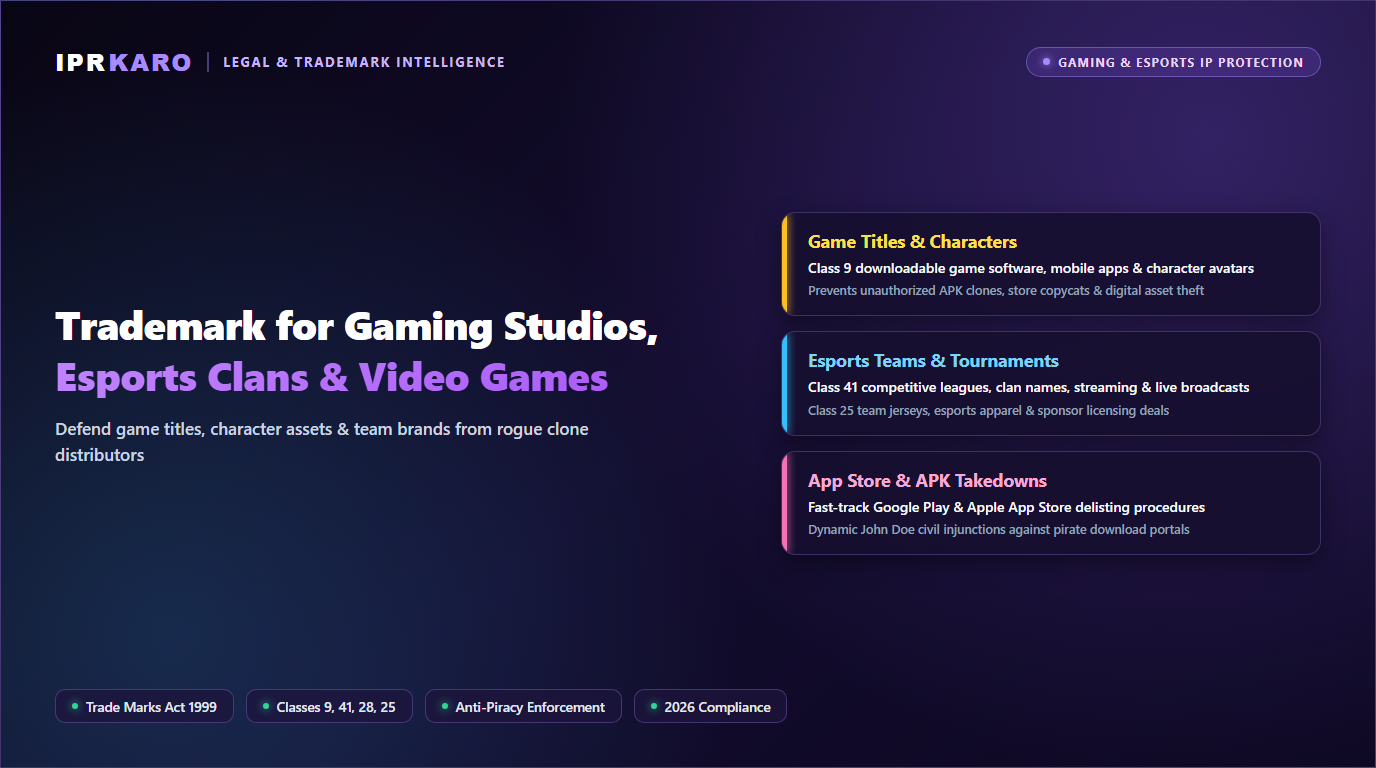
Trademark registration for gaming studios, esports clans, and video game titles in India requires a multi-class architecture spanning Class 9 (Downloadable video game software, mobile apps, and digital assets) and Class 41 (Esports tournament organizing, live gaming streaming, and online non-downloadable gaming services), supported by Class 28 (Gaming hardware & toys), Class 25 (Esports jerseys & merchandise), and Class 42 (Game engines & cloud server SaaS). A registered trademark certificate serves as the primary legal instrument to execute fast-track app takedowns on Google Play Store, Apple App Store, and Steam.
India has rapidly become one of the world's fastest-growing mobile gaming and esports ecosystems, boasting over 500 million active gamers. However, with massive player monetization and multi-million-dollar publisher valuations comes rampant intellectual property infringement: clone mobile games, rip-off APK files, stolen character assets, and counterfeit esports clan merchandise.
While copyright protects the underlying source code and visual illustrations, only a registered trademark under the Trade Marks Act, 1999 gives game developers exclusive statutory ownership over titles, logos, clan tags, and character brands. It provides the legal weapon needed to instantly delist clone apps from app stores and obtain John Doe (Ashok Kumar) injunctions in Indian High Courts.
Explore how trademark law intersects with tech and media in our specialized guides on trademark for mobile app names, trademarking characters and entertainment titles, and trademark for SaaS and software.
The Gaming & Esports IP Threat Landscape
The video game industry operates across complex digital distribution networks, exposing developers and esports organizations to five severe commercial vulnerabilities:
1. Lookalike App Store Clone Games
Rogue studios monitor trending indie games and publish copycat titles with nearly identical names and app icons on Google Play and Apple App Store within days of launch, siphoning organic player installs and ad revenue.
2. Unofficial Modded APK Mirrors
Third-party APK repositories host cracked, modded game clients using the authentic studio logo, injecting malware and damaging player trust and brand integrity.
3. Esports Clan Squatting & Roster Breakups
When esports teams qualify for national tournaments without formal trademark registration, departing players or rival managers often attempt to register the clan tag, triggering catastrophic ownership litigation.
4. Counterfeit Esports Apparel & Merch
Unlicensed e-commerce vendors print bootleg esports jerseys, hoodies, and gaming mousepads using team logos on Amazon, Flipkart, and Meesho.
The 6-Pillar Gaming Brand Moat
A sophisticated gaming intellectual property portfolio covers six distinct commercial assets:
Studio / Publisher Brand
The overarching corporate identity (e.g., Krafton, Supercell, Nazara) registered as a word mark and logo in Classes 9, 41, and 42 across all gaming publishing pipelines.
Individual Game Titles
Specific video game names and franchise titles (e.g., 'Battlegrounds', 'Raji: An Ancient Epic') protected in Class 9 and Class 41 before public Beta launch.
Esports Clan & Guild Logos
Esports organization names, acronyms, clan tags, and crests protected in Class 41 (Tournaments) and Class 25 (Apparel) to secure sponsorship deals.
Iconic Characters & Mascots
Hero silhouettes, distinctive character names, and 3D avatar designs registered as Device Marks in Class 9 and Class 28 (Action figures & toys).
In-Game Currencies & Assets
Proprietary virtual currency names, gems, skins, and digital battle pass brands registered under Class 9 and Class 36 to prevent black-market coin fraud.
Tournament & League Brands
Esports championship titles, seasonal premier leagues, and LAN tournament series protected in Class 41 and Class 35 for broadcast licensing.
Multi-Class Strategy: Classes 9, 41, 28, 25 & 42
Under the International Nice Classification system, gaming covers software, streaming entertainment, physical hardware, and lifestyle apparel:
Class 9: Video Game Software & Apps
Mandatory core class for all developers. Covers downloadable mobile game software, PC/console executables, VR/AR gaming applications, downloadable game patches, and digital virtual items.
Class 41: Esports & Online Gaming
Covers providing non-downloadable online video games, conducting esports competitions, live gaming streaming, clan entertainment services, and gaming broadcast production.
Class 28: Hardware, Toys & Collectibles
Covers arcade game machines, video game consoles, physical controllers, gaming joysticks, board games, and collectible action figures based on video game characters.
Class 25: Esports Jerseys & Apparel
Covers esports team jerseys, gaming hoodies, caps, t-shirts, jackets, and lifestyle footwear sold under the team or game brand.
Additionally, studios developing proprietary game engines, matchmaking cloud servers, and anti-cheat middleware should file in Class 42 (Software as a Service & Cloud Hosting), while those managing creator sponsorships and in-game ad networks should secure Class 35 (Advertising & Sponsorship Management).
Trademark vs Copyright Overlap in Gaming
Game developers often ask whether copyright alone is sufficient. The answer is an emphatic NO. Both IP rights perform distinct and complementary protective functions:
| Protection Parameter | Copyright (Copyright Act, 1957) | Trademark (Trade Marks Act, 1999) |
|---|---|---|
| Protected Subject Matter | Source code, 3D character mesh, music/OST, voiceovers, background art, script | Game title, studio logo, character names, clan crest, virtual currency |
| App Store Clone Takedowns | Slow; requires proving literal code or artwork theft | Instant; automated takedown for deceptive title or icon similarity |
| Merchandising & Licensing | Protects static artwork reproduction | Protects commercial brand rights on apparel, toys, and sponsor deals |
| Duration of Monopoly | Author's life + 60 years (finite term) | 10 years, renewable perpetually every 10 years forever |
Read our comprehensive analysis on trademark vs copyright difference in India and word mark vs device mark strategy.
Play Store & App Store Takedown Procedures
When a clone game launches on Google Play or Apple App Store, time is of the essence. Holding a registered trademark number or certificate unlocks fast-track administrative delisting:
Google Play Store IP Infringement Portal
Submit an official complaint through the Google Play Trademark Removal Form citing your Indian Trademark Registration Number in Class 9. Google algorithms and human compliance teams verify the certificate and delist the infringing clone within 24 to 72 hours.
Apple App Store Content Dispute Portal
File a formal grievance via Apple Legal Dispute Management. Apple notifies the infringing developer to provide proof of license within a strict deadline; failure to produce a valid license results in immediate app delisting across all global store regions.
High Court John Doe (Ashok Kumar) Injunctions
For widespread modded APK syndicates and private cheat servers operating on rogue domains, gaming studios can file an omnibus suit in Indian High Courts obtaining dynamic John Doe orders directing Department of Telecommunications (DoT) and Internet Service Providers (ISPs) to block hundreds of pirate mirror URLs simultaneously.
Esports Rosters & Merchandising Contracts
In esports, roster volatility is extremely high. Players frequently switch organizations between competitive seasons. Structuring bulletproof IP contracts is vital:
Key Legal Safeguards for Esports Organizations:
- Entity-Level TM Ownership: Never register the team trademark in an individual gamer's or streamer's personal name. Register exclusively under the organization's Private Limited or LLP entity.
- Player Contract Assignment Clauses: Ensure player contracts explicitly stipulate that in-game handles used under team branding remain the property of the organization during tournament participation.
- Merchandising Licensing under Section 49: When partnering with apparel manufacturers or energy drink sponsors, execute formal Registered User agreements on Form TM-U to safeguard brand title.
Government Fees & 50% Startup Subsidy
Indian trademark filing fees offer substantial statutory concessions for early-stage game studios and indie developers:
| Applicant Status | Official E-Filing Fee | Eligibility Proof |
|---|---|---|
| Indie Developer (Individual) | ₹4,500 per class | PAN Card / Aadhaar |
| DPIIT Recognized Gaming Startup | ₹4,500 per class | DPIIT Startup Recognition Certificate |
| Udyam Registered MSME Studio | ₹4,500 per class | Udyam Registration Certificate |
| Large Gaming Corporation (Non-MSME) | ₹9,000 per class | Certificate of Incorporation |
For a gaming studio protecting its brand across 4 key classes (9, 41, 28, 25), holding an MSME Udyam certificate cuts official filing costs from ₹36,000 down to ₹18,000.
Overcoming Section 9 & 11 Objections
Gaming trademark applications frequently encounter examination objections from the Trade Marks Registry:
Handling Section 9(1)(b) Descriptive Gaming Terms
Words like 'Sniper', 'Racing', 'Cricket', 'Ludo', or 'Battle' directly describe game genres. To overcome objections:
- • Composite Device Marks: Combine the genre term with a distinctive coined word and unique 3D game logo styling.
- • Acquired Distinctiveness: If the game has already amassed millions of downloads, file a Rule 25(2) User Affidavit with Google Play Console download reports, press releases, and esports tournament viewership statistics.
Handling Section 11(1) Prior Similar Titles
If the examiner cites an existing registered mark in Class 9 or Class 41:
- • Specification Restriction: Narrow the description of goods from broad 'computer software' to 'mobile electronic video games specifically in the tactical shooter genre'.
- • Non-Use Rectification: If the cited mark has remained unutilized on commercial app stores for over 5 years, file a cancellation petition under Section 47.
Gaming Asset IP Classification Matrix
Quick reference guide to classifying and registering gaming brand assets:
| Asset Type | Primary Class | Recommended TM Type | Enforcement Scope |
|---|---|---|---|
| Game Studio Brand | Class 9, 41, 42 | Word Mark + Device Logo | Company-wide publishing title |
| Video Game Title | Class 9 & Class 41 | Word Mark + App Icon Device | Play Store & App Store clone takedowns |
| Esports Clan & Tag | Class 41 & Class 25 | Device Crest + Word Mark | Tournament entry & Jersey merch |
| Game Mascots & Avatars | Class 9 & Class 28 | Device Mark (Artwork) | Action figures & Spin-off media |
| In-Game Currencies | Class 9 & Class 36 | Word Mark | Virtual asset black-market defense |
Step-by-Step Filing Workflow
Executing an airtight gaming trademark application in India follows six statutory phases:
Cross-Class Availability & App Store Search
Search IP India database across Classes 9, 41, 28, and 25. Concurrently conduct phonetic and visual audits on Google Play, Steam, and Apple App Store to avoid naming collisions.
Drafting Tailored Goods & Services Descriptions
Draft specific gaming specifications avoiding overly broad boilerplate text to prevent unnecessary Section 11 similarity citations with enterprise enterprise software.
Form TM-A Filing with MSME Claim
Submit Form TM-A on the IP India portal. Attach Udyam MSME certificate to claim the 50% government fee concession (₹4,500/class). If claiming prior use, attach a Rule 25(2) User Affidavit.
Examination Report Defense
Respond to statutory examination reports within 30 days, filing legal replies asserting distinctiveness, anti-dissection doctrine, and specialized gaming trade channels.
Journal Publication & Opposition Monitoring
The mark is advertised in the Trade Marks Journal for 4 months. Maintain active IP watch services to detect competitor bad-faith oppositions.
Registration Certificate & App Store Deployment
Receive Form RG-2 Registration Certificate. Register brand credentials on Google Play Brand Registry, Steam Partner portal, and Apple IP dispute channels.
Frequently Asked Questions
Q.Which trademark classes are essential for video games and mobile game developers in India?
A complete gaming trademark strategy spans five core classes: Class 9 (Downloadable video game software, mobile games, console ROMs, VR/AR software, and downloadable in-game assets), Class 41 (Providing online non-downloadable games, esports tournament organization, game streaming, and clan management), Class 42 (Game engine SaaS, cloud server matchmaking hosting, and anti-cheat infrastructure), Class 28 (Gaming consoles, arcade machines, physical controllers, and action figures), and Class 25 (Esports jerseys, team hoodies, caps, and branded merchandise).
Q.Can I trademark an individual video game title or mobile game app name?
Yes. An individual video game title (e.g., 'Battlelands', 'Shadow Blade', 'Ludo Empire') can be registered as a word mark in Class 9 and Class 41, provided the title is arbitrary, suggestive, or coined. Generic descriptive titles like '3D Car Racing' or 'Cricket 2026' face refusal under Section 9(1)(b) unless accompanied by a stylized logo device mark.
Q.How do I protect esports clan names, guild tags, and gaming streamer logos?
Esports organizations and clan owners must register their team name, clan tag, and team crest across Class 41 (Esports competitive teams, entertainment, and tournament participation), Class 25 (Branded jerseys, apparel, and footwear), and Class 35 (Sponsorship management, merchandise advertising, and influencer talent representation). Registering through an incorporated entity (LLP or Pvt Ltd) prevents co-founder and player roster disputes.
Q.What is the legal difference between trademark and copyright protection for video games?
Copyright automatically protects the creative expression — including underlying source code, 2D/3D graphics, character art meshes, animations, background music (OST), and storyline script under the Copyright Act, 1957. Trademark protects commercial brand identifiers — such as the game title, studio name, character names, guild logos, and in-game currencies against consumer confusion, copycat apps, and trademark passing off on app stores.
Q.How does trademark registration help remove clone apps from Google Play and Apple App Store?
A registered trademark certificate under Section 23 serves as conclusive proof of ownership on Google Play Console and Apple App Store IP Grievance Portals. App stores immediately execute expedited takedowns of unauthorized clone games, fake APK distributors, and deceptive title copycats without requiring prolonged court litigation.
Q.Can iconic video game characters, avatars, and in-game virtual currencies be trademarked?
Yes. Iconic game characters (such as distinctive mascots, hero silhouettes, and villain names) can be registered as both word marks and device marks in Class 9 and Class 41. Similarly, proprietary in-game virtual currencies, gems, and token names can be protected in Class 9 (digital virtual assets) and Class 36 (virtual currency services).
Q.Can a gaming studio or indie game developer claim the 50% government fee concession?
Yes. Indie game developers filing as individuals, or gaming startups holding DPIIT Startup Recognition or a valid Udyam MSME Certificate, qualify for a 50% statutory fee discount, paying an official fee of ₹4,500 per class (e-filing) instead of the standard ₹9,000 corporate fee.
Q.How do I avoid descriptive trademark objections under Section 9 for game titles?
To bypass Section 9(1)(b) objections, adopt fanciful or coined words (e.g., 'Rovio', 'Krafton', 'Zynga'), combine arbitrary words, or design a highly distinctive graphical logo device mark with unique typography and visual mascots. If filing after game launch, submit a Rule 25(2) User Affidavit with download metrics, Play Store revenue receipts, and YouTube stream analytics.
Scaling Gaming Studios & Global IP Strategy
As Indian gaming studios scale globally, filing international trademark applications via the Madrid Protocol (managed by WIPO) becomes essential. Securing your base registration in India allows seamless extension into North America, Southeast Asia, Europe, and the Middle East under a single international application.
Furthermore, institutional venture capital investors in the gaming ecosystem conduct deep IP audits before Series A and B funding rounds. Clear legal title across game titles, character assets, and clan identities maximizes studio valuation and unlocks global publishing distribution partnerships. Review our guides on international trademark registration under Madrid Protocol, trademark valuation for tech startups, and reclaiming squatted social media and gaming handles.
Protect Your Video Game & Esports Brand
Lock in exclusive trademark rights across Classes 9, 41, 28 & 25. Shield your games from app store clones, protect clan tags, and scale enterprise valuation.
Specialized Gaming IP Counsel • App Store Clone Takedowns • 50% MSME Subsidy • Pan-India