
Written byRahul Roy
Trademark Research Specialist
Overview & Quick Valuation Summary
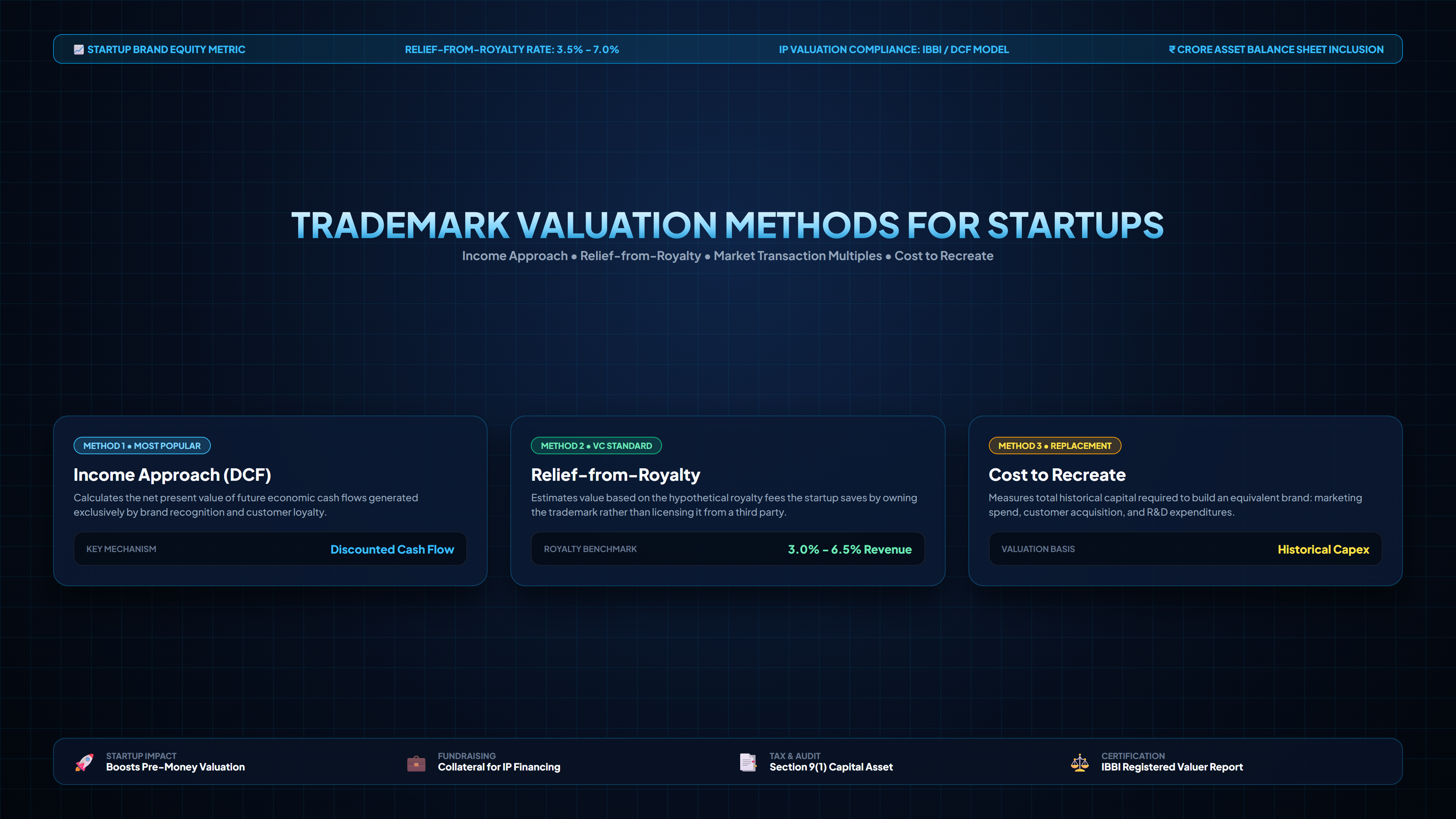
Trademark valuation for Indian startups is the quantitative financial assessment of a brand's economic worth, recognized under International Valuation Standards (IVS 210) and ICAI Valuation Standards. The most widely accepted method is the Income Approach via the Relief from Royalty (RfR) method, which discounts hypothetical future royalty savings to Present Value. Under Ind AS 38, self-generated trademarks cannot be capitalized on balance sheets, but acquired trademarks are recognized at fair value under Ind AS 103 (Purchase Price Allocation). Statutory valuation reports must be issued by an IBBI Registered Valuer under Section 247 of the Companies Act, 2013.
In India's burgeoning innovation economy, the primary drivers of enterprise value have shifted decisively from physical plants and machinery to intangible assets—principally registered trademarks, brand goodwill, proprietary algorithms, and customer stickiness. When a venture-backed startup prepares for a Series A/B funding round, corporate restructuring, joint venture, or merger &. Acquisition (M&A) transaction, quantifying the standalone financial value of its trademark portfolio becomes indispensable.
However, valuing a brand is fundamentally different from auditing physical inventory. It requires a rigorous cross-disciplinary synthesis of corporate finance, intellectual property jurisprudence under theTrade Marks Act, 1999, accounting mandates underInd AS 38 and Ind AS 103, and statutory tax rules under theIncome Tax Act, 1961.
To understand how trademark valuation impacts licensing structures and tax liability, explore our comprehensive analyses onGST and TDS on trademark royaltiesandtrademark assignment vs licensing in India.
The Three Core Valuation Methodologies
Under both Indian and global valuation frameworks (such as IVS 210 and ISO 10668 for monetary brand valuation), three recognized valuation approaches exist:
1. The Income Approach (Primary & Most Accurate)
The Income Approach measures the future economic earnings directly attributable to the trademark over its remaining economic life and discounts those cash flows to Net Present Value (NPV). Sub-methods include: (a)Relief from Royalty (RfR), (b)Multi-Period Excess Earnings Method (MPEEM), and (c)Incremental Cash Flow / Price Premium Method.
2. The Market Approach (Comparable Transactions)
The Market Approach determines value by analyzing observable market transactions involving the sale, assignment, or licensing of comparable brands within the same industry sector. Key metrics include Enterprise Value to Revenue multiples (EV/Revenue) and Brand Value to EBITDA ratios. However, because proprietary brands are inherently unique, direct comparables can be challenging to locate in early-stage markets.
3. The Cost Approach (Historical vs Replacement)
The Cost Approach calculates the total financial expenditure necessary to recreate or replace an identical brand of equivalent utility and recognition. It encompasses: (a)Historical Cost(accumulated R&D, trademark registration fees, marketing spend), and (b)Replacement Cost(current advertising costs to achieve equal brand awareness). This approach is primarily used as a baseline floor value for early-stage pre-revenue startups.
Income Approach & Relief from Royalty
TheRelief from Royalty (RfR)method is universally recognized as the gold standard for trademark valuation by institutional investors, big-four audit firms, and Registered Valuers.
Core Premise:Owning a registered trademark relieves the business from having to pay an ongoing royalty fee to an independent third-party IP licensor. Therefore, the value of the trademark equals the present value of the stream of post-tax royalty payments saved over the asset's useful economic life.
The Relief from Royalty Mathematical Formula
- Revenuet:Projected annual revenue forecast for years 1 to n.
- Royalty Rate:Arm's length benchmark percentage (typically 1.5% to 6% in India depending on sector).
- Tax Rate:Applicable corporate income tax rate (e.g., 22% or 25% + surcharge/cess).
- WACC:Weighted Average Cost of Capital (discount rate adjusted for intangible asset risk premium).
- TAB:Present value of future tax shield from Section 32 statutory depreciation deductions.
Balance Sheet Capitalization: Ind AS 38
Founders frequently ask:“Can we show our ₹50 Crore brand valuation on our audited balance sheet to increase net worth?”The answer under Indian accounting frameworks is governed strictly byInd AS 38 (Intangible Assets)andAS 26:
Self-Generated Trademarks (Ind AS 38.63)
Prohibited from Balance Sheet Capitalization.Expenditure incurred on internally generating brands, mastheads, publishing titles, and customer lists cannot be distinguished from the ongoing operating cost of developing the business as a whole. All brand-building expenses (advertising, PR, design) must be expensed in the Profit & Loss statement.
Acquired Trademarks (Ind AS 103 / 38)
Permitted at Fair Market Value.When a company acquires a trademark separately or through a corporate takeover/amalgamation under Ind AS 103, the identifiable trademark is capitalized on the balance sheet at fair value determined via an independent Purchase Price Allocation (PPA) study.
Amortization vs Indefinite Useful Life (Ind AS 36 Impairment)
Once an acquired trademark is capitalized, the company must assess whether its useful life isFinite(amortized over 10 to 20 years on a straight-line basis) orIndefinite(not amortized, but subjected to mandatory annual impairment testing underInd AS 36). If brand revenues decline or consumer sentiment deteriorates, an impairment loss must be written down in the P&L immediately.
Registered Valuer Mandate: Section 247
In India, brand valuation reports are not merely theoretical pitch-deck slides; they are statutory legal documents governed by strict regulatory oversight:
Mandatory IBBI Registration
UnderSection 247 of the Companies Act, 2013, any valuation of stocks, shares, debentures, securities, or intangible assets required under corporate law must be executed by a Registered Valuer registered with the Insolvency and Bankruptcy Board of India (IBBI).
Income Tax Rule 11UA Compliance
When raising equity funds from domestic or foreign investors at a premium (Section 56(2)(viib) angel tax provisions), fair market value justification requires a valuation report signed by a SEBI-registered Merchant Banker or an IBBI Registered Valuer.
Foreign Exchange Management Act (FEMA) Guidelines
Cross-border IP transfers, overseas technology licensing, and foreign direct investment (FDI) into Indian brand holding entities must satisfy RBI pricing guidelines and arm's length transfer pricing benchmarks under Section 92C of the Income Tax Act.
Trademark Valuation in Startup M&A
During mergers, corporate acquisitions, and strategic buyouts, intellectual property due diligence forms the bedrock of deal pricing:
- Chain of Title Verification:Ensuring the startup holds unencumbered, registered trademark certificates (Form TM-RG) from IP India across all operational classes without adverse opposition or rectification proceedings.
- Separation of Founder IP vs Company IP:Verifying that trademarks were officially assigned by the original founder to the Private Limited entity via registered Assignment Deeds (Form TM-P) with valid stamp duty. Learn more abouttrademark ownership structures in India.
- Brand Carve-Outs & Transitional Licensing:Structuring multi-year transitional brand license agreements (TMA) when an acquirer purchases a specific business division while the parent company retains other brand extensions.
7-Step Brand Valuation Workflow
Commissioning a defensible brand valuation report involves a structured 7-step quantitative and legal procedure:
IP Legal Audit & Registry Verification
Validate active status, renewal dates, class specifications, and freedom-to-operate status across Indian Trade Marks Registry portals.
Financial & Revenue Projection Modeling
Collate 3-5 years historical P&L statements and build 5-year discrete cash flow forecasts broken down by brand-specific product lines.
Royalty Rate Benchmarking & Brand Driver Analysis
Conduct empirical benchmarking using global royalty databases (ktMINE, RoyaltyStat) to determine market royalty rates (e.g., 2.5% to 5.0%).
Discount Rate (WACC) & Risk Premium Calculation
Calculate Weighted Average Cost of Capital adding a specific intangible asset risk premium (typically WACC + 2% to 5%) to discount cash flows.
Tax Amortization Benefit (TAB) Modeling
Incorporate present value of tax shields generated under Section 32(1)(ii) depreciation allowances into the net enterprise value.
Issuance of Statutory Valuation Certificate
IBBI Registered Valuer issues the formal valuation certificate under Section 247 for regulatory filing, board approvals, and audit compliance.
Annual Ind AS 36 Impairment Monitoring
Establish annual intangible asset review protocols to ensure balance sheet book values remain aligned with recoverable market amounts.
Valuation Approaches Comparison Matrix
Compare the primary valuation approaches, ideal use cases, data requirements, and audit defensibility:
| Approach | Primary Methodology | Ideal Startup Stage | Audit Acceptance | Key Input Variable |
|---|---|---|---|---|
| Income Approach | Relief from Royalty (RfR) / DCF | Revenue Generating (Series A+) | Highest (Universal Standard) | Royalty Rate & Revenue Projections |
| Income Approach | Multi-Period Excess Earnings (MPEEM) | Mature Brands & M&A Takeovers | Very High (Ind AS 103 PPA) | Contributory Asset Charges (CAC) |
| Market Approach | Comparable Transactions Multiple | Strategic M&A Buyouts | Moderate (Data Availability Limit) | EV/Revenue & Brand Deal Multiples |
| Cost Approach | Historical / Replacement Cost | Pre-Revenue / Seed Stage | Low to Moderate (Floor Value) | Historical Marketing & IP Costs |
Tax & Depreciation: Section 32 & 55
Trademark valuation carries profound direct and indirect tax consequences in India:
Section 32(1)(ii) — 25% Tax Depreciation
Acquired trademarks qualify for 25% annual depreciation on Written Down Value (WDV). If the trademark is acquired and put to use for less than 180 days in the financial year, 50% of allowable depreciation (12.5%) is claimed in Year 1.
Section 55(2)(a) — Deemed Nil Cost on Self-Generated Brands
When selling an internally developed trademark, the cost of acquisition is legally deemed to beNIL. The full transfer consideration is taxable as capital gains without standard cost indexation benefits.
GST & TDS Withholding Mandates
Trademark licensing and assignment attract18% GSTunder SAC Code 997336. Domestic royalty payments require2% TDS withholdingunder Section 194J(1)(ba) for technical/royalty services.
Valuation Readiness Audit Checklist
Before commissioning a registered brand valuation report for investors or statutory audits, ensure your corporate documentation is fully organized:
Unbroken Registered Title:Possess official Trademark Registration Certificates (Form TM-RG) in the company's corporate name across core commercial classes.
Audited Financial Statements:Compile 3 years of audited balance sheets, P&L accounts, and itemized marketing/PR expenditure ledgers.
Five-Year Financial Forecasts:Prepare defensible, management-approved 5-year discrete revenue projections supported by market size and customer acquisition unit economics.
Commercial Licensing Agreements:Collate all active franchise, distribution, or royalty agreements documenting existing brand monetization.
Frequently Asked Questions
Can an Indian startup capitalize its internally generated trademark on its balance sheet?
No. Under Indian Accounting Standard (Ind AS) 38 (Intangible Assets) Paragraph 63 and AS 26, internally generated brands, mastheads, publishing titles, customer lists, and trademarks cannot be recognized as intangible assets on the balance sheet because the expenditure cannot be distinguished from the cost of developing the business as a whole. Capitalization is only permitted when a trademark is acquired separately or as part of a business combination under Ind AS 103.
What is the Relief from Royalty (RfR) valuation method and why is it preferred for startups?
The Relief from Royalty (RfR) method is an income-based valuation technique that calculates the present economic value of a trademark by estimating the hypothetical royalty payments the startup avoids by owning the mark rather than licensing it from a third party. It is widely preferred by IBBI Registered Valuers and audit firms because benchmark royalty rates can be cross-referenced against empirical licensing transactions across comparable industries.
Who is legally authorized to issue a statutory trademark valuation report in India?
Under Section 247 of the Companies Act, 2013 and Rule 11UA of the Income Tax Rules, statutory trademark valuations for corporate restructuring, share allotments, mergers, and regulatory compliance must be conducted by an Insolvency and Bankruptcy Board of India (IBBI) Registered Valuer in the 'Securities or Financial Assets' asset class or an authorized Merchant Banker.
Is depreciation allowable on acquired trademarks under the Income Tax Act, 1961?
Yes. Under Section 32(1)(ii) of the Income Tax Act, 1961, acquired trademarks, franchises, patents, and intellectual property rights qualify as intangible assets eligible for statutory tax depreciation at the rate of 25% on a Written Down Value (WDV) basis. However, self-generated trademarks do not have an acquisition cost and therefore cannot claim depreciation.
How are capital gains calculated when a founder sells or assigns a self-generated trademark?
Under Section 55(2)(a) of the Income Tax Act, 1961, the cost of acquisition for self-generated trademarks, brand names, and goodwill is statutorily deemed to be 'NIL'. Consequently, the entire gross sale consideration received upon trademark assignment or transfer is taxable as capital gains (short-term or long-term depending on the holding period) without any deduction for indexation or historical brand-building costs.
How does trademark valuation impact startup fundraising and venture debt negotiations?
A certified trademark valuation establishes an empirical dollar value for brand equity, proprietary software names, and customer loyalty. In equity fundraising (Series A/B/C), it justifies premium share valuations under discounted cash flow models. In venture debt, registered trademarks and IP portfolios can serve as secondary intangible collateral to secure favorable credit terms and loan covenants.
What is Purchase Price Allocation (PPA) under Ind AS 103 for trademark acquisitions?
In M&A transactions and corporate takeovers, Purchase Price Allocation (PPA) under Ind AS 103 requires the acquirer to identify and allocate the total acquisition cost to all identifiable tangible and intangible assets at fair market value. Identifiable registered trademarks meeting the contractual-legal or separability criteria are recognized on the post-merger balance sheet at fair value, with the residual amount booked as goodwill.
What key documents are required by a Registered Valuer to conduct a trademark valuation?
A Registered Valuer requires: (1) Certified copy of Trademark Registration Certificate (Form TM-RG), (2) 3 to 5 years historical audited financials and 5-year projected profit & loss statements, (3) Historical marketing, advertising, and PR expenditure records, (4) Commercial licensing, franchising, or royalty agreements, (5) Market share analysis and competitor benchmarking reports, and (6) Any existing IP litigation or opposition status summaries.
Strategic IP Advisory & Valuations
An authoritative, mathematically defensible trademark valuation is one of the most powerful financial instruments a startup founder can possess. Whether you are pitching venture capital funds, preparing for an M&A acquisition, structuring cross-border brand licensing, or fulfilling statutory Ind AS 103 purchase price allocations, partnering with accredited IBBI Registered Valuers and senior IP litigators ensures full audit defensibility and unlocks maximum brand value.
Commission an IBBI Certified Brand Valuation Report
Get certified trademark valuation reports compliant with Section 247 Companies Act, Ind AS 38/103, and Rule 11UA for fundraising, M&A due diligence, and balance sheet capitalization.
IBBI Registered Valuers • Relief from Royalty Experts • Ind AS 103 PPA Reports • Startup Advisory