
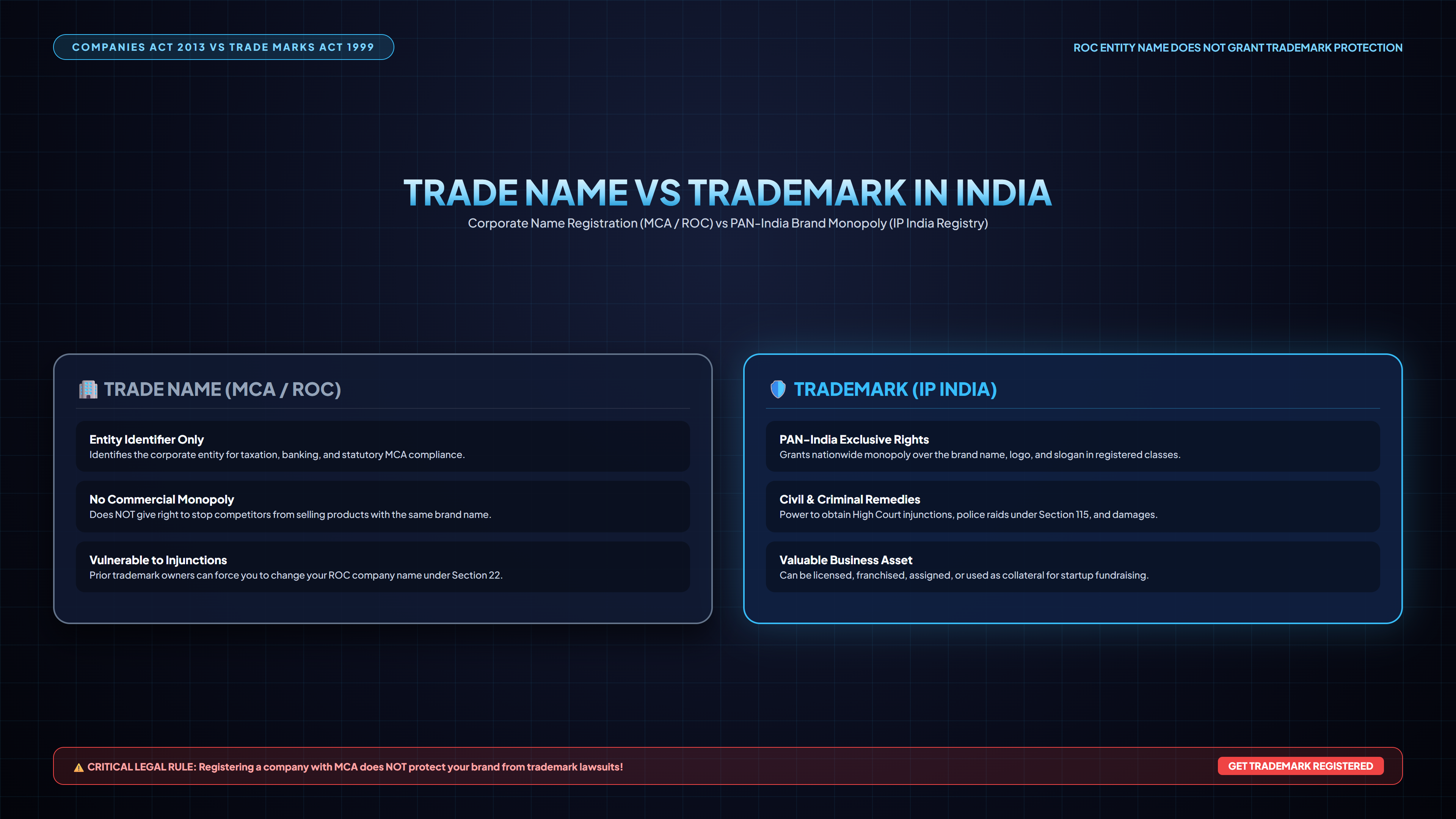
The Dangerous Myth of Commercial Registration
One of the most widespread and costly misconceptions among Indian MSME founders, traders, D2C startups, and retail store owners is the assumption that obtaining a GST Certificate or an MSME Udyam Registration gives them legal ownership over their business name. Business owners invest years of hard work, millions of rupees in inventory, digital marketing, signage, and customer goodwill, only to receive a sudden cease-and-desist legal notice from an entity holding a registered trademark.
Critical Legal Reality:
Commercial, municipal, and tax registrations (GSTIN, Udyam, Shop & Establishment, FSSAI, Import Export Code) are statutory administrative licenses intended solely for taxation, regulation, or state welfare schemes. They do NOT grant intellectual property ownership, brand exclusivity, or the legal right to stop competitors from copying your name under Indian law.
In India, brand ownership is governed strictly by the Trade Marks Act, 1999 administered by the Office of the Controller General of Patents, Designs and Trade Marks (CGPDTM / IP India). If you do not hold a registered trademark, any third party can legally register your brand name, secure exclusive statutory rights, and force you to rebrand your entire business.
Defining Trade Name vs Registered Trademark
To understand why tax registrations fail to protect your commercial goodwill, it is essential to distinguish between a Trade Name and a Trademark under Indian legal jurisprudence.
What is a Trade Name?
A Trade Name (or business/trading name) is the official or operational name under which an individual, partnership firm, LLP, or company conducts its day-to-day business. It is used on invoices, tax filings, lease agreements, vendor contracts, and bank accounts.
- • Governed by local municipal, tax, or corporate acts.
- • Grants no exclusive right over goods or services.
- • Confined to immediate local geographical territory.
- • Enforceable only through costly common law passing off suits.
What is a Trademark?
A Trademark under Section 2(1)(zb) of the Trade Marks Act, 1999 is a visually distinctive mark (word, brand, heading, label, ticket, name, signature, letter, numeral, shape of goods, packaging, or combination of colours) capable of distinguishing the goods or services of one enterprise from those of others.
- • Governed exclusively by the Trade Marks Act, 1999.
- • Grants nationwide statutory monopoly under Section 28.
- • Right to file infringement lawsuits & claim damages under Section 135.
- • Criminal remedies including police search and seizure under Section 115.
Why GST, MSME & Shop Act Do Not Protect Your Brand
Let us dissect the precise legal limitations of standard commercial registrations that business owners commonly rely upon in place of a registered trademark:
1. GST Registration (CGST Act, 2017)
GST registration is a tax collection mechanism enacted under Article 246A of the Indian Constitution and the Central Goods and Services Tax Act, 2017. When you apply for a GST number, the tax officer only verifies PAN details, identity proofs, and principal place of business.
The GST portal does not cross-check pending or registered trademarks on the IP India database. Ten different companies across Maharashtra, Gujarat, Delhi, and Karnataka can obtain GST registrations under the exact same trade name (e.g., "Apex Enterprises"). Having a GST certificate provides zero defense against a trademark infringement lawsuit under Section 29 of the Trade Marks Act.
2. MSME Udyam Registration (MSMED Act, 2006)
Udyam Registration is a self-declared government portal operated by the Ministry of Micro, Small and Medium Enterprises to categorize businesses based on investment in plant/machinery and annual turnover.
Its sole purpose is to extend government benefits such as lower interest rates on bank loans, exemption on tender earnest money deposits (EMD), and statutory interest on delayed payments under Section 16 of the MSMED Act. It does not evaluate brand distinctiveness, prior conflicting marks, or trademark exclusivity.
3. Shop & Establishment Act Licenses (Gumasta / Trade License)
Issued by local municipal corporations (e.g., BMC Mumbai, MCD Delhi, BBMP Bengaluru), these licenses regulate working hours, weekly holidays, wage payments, and health/fire safety standards for commercial establishments.
Municipal corporations possess no statutory authority to grant intellectual property rights. A Shop Act license is confined strictly to the physical municipal address listed on the certificate and provides zero nationwide brand exclusivity.
Comprehensive Statutory Comparison Matrix
Compare the legal standing, territorial jurisdiction, and protection levels of common Indian business registrations against a registered trademark:
| Registration Type | Governing Act | Territorial Scope | Brand Exclusivity | Infringement Remedy | E-Commerce Protection |
|---|---|---|---|---|---|
| GST Registration | CGST Act, 2017 | State / Pan-India (Tax) | None (0%) | No Right to Sue | Seller Onboarding Only |
| MSME Udyam | MSMED Act, 2006 | National (Benefits) | None (0%) | No Right to Sue | No Brand Lock |
| Shop & Establishment | State Specific Acts | Local Municipal Limit | None (0%) | No Right to Sue | Rejected for Brand Registry |
| MCA Company / LLP Name | Companies Act, 2013 | Pan-India Corporate Name | Limited (Corporate Only) | Common Law Passing Off | Partial / Unprotected Listings |
| Registered Trademark (®) | Trade Marks Act, 1999 | All 28 States & 8 UTs | Complete Monopoly (100%) | Section 29 Civil & Criminal | Amazon Registry & Flipkart Lock |
MCA Company Name vs Registered Trademark
Many founders believe that incorporating a Private Limited Company or LLP with the Ministry of Corporate Affairs (MCA) grants complete brand security because the Registrar of Companies (ROC) checks name availability under the SPICe+ portal.
While ROC name approval prevents another business from incorporating a company with the exact same corporate name, a company registration does not override trademark rights.
Section 16(1)(b) of the Companies Act, 2013 (Rectification of Name)
Under Section 16(1)(b) of the Companies Act, 2013, if a company is registered with a name that is identical with or too nearly resembles a registered trademark, the proprietor of the registered trademark can file an application before the Regional Director (RD) / Central Government. The government will direct the infringing company to change its registered company name within three months!
Consequently, even if you successfully incorporate "Zylos Technologies Private Limited" on the MCA portal, if another enterprise holds a prior registered trademark for "Zylos" in Class 9 or 42, they can legally compel you to change your corporate name and surrender all domain names and product branding.
Landmark Judicial Precedents on Trade Names
The Supreme Court of India and various High Courts have repeatedly affirmed the supremacy of registered trademarks over mere trade names, company names, and tax registrations:
Montari Overseas Ltd. v. Montari Industries Ltd. (1996 - Delhi High Court)
The Delhi High Court held that adopting a corporate name under the Companies Act does not grant immunity from trademark infringement. An enterprise cannot start a business using a corporate name that is deceptively similar to an existing established trademark or trade name of another company, as it causes confusion in the minds of consumers.
Mahendra & Mahendra Paper Mills Ltd. v. Mahindra & Mahindra Ltd. (2002 - Supreme Court of India)
The Supreme Court restrained the appellant from using the name "Mahendra & Mahendra" for their paper mill business despite having corporate registration, holding that the name was deceptively similar to the famous registered mark "Mahindra & Mahindra", creating an undeniable likelihood of commercial confusion and dilution of goodwill.
Laxmikant V. Patel v. Chetanbhai Shah (2002 - Supreme Court of India)
The Supreme Court ruled that honest commercial adoption of a business name requires conducting thorough due diligence. If an entity uses a trade name that damages the reputation or diverts customers from an established prior business, courts must immediately grant interim injunctions to protect goodwill, regardless of local commercial registrations.
Real-World Business Risks of Operating Without a Trademark
Relying solely on GST and MSME registrations exposes your enterprise to devastating operational, legal, and financial catastrophes:
A competitor or rogue distributor discovers your unregistered brand gaining traction, files a trademark application first on the IP India portal, and becomes the legal owner of your brand.
Platforms like Amazon, Flipkart, and Meesho require a trademark application or registration for Amazon Brand Registry and Flipkart Brand Lock. Without a TM, copycats can hijack your product listings.
Receiving an infringement injunction forces you to destroy printed packaging, tear down retail signage, change domains, and abandon accumulated customer search rankings overnight.
6-Step Roadmap: Transition from Trade Name to Trademark
Transform your vulnerable business trade name into a legally protected intellectual property asset through this systematic process:
Public Trademark Clearance Search
Conduct an exhaustive phonetic, visual, and semantic clearance search across the IP India public database to verify that your proposed mark is not deceptively similar to existing marks under Section 11.
Accurate Trademark Class Mapping
Identify all applicable classes among the 45 NICE classification classes (e.g., Class 25 for apparel, Class 30 for food products, Class 35 for retail/e-commerce, Class 42 for SaaS/software) to guarantee complete protection.
Claim 50% MSME Government Fee Concession
Attach your valid MSME Udyam Registration or DPIIT Startup India Certificate to reduce the official government filing fee from ₹9,000 to ₹4,500 per mark per class under the Trade Marks Rules, 2017. See our detailed guide on MSME trademark fee concessions.
Draft Prior User Date Affidavit (Rule 25)
If you have already been operating under your trade name, compile historical GST invoices, domain receipts, and packaging bills to claim your continuous prior use date under Section 34 prior user rights.
File Form TM-A Online & Use ™ Symbol
Submit Form TM-A through a registered trademark attorney. Immediately upon receiving your electronic acknowledgment receipt and application number, you are legally entitled to display the ™ symbol next to your brand. Review the difference between TM and R symbol.
Secure Certificate & Enforce Brand Monopoly
Overcome examination objections, clear trademark journal publication, and receive your 10-year renewable Registration Certificate (®), unlocking nationwide brand lock and enforcement powers.
Frequently Asked Questions
Q.Does having a GST registration protect my brand name across India?
No. A GSTIN (Goods and Services Tax Identification Number) is solely a tax compliance registration issued under the CGST Act, 2017. The GST portal does not perform brand clearance searches, nor does it confer exclusive proprietary ownership. Multiple entities across different states (or within the same jurisdiction) can operate with identical trade names on GST certificates without legal immunity from trademark infringement.
Q.Does an MSME Udyam Registration grant exclusive brand ownership?
No. Udyam Registration under the MSMED Act, 2006 serves only to qualify your enterprise for government subsidies, priority sector lending, collateral-free credit, and delayed payment dispute resolution under the Samadhaan portal. It provides zero intellectual property monopoly or legal standing to stop competitors from copying your brand name.
Q.What is the core difference between a Trade Name and a Trademark?
A Trade Name (business name) is the commercial identity under which an entity conducts routine operations, signs vendor contracts, files taxes, and maintains bank accounts. A Trademark is a legally protected intellectual property asset registered under the Trade Marks Act, 1999 that identifies the commercial source of specific goods or services and grants an exclusive, nationwide monopoly to prevent third-party infringement.
Q.If I register a Private Limited Company with MCA, do I still need a trademark?
Yes. While the Ministry of Corporate Affairs (MCA) checks name availability before incorporating a company or LLP, Section 16(1)(b) of the Companies Act, 2013 explicitly empowers a registered trademark owner to file a rectification petition and legally force the company to change its name within three months if it infringes a prior registered trademark.
Q.Can someone steal my brand name if I only have a Shop & Establishment License?
Yes. A Shop and Establishment license is purely a state municipal permit governing local working hours, health standards, and employee working conditions. It grants zero proprietary rights. Any competitor can register your brand name as a trademark with the Trade Marks Registry and issue a cease-and-desist notice forcing you to stop using your business name.
Q.What legal remedies exist for a registered trademark owner against a trade name infringer?
Under the Trade Marks Act, 1999, a registered trademark owner can file a civil infringement suit under Section 29 to obtain interim and permanent injunctions, confiscate infringing goods, recover damages or accounts of profits under Section 135, and initiate criminal proceedings under Section 103 and 104 with search and seizure police raids under Section 115.
Q.Can an unregistered trade name owner file a lawsuit against a copycat?
An unregistered trade name owner cannot file a statutory trademark infringement suit. Their only recourse is a common law 'passing off' action under Section 27(2). Passing off requires proving extensive commercial goodwill, deceptive misrepresentation by the defendant, and actual financial damage, which involves heavy evidentiary burdens and substantial legal expenses.
Q.How does having an MSME certificate help in trademark registration?
While MSME Udyam registration does not protect your brand automatically, holding a valid Udyam certificate entitles micro and small enterprises to a 50% government fee concession on trademark filing under the Trade Marks Rules, 2017 (reducing the official filing fee from ₹9,000 to ₹4,500 per class).
Strategic Trade Name vs Trademark Advice
Your brand name, logo, and commercial reputation are among the most valuable intangible assets of your business. Do not make the fatal mistake of relying on GST, MSME, or Shop Act licenses for brand security. Tax registrations certify your obligation to pay taxes; only a registered trademark certifies your right to own and defend your brand.
Partner with experienced intellectual property attorneys to conduct comprehensive trademark clearance, claim MSME fee subsidies, secure registration under the Trade Marks Act, 1999, and establish an unshakeable legal moat around your enterprise. For related enforcement workflows, explore our guides on how to send trademark legal notices, passing off vs trademark infringement, and Section 115 police raid procedures.
Protect Your Brand with an Official Registered Trademark
Do not leave your business name unprotected. Claim 50% MSME government fee discounts and secure pan-India brand ownership with senior IP advocates.
Registered IP Advocates • Free TM Search Report • 50% MSME Subsidy • Pan-India Protection