
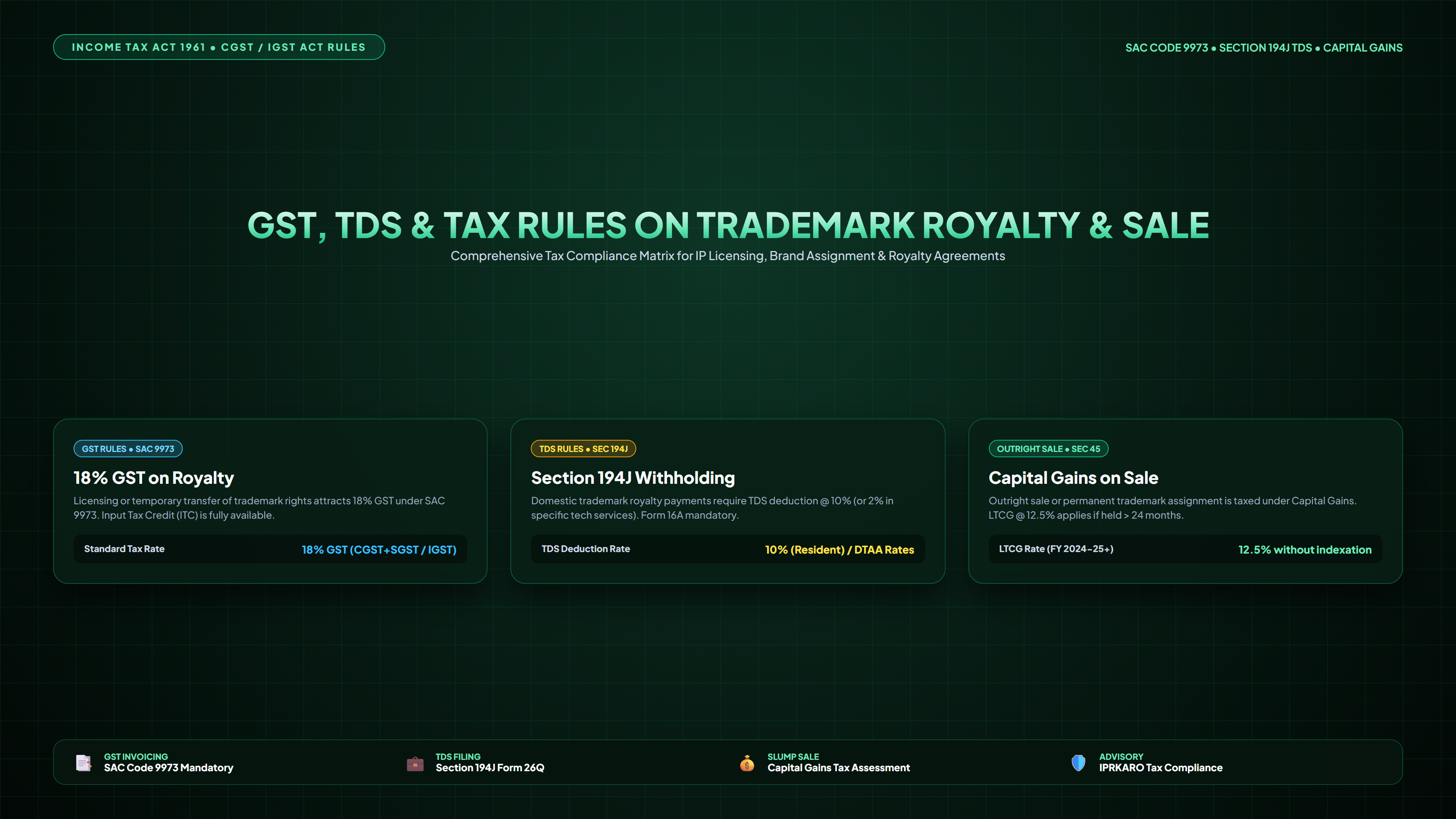
Taxation Architecture of Trademarks in India
Intellectual property assets, particularly registered trademarks and brand names, represent significant balance sheet value for startups, consumer conglomerates, and franchise networks. When monetizing a trademark, transactions broadly fall into two distinct legal and fiscal categories:
1. Trademark Licensing (Royalties)
Granting a temporary, revocable right to use the brand name while retaining legal title. Governed by SAC Code 997336 (18% GST) and subject to recurring TDS withholding under Section 194J (10%) or Section 195 for foreign licensors.
2. Trademark Assignment (Outright Sale)
Permanent transfer of proprietary ownership, goodwill, and title. Attracts 18% GST (Supply of Services) and triggers Capital Gains Tax under Section 55(2)(a) for the seller and 25% depreciation under Section 32 for the buyer.
Mischaracterizing brand licensing as a business service or failing to adhere to strict TDS, GST, and Form TM-P recordal requirements can result in severe disallowances under Section 40(a)(ia), GST input tax credit reversals, and penalties up to 200% under direct tax audit provisions.
GST Rates & SAC Code 9973 Classification
Under the Goods and Services Tax (GST) classification system, intellectual property transactions are categorized under Services Accounting Code (SAC) Heading 9973:
| SAC Code | Service Description | GST Rate | Tax Mechanism | ITC Availability |
|---|---|---|---|---|
| SAC 997336 | Licensing services for the right to use IP (Trademarks, Brand Names, Patents) | 18% (9% CGST + 9% SGST / 18% IGST) | Forward Charge (Domestic) / RCM (Import) | Fully Eligible (100%) |
| SAC 997331 | Licensing services for the right to use computer software / SaaS systems | 18% IGST / CGST+SGST | Forward Charge / OIDAR Rules | Fully Eligible (100%) |
| SAC 9973 / Sch II | Permanent Transfer or Assignment of Registered Trademark / Brand Rights | 18% IGST / CGST+SGST | Forward Charge (Supply of Services) | Fully Eligible (100% ITC) |
Is Trademark Sale a Supply of Goods or Services under GST?
Under Schedule II, Clause 5(c) of the CGST Act, 2017, "temporary transfer or permitting the use or enjoyment of any intellectual property right" is deemed a supply of services. Furthermore, the Authority for Advance Rulings (AAR) has consistently held that permanent assignment/transfer of trademarks constitutes a supply of services under SAC 9973 taxed at 18% GST.
Reverse Charge Mechanism (RCM) & Cross-Border Royalties
When an Indian subsidiary, franchisee, or licensee pays trademark royalties, franchise fees, or brand licensing charges to a foreign parent entity or overseas intellectual property holding company:
1. Mandatory 18% IGST Payment under RCM
Under Notification No. 10/2017-Integrated Tax (Rate), import of services where the supplier is located in non-taxable territory and the recipient is located in India requires the Indian recipient to pay 18% IGST under Reverse Charge Mechanism (RCM) through cash ledger. The paid IGST can be claimed as 100% Input Tax Credit in the same tax period.
2. Place of Supply Rules (Section 13 of IGST Act)
Under Section 13(2) of the IGST Act, the place of supply of intellectual property licensing services where the supplier or recipient is outside India is the location of the recipient of services (i.e., India), making it fully chargeable to Indian GST laws.
TDS Withholding Rules: Section 194J & Section 195
Direct tax withholding on trademark royalties is governed by strict statutory thresholds under the Income Tax Act, 1961:
Domestic Payments: Section 194J
- • Definition: Trademark royalty is defined under Explanation 2 to Section 9(1)(vi).
- • TDS Rate: Strict 10% TDS under Section 194J(1)(c).
- • No 2% Rate: While technical service fees under 194J(1)(a) were reduced to 2%, royalty payments remain taxed at 10%.
- • Threshold: ₹30,000 per financial year per payee.
- • Missing PAN: 20% TDS under Section 206AA.
- • Disallowance: 30% of expense disallowed under Section 40(a)(ia) if TDS is defaulted.
Cross-Border Remittances: Section 195
- • Domestic Base Rate: 20% + surcharge and cess under Section 115A.
- • DTAA Treaty Relief: 10% to 15% beneficial rate under Article 12 (Royalties) of Double Taxation Avoidance Agreements.
- • Mandatory Compliance: Tax Residency Certificate (TRC), Form 10F, and No-PE certificate from overseas brand owner.
- • Bank Remittance: Mandatory Form 15CA (online submission) and Form 15CB (Chartered Accountant certificate).
Capital Gains on Trademark Sale: Section 55(2)(a)
When an entrepreneur, startup, or corporation sells or assigns its registered trademark permanently under a Trademark Assignment Agreement, the transaction is treated as a transfer of a capital asset:
Self-Generated Trademarks (Cost Deemed to be NIL)
Under Section 55(2)(a) of the Income Tax Act, 1961, where a trademark or brand name was self-generated or internally developed by the seller without paying an acquisition purchase price, the cost of acquisition is statutorily deemed to be NIL. Consequently, the entire gross sale consideration (less brokerage/legal transfer expenses) is treated as taxable Capital Gains!
Purchased / Acquired Trademarks
If the seller previously purchased the trademark from a third party, the cost of acquisition is the actual monetary purchase price paid, reduced by the cumulative depreciation claimed under Section 32 in preceding assessment years.
Holding Period < 24/36 Months
Short-Term Capital Gain (STCG)
Taxed at normal corporate income tax slab rates (22% / 25% / 30% plus surcharge and cess).
Holding Period > 24/36 Months
Long-Term Capital Gain (LTCG)
Taxed at 20% (or revised 12.5% post-Finance Act 2024 amendments) under Section 112.
25% Depreciation on Acquired Trademarks: Section 32
When a company acquires a registered trademark or brand portfolio through an asset purchase deal, merger, or slump sale:
Statutory Intangible Asset Classification
Under Section 32(1)(ii) of the Income Tax Act, 1961, intangible assets (know-how, patents, copyrights, trademarks, licenses, franchises, or any other business or commercial rights of similar nature) acquired on or after April 1, 1998 are entitled to tax depreciation at the rate of 25% per annum on Written Down Value (WDV).
Comprehensive Trademark Tax Compliance Matrix
Review this consolidated master reference summarizing all direct and indirect tax parameters across commercial brand transactions:
| Transaction Type | SAC Code | GST Rate | TDS Section & Rate | Direct Tax (Seller/Licensor) | Tax Benefit (Buyer/Licensee) |
|---|---|---|---|---|---|
| Domestic Trademark Licensing | 997336 | 18% GST | Sec 194J (10%) | Business Income (PGBP) | 100% Revenue Expense + 100% ITC |
| Foreign Inbound Royalty (Import) | 997336 | 18% IGST (RCM) | Sec 195 (10%-20% DTAA) | Non-Resident Royalty Income | RCM ITC Credit + 15CA/CB Filing |
| Outright Sale (Self-Generated Brand) | 9973 / Sch II | 18% GST | Sec 194Q / Nil (Asset) | Capital Gains (Cost Nil under Sec 55) | 25% Depreciation under Sec 32 |
| Outright Sale (Acquired Brand) | 9973 / Sch II | 18% GST | Sec 194Q / Nil (Asset) | Capital Gains (Cost = Purchase - Dep.) | 25% Depreciation under Sec 32 |
6-Step Deal Structuring & Tax Compliance Playbook
Execute flawless brand licensing agreements and assignment contracts by adhering to this structured protocol:
Draft Robust Agreement with Tax Indemnity Clauses
Draft a comprehensive Trademark License or Assignment Deed defining the territory, royalty calculation formula (gross sales vs net profits), GST grossing-up provisions, and TDS certificate issuance obligations.
Invoicing under SAC Code 997336 & GST Compliance
Generate GST tax invoices quoting SAC 997336, state billing address, Place of Supply, and 18% IGST / CGST+SGST breakups. Ensure prompt filing in GSTR-1 for seamless GSTR-2B matching.
Execute 10% TDS Withholding under Section 194J
Deduct 10% TDS on every royalty milestone before disbursing payments, deposit with the central government by the 7th of the subsequent month, and issue quarterly Form 16A certificates to avoid Section 40(a)(ia) disallowances.
Statutory Form TM-P Recordal with IP India
File Form TM-P with the Trade Marks Registry under Section 45 (for assignments) or Section 49 (for registered user licensing). Official government recordal provides conclusive legal proof during Income Tax audits and GST investigations.
Transfer Pricing & Arm's Length Study (Section 92C)
For royalty arrangements between parent-subsidiary entities or related parties, maintain a formal Transfer Pricing Study using the Comparable Uncontrolled Price (CUP) or Transactional Net Margin Method (TNMM) to justify royalty rates (typically 1% to 5% of net sales).
Capitalization & 25% Depreciation Claim under Section 32
For purchased trademarks, capitalize the purchase cost plus registration stamp duty into the intangible asset block and claim 25% WDV depreciation in corporate Income Tax Return (ITR-6) filings.
Frequently Asked Questions
Q.What is the applicable GST rate and SAC code for trademark royalties in India?
Trademark royalties and licensing fees are classified under SAC Code 997336 (Licensing services for the right to use intellectual property and similar products). Under the GST regime, licensing of trademarks is treated as a supply of services taxed at 18% GST (9% CGST + 9% SGST for intra-state transactions, or 18% IGST for inter-state transactions).
Q.What is the TDS rate on domestic trademark royalty payments under Section 194J?
Under Section 194J(1)(c) of the Income Tax Act, 1961, trademark royalties are subject to a TDS deduction rate of 10% (if the payee provides a valid PAN) or 20% under Section 206AA (if PAN is not furnished). Note that while technical service fees under Section 194J(1)(a) were reduced to 2%, royalty payments for intellectual property use remain strictly subject to the 10% withholding rate once aggregate payments exceed ₹30,000 in a financial year.
Q.How is a permanent sale or assignment of a trademark taxed under GST?
Under Schedule II, Paragraph 5(c) of the CGST Act, 2017, the temporary licensing or permanent transfer of intellectual property rights is treated as a supply of services. Permanent assignment/sale of a trademark attracts 18% GST (SAC Code 997336 / 9973). The buyer can claim full Input Tax Credit (ITC) if the purchased brand is used in the course or furtherance of business.
Q.How are Capital Gains calculated on the sale of a self-generated trademark under Section 55?
Under Section 55(2)(a) of the Income Tax Act, 1961, the cost of acquisition for a self-generated or internally built trademark or brand name is deemed to be NIL. Therefore, the entire gross sale consideration (minus incidental transfer expenses) is treated as Capital Gains and taxed as Short-Term Capital Gain (STCG) or Long-Term Capital Gain (LTCG) depending on whether the asset was held for more or less than 24/36 months.
Q.Can an enterprise claim Income Tax depreciation on purchased trademarks under Section 32?
Yes. Under Section 32(1)(ii) of the Income Tax Act, 1961, acquired intangible assets including trademarks, know-how, patents, copyrights, licenses, and franchises qualify for depreciation at the rate of 25% on a Written Down Value (WDV) basis. Note that depreciation cannot be claimed on self-generated trademarks; it applies only to acquired/purchased commercial marks capitalized on the balance sheet.
Q.Does Reverse Charge Mechanism (RCM) apply to foreign trademark royalty payments?
Yes. When an Indian business pays brand royalties or franchise fees to an overseas brand owner (import of IP services), the Indian payer is liable to discharge 18% IGST under Reverse Charge Mechanism (RCM) under Notification No. 10/2017-Integrated Tax (Rate). The Indian enterprise can subsequently claim this tax as Input Tax Credit (ITC) in their GSTR-3B return.
Q.What TDS withholding rate applies to cross-border trademark royalty remittances under Section 195?
Under Section 195, cross-border royalty remittances to non-residents are subject to withholding tax at the domestic rate of 20% (plus applicable surcharge and cess) or the beneficial Double Taxation Avoidance Agreement (DTAA) treaty rate (typically 10% to 15% under Article 12 of Indian tax treaties), provided the non-resident furnishes a valid Tax Residency Certificate (TRC), Form 10F, and No-PE certificate, accompanied by Form 15CA and Form 15CB certifications.
Q.Is formal recordal with the Trademark Registry mandatory after a brand sale or licensing deal?
Yes. Under Section 45 (for trademark assignment/sale) and Section 49 (for registered user/licensing) of the Trade Marks Act, 1999, the parties must submit Form TM-P to record the title transfer or licensing terms on the official register of IP India. Without statutory recordal, the licensee or assignee faces severe evidential hurdles during tax audits and court enforcement.
Strategic Tax & IP Legal Advice
Structuring brand monetization, royalty agreements, and trademark assignments requires simultaneous mastery of intellectual property statutes and Indian tax laws. A poorly drafted licensing contract can trigger double taxation, GST reverse charge disputes, 30% expense disallowances under Section 40(a)(ia), and transfer pricing penalties.
Collaborate with dual-qualified IP attorneys and corporate tax strategists to structure tax-efficient licensing models, ensure SAC 997336 compliance, draft Section 194J/195 withholding agreements, and record assignments via Form TM-P. For related legal workflows, explore our guides on trademark assignment vs licensing, trade name vs trademark differences, and MSME trademark fee concessions.
Structure Tax-Compliant Trademark Royalties & Deals
Deploy senior IP advocates and corporate tax attorneys to draft licensing agreements, handle SAC 9973 GST compliance, manage TDS withholding, and record Form TM-P assignments.
Senior IP Advocates • SAC 9973 GST Advisory • Section 194J TDS Guidance • Form TM-P Recordal