
Written by Rahul Roy
Trademark Research Specialist
Overview of Joint Trademark Ownership
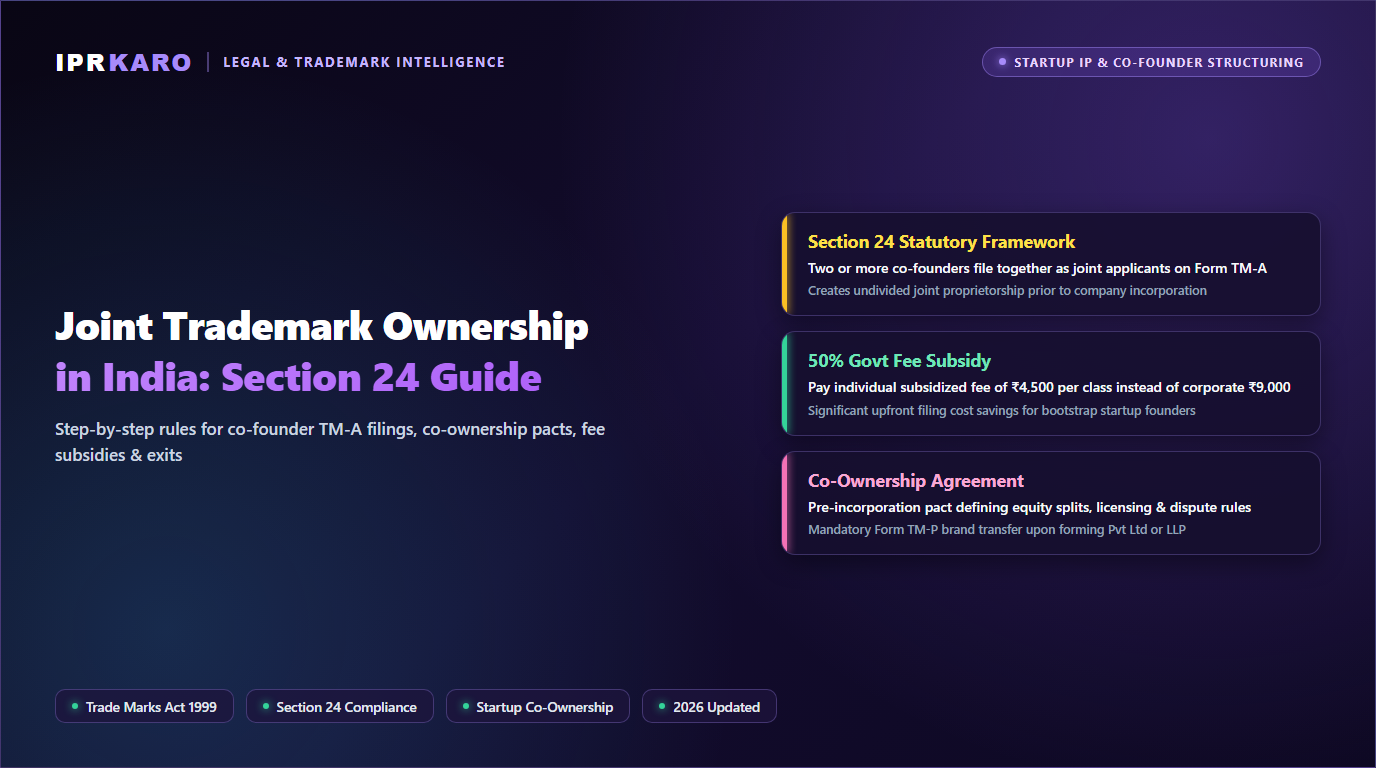
Yes, two or more co-founders can legally apply for and own a trademark together in India under Section 24 of the Trade Marks Act, 1999. In Form TM-A, the applicant category is chosen as "Joint Applicants," listing all founders' names and addresses. Joint owners hold equal, undivided shares by default and no single co-founder can license, assign, or monetize the trademark without the written consent of all other co-proprietors. Filing as joint individual applicants qualifies for a 50% government fee concession (₹4,500 vs ₹9,000).
In the fast-paced Indian startup ecosystem, building brand equity begins long before formal incorporation. Co-founders frequently launch MVPs, domain names, social media handles, and consumer apps before forming a Private Limited Company or Limited Liability Partnership (LLP). During this pre-incorporation phase, safeguarding brand equity is essential.
If one founder registers the trademark solely in their individual name, severe equity imbalances and trust issues arise. Conversely, waiting months until company incorporation risks brand squatting by unscrupulous competitors. Section 24 provides the statutory bridge, allowing multiple founders to hold undivided, joint legal ownership over the brand.
To understand how applicant legal structures affect filing rights, review our guides on who can apply for trademark in India and trademark fee concession for MSMEs and startups.
Section 24 Statutory Framework in India
Section 24 of the Trade Marks Act, 1999 governs the registration and mutual rights of joint proprietors. It establishes clear statutory guardrails for shared brand ownership:
“Where the relations between two or more persons interested in a trade mark are such that no one of them is entitled as between himself and the other or others to use it except (a) on behalf of both or all of them, or (b) to the goods or services with which both or all of them are connected in the course of trade, those persons may be registered as joint proprietors of the trade mark.”
1. Connected in the Course of Trade (Section 24(1))
Joint ownership is permitted only when all co-applicants share a genuine commercial connection with the goods or services. Two unrelated companies selling different goods cannot register as joint proprietors merely to share filing expenses.
2. Undivided Shares & Mutual Consent Rule (Section 24(2))
Subject to any contract to the contrary, the Act deems joint proprietors to hold undivided shares. Neither co-founder can independently grant a trademark license, execute a franchise agreement, or assign the brand to a third party without the explicit written concurrence of all co-owners.
3. Right to Use on Behalf of All
Any commercial use of the trademark by one joint owner in furtherance of the venture enures to the benefit of all joint owners, protecting the registration from non-use cancellation actions under Section 47 of the Trade Marks Act.
Individual Co-Founders vs Corporate Filing
Founders often debate whether to file as joint individuals immediately or wait until a Private Limited company is registered with the Ministry of Corporate Affairs (MCA). The comparison below highlights key legal considerations:
| Parameter | Joint Co-Founder Filing (Section 24) | Incorporated Company Filing |
|---|---|---|
| Applicant Legal Entity | Natural persons listed jointly as applicants | Private Limited Company / LLP / OPC |
| Official Govt Fee | ₹4,500 (Subsidized Individual rate) | ₹4,500 (with MSME) / ₹9,000 (standard) |
| Pre-Incorporation Protection | Immediate priority date secured | Delayed until Certificate of Incorporation |
| Equity & Exit Handling | Requires Co-Ownership Agreement & TM-P transfer | IP automatically belongs to company balance sheet |
| VC / Angel Investor Preference | Must be formally assigned to company prior to funding | Preferred during investor IP due diligence |
How Co-Founders File Together in Form TM-A
Filing a joint trademark application on the IP India e-filing portal involves structured procedural steps to ensure smooth examination without administrative objections:
Select 'Joint Applicants' Category
In Form TM-A, designate the applicant type as "Joint Applicants / Joint Proprietors" and input the legal names, nationalities, PAN numbers, and residential addresses of each co-founder.
Appoint Common Address for Service
The Registry requires a single address for service in India where all official hearing notices, examination reports, and journal publications will be dispatched.
Execute Form TM-48 (Power of Attorney)
All co-founders must jointly sign Form TM-48 Power of Attorney on appropriate non-judicial stamp paper, authorizing the registered trademark attorney.
Submit Joint User Date Affidavit (If Claiming Prior Use)
If the brand has prior commercial use under Section 34, submit a user affidavit affirmed jointly by all co-founders detailing first date of use and commercial evidence.
Official Fee Subsidies for Joint Applicants
Under the Trade Marks Rules, 2017, the official fee structure provides massive subsidies for individual entrepreneurs and small business entities:
All Applicants are Individuals / MSMEs
₹4,500 per class (e-filing)
When two or more co-founders file in their personal capacities as natural persons, or if all joint entities possess valid Udyam MSME certificates, the entire application qualifies for the 50% statutory discount.
Mixed Status Applicants (Company + Individual)
₹9,000 per class (e-filing)
If one co-applicant is an individual but the other is an incorporated corporate body without MSME / Startup India registration, the registry levies the standard corporate rate of ₹9,000 per class.
Essential Clauses in Co-Ownership Pacts
Filing jointly under Section 24 creates undivided rights. If co-founders lack a written Co-Ownership & IP Agreement, a dispute can paralyze the brand. Every startup co-ownership agreement must include these essential clauses:
1. Ownership Ratio & Equity Linkage
Specify exact percentage entitlements (e.g., 50:50 or 60:40) aligned with founder cap table equity, overriding the statutory default presumption of equal undivided interest.
2. Mandatory Assignment to Future Company
A binding covenant obligating all co-founders to assign 100% trademark title and goodwill to the newly incorporated Private Limited company within 30 days of incorporation without demanding separate cash consideration.
3. Unilateral Licensing & Assignment Prohibition
Strict negative covenants barring any individual co-founder from licensing, sub-licensing, creating liens, or pledging the mark without unanimous written consent.
4. Prosecution & Maintenance Cost Sharing
Clear allocation of attorney fees, official renewal fees, and defense costs in the event of third-party trademark oppositions or examination objections.
Managing Co-Founder Exits and IP Transfers
One of the greatest operational risks in early-stage ventures is a founder departure while a trademark is still registered in joint personal names:
The 'Deadlock Risk'
If a departing co-founder refuses to sign trademark assignment forms or demands an exorbitant payout, the remaining founders cannot register the mark under their company, obtain venture capital funding, or enforce against infringers. The trademark becomes legally frozen.
Execution of Trademark Assignment Deed
Upon founder exit, the departing founder must execute an IP Assignment Deed transferring all rights, title, and goodwill to the surviving co-founders or company. Learn the difference in our guide on trademark assignment vs licensing in India.
Filing Form TM-P with IP India
The change in ownership must be formally recorded on the IP India e-Register by filing Form TM-P along with the certified Assignment Deed and applicable official fees to substitute the proprietor details.
Joint Tenancy vs Tenancy in Common in IP
Indian property law recognizes two distinct modes of concurrent ownership, with major implications for intellectual property in the event of founder death or liquidation:
Tenancy in Common (Statutory Presumption)
Each co-founder holds a distinct, divisible percentage share. If a co-founder passes away, their trademark share passes to their legal heirs rather than automatically transferring to surviving co-founders.
Joint Tenancy with Survivorship (Contractual)
If expressly stipulated in a founder contract, co-owners hold a unified title. Upon the death of one founder, their share automatically vests in the surviving co-proprietor(s), preventing disruption to ongoing business operations.
Enforcement and Litigation by Joint Owners
Enforcing exclusive trademark rights under Section 29 (Infringement) and common law passing off requires careful procedural compliance when multiple proprietors are registered:
1. Joinder of All Joint Proprietors as Plaintiffs
In civil infringement litigation, the general rule is that all registered joint proprietors must be joined as co-plaintiffs. A single co-founder cannot claim 100% damages or an injunction without bringing all co-owners on record.
2. Non-Cooperating Co-Founder as Pro-Forma Defendant
If a recalcitrant co-founder refuses to participate in litigation against a third-party counterfeiter, the active co-founder can file the suit and array the non-cooperating co-proprietor as a pro-forma defendant to ensure legal representation of the whole mark.
3. Inter-Se Infringement Between Co-Owners
One joint proprietor cannot sue another joint proprietor for statutory trademark infringement, because both hold legal title to use the mark. Disputes between joint owners must be litigated under contract law or partnership dissolution claims.
Landmark Judicial Precedents on Joint Marks
Indian courts have shaped joint ownership doctrine through seminal rulings defining the boundaries of co-proprietorship rights:
Power Control Appliances v. Sumeet Machines Pvt. Ltd. (1994) 2 SCC 448
The Supreme Court held that there can be only one source and one proprietor of a trademark at a time. Where joint proprietors exist, their rights must be exercised collectively on behalf of the shared commercial venture, and one owner cannot use the mark in rivalry with the other.
Gujarat Bottling Co. Ltd. v. Coca Cola Co. (1995) 5 SCC 545
The Supreme Court emphasized that joint use agreements and licensing arrangements must uphold strict quality control to prevent deceptive public confusion and maintain brand distinctiveness.
Gufic Ltd. v. Clinique Laboratories LLC (2010) Del HC
The Delhi High Court affirmed that joint proprietors cannot independently alienate brand goodwill or grant third-party licenses without express contractual authorization from all co-owners.
Frequently Asked Questions
Q.Can two or more co-founders file a joint trademark application in India?
Yes. Under Section 24 of the Trade Marks Act, 1999, two or more individuals or entities can apply jointly as co-proprietors on Form TM-A if they share a bona fide commercial connection in the goods or services for which the mark is used or proposed to be used.
Q.What does Section 24 of the Trade Marks Act, 1999 mandate for joint owners?
Section 24(1) provides that persons may be registered as joint proprietors when no one of them is entitled to use the mark except on behalf of all of them or in connection with goods/services with which all are connected. Section 24(2) clarifies that joint owners hold equal undivided rights unless an agreement specifies otherwise, preventing any single owner from licensing or assigning the mark unilaterally.
Q.Can one joint trademark owner license or sell the brand without the other?
No. In the absence of an explicit contract to the contrary, neither joint owner can independently assign, license, franchise, or mortgage the trademark without the written consent of all registered joint proprietors. Unilateral licensing by one co-founder is legally void in India.
Q.What is the official government fee for joint individual trademark applicants?
If all joint applicants are natural persons (individuals) or qualify as registered MSMEs / DPIIT-recognized startups, the application qualifies for the subsidized fee of ₹4,500 for e-filing per class. If even one applicant is an incorporated company without MSME status, the standard fee of ₹9,000 per class applies.
Q.What happens to the joint trademark when co-founders incorporate a Private Limited company?
Once the corporate entity is incorporated, both co-founders must execute a formal Trademark Assignment Deed transferring their respective joint ownership shares and accrued goodwill to the company. Subsequently, Form TM-P must be filed with the Trade Marks Registry to update the registered proprietor name.
Q.What happens if a co-founder leaves the startup or a dispute arises?
If a co-founder exits without an IP assignment agreement, a legal deadlock occurs because the trademark cannot be modified, renewed, or assigned without their signature. To avoid this, founders should execute a robust Co-Ownership Agreement with buyout clauses, dispute resolution mechanisms, and automatic transfer upon departure.
Q.How should Form TM-48 (Power of Attorney) be executed for joint applicants?
Form TM-48 must contain the full legal names and residential addresses of all joint co-founders. It must be signed by each joint applicant individually or by an authorized signatory backed by a specific power of attorney or board resolution.
Q.Can one joint proprietor sue a third party for trademark infringement?
Generally, all joint proprietors must be joined as co-plaintiffs in an infringement suit under Section 29. If one co-founder refuses to join, the suing co-founder must name the non-cooperating co-proprietor as a pro-forma defendant to ensure the entire title is represented before the court.
Strategic IP Advice for Startup Founders
Joint trademark ownership under Section 24 provides an invaluable, low-cost legal shield for co-founders during the critical pre-incorporation phase. However, joint ownership must never be left unmanaged. Always execute a formal Co-Ownership Agreement alongside your Form TM-A application to define exit terms and mandate future company assignment.
Work with experienced startup trademark attorneys to structure your intellectual property portfolio seamlessly. For comprehensive startup trademark guidance, explore our guides on trademark registration for startups, trademark availability search, and free AI trademark search tool.
Protect Your Brand with Joint Filing
Secure 50% government fee subsidies, draft custom co-founder IP agreements, and register your joint brand with expert trademark attorneys.
Section 24 Compliance • Co-Ownership Agreements • Form TM-A & TM-P Filing • Pan-India