
Written by Rahul Roy
Trademark Research Specialist
Overview of Colour Trademark Registration
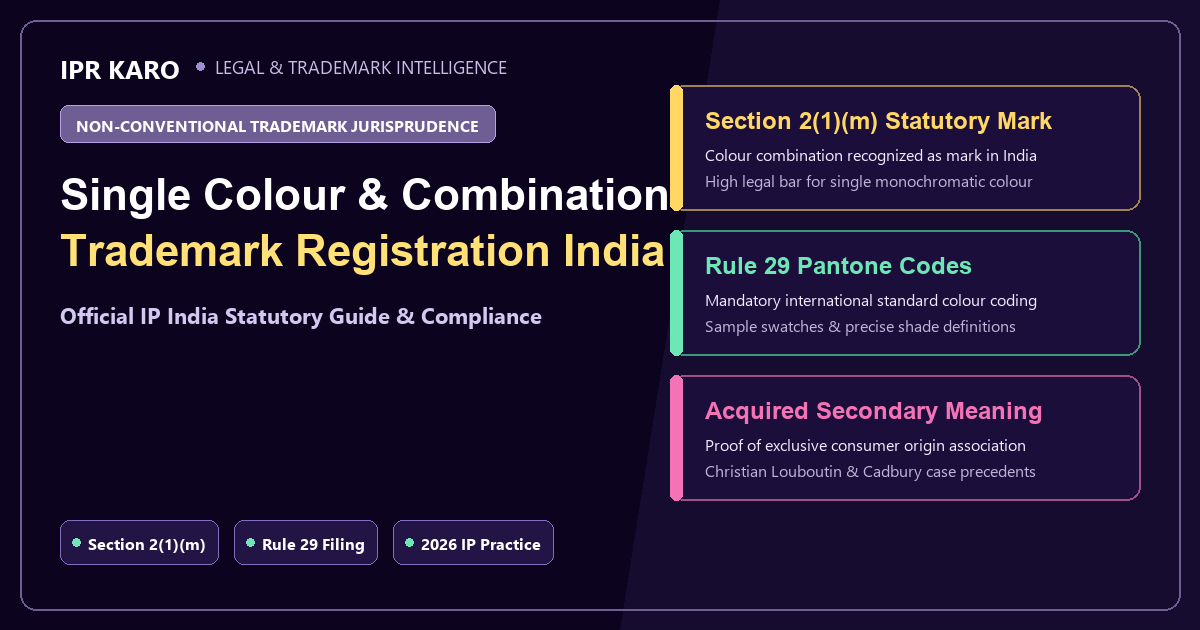
Under Indian trademark law, Section 2(1)(m) of the Trade Marks Act, 1999 explicitly recognizes a ‘combination of colours’ as a registrable mark, while a single monochromatic colour can be registered under Section 2(1)(zb) if it satisfies the twin tests of graphical representation and acquired distinctiveness (secondary meaning). Registering a colour requires compliance with Rule 29 of the Trade Marks Rules, 2017 using international Pantone codes, providing multi-year commercial sales and advertising records, and disproving utilitarian functionality or competitive colour depletion.
In an increasingly visual global marketplace, colour is the first sensory cue consumers perceive before reading brand names or analyzing logos. Distinctive visual assets like Tiffany & Co.'s robin egg blue, Cadbury's royal purple, Christian Louboutin's scarlet red shoe sole, and John Deere's green and yellow machinery trigger immediate commercial recognition.
However, granting a proprietary monopoly over a colour removes that shade from the competitive sphere of other businesses. Consequently, the Trade Marks Registry of India and High Courts enforce an exceptionally stringent standard of review for colour marks under Section 9 absolute grounds of refusal.
Whether you are an FMCG manufacturer, a luxury fashion house, or a direct-to-consumer (D2C) startup, understanding the statutory framework under Section 2(1)(m) is critical for securing and enforcing proprietary colour rights across India.
Statutory Definition: Section 2(1)(m) and 2(1)(zb)
The statutory basis for colour trademark protection in India rests on two interconnected definitions in the Trade Marks Act, 1999:
1. Section 2(1)(m) — The Definition of a ‘Mark’
Section 2(1)(m) states: “‘mark’ includes a device, brand, heading, label, ticket, name, signature, word, letter, numeral, shape of goods, packaging or combination of colours or any combination thereof.” By explicitly mentioning combinations of colours, Parliament codified statutory protection for multi-colour branding.
2. Section 2(1)(zb) — The Definition of a ‘Trade Mark’
Section 2(1)(zb) provides that a trade mark must be “capable of being represented graphically and which is capable of distinguishing the goods or services of one person from those of others...” Even though Section 2(1)(m) mentions combinations of colours, a single colour qualifies under Section 2(1)(zb) if it fulfills graphical representation and source distinctiveness.
3. Section 10 — Limitation as to Colour
Under Section 10(1), a trademark may be limited wholly or in part to any combination of colours, and any such limitation is taken into consideration by the Registrar or court when assessing the distinctive character of the mark. Under Section 10(2), if a trademark is registered without limitation of colour, it is deemed registered for all colours.
Single Colour vs Combination of Colours
In trademark jurisprudence, there is a fundamental legal difference between registering a single monochromatic colour versus a combination of colours:
Single Colour Marks
- Statutory presumption: Presumed inherently non-distinctive (devoid of inherent distinctiveness under Section 9(1)(a)).
- Evidentiary threshold: Exceptionally high. Requires 10+ years of exclusive use, immense market share, and proven consumer recognition.
- Opposition vulnerability: Highly vulnerable to objections under the Colour Depletion Doctrine.
- Examples: Christian Louboutin Red Sole, Tiffany Blue, Cadbury Purple.
Combination of Colours
- Statutory recognition: Expressly included in the statutory definition of a mark under Section 2(1)(m).
- Inherent distinctiveness: Higher probability of being distinctive when arranged in unique geometric ratios, bands, or trade dress layouts.
- Market impact: Leaves ample colour alternatives for competitors, facing fewer anti-monopoly objections.
- Examples: Colgate Red & White, John Deere Green & Yellow, Castrol Green/Red/White.
Proving Acquired Secondary Meaning for Colour Marks
Under the proviso to Section 9(1) of the Trade Marks Act, 1999, a mark devoid of inherent distinctiveness shall not be refused registration if, before the date of application, it has in fact acquired a distinctive character as a result of the use made of it.
To establish that a colour or colour combination has acquired secondary meaning in the minds of the purchasing public, applicants must furnish an exhaustive evidentiary record through a Rule 25 User Affidavit:
1. Duration & Exclusivity of Commercial Use
Evidence proving continuous, uninterrupted, and exclusive commercial adoption over a substantial number of years across multiple Indian states.
2. Multi-Crore Sales Turnover Figures
Chartered Accountant (CA) certified sales invoices demonstrating massive product penetration and market volume associated specifically with the colour-branded goods.
3. ‘Look-For’ Advertising Campaigns
Copies of high-budget print, television, digital, and billboard advertisements that explicitly educate consumers to identify the brand by its colour (e.g., “Look for the iconic Yellow Boots” or “The Red Sole Guarantee”).
4. Independent Consumer Perception Surveys
Statistically sound market research surveys demonstrating that when presented with the colour alone, a overwhelming majority of target consumers name the applicant's brand.
Colour Depletion & Functionality Doctrines
The primary legal obstacles to registering colour trademarks in India are two internationally recognized doctrines adopted by Indian courts:
The Colour Depletion Doctrine
Originating in common law jurisprudence, this doctrine states that there is a limited palette of primary and secondary colours. If single colours are monopolized by early market entrants, later competitors will run out of viable colours to dress their goods, restricting trade competition.
The Functionality Doctrine
Under Section 9(1)(b), a colour cannot be registered if it serves a functional purpose:
- Utilitarian Functionality: Black for heat absorption, orange for life jackets, blue for water plumbing pipes.
- Aesthetic Functionality: Pink for girls' toys, green for eco-friendly or herbal products, white for medical lab coats.
Rule 29: Representation & Pantone Color Standards
Under Rule 29 of the Trade Marks Rules, 2017, filing a colour trademark application requires meticulous technical compliance to meet the strict requirement of graphical representation:
“Where the mark contains a colour or a combination of colours, the applicant shall claim colour on the form and shall provide a reproduction of the mark in that colour or combination of colours, and shall also provide a description of the colour or combination of colours as well as international colour standard codes (such as Pantone, RAL, or CMYK).”
1. Pantone Matching (PMS)
Specify exact global codes (e.g., Pantone 18-1663 TPX for Red Sole or Pantone 2685C for Cadbury Purple).
2. Spatial Arrangement
Describe how the colours are applied to the physical goods, packaging ratios (e.g., 50:50 vertical split), or surface boundaries.
3. Non-Functional Declaration
Affirm in writing that the chosen colour combination performs zero engineering, thermal, or chemical functions.
Landmark Court Precedents on Colour Trademarks
The jurisprudence governing colour marks in India has been established through high-stakes litigation before the Supreme Court of India, Delhi High Court, and international IP tribunals:
1. Christian Louboutin SAS v. Mr. Pawan Kumar & Ors. (2017) DLT
The Delhi High Court declared Christian Louboutin's iconic Red Sole (Pantone No. 18-1663TPX applied to the outsole of women's high-heeled footwear) as a well-known trademark in India. The court held that the red sole had acquired global distinctiveness and consumer recognition as a badge of luxury origin.
2. Colgate-Palmolive Co. v. Anchor Health & Beauty Care Pvt. Ltd. (2003) DLT
The Delhi High Court protected Colgate's distinctive red and white colour combination trade dress (1/3 red and 2/3 white packaging for dental cream). The court restrained Anchor from using an identical colour proportion on competing toothpaste containers, ruling that illiterate and rural consumers rely heavily on visual colour schemes.
3. Deere & Company v. S. Harcharan Singh (2015) DLT
The Delhi High Court upheld John Deere's exclusive rights over its iconic Green and Yellow colour combination on agricultural tractors and harvesters, restraining local manufacturers from adopting the same colour scheme for farming implements under trade dress and passing off law.
4. Cadbury UK Ltd. v. The Comptroller General of Patents (UK / EU Precedents)
In the global trademark battle over Cadbury Purple (Pantone 2685C), international courts ruled that a colour mark application must not use vague language like “predominant colour”, establishing that applicants must define the exact spatial arrangement and Pantone code to satisfy the graphic clarity standard.
5. Qualitex Co. v. Jacobson Products Co., 514 U.S. 159 (1995)
The foundational US Supreme Court judgment holding that a single colour (green-gold for dry cleaning press pads) can be registered as a trademark if it has developed secondary meaning and serves no functional purpose, widely cited in Indian trademark commentaries.
Step-by-Step Colour Trademark Filing Procedure
Filing a colour trademark on the IP India e-filing portal involves specialized procedural requirements:
Conduct Specialized Visual Trademark Search
Perform comprehensive clearance searches across the IP India database, market shelves, and digital commerce channels to ensure no competing registered mark uses identical colour schemes in the relevant Nice classification classes.
Select ‘Colour Mark’ on Form TM-A
Under Category of Mark, select ‘Colour’ or check the explicit colour claim box. Upload a high-resolution representation showing the exact colour swatch and physical product application layout.
Draft Precise Descriptive Claim Statement
Draft a definitive colour specification: “The trade mark consists of the colour [Pantone Code XXXX] applied to [specific product surface/packaging] as depicted in the attached representation.”
Submit Rule 25 User Affidavit with Supporting Exhibits
Attach an exhaustive evidence dossier including tax invoices, advertising expenditures, media coverage, and packaging samples proving acquired distinctiveness under Section 9 proviso.
Colour Trademark Precedents & Industry Matrix
The table below summarizes notable colour trademark disputes and judicial determinations across key commercial sectors:
| Brand / Proprietor | Colour / Combination | Goods / Sector | Legal Outcome | Core Legal Principle |
|---|---|---|---|---|
| Christian Louboutin | Red Sole (Pantone 18-1663TPX) | Luxury High Heels | Protected / Well-Known | Acquired secondary meaning & high fashion origin badge |
| Colgate-Palmolive | Red & White (1/3:2/3 split) | Dental Care / Toothpaste | Injunction Granted | Trade dress passing off protection for illiterate consumers |
| John Deere | Green & Yellow | Agricultural Tractors | Injunction Granted | Longstanding commercial combination distinctiveness |
| Cadbury | Royal Purple (Pantone 2685C) | Chocolate Confectionery | Strict Graphic Scrutiny | Must define precise spatial arrangement on packaging |
| Qualitex Co. | Green-Gold | Dry Cleaning Press Pads | Registration Upheld | Single colour valid if secondary meaning + non-functional |
Overcoming Section 9 Absolute Grounds Objections
During trademark examination, the Registry almost automatically raises absolute grounds objections under Section 9(1)(a) claiming that colour marks are devoid of distinctive character. Deploy these proven legal arguments to secure acceptance:
1. Invoke Section 9 Proviso with Acquired Distinctiveness
Argue that through long and continuous prior use, the colour has transcended its decorative role and acquired a distinct secondary meaning, functioning as a definitive badge of commercial origin under the proviso to Section 9(1).
2. Disprove Utilitarian and Aesthetic Functionality
Demonstrate with technical data that the shade performs no thermodynamic, reflective, safety, or chemical purpose, and does not yield any cost or manufacturing advantage to the applicant.
3. Rebut the Colour Depletion Doctrine
Show that competitors in the same industry have countless alternative shades, hues, and contrasting packaging palettes available, proving that the registration will not stifle fair competition.
4. Offer a Restrictive Endorsement / Disclaimer
Offer to limit the colour protection specifically to the designated Pantone shade as applied to the exact product surface, satisfying the Registrar under trademark disclaimer and condition rules.
Frequently Asked Questions
Q.Can a single colour be registered as a trademark in India?
Yes, a single colour can theoretically be registered as a trademark in India under Section 2(1)(zb) read with Section 2(1)(m) of the Trade Marks Act, 1999. However, the legal threshold is extraordinarily high. An applicant must overcome the strict presumption of non-distinctiveness by submitting overwhelming documentary evidence proving that the single colour has acquired 'secondary meaning'—meaning consumers exclusively associate that specific shade with the applicant's goods.
Q.How does Section 2(1)(m) define a trademark regarding colour combinations?
Section 2(1)(m) of the Trade Marks Act, 1999 expressly includes a 'combination of colours' within the statutory definition of a 'mark'. When two or more distinctive colours are arranged in a unique spatial layout, pattern, or packaging get-up, the combination inherently possesses greater distinctiveness than a single colour and is recognized as a valid registrable trademark.
Q.What is Rule 29 of the Trade Marks Rules, 2017 regarding colour marks?
Rule 29 mandates that when an applicant claims trademark rights in a colour or combination of colours, they must explicitly claim colour protection on Form TM-A, furnish a reproduction of the mark in the exact colour or combination claimed, and provide a precise specification of the shades using recognized international colour identification standards (such as Pantone Matching System, RAL, CMYK, or RGB codes).
Q.What is the 'Colour Depletion Doctrine' in Indian trademark jurisprudence?
The Colour Depletion Doctrine is a legal principle holding that because the spectrum of basic usable colours in any given industry is finite, granting exclusive monopolies over single colours could stifle fair commercial competition. Indian courts and registries apply this doctrine to prevent competitors from being depleted of essential descriptive or functional colours.
Q.What is the Functionality Doctrine in colour trademark cases?
Under the Functionality Doctrine, a colour cannot be registered as a trademark if it serves a utilitarian purpose (e.g., yellow/orange for high-visibility safety jackets, silver for heat insulation) or an aesthetic functionality that provides a competitive advantage essential to the product's natural use or market appeal (e.g., green for organic/herbal cosmetics).
Q.What landmark rulings govern colour trademarks in the Delhi High Court?
Key rulings include Christian Louboutin SAS v. Pawan Kumar (recognizing Louboutin's iconic Red Sole - Pantone 18-1663TPX as a well-known trademark), Colgate-Palmolive Co. v. Anchor Health & Beauty Care (protecting the red-and-white 1/3:2/3 proportion toothpaste packaging trade dress), and Deere & Company v. S. Harcharan Singh (protecting John Deere's green and yellow agricultural equipment colour combination).
Q.What evidence is required to prove acquired distinctiveness for a colour mark?
Applicants must submit a detailed User Affidavit under Rule 25 supported by: (1) Longstanding exclusive and continuous commercial use, (2) Substantial sales turnover figures, (3) Extensive nationwide advertising and marketing expenditures featuring colour-centric campaigns (e.g., 'Look for the Purple Box'), (4) Independent market perception surveys, and (5) Unsolicited media and trade recognition.
Q.Can an applicant register a colour mark if competitors also use similar shades?
If competitors within the same product category routinely use identical or similar shades in the ordinary course of trade, the colour is considered common to the trade (publici juris). Under Section 9(1)(a) and 9(1)(b), the registry will refuse registration unless the applicant can prove that their specific Pantone shade has achieved unprecedented, exclusive consumer recognition.
Strategic Colour Brand Protection Advice
Building brand equity around proprietary colours provides unmatched consumer stickiness and anti-counterfeiting protection. However, navigating the intersection of Section 2(1)(m), Rule 29 Pantone requirements, and Section 9 examination objections demands deep IP litigation expertise.
Work with seasoned trademark attorneys to conduct visual clearance searches, draft airtight colour claim specifications, and establish secondary meaning evidence that withstands registry and judicial scrutiny. For related non-conventional IP strategies, explore our comprehensive guides on trade dress protection, word mark vs device mark, and how to overcome trademark objections.
Protect Your Brand's Signature Colours
Deploy expert IP litigators to secure single colour & combination trademarks, draft Rule 29 Pantone specifications, and build impenetrable brand monopolies.
Registered Trademark Attorneys • Rule 29 Pantone Specification • Section 9 Defense • Pan-India