
Written byRahul Roy
Senior Trademark & IP Attorney • Verified Expert
Overview: What is a Trademark Disclaimer?
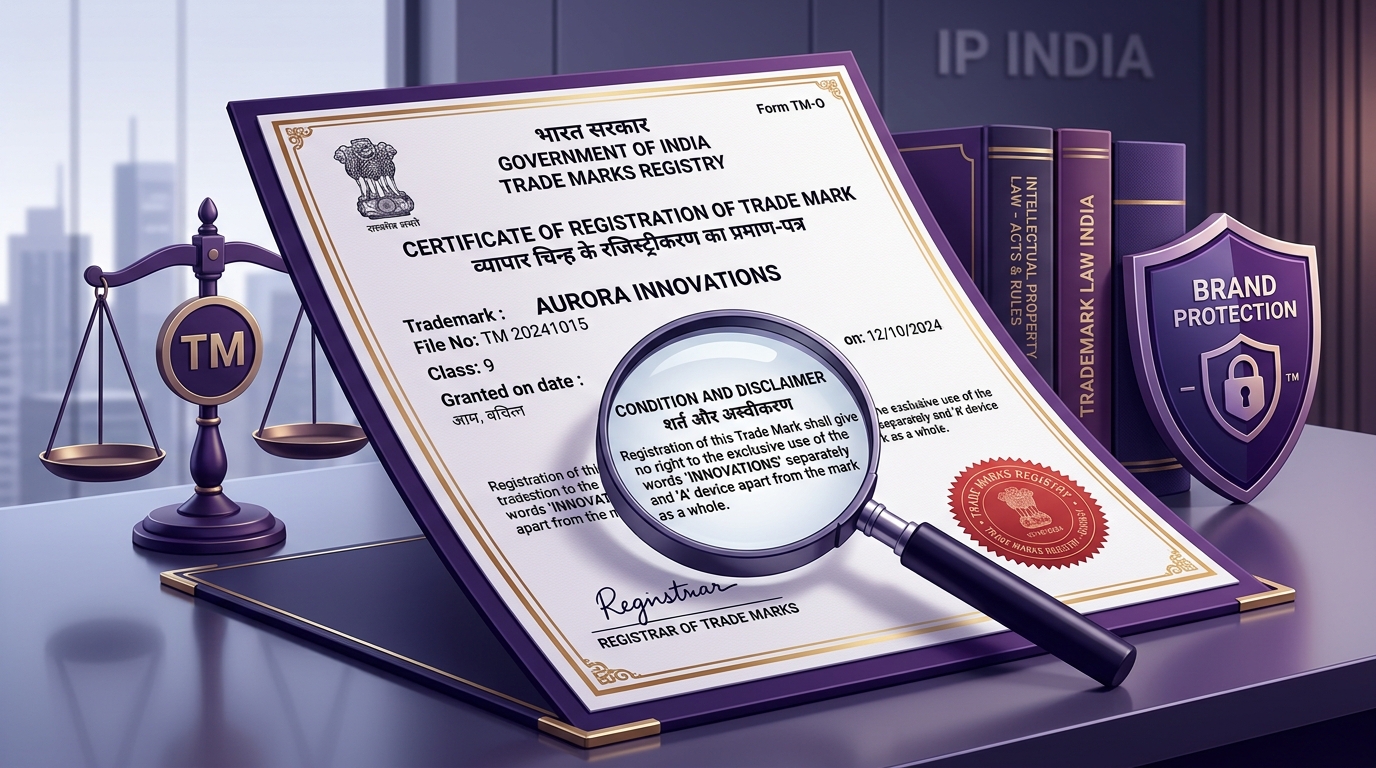
A trademark disclaimer is an official statutory condition entered by the Trade Marks Registry on your Trademark Registration Certificate (Form TM-RG). It expressly clarifies that the proprietor holds exclusive ownership over the combined trademarkas a whole, but claims no separate or standalone monopoly over non-distinctive, generic, descriptive, or common dictionary elements (such as “Pure”, “India”, “Herbal”, or “Tech”) contained within the composite logo or label.
Receiving your officialtrademark registration certificateis a landmark milestone for any business founder or enterprise. However, many trademark owners are surprised and concerned when they read the fine print in the box titled“Condition & Limitations”.
A typical entry reads:
Standard Certificate Disclaimer Condition
“Registration of this Trade Mark shall give no right to the exclusive use of the word(s) ‘ORGANIC CARE&rsquo. Separately and the device of ‘LEAF&rsquo. Apart from the mark as shown.&rdquo.
This condition doesnotmean your registration is defective, invalid, or inferior. Rather, it represents the delicate balance struck by the Trade Marks Act, 1999: granting commercial exclusivity to your brand’s distinctive identity while safeguarding the public domain so honest competitors can freely describe their own products.
Statutory Law: Section 17 & Section 28
To fully understand the legal scope of a disclaimer, one must examine the statutory foundation established under theTrade Marks Act, 1999:
Section 17(1): The Anti-Dissection Mandate
Section 17(1) enacts the fundamental rule of trademark law: When a trademark consists of several matters, its registration confers upon the proprietor the exclusive right to use the marktaken as a whole. You cannot isolate syllables or dissect the mark to claim exclusive ownership over fragments unless registered separately under Section 15.
Section 17(2): No Exclusivity in Descriptive Parts
Section 17(2) explicitly provides that where a trademark contains any matter that isnot registered separately, or contains matter that iscommon to the trade (publici juris)or is otherwise of anon-distinctive character, registration doesnotconfer exclusive rights in that individual part.
Section 28(2): Rights Subject to Certificate Conditions
While Section 28(1) gives you the exclusive statutory right to use the mark and obtain relief againsttrademark infringement, Section 28(2) makes this right strictlysubject to any conditions and limitations entered on the register.
Section 18(4) & Section 23: Registrar’s Discretion
The Registrar of Trade Marks is vested with wide statutory discretion under Section 18(4) and Section 23 to accept an application subject to conditions, amendments, modifications, or disclaimers as deemed appropriate to prevent unjust monopolies.
Why the Registrar Imposes Disclaimers
The Trade Marks Registry never imposes disclaimers arbitrarily. Disclaimers serve critical public policy purposes in commercial intellectual property:
Preventing Monopolies on Language
No single enterprise should monopolize ordinary English or vernacular words (such as “Fast”, “Pure”, “Super”, “Desi”, or “Royal”) that other honest businessmen require to describe their goods.
Preserving Geographical Names
Geographical indicators (such as “Himalaya”, “Delhi”, “Kashmir”, or “Bengal”) belong to the public domain. Disclaimers ensure multiple regional manufacturers can use origin names truthfully.
Protecting Generic Trade Terms
Terms common to an industry—such as “Pharma” for medicines, “Chai” for tea, or “Tech” for software—arepublici juris. Disclaimers prevent groundless infringement threats against legitimate traders.
Enabling Logo Approvals
Without disclaimers, composite labels containing descriptive taglines or common graphics would be summarily rejected under Section 9. Disclaimers allow composite marks to get registered.
Anti-Dissection Rule vs. Dominant Feature
In trademark litigation, Indian courts frequently address the tension between theAnti-Dissection Ruleand theDominant Feature Test. How does a disclaimer interact with these two judicial doctrines?
The Anti-Dissection Rule (*Whole Mark Rule*)
Under established jurisprudence (including the Supreme Court ruling inKaviraj Pandit Durga Dutt Sharma v. Navaratna Pharmaceutical Laboratories), a commercial trademark cannot be dissected into distinct elements for microscopic comparison. The average consumer of imperfect recollection perceives a brand as an integrated visual, phonetic, and commercial unit.
Therefore, even if your certificate contains a disclaimer on “SOLUTIONS”, another party cannot escape infringement if they copy your overall unique logo, identical color palette, distinctive font typography, and core coined prefix.
The Dominant Feature Rule (*South India Beverages Case*)
In the landmark judgmentSouth India Beverages Pvt. Ltd. V. General Mills Marketing Inc. (2014), the Delhi High Court Division Bench reconciled the Anti-Dissection Rule with practical commercial reality:
Practical Rule:If your mark is “AURORA INFORMATICS” with a disclaimer on “INFORMATICS”, “AURORA” is the distinctive dominant feature. A rival using “AURORA TECH” infringes your dominant mark, but a rival using “ZENITH INFORMATICS” does not!
Impact on Infringement vs. Passing Off
A crucial legal distinction lies betweenStatutory Infringement (Section 29)andCommon Law Passing Off (Section 27(2))when a disclaimer exists:
| Legal Dimension | Trademark Infringement (Sec 29) | Passing Off Remedy (Sec 27(2)) |
|---|---|---|
| Legal Source | Statutory Right under Trade Marks Act, 1999 | Common Law Right protecting goodwill & reputation |
| Effect of Disclaimer | Bars exclusivity over the disclaimed element. You cannot sue solely for use of that word. | No effect! Supreme Court held disclaimers do NOT affect common law passing off rights. |
| Landmark Precedent | Superon Schweisstechnik v. Prime Weld (2020) | Registrar of Trade Marks v. Ashok Chandra Rakhit (AIR 1955 SC 558) |
| Burden of Proof | Must prove deceptive similarity to the whole mark or dominant feature | Must prove prior use, commercial goodwill, deception, and likelihood of damage |
| Secondary Meaning Exception | Limited unless a fresh standalone registration is obtained | Extremely strong if extensive prior use associates the word with your business |
The Landmark “Shree” Ruling: Ashok Chandra Rakhit Case
InRegistrar of Trade Marks v. Ashok Chandra Rakhit Ltd. (1955), the Supreme Court of India established the definitive law on trademark disclaimers. The Court held that entering a disclaimer on the Register is an administrative measure to prevent false claims of statutory monopoly, butit does not destroy or diminish the proprietor’s common law rights. If the disclaimed word has acquired secondary meaning in the minds of consumers, the owner can still sue for passing off if a competitor attempts to deceive the trade.
Common Types of Disclaimers & Real Examples
The Trade Marks Registry enters several categories of conditions on registration certificates depending on the nature of the application:
Disclaimers on Descriptive & Laudatory Terms
Applied when a mark incorporates terms describing product attributes, quality, or ingredients (e.g., “Organic”, “Herbal”, “Pure”, “Fresh”, “Crisp”, “Super”, “Bio”).
Disclaimers on Geographical & Territorial Names
Applied when a logo includes city, state, or regional names (e.g., “Delhi”, “Mumbai”, “India”, “Himalayan”, “American”, “Kolkata”).
Disclaimers on Generic Artwork & Symbols
Applied when a label contains common industry graphics such as a green leaf for agricultural goods, a medical caduceus for clinics, a coffee cup for cafes, or a tooth icon for dental services.
Disclaimers on Single Letters & Numbers
Applied to standard single letters or general numerals (e.g., “24/7”, “100%”, “A1”, “360”, “99”) unless they possess verified stylized copyright distinctiveness.
How to Respond to Disclaimer Objections
During the trademark examination stage or during an officialtrademark hearing, an examiner or Hearing Officer may propose a disclaimer condition as a prerequisite for advertisement in the Trade Marks Journal.
How should you and your trademark attorney respond?
When to Accept the Disclaimer
- The disclaimed term is blatantly descriptive or generic to the industry.
- Your primary brand identity is an arbitrary coined word (e.g., “ZOMATO CAFE” disclaiming “CAFE”).
- Accepting the condition resolves examination objections immediately without costly appellate delays.
- Your composite logo gains full statutory registration across India.
When to Contest the Disclaimer
- The word is suggestive or arbitrary, not directly descriptive of the goods.
- You have established extensive prior commercial user backed by aUser Affidavit under Rule 25.
- The term has acquired immense secondary meaning and exclusive customer recognition.
- Accepting the disclaimer would leave the core essence of your word mark unprotected.
Removing Disclaimers in the Future:A disclaimer condition entered on a granted certificate cannot be removed retroactively via Form TM-M. If your brand grows and that particular word acquires standalone secondary distinctiveness, the correct statutory procedure is to file a fresh standaloneword mark applicationon Form TM-A with audited turnover certificates, advertising receipts, and nationwide user proof.
Frequently Asked Questions
Q.What does a trademark disclaimer mean on my registration certificate?
A trademark disclaimer is an official statutory condition entered by the Trade Marks Registry on your Trademark Registration Certificate (Form TM-RG). It expressly clarifies that the proprietor holds exclusive ownership over the combined trademark as a whole, but claims no separate or standalone monopoly over non-distinctive, generic, descriptive, or common dictionary elements (such as 'Organic', 'India', or 'Pure') contained within the composite logo or label.
Q.Does a disclaimer mean my entire trademark registration is weak or invalid?
No. A disclaimer does not weaken your overall registration. You still possess complete, exclusive nationwide rights over your brand name, composite artwork, unique color schemes, and distinctive layout as a combined whole. It simply prevents you from using the registration to bully honest competitors who use common dictionary or trade terms for describing their own goods.
Q.Can I sue a competitor for trademark infringement if they use my disclaimed word?
Under Section 17(2) and Section 28(2) of the Trade Marks Act, 1999, you cannot maintain a statutory trademark infringement lawsuit against a competitor solely because they used the disclaimed word or symbol. You can only succeed in an infringement claim if they copy your overall composite mark or replicate your non-disclaimed distinctive dominant features.
Q.Why did the Trade Marks Registry impose a disclaimer on my mark without my request?
Under Section 18(4) and Section 23 of the Trade Marks Act, the Registrar of Trade Marks exercises discretionary statutory power to balance private brand rights against the public interest. If an examiner notes that a trademark contains words that are common to the trade (publici juris) or purely laudatory, they impose a disclaimer condition during examination or show-cause hearing to prevent unlawful market monopolies.
Q.What is the difference between the Anti-Dissection Rule and a Disclaimer?
The Anti-Dissection Rule under Section 17(1) establishes that a composite trademark must be evaluated as a single, indivisible whole rather than broken into individual syllables or parts. A disclaimer operates under Section 17(2) as a statutory clarification, confirming that while the overall composite whole is protected, un-registered or generic individual parts do not confer independent exclusivity.
Q.Can I file a passing off lawsuit if my certificate contains a disclaimer?
Yes. As held by the Supreme Court of India in the landmark Registrar of Trade Marks v. Ashok Chandra Rakhit Ltd. Case, a disclaimer on the register affects only statutory infringement rights under the Trade Marks Act. It does not extinguish common law rights under Section 27(2). If a competitor deceives the public by copying your trade dress or commercial reputation, you can still file a common law passing off suit.
Q.Can I remove a disclaimer condition from my trademark certificate after registration?
Once entered on the register and issued on Form TM-RG, a disclaimer condition cannot simply be erased through an amendment. However, if that specific word or element acquires immense secondary meaning and distinctive brand recognition over years of continuous commercial use, you can file a fresh standalone trademark application on Form TM-A with a comprehensive User Affidavit under Rule 25.
Q.Should I accept a disclaimer during a trademark examination or show-cause hearing?
If the contested term is blatantly generic or descriptive (such as 'Ayurvedic', 'Super', or 'Dairy'), agreeing to a disclaimer is often a prudent legal strategy to secure fast registration of your composite logo without endless litigation. However, if the word is suggestive, arbitrary, or your primary distinctive brand identifier, you should instruct your trademark attorney to contest the condition with user evidence.
Trademark Disclaimer Action Checklist
When auditing your trademark registration certificate or formulating an enforcement campaign against infringers, follow this 7-point strategic checklist:
- Inspect Form TM-RG Certificate:Examine the “Condition & Limitations” column to identify any disclaimed words, graphics, or geographical terms.
- Identify Your Dominant Distinctive Mark:Isolate the non-disclaimed coined, arbitrary, or stylized element that serves as your primary brand identifier.
- Apply Whole Mark Evaluation:Evaluate competitor infringements against your composite label as an indivisible unit under Section 17(1).
- Avoid Groundless Legal Threats:Do not issue cease-and-desist notices against competitors purely for using the disclaimed generic word in a different logo format.
- Preserve Passing Off Evidence:Archive sales invoices, promotional expenditures, and social media engagement to support common law passing off claims under Section 27(2).
- Execute Multi-Mark Protection Strategy:Register separate word marks and standalone device marks under Section 15 to secure comprehensive protection.
- Maintain Decennial Renewal Docket:Ensure your registered trademark is renewed every 10 years by filingForm TM-Ron time.
Protect Your Brand with Precision
Need clarity on your Trademark Certificate conditions or facing infringement issues? Consult certified IP attorneys to evaluate your brand rights under Section 17 and enforce your intellectual property nationwide.
Certified IP Advocates • Supreme Court & High Court IPD Representation • 100% Confidential