
Written by Rahul Roy
Trademark Research Specialist
Overview: Foreign & NRI Trademark Filings
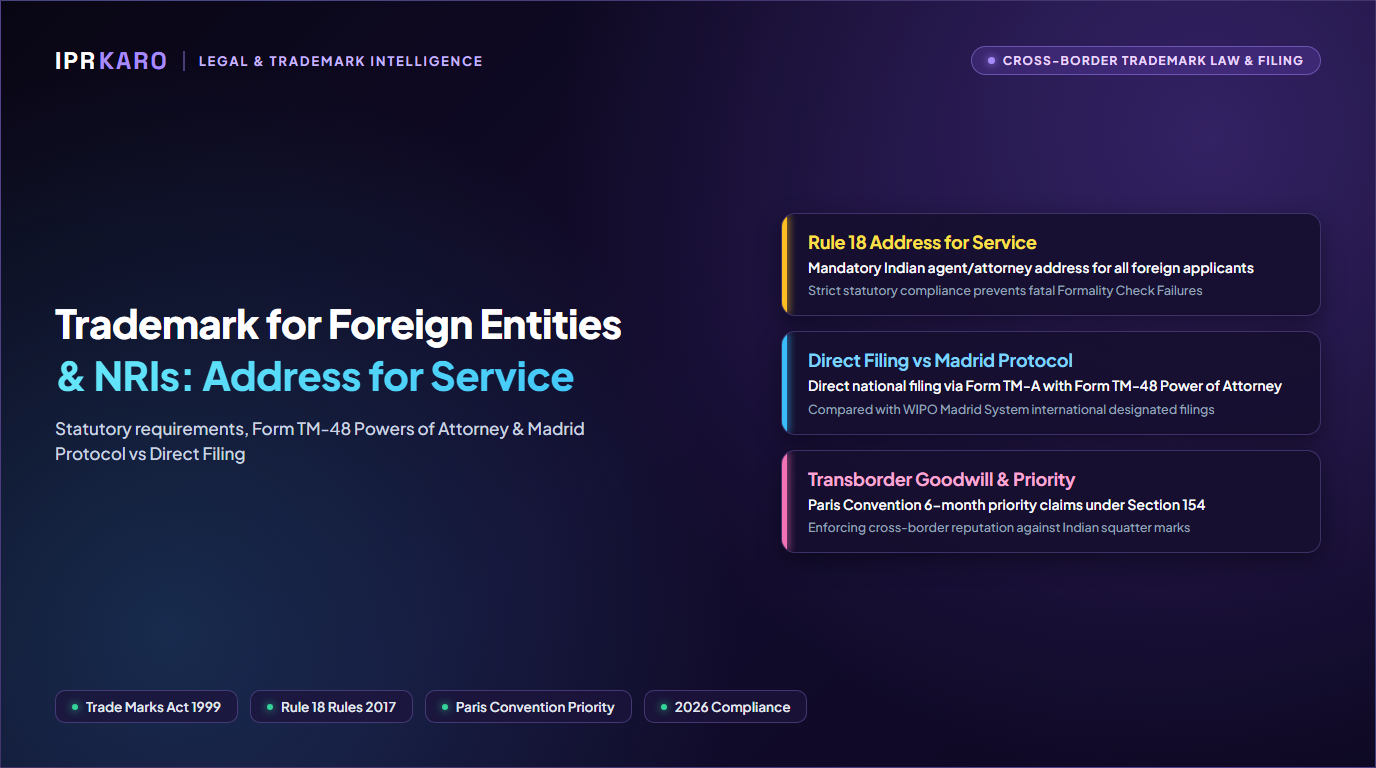
Under Section 18 of the Trade Marks Act, 1999 read with Rule 18 of the Trade Marks Rules, 2017, foreign companies, overseas corporations, and Non-Resident Indians (NRIs) who have no principal place of business in India are legally entitled to register trademarks in India, provided they furnish a mandatory “Address for Service in India”. This address—typically the registered office of an Indian trademark agent or advocate—is where all official notices, examination reports, hearing dates, and opposition proceedings are served. Foreign applicants can secure brand protection through Direct National Filing (Form TM-A via an authorized Indian attorney with Form TM-48 Power of Attorney) or through the Madrid Protocol (designating India under the Madrid System). Direct national filing provides greater speed, allows Paris Convention 6-month priority claims under Section 154, and ensures immediate local response handling for registry objections.
Entering the Indian market represents a massive commercial milestone for multinational corporations, cross-border e-commerce brands, SaaS technology companies, and diaspora-founded NRI enterprises. However, India operates under theterritoriality principleof trademark law. A trademark registered in the United States (USPTO), United Kingdom (UKIPO), European Union (EUIPO), Singapore, or the UAE conferszero automatic statutory protection in India.
Unprotected foreign brands face extreme vulnerability to predatory domain squatting, bad-faith trademark filings by local distributors, and counterfeiters flooding e-commerce marketplaces like Amazon India and Flipkart. Securing statutory brand rights through IP India is an indispensable prerequisite for launching operations or commercial distribution in India.
Explore essential cross-border procedural rules in our guides on Madrid Protocol international registration, Form TM-48 Power of Attorney rules, and who can apply for trademark in India.
Rule 18 Mandatory Address for Service
Rule 18 of the Trade Marks Rules, 2017 establishes the definitive statutory framework governing foreign applicants and NRIs:
Statutory Mandate under Rule 18(1) & 18(2)
“Every applicant or opponent, not having a principal place of business in India, shall furnish the Registrar with an address for service in India... And all applications, notices, summons, orders or other documents left at or sent by post to the address for service shall be deemed to be duly served.”
Why It Is Legally Essential
The Indian Trade Marks Registry does not transmit official notices or examination reports to overseas addresses. Having an authorized Indian attorney provide their official chambers/office address ensures all statutory deadlines are captured without delay.
Consequence of Omission
Filing an application without an Address for Service triggers an immediate “Formality Check Fail”. If unrectified within the statutory deadline, the Registry marks the application as “Abandoned” under Section 132.
Direct National Filing vs Madrid System
Foreign companies entering India have two primary legal routes to secure trademark registration:
Direct National Filing
Form TM-A via Indian Counsel- Faster Examination: Direct access to IP India e-filing portal; applications examined within 1–3 months.
- Direct Objection Handling: Immediate response filing for Section 9 & 11 objections by local litigators.
- No Central Attack Risk: Independent of the home country basic mark status.
- Paris Priority: Seamless 6-month priority claim under Section 154.
Madrid Protocol Designation
WIPO Form MM2 / Subsequent Designation- Centralized Filing: Single application at WIPO designating India alongside other jurisdictions.
- Currency Management: Statutory fees paid in Swiss Francs (CHF) through WIPO.
- Central Attack Vulnerability: If home mark fails within 5 years, Indian designation collapses.
- Local Counsel Still Required: Any Provisional Refusal in India requires appointing local Indian counsel.
Form TM-48 POA & Apostille Requirements
Form TM-48 is the statutory Power of Attorney required to authorize an Indian Trademark Agent or Advocate to represent a foreign entity before the Trade Marks Registry:
1. Corporate Execution & Signatory Authority
The TM-48 must be printed on company letterhead and executed by an authorized signatory (Director, Managing Partner, CEO, or Company Secretary). No corporate seal is mandatory, though recommended.
2. Notarization & Hague Apostille Convention
The signatory must sign the document before a local Notary Public in their home jurisdiction. For countries party to the Hague Apostille Convention (such as the US, UK, Germany, Australia, Japan, France), obtaining an Apostille certificate on the notarized POA ensures unquestioned legal validity in Indian courts and tribunals.
3. Non-Hague Countries & Consular Legalization
For non-Hague member nations (such as UAE, Qatar, Saudi Arabia, Singapore in certain matters), the notarized POA must be legalized by the Indian Embassy or Consulate in that country.
4. Stamping in India under State Stamp Acts
Once the original POA arrives in India, your Indian attorney gets the instrument stamped under the relevant State Stamp Act (e.g., Delhi, Maharashtra, or Haryana Stamp Act) within 3 months of its receipt in India.
Paris Convention 6-Month Priority Claims
India is a signatory to the Paris Convention for the Protection of Industrial Property and the WTO TRIPS Agreement. UnderSection 154 of the Trade Marks Act, 1999, foreign applicants enjoy statutory convention priority:
The Strict 6-Month Statutory Window
If a company files a trademark application in the United States, UK, EU, Singapore, Canada, or any other Paris Convention country onJanuary 1st, they can file an equivalent application in India anytime up toJuly 1st (within 6 months)and claim priority dating back to January 1st. Any local third party who filed a similar mark in India between January and July will be superseded and rejected under Section 11.
Priority Documentation Requirements
To substantiate a Section 154 priority claim in Form TM-A, the applicant must furnish aCertified Copy of the Priority Applicationissued by the home trademark registry (along with a certified English translation if the original document is in a foreign language) within 2 months of filing in India.
Transborder Reputation & Court Precedents
One of the most powerful legal doctrines in Indian trademark litigation is the recognition ofTransborder Goodwill and Spillover Reputation:
1. N.R. Dongre v. Whirlpool Corporation (1996) — Supreme Court of India
The Supreme Court held that Whirlpool had established transborder reputation in India through international magazines, advertisements, and worldwide brand presence, even though its washing machines were not actively sold in India due to import restrictions. The local squatter was restrained from using the mark.
2. Milmet Magna Pharma v. Allergan Inc. (2004) — Supreme Court of India
The Apex Court ruled that in medicinal and healthcare fields, a multinational corporation with prior worldwide use cannot be held hostage by a local Indian company copying their international brand name, upholding the first-in-the-world-market principle for global innovators.
3. Toyota Jidosha Kabushiki Kaisha v. Prius Auto Industries (2018) — Supreme Court
The Supreme Court reaffirmed the territoriality principle, clarifying that transborder reputation must be substantiated with concrete evidence proving that Indian consumers actually knew of the brand prior to the local defendant's adoption date. Proactive trademark filing remains the only fail-safe protection.
Documents Required for Foreign Entities
The documentary requirements for overseas corporations and Non-Resident Indians (NRIs) are straightforward and streamlined:
For Foreign Companies / Corporations
- Certificate of Incorporation / Business Registration Certificate.
- Form TM-48 Power of Attorney (notarized/apostilled).
- Full legal entity name, jurisdiction of incorporation & registered address.
- Clear high-resolution representation of the trademark (Word / Logo).
- Certified Priority Document (if claiming 6-month convention priority).
- User Affidavit under Rule 25 (if claiming prior use in India).
For Non-Resident Indians (NRIs)
- Copy of Passport (Indian passport or foreign passport with OCI card).
- Overseas residential address proof (utility bill / driving licence).
- Form TM-48 Power of Attorney authorizing Indian counsel.
- Mandatory Address for Service in India (provided by Indian attorney).
- User Affidavit (if claiming prior commercial use in India or globally).
Step-by-Step Indian Trademark Prosecution
The prosecution process for overseas applicants through an authorized Indian trademark attorney proceeds in 5 key phases:
Phase 1: Pre-Filing Clearance & Multi-Class Strategy
Conduct an exhaustive search on the IP India database to detect conflicting marks, phonetic similarities, or transliterations in Devanagari script across relevant Nice Classes.
Phase 2: Online E-Filing of Form TM-A with Priority Claim
Your Indian attorney files Form TM-A via the digital e-filing gateway, securing an instantaneous Trademark Application Number and statutory priority timestamp.
Phase 3: Examination & Written Response within 30 Days
The Examiner issues an Examination Report under Section 9 (absolute grounds) or Section 11 (relative grounds). Your Indian counsel files a formal legal reply within the strict 30-day statutory deadline.
Phase 4: Virtual Show-Cause Hearings
If the objection is maintained, the Registry schedules an online Video Conferencing (VC) hearing. Your Indian advocate presents oral arguments and judicial precedents before the Hearing Officer.
Phase 5: Journal Publication & Registration Certificate
The mark is advertised in the Trade Marks Journal for 4 months. If unopposed, the electronic Registration Certificate is issued under Section 23, valid for 10 years and renewable indefinitely.
Statutory Government Fee Structure
Statutory government fees prescribed by the First Schedule of Trade Marks Rules, 2017:
| Applicant Category | Official Govt Fee (INR) | Approx. USD ($) | Filing Mode |
|---|---|---|---|
| Foreign Corporate / Enterprise / LLP | ₹9,000 per class | ~$108 USD | Online E-filing (Form TM-A) |
| Individual NRI / Foreign Individual | ₹4,500 per class | ~$54 USD | Online E-filing (Form TM-A) |
| Foreign Startup / Small Enterprise (Eligible) | ₹4,500 per class | ~$54 USD | Online E-filing (with certificates) |
| Form TM-M (Adjournment / Extension) | ₹900 (Ind) / ₹1,800 (Corp) | ~$11 – $22 USD | Online E-filing |
Direct Filing vs Madrid Protocol Matrix
Comparison of key attributes between Direct Indian Filing and Madrid Protocol designation:
| Feature | Direct National Filing (Form TM-A) | Madrid Protocol (Designating India) |
|---|---|---|
| Speed of Examination | Fast (1–3 months) | Moderate (12–18 months) |
| Dependency on Home Mark | Completely independent | Vulnerable to Central Attack for 5 years |
| Objection Response Handling | Immediate by appointed Indian counsel | Requires belated appointment of local agent |
| Paris Convention Priority | Direct claim under Section 154 | Claimed at WIPO base filing |
| E-Commerce Brand Registry | Immediate TM Application number | Requires IRDI number & national indexing |
Frequently Asked Questions
Q.Can a foreign company or NRI register a trademark in India without an Indian office?
Yes. Foreign companies, overseas incorporated corporations, and Non-Resident Indians (NRIs) can register trademarks in India without having a physical branch or incorporated subsidiary in India. However, under Section 18 of the Trade Marks Act, 1999 and Rule 18 of the Trade Marks Rules, 2017, they must provide a mandatory 'Address for Service in India', which is typically provided by their authorized Indian trademark attorney.
Q.What is the 'Address for Service' requirement under Rule 18?
Rule 18 mandates that every trademark applicant whose principal place of business is outside India must furnish a valid postal address within India for service of all official communications. All examination reports, hearing notices, opposition notices, and official correspondence from the Trade Marks Registry are served at this address. Failure to provide a valid Address for Service leads to a Formality Check Fail and potential abandonment.
Q.Should a foreign enterprise choose Direct National Filing or the Madrid Protocol?
Direct National Filing (Form TM-A via an Indian attorney) is generally faster, allows immediate local handling of Section 9 and Section 11 examination objections, simplifies claiming Paris Convention 6-month priority, and prevents central attack vulnerabilities. The Madrid Protocol (designating India via WIPO Form MM2) is cost-effective when filing across multiple member nations simultaneously, but local Indian counsel is still required if the Indian Registry issues a Provisional Refusal.
Q.Does Form TM-48 (Power of Attorney) require notarization or apostille for foreign companies?
Form TM-48 executed by a foreign corporation must be signed by an authorized director/officer and notarized in the country of execution. If the country is a signatory to the Hague Apostille Convention, an Apostille certificate is recommended to avoid registry evidentiary requisitions. Non-Hague countries may require consular legalization. Once received in India, the POA is stamped in accordance with the local State Stamp Act.
Q.How does Paris Convention Priority work under Section 154 in India?
Under Section 154 of the Trade Marks Act, 1999, an applicant who has filed a trademark in any Paris Convention member country (or WTO member) can claim priority in India within 6 months from the initial foreign filing date. If granted, the Indian registration date retroactively matches the original foreign filing date, defeating intervening third-party applications.
Q.What is Transborder Reputation under Indian trademark law?
The Supreme Court of India recognizes the doctrine of 'Transborder Reputation' (established in N.R. Dongre v. Whirlpool and Milmet Magna, and refined in Toyota v. Prius). Under this doctrine, a foreign brand can prevent local copycats from passing off even before establishing physical sales in India, provided they prove that their global reputation and goodwill spilled over into India through international media, internet reach, travel, or global advertising.
Q.What are the government statutory fees for foreign trademark applicants in India?
The official IP India statutory e-filing fee for a foreign company / corporate applicant is ₹9,000 per mark, per class. For individual foreign proprietors or individual NRIs, the statutory fee is ₹4,500 per class. Foreign startups and MSMEs can claim the subsidized ₹4,500 fee if they provide verifiable equivalent qualification certificates recognized under bilateral or national guidelines.
Q.Can an NRI use their overseas passport and address while filing a trademark in India?
Yes. An NRI can file as an individual applicant using their overseas passport, foreign residential address, and nationality. However, they must appoint an authorized Indian Trademark Agent or Advocate to provide the mandatory Address for Service in India under Rule 18.
Strategic Cross-Border Trademark Advice
Expanding into India without securing national trademark rights leaves your brand exposed to opportunistic squatters, counterfeit imports, and non-negotiable distributor leverage. Under Rule 18 of the Trade Marks Rules, 2017, appointing an authorized Indian Trademark Agent or Advocate provides the mandatory Address for Service in India, ensuring seamless communication with the Trade Marks Registry and prompt defense of your intellectual property.
Whether filing directly via Form TM-A with Paris Convention priority or designating India under the Madrid Protocol, partnering with seasoned Indian IP litigators ensures fast registration and formidable brand protection. For related international business guidance, explore our guides on customs recordation of trademarks in India, deceptive similarity trademark test, and trademark coexistence agreements.
Register Foreign Trademark in India
Deploy registered Indian trademark attorneys to establish your mandatory Rule 18 Address for Service, execute Form TM-48 POA, and protect your brand across India.
Registered Trademark Attorneys • Rule 18 Address for Service • Paris Convention Priority • Pan-India