
Written by Rahul Roy
Trademark Research Specialist
Overview & The 60-Day Statutory Mandate
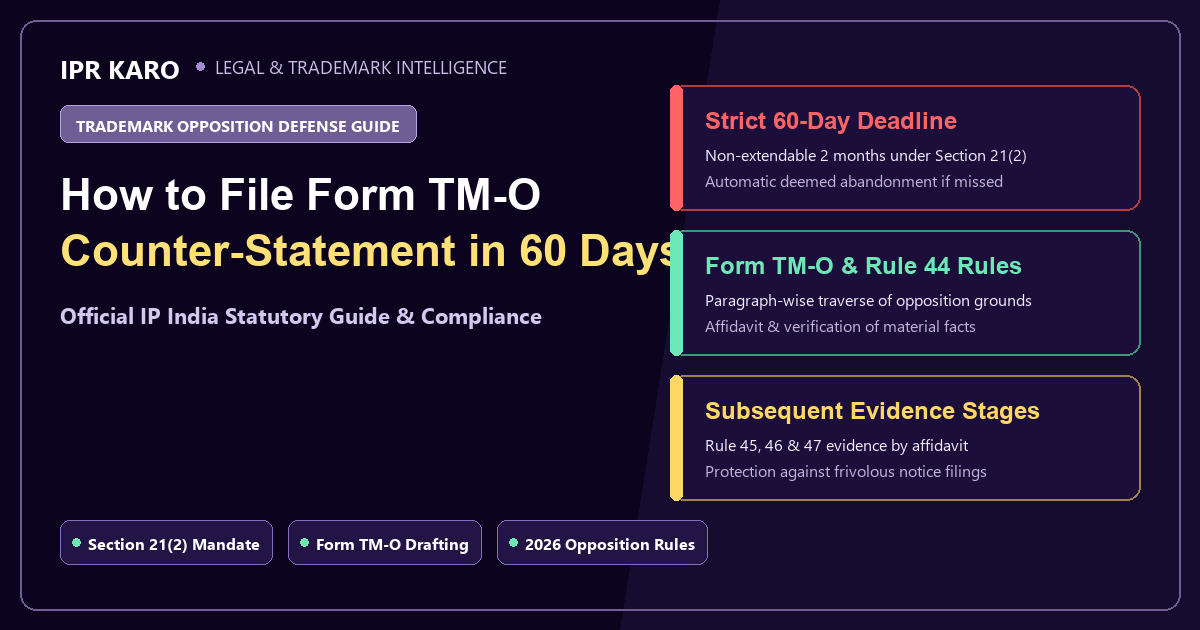
Under Section 21(2) of the Trade Marks Act, 1999, an applicant whose published mark is opposed has an unextendable statutory deadline of exactly two months from the receipt of the Notice of Opposition to file a Counter-Statement on Form TM-O. If the Counter-Statement is not filed within these two months, the application is deemed abandoned by operation of law. Neither the Registrar nor the courts have the discretionary power to condone delay under Section 131.
After clearing initial examination and being advertised in the Trade Marks Journal, an application enters a mandatory 4-month public opposition window under Section 21(1). If a competitor, prior registrant, or third party files a formal Notice of Opposition on Form TM-O, the Trade Marks Registry serves a copy on the applicant.
This service triggers the statutory defense mechanism. The applicant must file a paragraph-wise Counter-Statement traversing each ground raised by the opponent. Filing Form TM-O transitions the matter into an adversarial, inter-partes judicial proceeding where the applicant can assert superior rights, honest concurrent adoption, or distinct commercial markets.
Learn how opposition dynamics compare with other prosecution stages in our guides on Section 9 vs Section 11 grounds and Section 34 prior user rights.
Statutory Provisions: Section 21(2) & Rule 44
The legal foundation governing Counter-Statements in Indian trademark opposition consists of parliamentary statute and statutory procedural rules:
Section 21(2) of Trade Marks Act, 1999
“The Registrar shall serve a copy of the notice on the applicant for registration and, within two months from the receipt by the applicant of such copy of the notice of opposition, the applicant shall send to the Registrar in the prescribed manner a counter-statement of the grounds on which he relies for his application, and if he does not do so he shall be deemed to have abandoned his application.”
1. Rule 44(1) — Prescribed Form & Verifications
Rule 44(1) mandates that the Counter-Statement must be filed on Form TM-O within two months from the date of receipt of the copy of notice of opposition. It must set out the grounds upon which the applicant relies for their application and indicate what facts, if any, alleged in the notice of opposition are admitted by the applicant.
2. Rule 44(2) — Service on the Opponent
Under Rule 44(2), the applicant shall serve a copy of the Counter-Statement on the opponent within two months from the date of receipt of the notice of opposition and intimate the same to the Registrar.
3. Deemed Statutory Abandonment
The words “he shall be deemed to have abandoned his application” create an automatic statutory consequence. Unlike discretionary procedural delays, failure to file Form TM-O automatically extinguishes the pending application without requiring a separate show-cause hearing.
Why the 2-Month Deadline Cannot Be Extended
A frequent and catastrophic mistake made by applicants is assuming that the 2-month deadline to file a Counter-Statement can be extended by filing Form TM-M for extension of time under Section 131. This assumption is legally incorrect:
Section 131 Inapplicability
Section 131 permits the Registrar to extend time for procedural acts except where a time is expressly provided in the Act. Because Section 21(2) expressly fixes a two-month timeline with an explicit abandonment clause, Section 131 extension powers are legally barred.
Settled High Court Jurisprudence
The Delhi High Court in Sunrider Corporation v. Hindustan Lever Ltd. (2007) and subsequent rulings affirmed that the statutory period of two months for filing a counter-statement is mandatory, and the Registrar has zero discretion to condone delay.
Anatomy & Drafting of Form TM-O Counter-Statement
A professionally drafted Counter-Statement serves as the foundational legal pleading that protects your brand throughout subsequent evidence stages and final hearing arguments. It must contain four distinct structural sections:
1. Cause Title & Particulars of the Competing Marks
Specify the Application Number, Class, Opponent's Name, Opposition Number, Journal Number, and the details of both the Applicant and Opponent with complete addresses for service.
2. Preliminary Objections
Challenge the maintainability of the opposition on threshold legal grounds, including: lack of locus standi, suppression of material facts, frivolous delay tactics, estoppel, and acquiescence under Section 33.
3. Paragraph-Wise Traverse & Specific Denials
Address every single numbered paragraph of the opponent's Notice of Opposition. Avoid vague or evasive denials; specifically deny allegations of deceptive similarity under Section 11, bad faith under Section 18, and lack of distinctiveness under Section 9.
4. Affirmative Case & Rule 44 Verification
State the true adoption story of the mark, prior continuous commercial use under Section 34, bona fide honest concurrent use under Section 12, and conclude with a formal verification affirming that the statements are true to the applicant's knowledge and belief.
Step-by-Step E-Filing Guide on IP India Portal
Filing Form TM-O online requires seamless execution on the comprehensive IP India e-filing module:
Log in to IP India Comprehensive e-Filing Portal
Access the portal using a valid Class 3 Digital Signature Certificate (DSC) registered in the name of the Applicant or their authorized Trademark Agent / Attorney via Form TM-48 Power of Attorney.
Select Form TM-O > Counter-Statement
Navigate to New Application > Form TM-O > select ‘Counter-Statement to Notice of Opposition’. Enter the Trademark Application Number and Opposition Number to automatically populate case details.
Upload Digitally Signed Counter-Statement PDF
Upload the complete Counter-Statement document in searchable PDF format, ensuring it contains the signed legal verification and registered address for service in India.
Pay Statutory Fee & Serve Advance Copy on Opponent
Pay the government fee (₹2,700 for MSME/Individuals, ₹5,400 for Corporates) via payment gateway, download the official CBR acknowledgment receipt, and immediately serve a copy via registered post/email on the opponent's attorney under Rule 44(2).
Post-Filing Opposition Roadmap (Rules 45 to 50)
Filing Form TM-O is the initial defensive salvo. It activates the full procedural timeline of trademark opposition under the Trade Marks Rules, 2017:
Stage 1: Rule 45 — Opponent's Evidence in Support (2 Months)
Within 2 months of receiving your Counter-Statement, the opponent must file an Evidence Affidavit with supporting documents, or intimate that they waive evidence and rely on the notice. If the opponent fails to do either, the opposition is deemed abandoned!
Stage 2: Rule 46 — Applicant's Evidence in Support of Application (2 Months)
Within 2 months of receiving the opponent's Rule 45 evidence, the applicant must file an exhaustive User Affidavit with sales invoices, CA certificates, and marketing proofs proving prior use, reputation, and distinctiveness.
Stage 3: Rule 47 — Opponent's Evidence in Reply (1 Month)
The opponent is given 1 month to file evidence strictly confined to rebutting new matters raised in the applicant's Rule 46 evidence.
Stage 4: Rule 50 — Final Hearing & Registration Order
The Hearing Officer schedules an online video conference show-cause hearing. Both counsels present arguments, following which the Registrar either dismisses the opposition and issues the registration certificate, or upholds the opposition and refuses registration.
Top Preliminary Objections & Affirmative Defenses
When drafting your Counter-Statement, incorporate strategic statutory defenses to dismantle the opponent's case:
Prior Continuous User (Section 34)
If the applicant adopted and used the mark prior to the opponent's application or claimed use date, Section 34 protects the prior user from being restrained by a later registered proprietor.
Honest Concurrent Use (Section 12)
Even if similarity exists, Section 12 empowers the Registrar to permit concurrent registration of identical or similar marks where the applicant adopted the mark honestly and used it extensively without confusion.
Anti-Dissection Rule (Section 17)
If the opponent bases their opposition on a generic prefix, suffix, or descriptive term, invoke Section 17 to prove that marks must be compared in their entirety as composite wholes.
Disparity in Trade Channels & Goods
Demonstrate that although the marks exist in related classifications, the targeted consumers, pricing tiers, and commercial channels do not overlap, eliminating likelihood of confusion.
Opposition Fee Schedule & Statutory Timelines Table
The table below provides a quick reference guide to statutory forms, official fees, and non-extendable deadlines across the entire trademark opposition process:
| Opposition Stage | Statutory Form | Govt Fee (MSME/Individual) | Govt Fee (Others) | Statutory Deadline | Consequence of Default |
|---|---|---|---|---|---|
| Notice of Opposition | Form TM-O | ₹2,700 | ₹5,400 | 4 Months from Journal date | Mark proceeds to registration |
| Counter-Statement (Defense) | Form TM-O | ₹2,700 | ₹5,400 | Strict 2 Months (60 Days) | Deemed Abandonment of Application |
| Opponent Evidence (Rule 45) | Affidavit | Nil | Nil | 2 Months from Counter-Statement | Deemed Abandonment of Opposition |
| Applicant Evidence (Rule 46) | Affidavit | Nil | Nil | 2 Months from Rule 45 Evidence | Matter proceeds to hearing on record |
| Final Hearing (Rule 50) | Form TM-M (if adjourned) | ₹900 | ₹1,800 | As notified by Registry | Ex-parte dismissal or refusal |
5 Fatal Mistakes Leading to Trademark Abandonment
Thousands of valid trademarks are abandoned every year due to avoidable procedural oversights during opposition proceedings:
1. Confusing Calendar Months with 60 Days
Section 21(2) specifies two months from the date of receipt, which is calculated based on calendar months (e.g., received on March 15 → deadline is May 15). Miscalculating the date by even 24 hours causes irreversible abandonment.
2. Relying on General or Blanket Denials
Drafting a single generic line stating “all allegations are denied” is treated as evasive under Order VIII of the CPC and Rule 44. Specific, paragraph-wise traverse is mandatory to prevent admissions by implication.
3. Failure to Serve Advance Copy on Opponent
Filing Form TM-O on the portal without simultaneously serving a copy on the opponent's attorney creates procedural defect notices and delays the commencement of the opponent's Rule 45 evidence clock.
4. Filing Form TM-M Extension of Time
Attempting to buy time by filing Form TM-M under Section 131. The Registry routinely rejects such applications without hearing, leaving your mark deemed abandoned.
5. Outdated Address for Service on e-Portal
If your attorney changed or email address was inactive, notice of opposition served via official email is deemed legally served. Regularly monitor your trademark status online to avoid missing notices.
Frequently Asked Questions
Q.What is the exact deadline to file a Counter-Statement in trademark opposition?
Under Section 21(2) of the Trade Marks Act, 1999 read with Rule 44 of the Trade Marks Rules, 2017, the applicant must file the Counter-Statement on Form TM-O within exactly two months (approximately 60 days) from the date of receipt of the official Notice of Opposition from the Trade Marks Registry.
Q.Can the 2-month deadline for filing a Counter-Statement be extended under Section 131?
No. Unlike examination reply deadlines, the two-month deadline under Section 21(2) is a strict statutory limitation period. The Supreme Court and High Courts have consistently held that the Registrar of Trade Marks has no statutory power under Section 131 or Rule 109 to condone delays or extend time for filing a Counter-Statement. Missing the deadline results in irreversible statutory abandonment.
Q.What happens if an applicant fails to file Form TM-O within the 2-month period?
If the applicant fails to file the Counter-Statement within the statutory two-month timeline, Section 21(2) mandates that the trademark application shall be deemed to have been abandoned by operation of law. The Trade Marks Registry will update the application status to 'Abandoned', and the mark cannot be revived.
Q.What is the official government fee for filing Form TM-O for a Counter-Statement?
The statutory government fee for filing Form TM-O (Counter-Statement to Notice of Opposition) via the official IP India e-filing portal is ₹2,700 for Individuals, Startups, and MSMEs (UDYAM certificate holders). For other commercial entities and corporate bodies without MSME certification, the e-filing fee is ₹5,400 per class.
Q.How should the Counter-Statement be structured under Rule 44?
Under Rule 44, the Counter-Statement must contain: (1) An explicit statement of the grounds on which the applicant relies for their application, (2) Admission or specific denial of each material allegation contained in the Notice of Opposition, (3) Affirmative defenses (such as prior continuous use under Section 34, honest concurrent adoption under Section 12, or lack of similarity), and (4) A formal legal Verification signed and affirmed by the applicant or authorized attorney.
Q.What happens after the Counter-Statement is filed?
Once Form TM-O is filed, the Registry serves a copy on the Opponent. Under Rule 45, the Opponent has 2 months to either file an Affidavit in Support of Opposition (Evidence in Support) or intimate that they rely solely on the facts stated in their Notice of Opposition. If the Opponent fails to file evidence or intimation within 2 months, the opposition itself is deemed abandoned.
Q.What is the difference between an Examination Objection Reply and a Counter-Statement?
An Examination Objection Reply (under Section 9 or 11) is submitted to the Trademark Examiner during the internal ex-parte examination stage before journal publication. A Counter-Statement (Form TM-O) is a formal adversarial legal defense filed during inter-partes opposition proceedings before the Hearing Officer after a third party formally challenges your published mark.
Q.Do I need to attach evidence when filing Form TM-O Counter-Statement?
No. At the initial Form TM-O stage, you are only required to file the verified legal pleading (Counter-Statement) setting forth your grounds of defense and specific denials. Substantive documentary evidence (sales invoices, CA certificates, media coverage, advertising proof) is filed at the subsequent Rule 46 stage via a detailed Evidence Affidavit.
Strategic Trademark Opposition Defense Advisory
Trademark opposition is a formal trial before the Registrar of Trade Marks governed by statutory deadlines and evidentiary rules. The Counter-Statement sets the boundaries of your defense; any ground, prior use claim, or commercial distinction omitted in Form TM-O cannot be introduced later during evidence or final hearing.
Work with seasoned trademark litigators to review the notice of opposition, calculate statutory limitation periods, and draft an authoritative Form TM-O Counter-Statement that shifts the burden back to the opponent. For deeper insights into trademark enforcement and defense, review our guides on passing off vs trademark infringement, responding to legal notices, and trademark VC hearing procedure.
Defend Your Trademark Within 60 Days
Deploy senior IP litigators to draft and e-file your Form TM-O Counter-Statement, traverse opposition grounds, and prevent deemed statutory abandonment.
Registered Trademark Attorneys • 60-Day Section 21(2) Compliance • Paragraph-Wise Denial • Pan-India