
Written by Rahul Roy
Trademark Research Specialist
Overview of Franchise Trademark Licensing
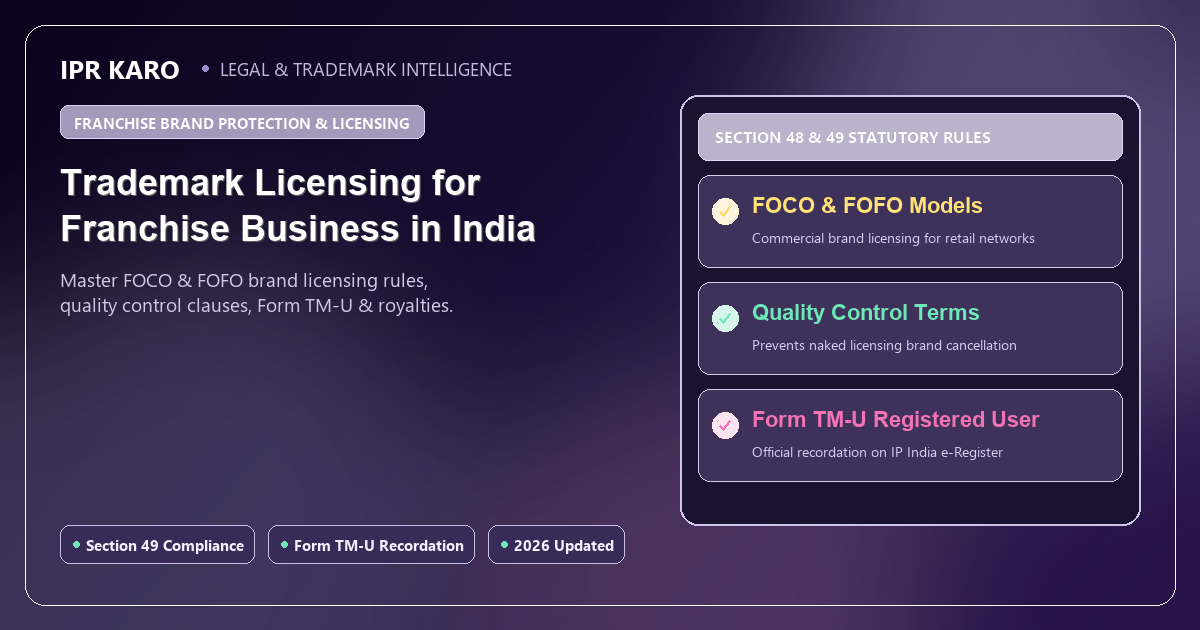
In India, trademark licensing in a franchise model grants the franchisee a conditional legal right to commercially use the franchisor's brand, logo, and trade dress while retaining 100% trademark title with the franchisor. Governed by Sections 48 and 49 of the Trade Marks Act, 1999, every valid agreement must mandate strict quality control to avoid "naked licensing" brand cancellation. Filing Form TM-U registers the franchisee as an official "Registered User" on the IP India e-Register, ensuring the franchisee's commercial use protects the mark from non-use cancellation under Section 47.
Franchising is the primary growth engine for India's food & beverage, retail, hospitality, education, and wellness sectors. Whether operating a Quick Service Restaurant (QSR) network, a fitness studio chain, or a salon franchise, the entire commercial value proposition hinges upon consumer trust in the registered brand name.
However, granting third-party business partners the authority to display your trademark without airtight contractual safeguards can result in catastrophic brand dilution, customer confusion, non-payment of royalties, and even judicial cancellation of your trademark. Understanding the legal difference between trademark assignment and licensing is vital—learn more in our guide on trademark assignment vs licensing in India.
Discover the statutory requirements, mandatory clauses, tax implications, and procedural steps to register your franchise brand on Form TM-U.
Section 48 and 49 Statutory Framework
The Trade Marks Act, 1999 contains clear statutory provisions establishing the rights, duties, and recordation of authorized users:
1. Section 48 (Registered Users & Permitted Use)
Section 48(1) permits a person other than the registered proprietor to be registered as a "Registered User." Crucially, Section 48(2) provides that "permitted use" of a trade mark by a registered user shall be deemed to be use by the proprietor himself for all statutory purposes, including defending against Section 47 non-use cancellation actions.
2. Section 49 (Form TM-U Application)
Section 49 dictates that the proprietor and the proposed registered user must apply jointly in writing to the Registrar on Form TM-U, accompanied by the written agreement and an affidavit disclosing the relationship, degree of quality control, goods/services covered, and license term.
3. Section 52 (Right of Registered User to Sue Infringers)
A recorded Registered User holds the statutory right under Section 52 to call upon the registered proprietor to institute legal proceedings against third-party infringers. If the proprietor refuses or neglects to do so within two months, the Registered User can institute the infringement suit in their own name.
FOCO vs FOFO Franchise Trademark Models
The structure of your trademark licensing agreement depends on the commercial operational format deployed in India:
| Operational Dimension | FOFO (Franchise Owned, Franchise Operated) | FOCO (Franchise Owned, Company Operated) |
|---|---|---|
| Store Operations & Staffing | Franchisee hires staff and manages daily store | Franchisor manages store operations directly |
| Trademark License Scope | Comprehensive license for commercial operations | Limited license tied to revenue-sharing entity |
| Quality Control Scrutiny | High risk: Requires strict audits, mystery shoppers & SOPs | Low risk: Direct operational oversight by brand |
| Brand Dilution Risk | Moderate to High if franchisee cuts quality corners | Minimal (Uniform corporate quality standards) |
| Form TM-U Recordation | Highly Recommended to prove permitted use | Recommended for financial compliance & tax clarity |
Quality Control and Naked Licensing Dangers
The single most perilous mistake franchisors make is executing a "naked license"—licensing a brand name without active and legally enforceable quality control provisions:
The Legal Danger of 'Naked Licensing'
Under Indian trademark jurisprudence, a trademark serves as a guarantee of consistent commercial quality. If a brand owner licenses their mark without actively monitoring or enforcing quality standards, the mark ceases to indicate origin. Courts view this as abandonment, paving the way for rivals to file trademark cancellation petitions under Section 57.
1. Mandatory Supplier Sourcing Covenants
Mandate that all raw materials, ingredients, store fixtures, and branded packaging must be procured exclusively from franchisor-approved vendors.
2. Unannounced Inspection & Audit Rights
Franchisor auditors must have express contractual rights to enter franchise premises unannounced to inspect hygiene, service quality, accounting software, and brand compliance.
3. Mandatory Staff Training & Certification
Franchisees and outlet managers must undergo continuous training programs and maintain compliance with standard operating procedure (SOP) manuals.
4. Immediate Termination for Quality Breaches
Any compromise on consumer safety, hygiene, or counterfeit ingredient substitution must trigger immediate suspension and contract termination without cure periods.
Essential Clauses in Franchise IP Agreements
Every professional Trademark Licensing Agreement for a franchise business must incorporate the following comprehensive clauses:
1. Scope of Grant & Territorial Exclusivity
Explicitly define whether the license is non-exclusive, sole, or exclusive within a defined geographic radius (e.g., 3-kilometer radius around the outlet) and restrict online sales if reserved for the parent brand.
2. Goodwill Accrual Exclusively to Franchisor
An unequivocal acknowledgment that all commercial goodwill, brand equity, and reputation generated by the franchisee's use vests solely and perpetually in the franchisor, preventing any equity claim by the franchisee upon exit.
3. Trade Dress & Interior Design Protection
Enforce strict adherence to store aesthetic layouts, interior colour palettes, staff uniforms, and menu typography under trade dress protection in India.
4. Post-Termination De-Branding Covenants
Impose a strict 7-day timeline for full de-branding upon contract expiry, including removal of signboards, return of confidential recipes, transfer of local Google Business listings, and a 2-year non-compete covenant within the territory.
Royalty Structures and Financial Terms
The financial framework of a franchise trademark licensing agreement must balance operational incentives with statutory tax compliance in India:
Upfront Franchise Fee
One-time, non-refundable onboarding fee covering territory reservation, initial training, site setup, and license activation.
Recurring Royalty
Monthly royalty calculated either as a percentage of gross sales (typically 4%-8%) or a fixed monthly floor amount.
Marketing Levy (MDF)
Brand development fund (1%-3% of revenue) pooled exclusively for national advertising, digital campaigns, and PR.
For detailed tax guidelines on GST rates, reverse charge mechanism (RCM), and TDS deductions on intellectual property royalties, review our comprehensive guide on GST, TDS and tax rules on trademark royalties in India.
Form TM-U Registered User Filing Process
To record a franchise licensee as an official Registered User under Section 49, follow this procedural roadmap on the IP India portal:
Execute Duly Stamped Licensing Agreement
Execute the agreement on state-compliant non-judicial stamp paper with full details of registered marks, classes, and quality control terms.
Draft Licensor Affidavit & Statement of Case
Prepare an affidavit affirmed by the licensor verifying the license terms, degree of franchisor inspection, and confirmation that the mark is valid.
Submit Joint Form TM-U on IP India Portal
File Form TM-U jointly listing the registered proprietor and registered user details, attaching the agreement, affidavit, and Form TM-48 Power of Attorney.
Pay Official Fee & Obtain Registered User Entry
Pay the statutory fee of ₹4,500 per mark per class. The Registrar publishes the entry in the Trade Marks Journal and issues the Registered User certificate.
Registered User vs Unregistered Licensee
Understanding the legal distinction between an unregistered licensee (common law contractual licensee) and a recorded Registered User under Section 49 is crucial:
| Legal Parameter | Registered User (Form TM-U Recorded) | Unregistered Licensee (Contract Only) |
|---|---|---|
| Statutory Recognition | Recognized under Section 49 on IP India e-Register | Private contract under Indian Contract Act 1872 |
| Right to Sue Infringers | Direct statutory right under Section 52 | Cannot sue independently under Trade Marks Act |
| Proof of Commercial Use | Conclusive proof of 'permitted use' u/s 48(2) | Requires extensive invoices to establish common law use |
| Third-Party Notice | Public notice through Trade Marks Journal | Confidential between contracting parties |
Stamp Duty and Registration Compliance
A trademark license agreement that is improperly stamped is legally inadmissible in court under Section 35 of the Indian Stamp Act, 1899:
1. State-Wise Stamp Duty Rates
In states like Maharashtra (Article 25/36), stamp duty is calculated as a percentage of total consideration or minimum fixed amounts. In Delhi and Karnataka, slab-based non-judicial stamp duty applies.
2. Impounding Risk for Under-Stamped Agreements
If a dispute arises and an under-stamped agreement is presented before a High Court or arbitrator, the document will be impounded, attracting a 10x penalty on the deficit stamp duty before proceedings can commence.
3. Notarization and Attestation
The licensing agreement should be signed by authorized signatories on each page and attested by a public notary to ensure evidentiary authenticity.
Landmark Judicial Rulings on IP Licensing
Indian courts have settled fundamental principles governing brand licensing and negative covenants in franchise contracts:
Gujarat Bottling Co. Ltd. v. Coca Cola Co. (1995) 5 SCC 545
The Supreme Court upheld negative covenants during the term of a trademark franchise license, ruling that a clause prohibiting a franchisee from manufacturing or selling competing beverages during the agreement does not violate Section 27 of the Indian Contract Act (restraint of trade) and is essential to protect brand integrity.
Rob Mathys Group v. Synthes AG (1997) PTC 669
The court established that licensing a trademark without exercising quality control destroys the distinctiveness of the mark, reducing it to a deceptive symbol and forfeiting statutory protection.
Bata India Ltd. v. Pyare Lal & Co. AIR 1985 All 242
The court ruled that brand goodwill created through authorized commercial licensees vests entirely in the brand owner, protecting well-known trademarks from misappropriation by local operators.
Frequently Asked Questions
Q.What is a Trademark Licensing Agreement in a franchise business?
A Trademark Licensing Agreement is a legally binding contract where the brand owner (Franchisor/Licensor) grants a franchisee (Licensee) the conditional, non-exclusive or exclusive legal right to use its registered brand name, logo, trade dress, and business format in exchange for upfront franchise fees and ongoing royalties.
Q.Is it mandatory to register a franchise licensee as a 'Registered User' on Form TM-U?
Under the Trade Marks Act, 1999, registration on Form TM-U is permissive rather than strictly mandatory. However, registering the franchisee as a 'Registered User' under Section 49 grants statutory recognition, enables the licensee to defend against infringers under Section 52, and creates irrebuttable proof of 'permitted use' defending against non-use cancellations under Section 47.
Q.What is 'Naked Licensing' and how does it endanger the franchisor's trademark?
'Naked licensing' occurs when a franchisor licenses their trademark to franchisees without maintaining active, verifiable quality control mechanisms. Under Indian law and common law doctrine, licensing without quality inspection dilutes distinctiveness, misleads the public, and exposes the trademark to cancellation under Section 57.
Q.What is the difference between FOCO and FOFO franchise models in trademark licensing?
In FOFO (Franchise Owned, Franchise Operated), the franchisee runs daily outlet operations, making rigorous trademark SOPs, brand audits, and training covenants crucial. In FOCO (Franchise Owned, Company Operated), the franchisor manages operations directly, retaining direct operational quality control while licensing the brand to the outlet entity.
Q.What documents and details are required to file Form TM-U with IP India?
Filing Form TM-U requires: (1) Duly stamped and executed Trademark License / Franchise Agreement, (2) An affidavit by the licensor confirming relationship terms, degree of quality control, goods/services covered, and license duration, (3) Prescribed official fee of ₹4,500 per mark per class, and (4) Form TM-48 Power of Attorney.
Q.How should royalties and franchise fees be structured in the agreement?
The agreement should define: (1) Upfront non-refundable franchise onboarding fee, (2) Recurring monthly royalty (either a fixed amount or 4%-10% of gross revenue/turnover), (3) Marketing/brand development fund contribution (typically 1%-3%), (4) GST applicability (18% under SAC 997331), and (5) Strict interest penalties for late payments.
Q.What happens to the franchisee's brand rights upon contract termination?
Upon termination or non-renewal, the franchisee's license immediately ceases. The contract must mandate immediate de-branding within 7 to 14 days, removal of all signboards, destruction or handover of branded packaging, cessation of social media accounts, and strict adherence to post-term non-compete covenants.
Q.What is the stamp duty requirement for a Trademark Franchise Agreement in India?
Stamp duty on trademark license agreements is governed by respective State Stamp Acts. For instance, in Maharashtra under Article 25/36, stamp duty is levied on the total royalty/consideration, while Delhi and Karnataka have specific slab-based stamp duties. Non-stamping or under-stamping renders the agreement inadmissible in Indian courts under Section 35 of the Indian Stamp Act.
Strategic Brand Protection for Franchisors
Expanding a franchise brand in India offers explosive growth potential, but scaling without a customized Trademark Licensing Agreement exposes your enterprise to operational disruption and brand dilution. Always include rigorous quality control mechanisms, execute state-compliant stamped documents, and record major franchise partners as Registered Users on Form TM-U.
Collaborate with veteran franchise IP attorneys to draft customized licensing contracts and protect your brand equity. For related commercial IP strategies, review our guides on responding to trademark infringement notices, anti-counterfeiting police raids under Section 115, and how to get well-known trademark status.
Protect Your Franchise Brand Today
Deploy expert franchise IP attorneys to draft airtight licensing agreements, incorporate quality audit clauses, and record Registered Users on Form TM-U.
Section 48 & 49 Compliance • Quality Control Audits • Form TM-U Recordation • Pan-India