
Written byRahul Roy
Trademark Research Specialist
Overview of Geographical Trademarks
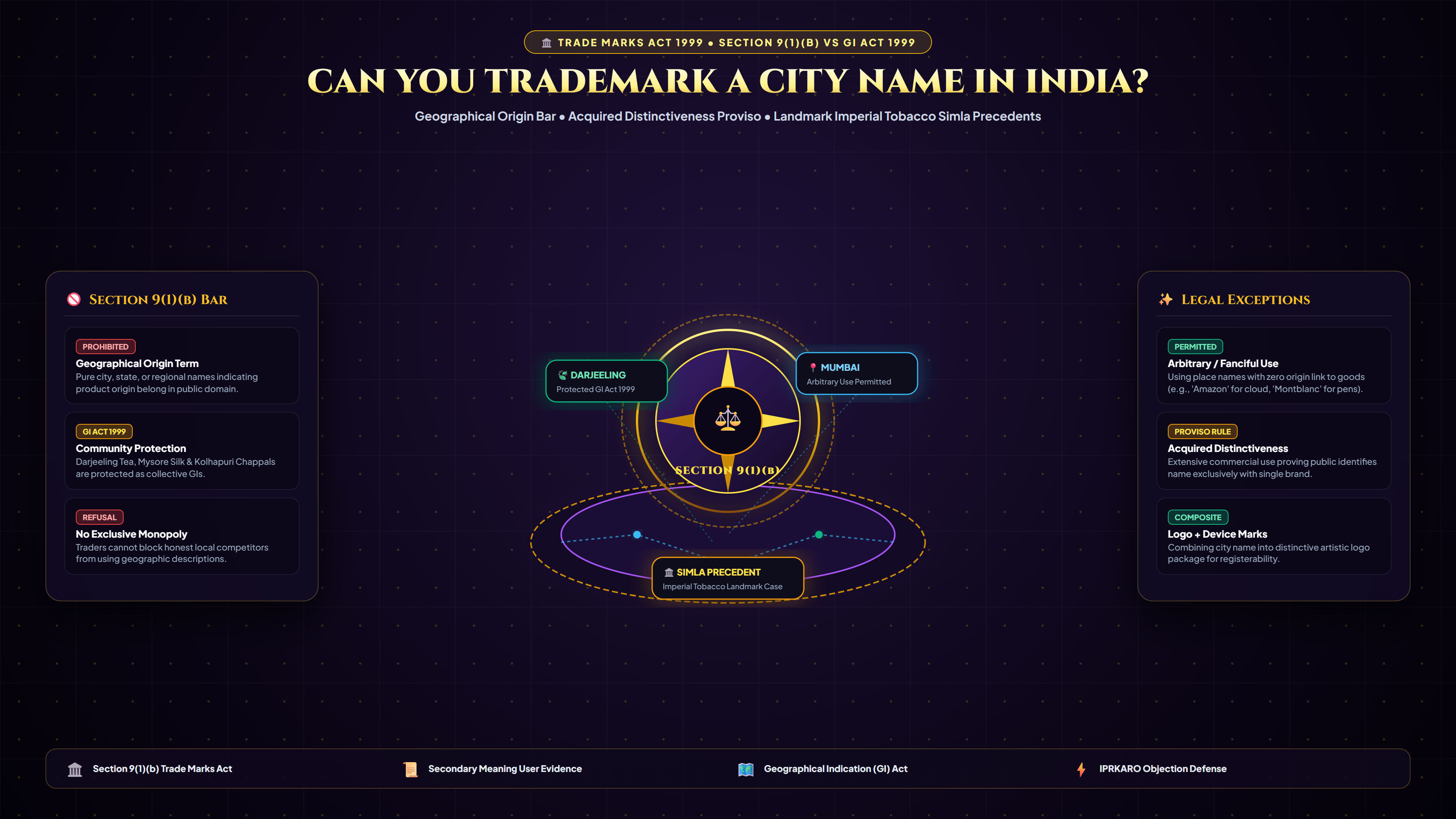
Under Section 9(1)(b) of the Trade Marks Act, 1999, you cannot register a standalone city, state, country, or geographical name as a trademark if it indicates the geographical origin of the goods or services. However, geographical names can be registered in India if: (1) the name is used arbitrarily with no geographical connection to the product (e.g., “Amazon&rdquo. For retail or “Patagonia&rdquo. For apparel), (2) the mark has acquired proven secondary meaning and distinctiveness through long continuous commercial sales under the Section 9 proviso, or (3) the mark is filed as a distinctive composite device logo with a statutory disclaimer on the geographical term.
Founders frequently draw inspiration from geographical landmarks, historic capitals, and regional identities when naming their commercial brands. Whether launching “Kashmir Organic Walnuts”, “Jaipur Royal Jewels”, “Mysore Silk Crafts”, or “Calcutta Sweets”, trademark applicants routinely run into severe examination objections from the Trade Marks Registry.
The fundamental purpose of trademark law is to indicate commercial source—identifying that a product originates from one particular company rather than a physical territory. Granting an exclusive commercial monopoly over a city or region would unfairly prevent honest local businesses from describing where their products are manufactured.
Understanding the statutory prohibitions of Section 9(1)(b), the doctrine of acquired distinctiveness, and the distinction between individual trademarks and collective Geographical Indications (GIs) is vital for brand protection. Review our related guides onabsolute grounds for trademark rejectionandtrademark disclaimers and conditions.
Section 9(1)(b) Statutory Mandate
Section 9(1)(b) of the Trade Marks Act, 1999 establishes an absolute ground for the refusal of trademark registration:
“Section 9(1) — The trade marks—
(b) which consist exclusively of marks or indications which may serve in trade to designate the kind, quality, quantity, intended purpose, values, geographical origin or the time of production of the goods or of rendering of the service or other characteristics of goods or services,
shall not be registered.”
Under this provision, the Trade Marks Examiner issues an official Examination Report objecting to the mark if the name consists exclusively of a geographical location. The statutory test hinges on whether the public or competitors would reasonably perceive the word as describing where the goods are cultivated, manufactured, or traded.
Why Place Names Belong in Public Domain
The legal prohibition against monopolizing geographical names is anchored in three foundational IP doctrines:
Protection of Honest Trade
Traders operating in a specific city (e.g., brass artisans in Moradabad or leather tanners in Kanpur) have a legitimate commercial right to state their geographical location on invoices, packaging, and advertising.
Preventing Consumer Deception
If an enterprise uses a renowned place name (e.g., “Kashmiri Saffron”) for products grown in Maharashtra, it misleads buyers regarding the authenticity, climate, and soil characteristics of the goods.
Preserving Public Commons
Names of sovereign states, capital cities, pilgrimage towns, and natural rivers are collective national heritage and cannot be privatized by a single corporate entity.
The Proviso: Secondary Meaning Defense
The statutory bar under Section 9(1)(b) is not insurmountable. TheProviso to Section 9(1)creates an explicit statutory exception:
Section 9(1) Statutory Proviso
“Provided that a trade mark shall not be refused registration, if before the date of application for registration it has in fact acquired a distinctive character as a result of the use made of it or is a well-known trade mark.”
Under this proviso, if an applicant can prove that through continuous, extensive, and long-standing commercial exploitation, the relevant purchasing public no longer identifies the word with the geographical territory, but exclusively identifies it with the applicant's enterprise, the mark is deemed to have acquiredSecondary Meaning.
For example, while “Bikanervala&rdquo. Contains the geographical name Bikaner, its nationwide restaurant chain and continuous usage since 1905 established overwhelming secondary meaning. This enables successful trademark protection across food classes.
Bare vs Arbitrary & Composite Marks
Indian trademark jurisprudence categorizes geographical name applications into three distinct legal classes:
1. Bare Descriptive Geographical Marks (Strictly Prohibited)
Applying for a plain word mark of a geographical location for goods directly originating from or famous in that location (e.g., “Agra&rdquo. For Petha, “Nagpur&rdquo. For Oranges, “Surat&rdquo. For Diamonds, or “Banaras&rdquo. For Sarees). These applications face immediate refusal under Section 9(1)(b) because no single trader can privatize descriptive origin markers.
2. Arbitrary / Fanciful Geographical Marks (Permissible)
When a geographical name is used on goods that haveno geographical connection or historical associationwith that location, the name is arbitrary and inherently distinctive. Classic examples include:
- Amazon:Geographical river/forest used for an e-commerce platform.
- Montblanc:Highest Alpine peak used for luxury writing instruments.
- Patagonia:South American region used for outdoor apparel.
- Boston Scientific:American city used for specialized cardiovascular catheters.
3. Composite Device Marks with Disclaimers (Widely Accepted)
Combining a geographical name with distinctive graphic devices, logos, crests, stylized typography, or unique prefix/suffix words (e.g., “Jaipur Jewels” inside a distinctive royal crest logo). The Registry accepts such applications by entering a statutory disclaimer under Section 18(4) disclaiming exclusive proprietary rights over the standalone geographical word.
Trademark vs Geographical Indication (GI)
A critical legal distinction exists between individual Trademarks under the Trade Marks Act, 1999 and registered Geographical Indications under theGeographical Indications of Goods (Registration and Protection) Act, 1999:
| Comparison Parameter | Trademark (TM Act 1999) | Geographical Indication (GI Act 1999) |
|---|---|---|
| Right Ownership | Private individual, company, or single legal entity | Collective public right owned by an entire community/association |
| Primary Purpose | Identifies commercial source and distinguishes brand origin | Identifies goods originating in a specific territory with unique regional qualities |
| Link to Geography | Geography is prohibited unless secondary meaning or arbitrary use exists | Geographical territory is mandatory; qualities must stem from soil/climate/craft |
| Assignability & Licensing | Freely assignable, licensable, and transferable under Section 37/45 | Strictly non-assignable and non-transferable (Section 24 GI Act) |
| Statutory Conflict Rule | Cannot register a recognized GI as an individual private trademark | Section 25 GI Act invalidates conflicting subsequent trademarks |
| Representative Examples | Tata, Infosys, Bikanervala, Amul, Raymond | Darjeeling Tea, Kanchipuram Silk, Kolhapuri Chappal, Alphonso Mango |
Landmark Judicial Precedents on Geographical Trademarks
Indian High Courts and the Supreme Court have developed a rich body of jurisprudence regarding geographical trademarks:
Imperial Tobacco Co. of India v. Registrar of Trade Marks (AIR 1977 Cal 413)
Simla CaseThe Dispute:Imperial Tobacco sought to register the word mark “SIMLA” for cigarettes with a snow-capped mountain label. The Registrar refused under Section 9, holding Simla to be a well-known hill city.
Ruling:The Calcutta High Court affirmed the refusal. The Court ruled that a geographical name with well-known topographical identity cannot be registered as an ordinary word mark without conclusive, overwhelming proof of acquired distinctiveness displacing its primary geographical meaning at the time of application.
Bikanervala v. Aggarwal Bikanervala (Delhi High Court)
Secondary MeaningThe Dispute:The plaintiff registered “Bikanervala” for sweets and savouries and sued a competitor using an identical geographical business name.
Ruling:The Delhi High Court held that continuous, extensive commercial use spanning several decades had vested the geographical term “Bikanervala&rdquo. With strong secondary meaning. This grants the proprietor proprietary rights to restrain deceptively similar commercial use.
London Dairy vs Londonderry (Bombay High Court)
Foreign LocationThe Dispute:Conflict between premium ice cream brand “London Dairy” and confectionery brand “Londonderry” regarding phonetics and geographical associations.
Ruling:The Bombay High Court emphasized that foreign city names or regional references used in commercial branding must be evaluated based on the perception of the average Indian consumer and whether the public associates the goods with the foreign territory.
Acquired Distinctiveness Evidence Dossier
To successfully invoke the Section 9(1) Proviso before the Trade Marks Hearing Officer, your legal dossier should compile:
Chartered Accountant Certified Turnover Certificate
Year-wise audited revenue figures under the brand name spanning at least 5 to 10 years.
Multi-State Commercial Tax Invoices
GST tax invoices demonstrating pan-India sales distribution and commercial presence across diverse states.
Promotional & Advertising Expenditure Proofs
Invoices for TV commercials, digital marketing, hoardings, print ads, and influencer campaigns.
Independent Market & Consumer Surveys
Empirical evidence showing consumers identify the term exclusively with your enterprise.
Geographical Brand Clearance Matrix
Evaluate your proposed brand name against the Indian Trade Marks Registry clearance matrix:
| Brand Name Scenario | Section 9(1)(b) Risk Level | Recommended Registration Strategy |
|---|---|---|
| “Banaras Sarees” for Silk Garments | Extreme (100% Refusal) | Conflict with GI Act & Section 9(1)(b). Must rebrand or create distinctive composite logo with heavy disclaimer. |
| “Jaipur Royal Living” for Furniture | Moderate (Objection Likely) | File as Device Mark with artistic logo. Agree to disclaimer on “Jaipur” under Section 18(4). |
| “Amazon” for E-Commerce / Cloud | Low (Permissible) | Arbitrary use. Geographical location has no association with computer software or internet retail. |
| “Bikanervala” (Established 50+ Yrs) | Low (Overcome via Proviso) | Submit Rule 25 User Affidavit with multi-crore turnover establishing nationwide secondary meaning. |
7-Step Roadmap to Register a Geographical Brand
Follow this systematic legal roadmap to successfully secure trademark registration for a brand containing geographical elements:
Search & Geographical Link Analysis
Conduct public search on the IP India portal. Evaluate whether the location is historically or commercially linked to the designated goods.
Verify Non-Conflict with GI Registry
Cross-reference the official Geographical Indications Registry at Chennai to ensure no registered GI exists for that product category.
Design a Distinctive Composite Device
Instead of a bare word mark, design a distinct logo with stylized typography, graphic crests, and unique color schemes.
Compile Prior Use Evidence Dossier
Gather CA turnover certificates, tax invoices, media coverage, and advertisement expenses to substantiate prior commercial use.
Draft & File User Affidavit under Rule 25
Execute an affidavit on non-judicial stamp paper stating the exact date of continuous commercial use across India.
Respond to Section 9(1)(b) Objection
Submit a comprehensive legal response citing Imperial Tobacco, Bikanervala, and arbitrary usage doctrines within 30 days.
Accept Disclaimer & Obtain Grant Certificate
Accept a Section 18(4) disclaimer condition during the show cause hearing to secure journal advertisement and final registration.
Frequently Asked Questions
Q.Can I register a city or state name as a trademark in India?
As a general rule under Section 9(1)(b) of the Trade Marks Act, 1999, bare geographical names (such as Mumbai, Kashmir, or Gujarat) cannot be registered if they serve to designate the geographical origin of the goods or services. However, registration is permissible if: (1) the geographical name is used arbitrarily for unrelated goods with no geographical association (e.g., 'Amazon' for e-commerce or 'Montblanc' for pens), (2) the brand has acquired extensive 'secondary meaning' through continuous long-standing commercial use under the Section 9 proviso, or (3) it is filed as a stylized composite device mark with a disclaimer on the place name.
Q.What is the absolute ground of refusal under Section 9(1)(b)?
Section 9(1)(b) prohibits registration of trade marks that consist exclusively of marks or indications which may serve in trade to designate the kind, quality, quantity, intended purpose, values, geographical origin, or the time of production of the goods or rendering of the service. This ensures geographical names remain in the public domain so local enterprises can honestly describe the origin of their products.
Q.How do you prove 'acquired distinctiveness' for a geographical mark?
Under the Proviso to Section 9(1), an applicant must submit a User Affidavit under Rule 25 supported by documentary evidence: (1) Chartered Accountant certified annual sales turnover certificates spanning several years, (2) pan-India advertising and marketing invoices, (3) continuous tax invoices showing sales across multiple states, (4) sample packaging, promotional materials, and media coverage, and (5) consumer association surveys proving the public associates the name exclusively with the applicant rather than the physical location.
Q.What is the difference between a Trademark and a Geographical Indication (GI)?
A Trademark is a private proprietary right owned by a single individual, company, or entity to distinguish its commercial goods/services from competitors. A Geographical Indication (GI) under the GI Act, 1999 is a collective public right granted to an entire community of producers in a specific region where the product's quality, reputation, or characteristics are strictly attributable to its geographical origin (e.g., Darjeeling Tea, Kanchipuram Silk, Kolhapuri Chappal). A GI can never be monopolized as an individual trademark.
Q.What happened in the landmark Simla Cigarettes case (Imperial Tobacco)?
In Imperial Tobacco Co. Of India Ltd. V. Registrar of Trade Marks (AIR 1977 Cal 413), the Calcutta High Court refused trademark registration for 'Simla' regarding cigarettes. The Court held that Simla was a prominent, well-known hill station and capital city. Because the word was primarily geographical and lacked overwhelming acquired distinctiveness at the date of application, no single manufacturer could claim a commercial monopoly over it.
Q.Can I register a composite logo containing a city name?
Yes. While a standalone word mark for a city name is strictly scrutinized, applicants can successfully register composite device marks or logo marks that incorporate unique graphic crests, distinct color combinations, typography, and additional brand elements. In such cases, the Trade Marks Registry usually imposes a statutory condition or disclaimer under Section 18(4) stating that the registration grants no exclusive right to the standalone geographical name.
Q.Can foreign city or country names be registered as trademarks in India?
Foreign geographical names can be registered in India if they are used arbitrarily and the Indian purchasing public does not associate that foreign location with the specific goods (e.g., 'Boston Scientific' for medical devices or 'Manhattan' for fashion apparel). However, if the foreign region is globally renowned for specific goods (e.g., 'Champagne' or 'Swiss' for watches), registration is prohibited under Section 9(1)(b) and international treaties.
Q.How do I reply to a Section 9(1)(b) geographical objection from the Registry?
To overcome a Section 9(1)(b) objection, your IP attorney must file a comprehensive written response within 30 days: (1) establishing that the mark is fanciful/arbitrary with no geographical link to the goods, (2) demonstrating that the goods are not produced in that region and the public is not deceived, (3) submitting a Section 9 user affidavit with audited sales turnover proving secondary meaning, or (4) offering a voluntary disclaimer on the geographical term while protecting the distinct composite device mark.
Strategic Geographical Trademark Counsel
Securing trademark protection for a brand containing geographical terms requires meticulous clearance search, creative brand structuring, and robust evidentiary proof. Relying on an unprepared word mark application often triggers avoidable Section 9(1)(b) refusals and prolonged Registry litigation.
Partner with experienced trademark attorneys at IPR Karo to conduct pre-filing clearance searches, structure arbitrary or composite logo applications, draft bulletproof Rule 25 user affidavits, and represent your brand during Registry show cause hearings. For further strategic guidance, explore our analyses onprior user rights under Section 34,word mark vs device mark strategies, andtrademark hearing procedures.
Register Your Geographical Brand with Legal Certainty
Deploy expert trademark advocates to structure composite marks, overcome Section 9(1)(b) objections, draft user affidavits, and secure proprietary brand ownership.
Registered IP Attorneys • Section 9 Proviso Evidentiary Dossiers • Pan-India Show Cause Hearings