
Written by Rahul Roy
Commercial IP Litigation Specialist
Overview of Trademark Monetary Relief
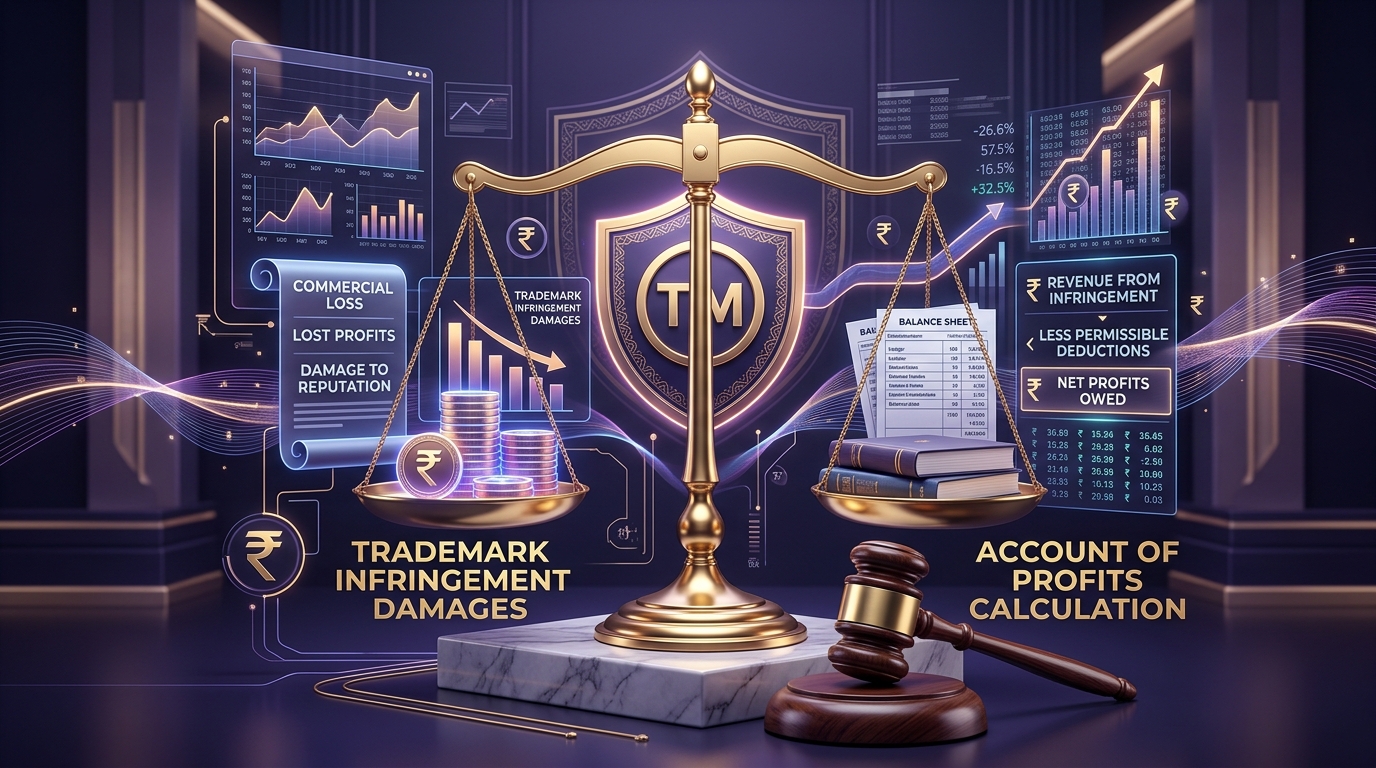
In Indian trademark litigation, monetary relief is governed by Section 135(1) of the Trade Marks Act, 1999. A successful plaintiff is entitled to an injunction together with either: (1) Compensatory Damages (reimbursing the plaintiff for actual losses suffered such as diverted sales, brand dilution, and price erosion), OR (2) An Account of Profits (compelling the defendant to surrender all net commercial profits earned from the infringing goods). Additionally, Indian High Courts routinely award Punitive and Exemplary Damages under the landmark 5-tier financial matrix established in Philips v. Amazestore (2019), along with actual legal costs under Section 35 of the amended Commercial Courts Act, 2015.
For decades, intellectual property litigation in India was viewed primarily as a battle for injunctive relief. Infringers frequently treated ex-parte injunctions as a mere pause button, liquidating clandestine inventory through parallel distribution networks and opening new storefronts with impunity. However, the operationalization of theCommercial Courts Act, 2015and the progressive jurisprudence of theDelhi High CourtandBombay High Courthave revolutionized monetary enforcement.
Today, trademark infringement suits represent high-stakes commercial actions where multi-crore damages and criminal asset freezes strip counterfeiters of their unlawful profits. Brand owners who understand how to quantify damages, leverage forensic accounting, and secure ex-parte local commissioners can transform intellectual property protection from a defensive legal expenditure into an aggressive revenue-recovery strategy.
To understand how statutory infringement claims differ from common law passing off actions, review our detailed guide on passing off vs trademark infringement in India and our breakdown of how to stop trademark infringement effectively.
Section 135 Statutory Relief Framework
Section 135 of the Trade Marks Act, 1999 defines the full spectrum of civil remedies available to an aggrieved trademark proprietor or registered user in a suit for infringement or passing off:
“135. Relief in suits for infringement or for passing off.—(1) The relief which a court may grant in any suit for infringement or for passing off referred to in section 134 includes an injunction (subject to such terms, if any, as the court thinks fit) and at the option of the plaintiff, either damages or an account of profits, together with or without any order for the delivery-up of the infringing labels and marks for destruction or erasure.”
1. Injunctions (Section 135(1))
Courts grant ad-interim, temporary (Order XXXIX Rules 1 & 2 CPC), and permanent injunctions restraining the defendant, their dealers, distributors, stockists, and agents from manufacturing, advertising, exporting, or marketing products under the deceptively similar mark.
2. Monetary Relief: Damages OR Account of Profits
The statute explicitly provides the monetary remedy“at the option of the plaintiff”, granting the right to choose between compensatory recovery for loss suffered or disgorgement of the defendant's unjust commercial gains.
3. Delivery-Up & Destruction (Section 135(1)(b))
The court orders the physical delivery-up of all counterfeit packaging, dies, master moulds, packaging cartons, stationery, brochures, and digital promotional matter for supervised destruction or erasure of the infringing mark.
4. Statutory Exception: Innocent Infringement (Section 135(3))
Under Section 135(3), the court will not grant damages or an account of profits (other than nominal damages) if the defendant establishes that at the time they commenced using the mark, they were unaware and had no reasonable grounds for believing that the trademark was registered, and upon becoming aware, immediately ceased all commercial use.
The Doctrine of Election of Remedies
The statutory phrase“either damages or an account of profits”enshrines a foundational common law principle known as theDoctrine of Election. A brand owner cannot claim both remedies simultaneously in the final decree.
Compensatory Damages
Focuses entirely on thePlaintiff's financial injury. Reimburses the trademark proprietor for the profit they would have made had the infringer not diverted customers, as well as brand dilution and advertising rehabilitation costs.
Account of Profits
Focuses entirely on theDefendant's unjust enrichment. Strips the defendant of all net profits generated by riding on the plaintiff's goodwill, regardless of whether the plaintiff suffered equivalent financial losses.
Why Double Recovery is Impermissible
As established in landmark English precedents adopted across Indian courts (such asNeilson v. Betts (1871) LR 5 HL 1and reaffirmed by the Delhi High Court inColgate-Palmolive Co. v. Anchor Health and Beauty Care Pvt. Ltd.), damages and account of profits are mutually exclusive. To grant both would mean compensating the plaintiff for sales they lost, while also handing them the profits the defendant earned on those same sales, resulting in unjust double enrichment.
Methodologies for Calculating Damages
When claiming Compensatory Damages, the plaintiff carries the burden of establishing the quantum of actual loss. Indian Commercial Courts employ three recognized legal calculation formulas:
Method 1: Lost Sales / Diverted Custom Formula
This is the most common method in direct market competition. The court presumes that every unit sold by the counterfeiter represents a sale diverted away from the genuine brand owner.
Example: If the defendant sold 50,000 counterfeit electrical switches, and the plaintiff earns ₹120 net profit per genuine switch, the baseline compensatory damages equal ₹60,00,000.
Method 2: Reasonable Royalty / Hypothetical Licensing Fee
Where the plaintiff cannot prove that every customer would have purchased genuine goods (e.g., luxury fashion counterfeits sold at 90% discount in street markets), courts calculate the royalty fee the defendant should have paid under a legitimate commercial trademark licensing agreement.
To understand how trademark licensing contracts structure royalty fees in India, review our guide on trademark licensing agreements for franchise businesses.
Method 3: Price Erosion, Goodwill Dilution & Corrective Advertising
Beyond direct lost sales, the plaintiff can claim consequential damages for long-term commercial harm:
- Price Erosion: Loss incurred when the brand was forced to cut genuine prices to compete with cheap knockoffs.
- Reputational Tarnishment: Substandard counterfeit quality causing consumer complaints, distributor cancellations, and negative reviews.
- Corrective Advertising: The documented cost of public warning notices, national newspaper campaigns, and PR drives to restore brand integrity.
Account of Profits & Disgorgement Formula
An Account of Profits treats the infringer as if they were conducting business as an unauthorized agent or constructive trustee of the trademark owner, requiring complete disgorgement of net illicit gains:
The Forensic Accounting Formula
Permissible Deductions (Allowed)
- Actual cost of raw materials used in infringing batches
- Direct factory labor directly linked to production
- Direct packaging and freight shipping costs
- Excise duty / GST paid directly on the specific sales
Non-Deductible Expenses (Disallowed)
- General corporate overheads (rent, electricity, admin)
- Directors' remuneration, personal salaries, or bonuses
- Marketing expenses spent promoting the counterfeit mark
- Legal fees incurred fighting the infringement suit
The Apportionment Rule
If the infringing product contains complex non-infringing proprietary components (e.g., a complex electronic machine where only the outer casing bears an infringing badge), the court will apportion profits, disgorging only the portion attributable to the trademark's commercial pull rather than the entire machine's manufacturing value.
Reverse Evidentiary Burden under Section 106 Evidence Act
Because manufacturing figures, sales registers, and raw material costs lie within the special personal knowledge of the infringer, underSection 106 of the Indian Evidence Act, 1872, the burden of proving allowable deductions rests squarely on the defendant. If the defendant fails to produce credible audited books, the court accepts the plaintiff's reasonable revenue estimates in full.
Punitive & Exemplary Damages in India
Beyond compensatory relief, Indian High Courts have established robust jurisprudence awarding exemplary and punitive damages to punish deliberate counterfeiting and deter third-party infringers:
1. Time Incorporated v. Lokesh Srivastava (2005) 30 PTC 3 (Del)
The landmark Delhi High Court judgment that introduced punitive damages into Indian IP jurisprudence. Justice R.C. Chopra held:“This Court has no hesitation in saying that a time has come when the Courts dealing with intellectual property rights must not only grant compensatory damages but also award punitive damages to discourage law breakers... An infringer cannot be allowed to walk away with an injunction after pocketing illicit fortunes.”
2. Hindustan Unilever Ltd. v. Reckitt Benckiser (India) Ltd. (2014) 57 PTC 495 (Del) (DB)
A Division Bench of the Delhi High Court streamlined the rules for punitive damages, reaffirming the House of Lords doctrine inRookes v. Barnard. The court held that punitive damages are strictly justified where the defendant's conduct has been calculated to make a profit for themselves which may well exceed the compensation payable to the plaintiff.
3. Cartier International v. Gaurav Bhatia (2016) 65 PTC 168 (Del)
In an enforcement action against an online portal selling counterfeit Cartier watches, the Delhi High Court awarded ₹1 Crore in punitive and compensatory damages, emphasizing that digital counterfeiting poses an existential threat to luxury consumer markets and demands severe financial deterrence.
4. Super Cassettes Industries Ltd. v. Rachana Television (2013)
The High Court affirmed that where a defendant chooses to stay away from court proceedings (ex-parte default) after service of summons, they cannot escape monetary liability. Courts are fully empowered to assess damages based on the plaintiff's unrebutted evidence and commissioner reports.
Philips v. Amazestore 5-Tier Damages Matrix
In the watershed judgment ofKoninklijke Philips N.V. & Anr. v. Amazestore & Ors. (2019) 78 PTC 618 (Del), Justice Pratibha M. Singh formulated an authoritative, standardized 5-tier financial slab for awarding damages in intellectual property suits:
First-time infringer who adopts a similar mark innocently without knowledge, offers immediate undertakings, and ceases use upon notice.
Deliberate adoption of a deceptive mark by a commercial entity attempting to ride on brand equity without authorization.
Entity that suffered prior cease & desist notices or prior court orders, but resumes clandestine infringement or ignores court summons.
Organized counterfeit operations fabricating exact cloned logos, safety packaging, and false warranty cards across regional supply chains.
Large syndicates operating illicit manufacturing units, tampering with sealed court evidence, breaching interim injunctions, and running multi-state rackets.
Local Commissioners & Evidentiary Proof
Calculating damages in trademark litigation rarely relies on voluntary admissions. Infringers maintain clandestine cash books and avoid filing official GST returns. Securing tangible evidence requires strategic court machinery:
1. Order XXVI Rule 9 CPC: Ex-Parte Local Commissioner
On Day 1 of filing the suit, the plaintiff moves an application under Order XXVI Rule 9 of the CPC seeking the appointment of an advocate as an ex-parte Local Commissioner. The commissioner visits the defendant's factory, warehouse, and retail shops without prior notice, accompanied by local police protection (Section 115 CrPC / BNSS assistance).
2. Physical Inventory & Stock Seizure
The Local Commissioner prepares an exhaustive, itemized inventory sheet recording exact unit counts, batch numbers, MRP stickers, packaging cartons, and manufacturing machinery. The infringing goods are seized on superdari (custody bond), preventing illicit disposal.
3. Impounding Electronic Ledgers, Hard Drives & GST Invoices
The commissioner stamps and signs every page of the defendant's physical sales ledgers, stock registers, and cash books, while making mirror image copies of accounting software (Tally, SAP, QuickBooks) and hard drives. These digital logs prove exact sales turnover over preceding financial years.
4. Discovery & Interrogatories under Order XI CPC
Under Order XI CPC (as amended by the Commercial Courts Act 2015), the plaintiff serves interrogatories requiring the defendant to disclose income tax returns, audited balance sheets, e-way bills, and bank statements on affidavit. Concealment of assets attracts criminal perjury and adverse inferences.
For an exhaustive breakdown of criminal raids and police coordination under Section 115, read our specialized guide on anti-counterfeiting police raid procedures in India and John Doe (Ashok Kumar) ex-parte search orders.
Summary Judgment & Actual Legal Costs
The Commercial Courts Act, 2015 introduced groundbreaking procedural reforms that enable brand owners to recover damages rapidly without enduring a 10-year trial:
Summary Judgment (Order XIII-A CPC)
Commercial courts can pass a final decree and award substantial damages on a Summary Judgment application where the defendant has no real prospect of successfully defending the trademark infringement claim. When counterfeiters fail to file a written statement or offer frivolous defenses, courts dispense with oral witness examination and decree damages based on documentary records.
Actual Costs Regime (Section 35 CPC)
Unlike traditional civil suits where nominal statutory costs of ₹5,000 were awarded, amended Section 35 mandates the award of “Real and Actual Costs”. Winning plaintiffs routinely recover Senior Advocate appearance fees, solicitor charges, court filing fees, Local Commissioner honorariums, and private investigator expenses, running into ₹15 Lakh to ₹50 Lakh.
Monetary Remedies Comparison Matrix
The comparative matrix below outlines the critical differences, evidentiary thresholds, and strategic utility of each monetary remedy in Indian commercial litigation:
| Relief Head | Legal Foundation | Calculation Metric | Burden of Proof | Strategic Recommendation |
|---|---|---|---|---|
| Compensatory Damages | Section 135(1) TM Act / Tort Law | Lost sales margin, royalty equivalent & brand dilution | On Plaintiff (Proof of loss) | Best when plaintiff has clear proof of sales drop or licensing rates |
| Account of Profits | Section 135(1) TM Act / Equity | Gross infringing turnover minus direct production costs | On Defendant (Sec 106 Evidence Act) | Best when infringer had massive sales but plaintiff lost few direct sales |
| Punitive Damages | Philips v. Amazestore / Rookes Doctrine | 5-tier slab (₹10 Lakh to ₹5 Crore based on mala fides) | Flagrant conduct / repeat infringement | Must be pleaded in every deliberate counterfeit suit |
| Actual Legal Costs | Section 35 CPC (Commercial Courts Act) | Actual invoices of legal counsels, court fees & commissions | Statement of Costs filed on affidavit | Always claim alongside main monetary prayer |
The Brand Owner's Litigation Recovery Playbook
To maximize monetary recovery in Indian commercial courts, corporate legal teams and trademark proprietors should execute a structured 5-phase litigation roadmap:
1Pre-Litigation Trap Purchases & GST Invoicing
Engage private IP investigators to conduct test purchases of infringing goods. Secure signed tax invoices, e-way bills, packaging samples, and video recordings documenting the point of sale. This defeats any claim of “innocent infringement” under Section 135(3).
2Draft Comprehensive Plaint with Multi-Tier Prayers
Pleade alternative prayers in the plaint: (a) Injunction, (b) Delivery-up, (c) Compensatory damages assessed provisionally, (d) Account of profits upon discovery of books, (e) Punitive damages under Philips v. Amazestore slabs, and (f) Actual litigation costs under Section 35 CPC.
3Move Ex-Parte for Local Commissioners on First Hearing
Never serve advance notice in counterfeit suits. Move an urgent ex-parte application under Order XXVI Rule 9 CPC. Ensure the commission order authorizes the seizure of computer hard drives, cloud accounts, and GST sales ledgers.
4Forensic Audit & Calculation of Illicit Turnover
Analyze the seized invoices and digital accounts through a Chartered Accountant / Forensic Auditor. Present a sworn CA Certificate calculating exact lost sales or defendant's net illicit profits before the Case Management Hearing.
5Execute the Money Decree & Attach Assets
Upon passing of the decree, file execution proceedings under Order XXI CPC to attach the defendant's bank accounts, commercial properties, factory machinery, and receivables, ensuring actual cash recovery.
Frequently Asked Questions
Q.What is the difference between Compensatory Damages and Account of Profits in India?
Under Section 135(1) of the Trade Marks Act 1999, Compensatory Damages focus on compensating the plaintiff for actual losses suffered (such as lost sales margin, business disruption, price erosion, or brand dilution). In contrast, Account of Profits requires the defendant to disgorge and surrender all net illicit profits earned through the unauthorized sale of infringing or counterfeit goods, preventing unjust commercial enrichment.
Q.Can a trademark owner claim both Damages and Account of Profits simultaneously?
No. Under the established Doctrine of Election recognized by Indian courts (following Neilson v. Betts and Colgate-Palmolive), a plaintiff must elect between either Compensatory Damages OR an Account of Profits before the final decree. Awarding both would result in double recovery for the same commercial wrong, which is impermissible in civil jurisprudence.
Q.How does the Delhi High Court assess Punitive Damages under the Philips v. Amazestore ruling?
In Koninklijke Philips N.V. v. Amazestore (2019), the Delhi High Court established an authoritative 5-tier financial slab for punitive damages based on defendant conduct: (1) First-time innocent infringers: Injunction with nominal costs; (2) First-time deliberate infringers: Injunction plus ₹10 Lakh to ₹25 Lakh; (3) Repeat infringers: Injunction plus ₹25 Lakh to ₹50 Lakh; (4) Persistent flagrant counterfeiters: Injunction plus ₹50 Lakh to ₹1 Crore; and (5) Organized syndicates flouting court injunctions: Injunction plus ₹1 Crore to ₹5 Crore or more.
Q.How does a Local Commissioner help in quantifying financial damages?
Under Order XXVI Rule 9 of the Code of Civil Procedure (CPC), the court appoints a Local Commissioner who conducts an unannounced spot inspection of the defendant's premises. The commissioner seizes infringing stock, stamps books of accounts, takes custody of computer hard drives, and impounds GST invoices, ledgers, and shipping challans. This documented inventory forms the indisputable empirical foundation for calculating sales volume and financial damages.
Q.What is the 'Reasonable Royalty' method of calculating trademark damages?
When a plaintiff cannot precisely demonstrate lost sales volume, Indian commercial courts frequently apply the 'Reasonable Royalty' standard. This method calculates what a willing licensee would have paid the trademark owner under a bona fide commercial licensing agreement during the duration of infringement, factoring in industry royalty benchmarks, market turnover, and brand reputation.
Q.What deductions can a defendant claim when an Account of Profits is ordered?
Under the Account of Profits formula, a defendant can only deduct direct, legitimate manufacturing and distribution costs incurred in producing the infringing goods (e.g., actual raw materials, direct packaging, freight). General corporate overheads, executive salaries, taxes, and promotional expenses incurred to promote the counterfeit mark are strictly non-deductible.
Q.Can trademark damages be awarded through Summary Judgment without a full trial?
Yes. Under Order XIII-A of the CPC, as incorporated by the Commercial Courts Act 2015, the Commercial Court can pass a Summary Judgment awarding both permanent injunctions and substantial monetary damages if the defendant has no real prospect of successfully defending the claim and there is no compelling reason for a lengthy oral trial.
Q.How are litigation costs and attorney fees recovered in trademark suits?
Under Section 35 of the CPC (amended by the Commercial Courts Act 2015), the general rule is that costs follow the event. Successful plaintiffs are routinely awarded actual legal expenses, including Senior Advocate fees, court filing fees, Local Commissioner charges, and investigation expenses, penalizing frivolous defenses and bad-faith litigation delays.
Strategic Enforcement Summary
Recovering damages and stripping illicit profits in trademark infringement suits is no longer a theoretical exercise in Indian courts. With the Commercial Courts Act accelerating trials and High Courts imposing strict punitive financial penalties, brand owners have unprecedented power to penalize IP theft.
Partner with specialized intellectual property litigators and forensic valuation experts to prepare foolproof evidentiary dossiers, appoint local commissioners, and recover maximum financial damages. For related brand enforcement strategies, review our guides on responding to trademark legal notices, trademark valuation methods for startups, and deceptive similarity tests in trademark law.
Recover Maximum Damages for Trademark Infringement
Deploy elite commercial IP litigators to secure ex-parte local commissioner raids, freeze counterfeit operations, and claim multi-crore punitive damages and account of profits.
High Court IP Litigators • Commercial Suits • Ex-Parte Local Commissioners • Pan-India Enforcement